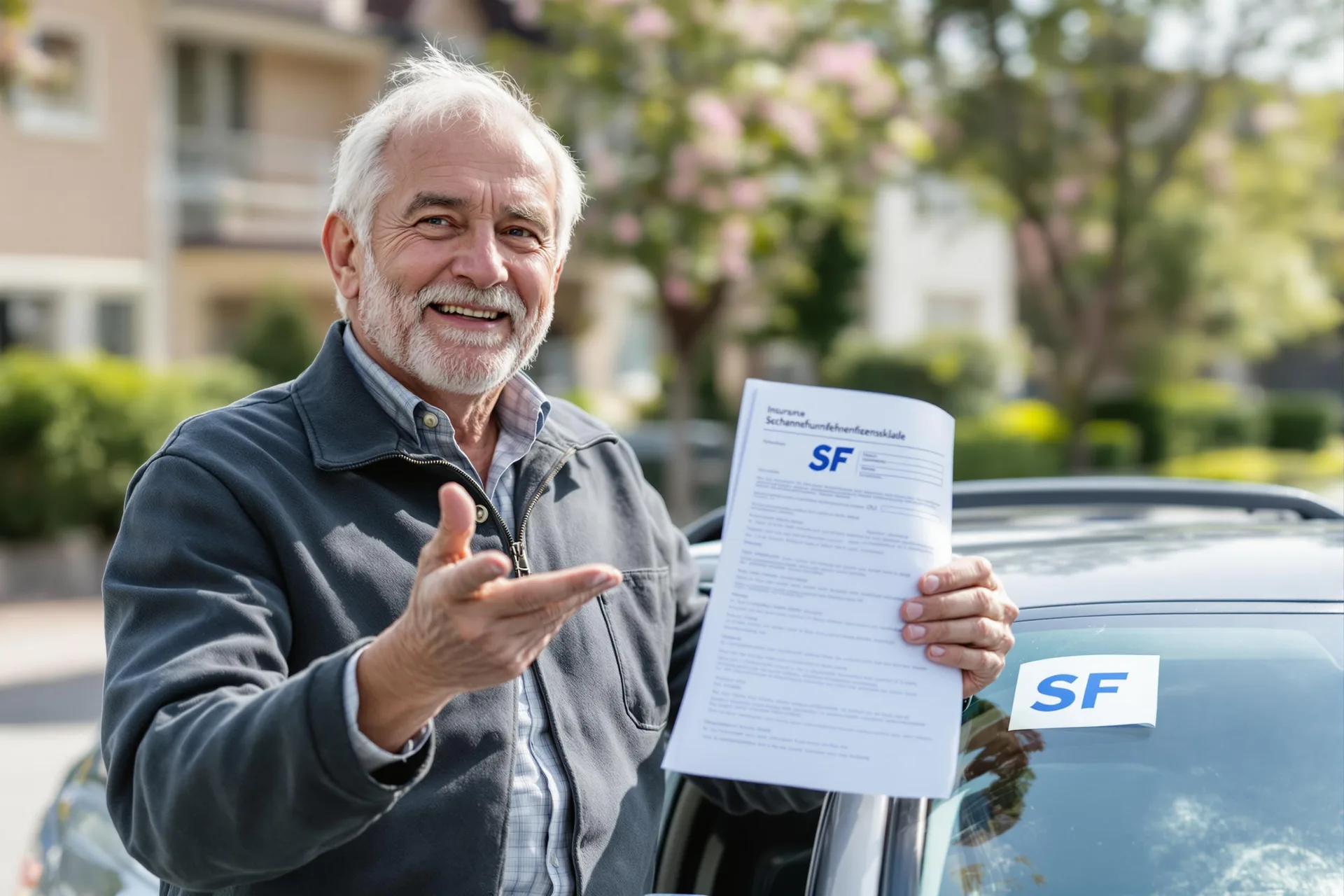
Best no-claims bonus class
What is the best no-claims bonus class? Learn how no-claims bonus classes work and how you can lower your premiums. Find out more now at nextsure!
 Katrin StraubManaging DirectorInsurance expert with over 20 years of experience in the insurance industry.
Published on
Last updated on
11 min read
Table of Contents
Dreaming of lower car insurance premiums? Your no-claims discount is the key. Find out how this system works and how you can achieve and keep the best no-claims discount for you.
Understanding the no-claims bonus system
The no-claims discount is a bonus system used by motor insurers for claim-free driving. For each year without a reported claim, you move up to a higher SF class. This leads to a higher no-claims discount and therefore a lower insurance premium. SF classes usually range from SF 1 to SF 50, with SF 50 granting the highest discount. There are also special classes such as M (malus class) or S, which usually apply after claims or to new drivers and lead to higher premiums. The exact amount of the discount varies depending on the insurer.
The highest achievable SF class, often SF 50, offers the maximum discount of up to eighty-five per cent. You can find your current SF class on your latest premium statement. This system applies to both motor third-party liability insurance and comprehensive cover, but not to partial cover. A look at your insurer's SF class table will tell you the exact discounts. Knowing the premium rate for your motor insurance is crucial here.
Determine and assess your current no-claims bonus class
To calculate your current no-claims bonus class, you can use the number of years you have been insured without claims. For example, if you have been insured claim-free for fifteen years, you are usually in SF class 15. You will always find the exact information on your latest premium statement from your motor insurance policy. It is important to know that the SF class for third-party motor liability and comprehensive cover is managed separately and may be different. The vehicle type class of your car also affects the premium amount, but not the SF class directly.
The "best" no-claims bonus class is the one with the highest discount, usually SF 35 or SF 50, depending on the insurer. When you change insurers, your previous SF class is usually taken over by the new insurer. An exception may apply if a special classification or no-claims discount protection existed with the previous insurer. The question "How much does car insurance cost?" therefore depends heavily on your SF class.
Strategies for improving your no-claims bonus
The most obvious way to improve your no-claims bonus class is to drive accident-free for several years. Each year without a reported claim leads to a better rating. However, there are other ways to positively influence your classification or avoid a downgrade. An important consideration is to pay for minor damage yourself rather than reporting it to the insurer. In the long term, this can be cheaper than the higher premiums after a downgrade. Here, weigh the repair costs against the possible increase in premiums over several years.
Another option is to take out a policy with no-claims discount protection. This additional module prevents a downgrade after a claim, but it does cost an extra premium. No-claims discount protection can be worthwhile for frequent drivers or owners of expensive vehicle models, as the claim risk or potential extent of a downgrade is greater here. Please note that no-claims discount protection usually only applies with your current insurer, and when switching, your actual claims record counts. For young drivers, there are often special rules.
Here are some tips for improving and protecting your no-claims bonus class:
- Drive defensively and avoid accidents.
- For minor damage, check whether paying yourself is cheaper than making a claim with the insurer.
- Consider a policy with no-claims discount protection if you absolutely want to avoid a downgrade.
- Take advantage of the option to transfer a no-claims bonus class from family members.
- Find out about special classifications for second cars.
Continuously improving your no-claims bonus class is an active process that pays off financially.
The pitfalls of downgrading after a claim
If you report a claim to your motor third-party liability or fully comprehensive insurance and it is settled by them, your no-claims bonus class will be downgraded in the next insurance year. This means a lower no-claims discount and therefore higher premiums. The number of classes you are downgraded by depends on your current no-claims bonus class and your insurer’s downgrading table. The higher your no-claims bonus class, the more severe the downgrade can be. It is important to know that for the downgrade, the number of claims is what matters, not necessarily the amount of the claim.
The exact rules for downgrading can be found in the insurance conditions of your policy. After a settled claim, you often have a special right of cancellation and can switch to a cheaper provider, even though this does not prevent the downgrade itself. It is worth considering whether fully comprehensive insurance is still worthwhile if premiums rise sharply due to downgrades. The difference between third-party, fire and theft and fully comprehensive cover also plays a role here, as third-party, fire and theft insurance does not use no-claims classes.
Expert knowledge: special cases and specific regulations
Besides the standard classifications, there are a few special cases when it comes to no-claims classes. New drivers often start in SF class 0 or SF ½, for example, which is associated with higher premiums. After three years of holding a driving licence, classification in SF ½ is often possible. A transferring the SF class to children can provide financial relief here. The option of taking over car insurance from one's parents is common practice.
A special classification can also be granted for second cars, often cheaper than the initial classification of a new driver. Some insurers even offer to classify the second car in the same SF class as the first car. In the event of a policy interruption, for example if you deregister your vehicle for a few years, the SF class is usually retained for a period of seven to ten years. Our expert tip: In the event of a policy interruption, have your attained SF class confirmed in writing by the insurer. This makes recognition easier when you take out a new policy later on. The exact deadlines for expiry or recognition vary depending on the provider.
Key points at a glance:
- New drivers often receive SF 0 or SF ½.
- Transferring SF classes is usually possible within the family.
- Second cars often benefit from cheaper special classifications.
- In the event of policy interruptions, the SF class remains valid for around seven to ten years.
- Discount protection prevents a downgrade, but usually applies only with the current insurer.
- The SF class is generally transferred when changing insurers, but special classifications are not always.
These rules show how important an individual assessment of your situation is.
Secure the long-term benefits of a high no-claims discount class
A high no-claims bonus class is the result of years of accident-free driving and is rewarded with significant premium discounts. The maximum discount can be as much as eighty-five per cent. To secure these benefits in the long term, it is advisable to continue driving carefully even after reaching a high no-claims bonus class. The temptation to process minor damage through the insurance should always be critically questioned, as a downgrade can wipe out many years of savings. Maintaining a high no-claims bonus class often outweighs the short-term saving achieved by having the insurer settle a claim.
Find out regularly about the terms of your insurance contract and the options for protecting your no-claims bonus class. Comparing providers can be worthwhile, as the discount scales and downgrade tables vary. Remember that a good no-claims bonus class is a valuable asset that gives you financial benefits over many years. If you would like advice on your individual situation, we will be happy to help.
Frequently asked questions
- What is the highest no-claims bonus class?
The highest no-claims class varies depending on the insurer; it is often SF 35, SF 40 or SF 50. This class grants the maximum no-claims discount.
- How is my no-claims class calculated?
Your no-claims bonus class generally corresponds to the number of years you have driven and been insured without an accident. One year without a reported claim results in a move up by one class.
- What happens to my no-claims bonus class after an accident?
After an accident that your insurer settles, you will be downgraded to a lower SF class. This leads to a higher premium in the following year.
- Can I take over someone else’s no-claims bonus?
Yes, a transfer of the no-claims bonus class is often possible, usually within the family (e.g. from parents to children) or between spouses. However, only as many years can be transferred as the recipient could have accumulated themselves.
- Is discount protection worth it?
Discount protection can be worthwhile to avoid being downgraded after a claim. However, it comes at an additional cost and usually only applies with your current insurer. Weigh up the cost of discount protection against the possible increase in premiums.
- Does my no-claims bonus expire if I deregister my car?
Your no-claims class does not expire immediately. Most insurers recognise it for a period of seven to ten years after the end of the contract. It is advisable to have the no-claims class confirmed when you deregister.
Sources
- [1]Wikipedia provides a comprehensive overview of the no-claims discount (SFR).
- [2]Die Versicherer provides an informative article on the no-claims discount.
- [3]Gabler Wirtschaftslexikon provides a detailed definition of the no-claims discount.
- [4]Statista provides relevant statistics on motor insurance.
- [5]GDV provides information on the impact of age on motor insurance premiums.
- [6]GDV offers insights into the business development of motor vehicle liability insurance.
- [7]Die Versicherer enables a lookup of type classes for motor insurance.