Tarantula Liability Insurance: Costs, Rules & Comparison
Do you need tarantula liability insurance? Learn about legal requirements, search-cost cover, and specialized exotic pet tariffs.
All details are taken from the provider's linked product page and the contract documents (IPID/policy conditions) published there; the insurer's documents prevail. Premiums, benefits and the insurance product itself may change – please verify the details directly with the partner before signing up; only the information provided there is binding.
 Katrin StraubManaging DirectorInsurance expert with over 20 years of experience in the insurance industry.
Published on
12 min read
Table of Contents
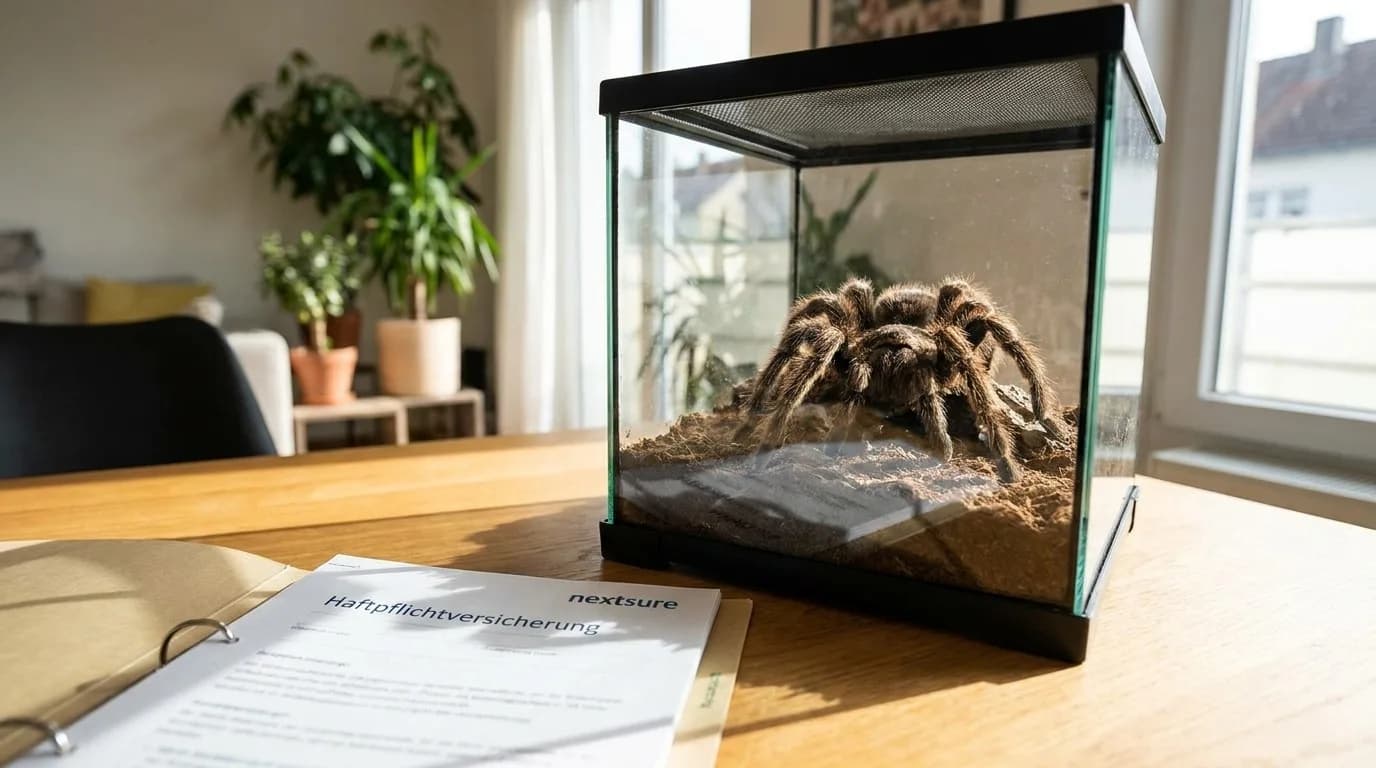
Tarantula liability insurance protects owners from the unlimited financial consequences of strict liability under Section 833 of the German Civil Code (BGB). The financial risk is enormous. Since standard personal liability insurance usually excludes wild and exotic animals, a specialist policy is essential. It covers personal injury from bites, property damage, and expensive search operations and fire department call-outs if the animal escapes its terrarium.
Exotenversicherung
Find personalised tariffs, compare services, and benefit from transparent information and personal advice – digital and straightforward.
Learn moreLiability Risks and Legal Basics for Spider Owners
Strict Liability Under the German Civil Code
When acquiring a tarantula, owners often underestimate the far-reaching legal consequences of the hobby. The legal basis for animal-owner liability is Section 833 of the German Civil Code (BGB). This section governs so-called strict liability for animal owners in Germany very clearly. Owners are liable without limit for all direct and indirect damage their animals cause [1]. In a worst-case scenario, that means unrestricted access to the owner's entire personal assets. Dedicated tarantula liability insurance is therefore an absolutely necessary shield for anyone keeping these animals. Anyone who keeps wild animals such as venomous snakes or spiders at home carries a considerable safety risk [3]. A bite or an allergic reaction in a visitor can quickly trigger medical treatment costs in the tens of thousands of euros. The law makes no distinction between intent and accident here. Liability applies immediately. Even if the terrarium was secured to the most modern standards, the owner remains fully financially responsible.
Indirect Damage and Panic Reactions
Strict liability applies completely regardless of any actual fault or negligence on the owner's part. If a tarantula escapes its terrarium, the owner is liable for all resulting consequences. This includes personal injury from bites just as much as property damage or financial loss to third parties. People often react with extreme panic, especially around exotic animals. An escaped scorpion or spider can trigger panic and thereby cause indirect damage such as traffic accidents, for which the owner is liable [2]. The financial burden in such cases can quickly threaten someone's very existence. Experienced keepers therefore check their policies very carefully. Standard personal liability insurance is almost never enough here. Specialized tariffs provide the necessary scope of cover for these unpredictable chain reactions. A traffic accident caused by a startled passerby can quickly run into six figures. Sums like that ruin uninsured owners.
Reversal of the Burden of Proof and Passive Legal Defense
Another critical aspect is the reversal of the burden of proof in animal-owner liability under German civil law. The injured party only has to prove that the animal caused the damage. For exotic animals, the owner can barely rely on the exemptions available for ordinary pets. Courts regularly classify tarantulas as wild animals. This significantly worsens the liability situation for the owner. Strong tarantula liability insurance covers not only legitimate compensation claims in these cases. It also acts as passive legal defense for the policyholder. The insurer fights off unjustified claims at its own expense. This legal support is extremely valuable in what are often emotionally charged conflicts. Legal fees and court costs are borne by the insurer. That spares the owner's nerves and their wallet.
Coverage Gaps in Personal Liability Insurance for Exotic Animals
The Exclusion of Wild Animals in Standard Policies
Personal liability insurance offers solid basic cover for everyday life, but has massive gaps when it comes to exotic animals. General liability insurance terms usually explicitly exclude keeping wild animals. Tame small animals such as guinea pigs or rabbits are covered at no extra charge. Tarantulas, however, fall legally and from an insurance standpoint into the category of wild animals. Anyone who relies on their normal policy risks total financial ruin in the event of a claim. Insurers consistently refuse to pay out for exotic animals. Dedicated exotic pet insurance closes this dangerous gap in cover. It's precisely tailored to the risks of keeping exotic animals. Owners must take out this separate contract before acquiring the animal. Signing up afterward doesn't cover damage that has already occurred. Act in time.
How the Insurance Terms Define "Exotic"
The exact definition of what counts as an exotic or wild animal varies between individual insurers. A small number of premium personal liability tariffs include non-venomous spider species up to a certain number. This, however, is the absolute exception in the German insurance market. As soon as the animal carries a certain risk potential, the standard tariffs' risk exclusion kicks in. Owners of Poecilotheria species or other highly venomous tarantulas always need a specialist policy. Failing to inform the insurer of the exact species kept is grossly negligent. False information leads to immediate loss of cover. Transparency when applying is the top priority. Only then does cover apply when it matters. Stating the correct Latin name is essential here. Insurers scrutinize these details meticulously in the event of a claim.
Increased Risk From Breeding and Reproduction
An often-overlooked issue in standard contracts is the automatic increase in risk from an unexpected increase in the animal population. Tarantulas produce egg sacs containing hundreds of young. A normal policy, even one that tolerates a single animal, never covers this sudden population increase. Specialized exotic pet tariffs, however, often cover offspring at no extra charge up to a certain age of the young animals. This gives breeders the legal and financial certainty they need. Notification obligations for population changes are clearly regulated in specialist contracts. Owners must observe the exact deadlines for reporting these changes. A professional broker helps structure these complex contracts. Adjusting the policy in time prevents nasty surprises. Breeders should update their inventory lists every quarter. That creates legal certainty for everyone involved.
State Requirements and the Dangerous Animals Act in North Rhine-Westphalia
The Strict Requirements of the Dangerous Animals Act
State regulations increasingly govern the keeping of potentially dangerous animals in Germany with growing strictness. A prominent example is the Dangerous Animals Act (Gifttiergesetz) in North Rhine-Westphalia, which historically came into force in 2021. NRW's Dangerous Animals Act requires liability insurance with a minimum sum insured of 1 million euros, which must also cover the animal escaping [5]. This mandatory insurance applies to owners of highly venomous spiders, scorpions, and snakes. Anyone who cannot provide proof of this insurance isn't allowed to keep these animals in NRW. The authorities monitor compliance with these requirements very closely. Violations lead to substantial fines and confiscation of the animals. Tarantula liability insurance is no longer optional here. It's a mandatory legal requirement. Without a policy, an immediate ban on keeping the animal is imminent.
Notification Obligations and Official Permits
Beyond the pure insurance requirement, there are extensive notification obligations to the relevant state offices for nature, environment, and consumer protection. Owners must document the exact population, species, and housing location of the animals in detail. Owners submit the insurance confirmation to the authority without being asked. Depending on the state and municipality, proof of liability insurance or expertise may be required for keeping certain reptiles and spiders [4]. This federal fragmentation makes the legal situation very confusing for owners. Moving to a different state can bring entirely new requirements. The insurance terms must be valid nationwide. Only then does the owner stay legally safe when changing their place of residence. Check the rules before every move. Local regulatory authorities provide binding information on this.
Species Protection and CITES Certificates
Besides hazard-prevention law, keeping exotic animals also touches on strict international species-protection agreements. Many tarantula species, such as the popular Brachypelma smithi, fall under the Washington Convention on species protection (CITES). Owners need valid proof of origin or a CITES certificate for these protected animals. In the event of a claim, insurers check whether the animal was legally acquired and registered. If these documents are missing, the insurance can refuse to pay due to a breach of policy obligations. Legal origin is the basic requirement for effective insurance cover. Owners should keep all documents safe and back them up digitally. Complete documentation protects against trouble with the authorities and financial losses. Scan all purchase receipts immediately. This makes it much easier to provide proof if needed.
Cost Risk From Search Operations and Fire Department Call-Outs
The Financial Scale of an Escape
Cost risk and call-out fees rise rapidly if a tarantula escapes its terrarium unnoticed. An escaped spider triggers expensive search operations by the fire department or specialists, costs that owners without insurance pay themselves [1]. In such cases, the fire department often turns out in force with specialized equipment. Hourly rates for emergency vehicles and personnel quickly add up to several thousand euros. If the animal escapes in an apartment building, the authorities often order the evacuation of the entire building. The person responsible bears the cost of housing evacuated neighbors in a hotel. These costs blow the budget of most private individuals. Strong insurance is the only way out here. Check the sums insured carefully. Limits that are too low are dangerous.
Using Pest Controllers and Specialists
The fire department doesn't always catch the animal immediately, which calls for further professional measures. The situation often requires specialized pest controllers or experts from zoos. These professionals charge high fees for their expertise and the elaborate search using thermal imaging cameras or endoscopes. An escaped venomous animal can lead to evacuations and expensive operations, which is why the insurance absolutely must include hazard-prevention expenses [3]. Hazard-prevention costs are a core component of exotic pet liability cover. They cover preventive measures before any actual personal injury even occurs. If this component is missing from the terms, the owner is left to cover the search costs themselves. Checking the clauses carefully is essential. Watch for the term hazard prevention (Gefahrenabwehr). It carries enormous legal weight.
Rental Property Damage From Search Operations
Significant damage to the building fabric often occurs during an intensive search for an escaped spider. Emergency crews remove skirting boards, open drywall, or dismantle ventilation ducts. Tarantula liability insurance must cover this so-called rental property damage with sufficiently high sums. The landlord will demand full restoration to the original condition. Damage to a neighbor's property, if the spider gets into the neighboring apartment, is likewise covered here. Settling such property damage claims is often complex and lengthy. The insurer takes over negotiations with the injured parties. This relieves the owner in what is already an extremely stressful, exceptional situation. Document all damage with photos. This considerably speeds up the later claims settlement.
Tariff Features of Specialized Exotic Pet Liability Cover
Comparing Sums Insured and Coverage Limits
The features of a good exotic pet policy differ drastically from the standard products on the big comparison portals. The sum insured for personal injury and property damage should be at least ten million euros, ideally even fifty million euros. Personal injury from allergic shock after a bite causes extreme costs for medical treatment, pain and suffering compensation, and lifelong pension payments. A sum insured that's set too low leads to personal liability for the difference. Premium differences between five and fifty million euros of cover are marginal. Cutting corners on the sum insured is the wrong approach. nextsure only offers tariffs with up-to-date, safe sums insured. Quality clearly comes before an apparently cheap price here. Compare the benefits in detail. A cheap tariff is often worthless.
Specific Inclusions for Exotic Pet Keeping
The insurance terms must reflect the specific realities of keeping exotic animals precisely, with no room for interpretation. This includes covering temporary stays abroad, if the animal is transported to an exhibition or a vet in a neighboring country. Including pet sitters in cover is also an essential feature. If friends or neighbors feed the spider during a vacation, they must be included in the insurance cover. If the animal causes damage during this time, the owner's policy applies. Some tariffs require proof of the sitter's expertise. Owners need to identify such hidden clauses before signing the contract. Transparent terms with no surprise exclusions are the hallmark of a premium tariff. Read the fine print carefully. It protects you from expensive surprises.
Waiving the Gross Negligence Defense
A decisive quality criterion is whether the insurer waives the defense of gross negligence. If the owner forgets to properly lock the terrarium after feeding, this is often legally classed as gross negligence. Without this specific clause, the insurance could reduce or completely refuse the payout in such a case. Waiving this defense guarantees payment even in the case of human error. Nobody is infallible, especially not in day-to-day handling of these animals. This clause separates the high-quality tariffs from inadequate basic products. nextsure strictly checks for this feature when selecting partner insurers. It provides the owner with maximum security. Watch for this wording. It's the heart of a good policy.
| Coverage feature | Minimum requirement | nextsure's recommendation |
|---|---|---|
| Sum insured | €1 million (legal minimum, NRW) | At least €10 million to €50 million |
| Search and recovery costs | Partially excluded | Fully included, no sub-limit |
| Third-party sitter risk | Family members only | Covers all unpaid sitters |
| Gross negligence | Payout reduction possible | Defense fully waived |
Comparing the insurance terms pays off, since premium differences are often small while the differences in cover are substantial.
Covering Scorpions and Other Terrarium Animals
Combined Policies for Mixed Animal Collections
Covering additional species is an important topic, since many keepers don't just keep a single species. Alongside tarantulas, scorpions, centipedes, or exotic insects are often found in home terrarium setups. A good tarantula liability policy allows bundling these different animals into a single contract. This reduces administrative effort and significantly lowers annual premium costs. Owners must, however, inform the insurer exactly about each individual species kept. Blanket statements like "various insects" aren't enough in the event of a claim. A detailed inventory list is part of the insurance contract. This list must be consistently updated whenever new animals are acquired. Report new animals without delay. Only then does cover remain complete and uninterrupted.
Health Insurance for Exotic Animal Collections
Besides pure liability cover, medical care for the animals is also increasingly coming into focus for owners. Vet costs for specialized exotic-animal vets have risen sharply in recent years due to the new fee schedule. While general pet health insurance often only covers standard pets, niche products now exist. Health insurance for exotic pets covers operations and expensive diagnostics. Anyone who insures their collection often thinks holistically. Similar to health insurance for dogs or cover for cats, this protects against unexpected financial burdens. Combining liability and health cover closes the financial gap in care. That makes vet visits budgetable. It protects the household budget effectively.
Special Considerations When Keeping Scorpions
Scorpions carry a different risk potential than tarantulas and require a precise risk assessment by the insurer. Species of the genus Androctonus or Leiurus have highly potent venom that can be life-threatening to humans. Premiums for these highly venomous species are naturally higher than for less venomous tarantulas. The insurer often requires detailed information on how the terrarium is secured, such as lockable sliding panes. Complying with these safety requirements is a mandatory condition for cover. Breaching these obligations risks losing cover. A reputable broker clarifies these technical details before the application is submitted. This prevents later disputes during claims settlement. Document your safety measures. Photos of the terrarium locks are very helpful here.
Frequently Co-Insured Exotic Species
- Tarantulas (Theraphosidae) of all common genera
- Scorpions (Scorpiones), depending on toxicity
- Centipedes (Scolopendridae) and millipedes
- Praying mantises (Mantodea) and other exotic insects
- Non-venomous large snakes and lizards (often in separate tariffs)
Insurers always classify the risk based on the exact scientific species name and calculate the premium accordingly.
Digital Sign-Up and Contract Management via the nextsure Platform
Transparent Comparison of Niche Tariffs
Signing up for and comparing specialty insurance products used to be tedious and paper-heavy. The big comparison portals mostly ignore niche products like tarantula liability insurance entirely. nextsure closes this gap with a dedicated digital platform for hand-picked exotic pet tariffs. The algorithm analyzes individual needs based on the species kept and immediately filters out unsuitable offers. Users get a transparent comparison of the best available policies on the market in just a few minutes. The terms are presented in a clearly structured way, without incomprehensible insurance jargon. This enables an informed decision without hours of research. The focus is on quality and genuine cover. Compare the tariffs at your own pace. The platform is available at any time.
Simple Online Sign-Up With No Paperwork
The entire application process at nextsure is fully digital and designed for maximum efficiency for the user. Once the right tariff is chosen, sign-up happens directly online over a secure connection. An electronic signature replaces mailing paper application forms. The insurance policy and all relevant documents are available in the digital customer portal immediately after review. This is especially important when authorities require quick proof of insurance. The digital folder brings all contracts together in one central place. Customers have access to their data anytime via smartphone or computer. This service philosophy redefines modern insurance brokering. Paperwork is a thing of the past. Everything is digital and available immediately.
Personal Expert Advice in the Event of a Claim
Despite consistent digitalization, personal support remains a central pillar of nextsure's philosophy. As a licensed insurance broker under Section 34d of the German Trade Regulation Act (GewO), the team stands legally on the customer's side. In a complex claim, such as an escaped animal, the experts take over communication with the insurance company. They review settlement offers and consistently enforce policyholders' legitimate claims. This professional support is invaluable for specialty risks. The combination of digital efficiency and personal expertise delivers the best result. That way, the hobby of keeping exotic animals doesn't become an incalculable financial risk. Trust professional help. We won't leave you on your own in the event of a claim.
Frequently asked questions
- Do I Really Need Liability Insurance for a Tarantula?
Yes, specialized liability insurance is strongly recommended and even a legal requirement in some German states. Under Section 833 BGB, you're liable without limit, with your personal assets, for any damage your spider causes. Since standard personal liability tariffs exclude wild animals, you need a specific exotic pet tariff.
- Are Search Costs Covered if the Spider Escapes?
A quality tarantula liability policy covers the cost of search operations, fire department call-outs, and necessary evacuations. These so-called hazard-prevention expenses are essential, since an escaped exotic animal often triggers panic and brings in professional emergency crews, which can quickly cost thousands of euros.
- Does the Dangerous Animals Act Also Apply to Tarantulas?
That depends on the specific state and the exact spider species. In North Rhine-Westphalia, highly venomous tarantula species (such as Poecilotheria) fall under the Dangerous Animals Act. This law requires liability insurance with a minimum sum insured of one million euros in order to legally keep the animal.
- Does My Normal Personal Liability Insurance Cover Exotic Spiders?
In the vast majority of cases, normal personal liability insurance does not cover exotic spiders. The insurance terms explicitly exclude wild animals. Only tame small animals are covered by default. Never rely on a standard policy without written confirmation for your specific spider species.
- Can Scorpions and Centipedes Also Be Insured?
Yes, scorpions, centipedes, and other exotic terrarium animals can be covered under specialized exotic pet liability tariffs. Different species can often be bundled into a single policy. The premium is based on the risk potential and toxicity of the exact scientific species named.
- What Happens if the Spiders Unexpectedly Breed?
Good exotic pet tariffs account for tarantulas breeding and cover the offspring at no extra charge up to a certain age (often six to twelve months). You must, however, inform the insurer of the change in population, so as not to jeopardize cover through an unreported increase in risk.
Sources
Conclude directly online
Verified partner tariffs at no extra cost. The button takes you straight to the provider's calculator.
 Cleos Welt
Liability insurance for exotic animals
Liability cover for owners of exotic animals such as snakes, spiders, or alpacas, with coverage of up to €10 million.
- Sum insured:
- up to €10 million
- Number of animals:
- up to 200 smaller animals or a maximum of 5 larger animals
- Events:
- covered (e.g. trade fairs)
- Personal injury, property damage, and financial loss: up to €10 million
- Search, rescue, and recovery operations: up to €1.5 million
- Damage to rented premises up to €300,000; up to €5,000 in vacation accommodation
- Commercial use covered up to €22,000 in annual revenue
- Young animals up to 12 months old are covered
- Meets the mandatory insurance requirement under the NRW Venomous Animals Act (Gifttiergesetz, €1 million)
Key exclusions
- Animals subject to a keeping ban
- Herds of more than 5 larger animals (e.g. alpacas, donkeys)
Google Rezensionen: 4,5/5 Sterne (210 Bewertungen)
Cleos Welt insgesamt (Anbieterbewertung, alle Versicherungen)
Includes an update guarantee and a grandfathering guarantee (Besitzstandsgarantie); proof for authorities is provided directly after the policy starts.
Fact sheet: benefits, exclusions and waiting periods in detail
Cleos Welt
Small pet insurance
Health insurance for small mammals, birds, and reptiles: reimburses surgery, treatment, and after-care costs up to the agreed maximum veterinary fee schedule (GOT) rate.
- Waiting period:
- 30 days, 6 months for specific surgeries
- Coverage abroad:
- up to 12 months
- Age-based adjustment:
- 3% premium increase per year
- Surgery, treatment, and after-care up to the agreed maximum GOT rate
- Medication as well as boarding and feeding during clinic stays
- Specific surgeries (egg binding, otitis, malocclusion) after a 6-month waiting period
- Remote diagnostics and consultation with a veterinarian
- Optional: vaccinations, neutering, physiotherapy, and supplemental dental cover
- Accidents are covered with no waiting period
Key exclusions
- Pre-existing conditions and treatments recommended before the policy started
- Myxomatosis/RHD in rabbits without proof of vaccination
- Neutering/spaying without a separate agreement
- Damage from Encephalitozoon cuniculi without a negative test (test max. 1 year old)
Google Rezensionen: 4,5/5 Sterne (210 Bewertungen)
Cleos Welt insgesamt (Anbieterbewertung, alle Versicherungen)
Cancellation possible at any time with 14 days' notice; sum insured and deductible (Selbstbeteiligung) as stated in the policy. Insurer: Uelzener Allgemeine Versicherungs-Gesellschaft a.G.
Fact sheet: benefits, exclusions and waiting periods in detail
All details are taken from the provider's linked product page and the contract documents (IPID/policy conditions) published there; the insurer's documents prevail. Premiums, benefits and the insurance product itself may change – please verify the details directly with the partner before signing up; only the information provided there is binding.
Information last updated: July 2026 · Source: provider product information (IPID/policy conditions)