Grey Parrot & Royal Python Pet Insurance
Protect yourself against high vet costs for exotic pets. Compare cover for grey parrots and royal pythons. Get free advice now!
All details are taken from the provider's linked product page and the contract documents (IPID/policy conditions) published there; the insurer's documents prevail. Premiums, benefits and the insurance product itself may change – please verify the details directly with the partner before signing up; only the information provided there is binding.
 Katrin StraubManaging DirectorInsurance expert with over 20 years of experience in the insurance industry.
Published on
Last updated on
5 min read
Table of Contents
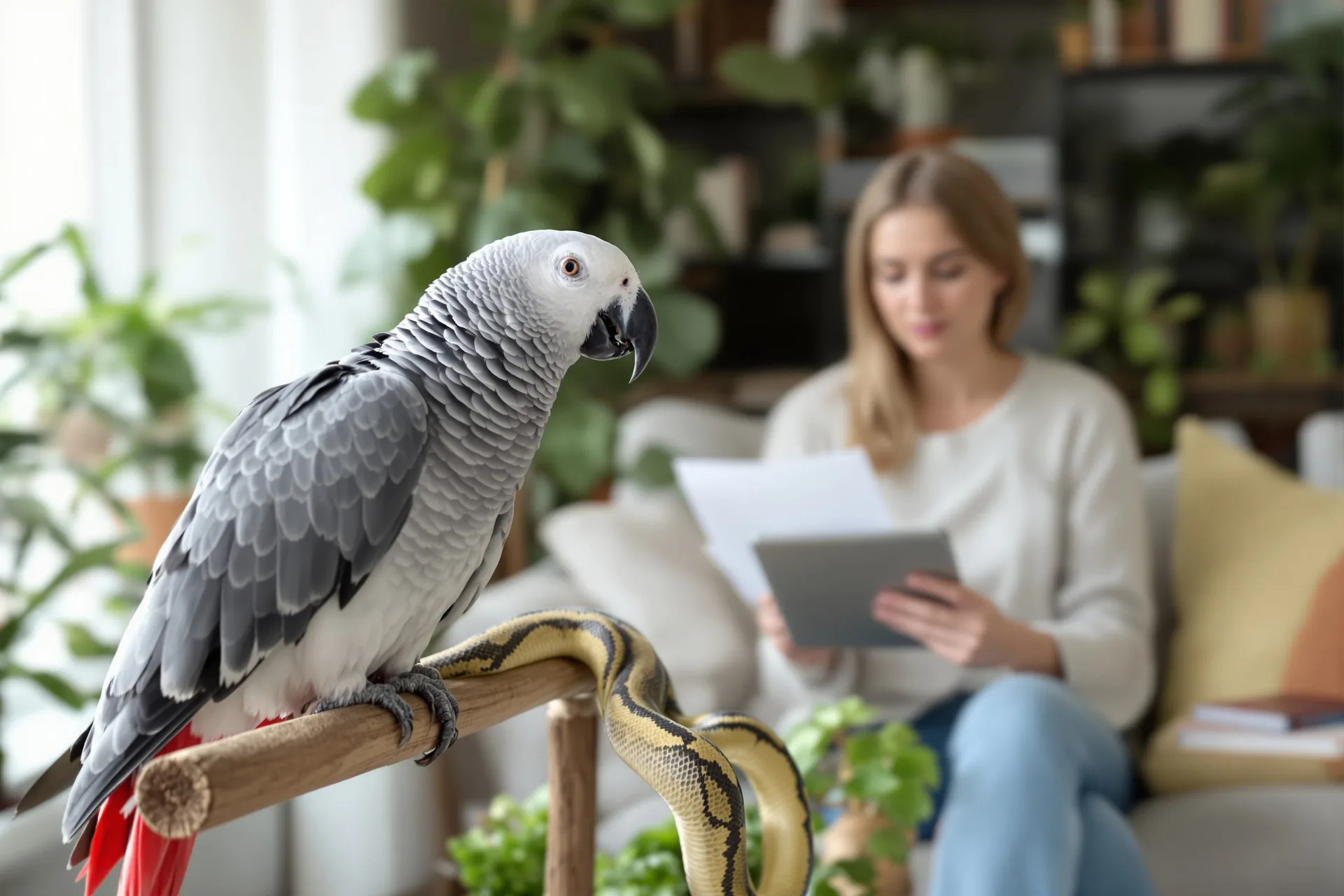
A grey parrot can live for over 50 years, and a royal python for up to 40 years. Over such a long time, trips to the vet are inevitable, and the costs can quickly reach four-figure sums. Specialised health insurance protects you from these financial burdens.
Small pet insurance
Small pet insurance for rabbits, guinea pigs, parrots and reptiles: Cleos Welt from 6.99 EUR a month, up to 4x the GOT rate, no waiting period for accidents.
Learn moreRisk analysis: The most common diseases and their costs
Exotic animals such as grey parrots and king pythons are susceptible to specific illnesses that require expensive treatment. In grey parrots, aspergillosis, a fungal infection of the respiratory tract, is one of the most common diagnoses and often costs hundreds of euros. Psittacine Beak and Feather Disease (PBFD) is a viral disease that can incur diagnosis and treatment costs of more than 500 euros.
King pythons often suffer from parasitic infestations such as mites, the treatment of which extends over several weeks and quickly exceeds 150 euros. Respiratory diseases, usually caused by poor husbandry, require diagnostic procedures such as X-rays, which according to the German Scale of Fees for Veterinarians (GOT) cost at least 26.53 euros per image. A specialised exotic animal insurance policy is therefore an important form of financial protection. Cover amounts often extend to as much as 5,000 euros per year.
These examples illustrate how quickly the costs can far exceed the purchase prices of the animals.
GOT practice check: understanding and calculating veterinary bills correctly
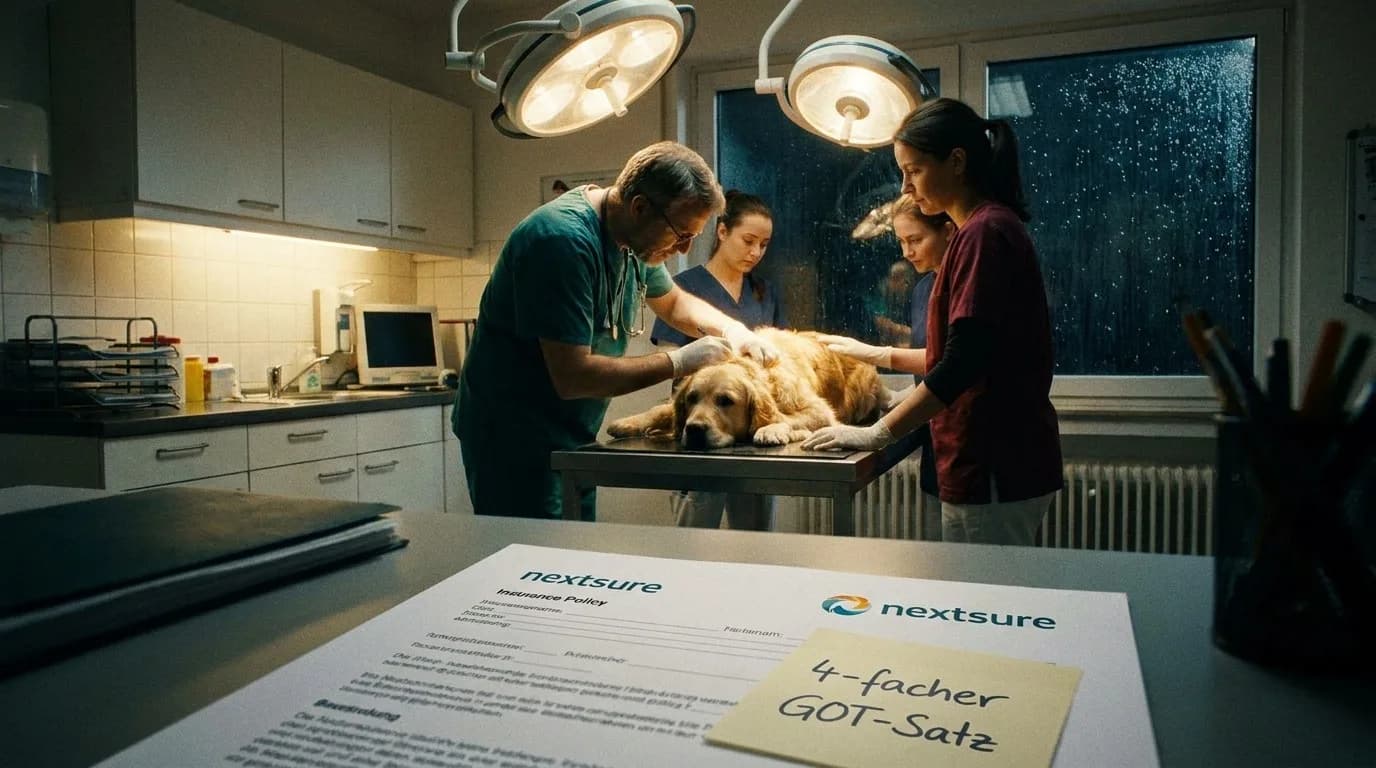
The schedule of fees for veterinarians (GOT) regulates billing in Germany and was comprehensively revised most recently in 2022. A general examination for a large parrot or a reptile costs at least EUR 23.62 net under the GOT. In emergency out-of-hours care, however, the vet can charge up to four times the rate, pushing the cost to over EUR 94 for the examination alone.
Imagine a practical example: your royal python is refusing food and has wheezy breathing. The vet diagnoses pneumonia. The bill could be made up as follows:
- General examination in emergency out-of-hours care (triple rate): EUR 70.86
- X-ray examination (double rate): EUR 53.06
- Injection with antibiotics (double rate): EUR 23.00
- Medication costs: approximately EUR 30
All in all, costs can quickly exceed EUR 175 for a single visit. A good pet insurance policy covers these items and protects your budget. Analysis of the tariffs shows that the best policies reimburse up to four times the GOT rate.
Benefit comparison: choosing the right policy for parrots and snakes
Not every pet insurance policy is suitable for exotic animals; the differences in detail are considerable. A high-performance policy for a grey parrot and a royal python should meet at least the following four criteria. Make sure that both outpatient treatment and surgery are covered. Many basic tariffs, similar to those of dog health insurance, cover only surgical procedures.
Important criteria for your selection are:
- GOT rate reimbursement: The plan should cover at least twice, and ideally three or four times, the standard fee schedule rate.
- Freedom to choose your vet: You must be able to consult a vet specialising in exotic animals, who may not be the one closest to you.
- Diagnostic cover: Costs for X-rays, CT scans, MRI scans and laboratory tests should be explicitly included.
- Waiting periods: Waiting periods of one to three months after the contract is signed are common before benefits can be claimed.
Some providers, such as Petcover, offer cover limits of up to €5,000, which is sufficient for most treatments. Careful review of the contract terms is crucial so that you are not left to cover the costs yourself in an emergency.
Legal Foundations: Husbandry Regulations and their Relevance to Insurance Law
The keeping of African grey parrots and royal pythons is subject to clear legal regulations, compliance with which is also important for insurance cover. African grey parrots are protected under the Washington Convention on International Trade in Endangered Species (CITES) and must be registered. The Animal Welfare Act also requires them to be kept in pairs in an aviary with a minimum floor area of three by one metre.
For the royal python, the reporting requirement has been suspended since 2005, but proof of origin is mandatory when it is passed on. Breaches of these husbandry regulations can result in the insurer refusing to pay in the event of a claim. If a disease can be proven to be attributable to incorrect husbandry conditions, the insurer may refuse to cover the costs. Appropriate animal husbandry, as is also required for poultry, is therefore not only an ethical requirement but also a contractual one.
Our expert tip: Document the origin and husbandry conditions of your animals completely from the outset. This strengthens your position vis-à-vis the authorities and insurers.
Optimise contract details: manage exclusions and supplementary services strategically
The devil is in the detail, more precisely in the General Insurance Terms and Conditions (AVB). Many contracts exclude congenital or genetic illnesses from the obligation to provide benefits. Treatments required during the initial waiting period, often three months, are usually not covered. Check these clauses carefully before signing a contract.
Look out for useful additional benefits that round off the cover. These include, for example:
- Subsidies for preventive measures such as annual check-ups.
- Coverage of the costs for alternative treatment methods.
- Cover for microchip identification.
Some insurers offer, similar to the cat health insurance, a reduced premium if an excess of, for example, 250 euros per year is agreed. Our expert tip: find out in advance whether prophylactic treatments, such as a deworming treatment, are reimbursed, as this is not always standard with exotic pet insurance. Comprehensive cover is the key to your pet's long-term health.
Frequently asked questions
- Why is health insurance useful for my African grey parrot?
An African grey parrot can live 50 years or more. During this time, chronic illnesses or accidents can occur. An operation or long-term treatment can quickly incur costs of over €1,000, which insurance covers.
- Does the insurance also cover preventive check-ups?
That depends on the selected plan. Basic plans often only cover treatments and operations. Premium plans can also include allowances for preventive measures such as annual health checks or claw trimming.
- Is there a waiting period after signing the contract?
Yes, most insurance policies have a general waiting period of one to three months. For specific treatments or operations, this can also be longer. Accidents are often excluded from the waiting period.
- What happens if my vet charges a higher GOT fee rate?
Check before signing the contract up to what rate your plan reimburses the costs. Good plans cover two to four times the standard rate, which is also sufficient for emergency services or complicated treatments. If the bill exceeds this, you must cover the difference yourself.
- Are congenital diseases covered for my royal python?
As a rule, congenital and genetic conditions, as well as their consequences, are excluded in most policies. It is important to carefully review the insurance terms and conditions in this regard.
- Can I choose any veterinarian?
Yes, with most good policies for exotic pets, you are free to choose your vet. This is particularly important, as you need a specialist vet for birds or reptiles, who may not practise in your immediate area.
Sources
- [1]On Gesetze im Internet you will find the official legal text of the Veterinary Fees Schedule (GOT) from 2022.
- [2]The Bundestierärztekammer provides comprehensive information on the Veterinary Fees Schedule (GOT).
- [3]Statista presents statistics from a survey of pet owners regarding health insurance for their animals.
- [4]The Verbraucherzentrale provides information on the usefulness and necessity of health insurance for pets.
- [5]The Exopet study offers insights into research findings and information on exotic pets.
- [6]The German Animal Welfare Federation provides a position paper on keeping exotic animals in private households.
Conclude directly online
Verified partner tariffs at no extra cost. The button takes you straight to the provider's calculator.
 Cleos Welt
Small pet health insurance
Health insurance for small mammals, birds and reptiles in three tariffs: surgery, treatment, diagnostics and medication up to 3 or 4 times the GOT rate.
- Premium:
- from 6.99 EUR a month
- Annual benefit:
- 3,000 EUR, 5,000 EUR or unlimited
- GOT rate:
- 3 times, Rundum 4 times
- Deductible:
- 0 EUR
- Waiting period:
- 30 days, 6 months for specific surgeries
- Cover abroad:
- up to 12 months
- Surgery, treatment and after-care up to the agreed maximum GOT rate
- Laboratory and imaging diagnostics, medication, boarding and feeding in the clinic
- Specific surgeries (egg binding, otitis, malocclusion) after a 6-month waiting period
- Remote diagnostics and consultation with a veterinarian
- Rundum tariff: unlimited annual benefit, 4 times the GOT rate, 200 EUR preventive-care budget
- Accidents without a waiting period, previous insurance counts towards it
Key exclusions
- Pre-existing conditions and treatments begun or recommended before the policy started
- Preventive care, vaccinations and parasite products unless agreed as an add-on
- Neutering/spaying without a separate agreement
- Routine dental work in mammals without the dental add-on
- Travel and transport costs, reports, and the emergency fee when no operation follows
- Epidemics, pandemics, war, earthquake and flood
Google Rezensionen: 4,5/5 Sterne (210 Bewertungen)
Cleos Welt insgesamt (Anbieterbewertung, alle Versicherungen)
Annual age adjustment of 3% of the premium; cancel monthly with 14 days' notice; sum insured and deductible as stated in the policy. Insurer: Uelzener Allgemeine Versicherungs-Gesellschaft a.G.
Fact sheet: benefits, exclusions and waiting periods in detail
Cleos Welt
Rabbit insurance
The same small pet health insurance with rabbit premiums and the dental add-on that makes the difference for teeth that grow for life.
- Premium:
- from 34.99 EUR a month
- Rundum:
- from 62.99 EUR a month
- Dental add-on:
- from 20.00 EUR a month
- Deductible:
- 0 EUR
- Waiting period:
- 30 days, malocclusion 6 months
- Malocclusion surgery (tooth misalignment) covered after a 6-month waiting period
- Dental add-on from 20 EUR a month: 500 EUR tooth extractions and corrections plus 200 EUR dental prevention a year
- Rundum: unlimited annual benefit, 4 times the GOT rate, 200 EUR preventive-care budget
- Myxomatosis and RHD covered if vaccination is proven by an international vaccination certificate
- E. cuniculi covered if a negative test from no more than one year before the start of cover exists
- Accidents without a waiting period, cancel monthly with 14 days' notice
Key exclusions
- Myxomatosis/RHD without proof of vaccination in the international vaccination certificate
- Damage from Encephalitozoon cuniculi without a negative test that is at most one year old
- Tooth trimming, extractions and dental prevention without the dental add-on
- Neutering/spaying without a separate agreement
- Pre-existing conditions and treatment during the waiting period
Google Rezensionen: 4,5/5 Sterne (210 Bewertungen)
Cleos Welt insgesamt (Anbieterbewertung, alle Versicherungen)
Husbandry duty under the terms: rabbits per section 35 of the German animal welfare livestock husbandry ordinance. Annual age adjustment of 3%. Insurer: Uelzener Allgemeine Versicherungs-Gesellschaft a.G.
Fact sheet: benefits, exclusions and waiting periods in detail
Cleos Welt
Parrot insurance
The same small pet health insurance with bird premiums: egg binding and beak treatment are the cases that matter for parrots.
- Premium:
- from 10.49 EUR a month
- Rundum:
- from 20.99 EUR a month
- Deductible:
- 0 EUR
- Waiting period:
- 30 days, egg binding 6 months
- Egg-binding surgery with diagnostics and after-care covered after a 6-month waiting period
- Beak treatment included in all tariffs according to the product page
- Treatment, diagnostics and medication up to the agreed GOT rate
- Rundum: unlimited annual benefit, 4 times the GOT rate, 200 EUR preventive-care budget
- Accidents without a waiting period, cover abroad up to 12 months
- Also insurable for finches, chickens and pigeons as well as reptiles
Key exclusions
- Cosmetic beak and tooth trimming to breed or show standard
- Examination and treatment of young animals after hatching
- Preventive care, vaccinations and parasite products unless agreed as an add-on
- Pre-existing conditions and treatment during the waiting period
Google Rezensionen: 4,5/5 Sterne (210 Bewertungen)
Cleos Welt insgesamt (Anbieterbewertung, alle Versicherungen)
Species-appropriate husbandry (housing, temperature, rest periods) is a policyholder duty. Annual age adjustment of 3%. Insurer: Uelzener Allgemeine Versicherungs-Gesellschaft a.G.
Fact sheet: benefits, exclusions and waiting periods in detail
Cleos Welt Small pet health insurance: Monthly premium by species and tariff (product pages, as of July 2026)
| Species | Basis (up to 3,000 EUR/year, 3x GOT rate) | Standard (up to 5,000 EUR/year, 3x GOT rate) | Rundum (unlimited, 4x GOT rate) |
|---|---|---|---|
| Cheapest species | from 6.99 EUR | from 13.99 EUR | from 17.49 EUR |
| Parrot | from 10.49 EUR | from 17.49 EUR | from 20.99 EUR |
| Guinea pig | from 20.99 EUR | from 31.49 EUR | from 34.99 EUR |
| Rabbit | from 34.99 EUR | from 48.99 EUR | from 62.99 EUR |
All details are taken from the provider's linked product page and the contract documents (IPID/policy conditions) published there; the insurer's documents prevail. Premiums, benefits and the insurance product itself may change – please verify the details directly with the partner before signing up; only the information provided there is binding.
Information last updated: July 2026 · Source: provider product information (IPID/policy conditions)