How much does horse surgery insurance cost per month?
Horse surgery insurance per month: realistic premium ranges, surgery costs from €8,000, daily clinic rates, plus waiting periods and GOT fee rates at a glance.
All details are taken from the provider's linked product page and the contract documents (IPID/policy conditions) published there; the insurer's documents prevail. Premiums, benefits and the insurance product itself may change – please verify the details directly with the partner before signing up; only the information provided there is binding.
 Katrin StraubManaging DirectorInsurance expert with over 20 years of experience in the insurance industry.
Published on
13 min read
Table of Contents
Depending on the tariff level, the horse's age and health, the monthly premium in 2026 ranges from around 22 euros in the entry-level tariff to around 100 euros in the highest tier: one major provider quotes 21.71 euros for the basic tariff and 103.14 euros for the top tariff in 2026. For comparison: the same insurer puts a colic surgery at 8,000 to 12,000 euros — critics of the veterinary fee schedule (GOT) reformed at the end of 2022 even say 12,000 to 15,000 euros — plus clinic stay, infusions and medication.
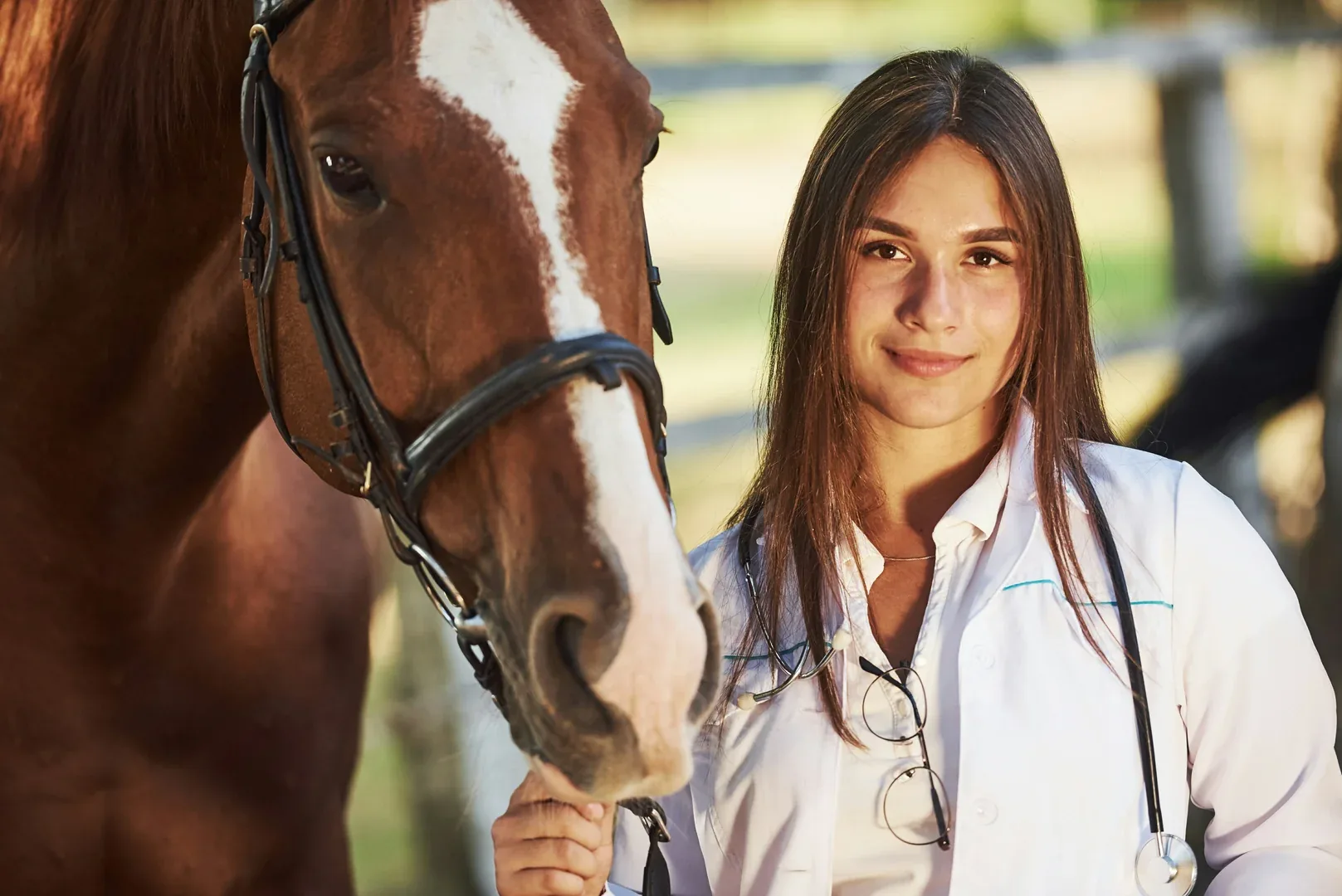
Equine surgery insurance
Horse surgery insurance via nextsure: Three flexible tariffs, reimbursement up to twice the GOT rate, and free choice of clinic worldwide. Protect your horse from high surgery costs – digital, transparent and uncomplicated.
Learn moreThe short answer: monthly premium between around 20 and over 100 euros
Depending on the tariff level, the horse's age at the start of the contract and the health declaration, horse surgery insurance costs between around 22 euros and around 100 euros per month. On the market, simple basic tariffs start in 2026 at 21.71 euros per month, while the highest tier from the same provider is calculated at 103.14 euros monthly.[1] The exact premium for your horse can only come from an individual calculation based on age, use and health data.
| Price factor | What is common in the market |
|---|---|
| Tariff level | [1]Basic tariffs start in 2026 at just under 22 euros per month; premium tiers cost a multiple of that, up to around 100 euros. |
| Maximum reimbursement per surgery | [1]Simple tariffs cap the reimbursement per operation — at one major provider in 2026, for example, at 1,500 euros in the basic tariff and 4,000 euros in the mid-tier tariff; the highest tier pays without a limit. |
| Reimbursable GOT rate | As a rule up to 2 times the fee schedule rate, in some premium tariffs up to 4 times. |
| Aftercare and stabling | [1]The periods differ by provider: one major insurer covers aftercare and inpatient stabling for up to 15 days from the operation, while the tariffs brokered via nextsure cover stabling up to the 10th calendar day and follow-up treatment up to day 14. |
| Deductible | [2]Higher deductibles lower the monthly premium; tiers of 250, 500 or 1,000 euros per claim are common. |
These entry-level prices apply to young, healthy horses and usually come with a deductible, meaning an out-of-pocket share per claim. Fixed tiers of 250, 500 or 1,000 euros per claim are common.[2] Anyone insured without a deductible pays noticeably more.
- Tariff tier and maximum reimbursement: Basic plans cap the payout per operation, premium tiers often pay without a maximum limit.
- Reimbursement cap on the GOT rate: The higher the reimbursed share of the fee schedule (GOT), the more expensive the premium.
- Deductible: the freely chosen out-of-pocket share per claim; higher deductibles lower the monthly premium.
- Aftercare: the duration of reimbursed follow-up treatment and the daily flat rate for stabling differ considerably between plans.
- Payment method and term: Annual payment and longer contract terms bring a premium discount with many providers.
Important context: as a marketplace, nextsure is a broker that compares plans independently but does not insure anything itself. The binding premium always depends on the insurer's acceptance decision and the health declaration for your horse.
What a single operation on a horse costs
The premium only pays off if you compare it with the risk it covers. And with horses, that risk is large: an operation on a large animal under general anaesthesia is among the most expensive treatments in veterinary medicine altogether. The range extends from four-figure amounts for minor procedures well into the five-figure range.
| Procedure | Typical costs |
|---|---|
| Colic surgery (abdomen), the most common procedure | [1][3]Guide value from a major insurer for 2026: 8,000 to 12,000 euros; critics of the fee reform already cited 12,000 to 15,000 euros in 2023, in individual cases up to 21,000 euros |
| Fracture treatment | [1]6,000 to 12,000 euros (as of 2026) |
| Arthroscopy (joint endoscopy) | [1]5,000 to 10,000 euros (as of 2026) |
| Dental and jaw surgery | [1]1,500 to 6,000 euros (as of 2026) |
| Joint chip removal | [3]3,000 to 4,000 euros after the reform, previously around 1,200 euros |
| Eye surgery on a horse | [4]just over 31,000 euros in one invoice submitted to NDR in 2025; before the reform, the comparable procedure cost around 6,800 euros |
The most expensive operation on a horse is colic surgery with complications. Emergency call-out, surgery at the increased GOT rate at night, several days of inpatient treatment and a follow-up operation add up: horse owners report 12,000 to 15,000 euros for colic surgery, in individual cases 21,000 euros.[3] In documented extreme cases, the treatment costs are still considerably higher: NDR reports on a horse with a joint injury whose bill reached just over 74,000 euros before the animal had to be put down.[4]
What a horse costs per day at the veterinary clinic
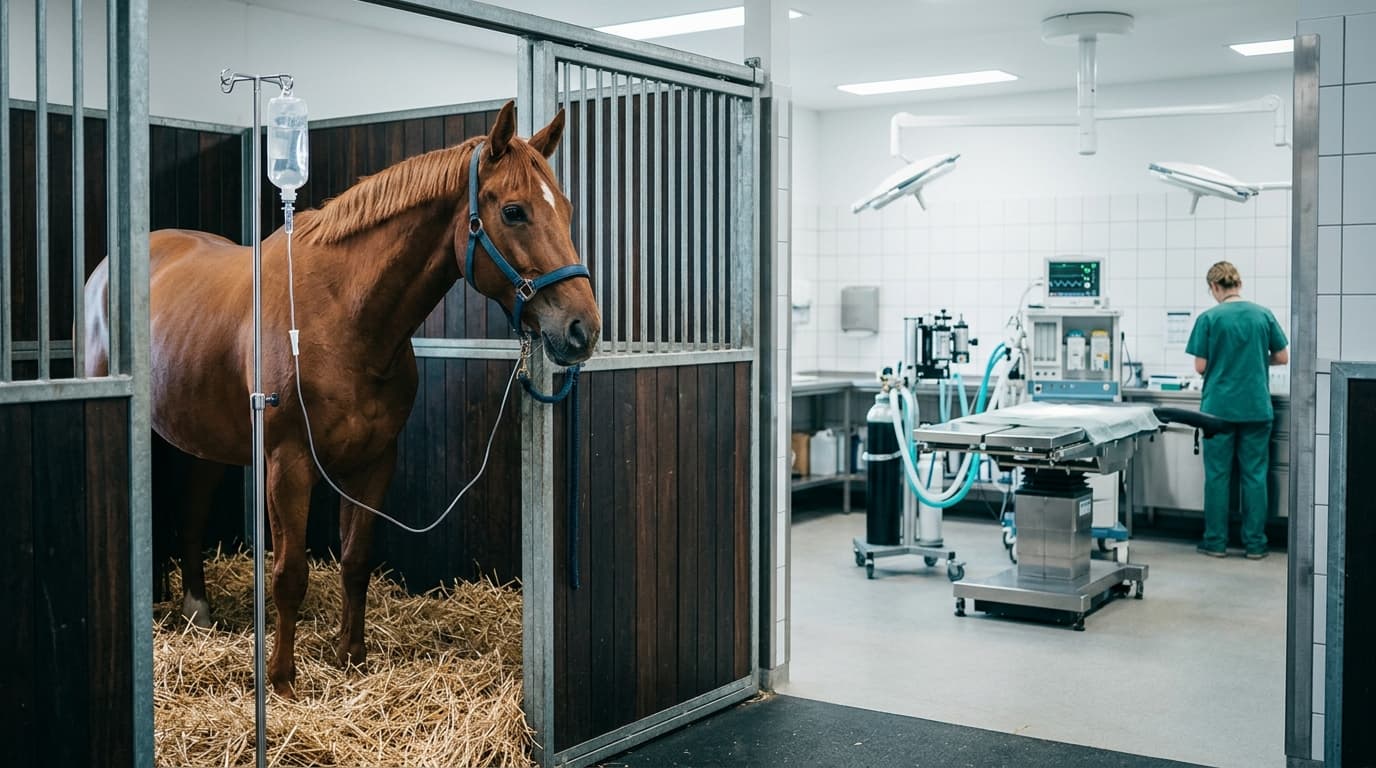
The clinic bill grows mainly through the length of the stay. Stabling alone in the clinic's horse barn is usually charged in 2026 as a daily flat rate of about 20 to 50 euros.[5] The far larger item is the treatment itself: infusions, medication, bandage materials and constant veterinary checks are added to every day and drive up the daily total.[6]
- Stabling at the veterinary clinic: in 2026 usually 20 to 50 euros per day as a flat rate, more in specialist clinics with intensive monitoring.[5]
- Treatment per day: infusions, medication and bandage materials are added to every clinic day and multiply the stabling costs.[6]
- Typical length of stay after colic surgery: 7 to 14 days, longer with complications.[7]
- Order of magnitude: a smooth course with about one week in the clinic stays in the mid four-figure to low five-figure range; according to horse owners, a complication case with colic surgery runs 12,000 to 15,000 euros.[3]
This is exactly where equine surgery insurance comes in: it reimburses the stay at the veterinary clinic up to the 10th calendar day after surgery and aftercare up to day 14, plus medication and consumables if prescribed by the vet. The pre-surgery examination and transport costs for an emergency transport to the operation are also covered, depending on the tariff. On request, the insurer settles directly with the clinic (direct billing), so you don't have to front five-figure sums.[8]
Why the GOT rate drives the price so strongly
The GOT, the fee schedule for veterinarians (Gebührenordnung für Tierärztinnen und Tierärzte), is the legally binding federal ordinance according to which your vet bills. It does not set fixed prices, but provides a seamless range from the simple to the triple rate. Which rate applies depends on the difficulty of the case, time required and local conditions.[9]
- Regular treatment time: billing between the simple and triple rate depending on effort.[9]
- Emergency service (at night, on weekends, on public holidays): mandatory at least the double rate, up to the quadruple rate under difficult conditions.[10]
- Emergency service fee: in addition, a flat fee of 50 euros net per call-out applies.[10]
- Surcharge: value-added tax is added to the fees.
Since the reformed GOT came into force at the end of 2022, veterinary treatments have become on average around one third more expensive, according to the Federal Chamber of Veterinarians (Bundestierärztekammer).[4] How strongly individual procedures are affected is shown by invoices that the Second Chairman of the Association of German Animal Owners (Vereinigung Deutscher Tierhalter) presented to NDR in 2025: an eye surgery on a horse that cost around 6,800 euros under the old fee schedule came to just over 31,000 euros after the reform.[4]
Honestly: reimbursement up to 2 times the GOT rate, as many tariffs provide, covers regular clinic operation well. But if your horse is operated on during emergency service and the clinic bills above the double rate, you will bear a share of the costs yourself, unless the tariff includes the 4-fold emergency service rate.[10] You should factor this difference into the tariff price.
Waiting periods, pre-existing conditions and exclusions
Whether the premium is worth anything in an emergency is decided in the fine print. The waiting period is the period after the start of the contract during which the insurer does not yet pay for illness cases. If an illness or its first symptom occurs during this time, it is permanently not insured.
| Event | Waiting period |
|---|---|
| Accident | [11]none, cover applies immediately |
| Abdominal surgery (colic) | [11]5 days |
| Illness in general | [11]3 months |
| Joint surgeries in chips (detached bone or cartilage particles in the joint), OC (osteochondrosis, a disorder of cartilage ossification during growth) and OCD (osteochondrosis dissecans, the more severe form in which cartilage-bone parts loosen) as well as Birkeland fractures (detachments on the cannon bone) | [11]12 months |
| Medically necessary castration | [11]6 months |
Pre-existing conditions are the second stumbling block: if clinically relevant symptoms or a diagnosis existed before the start of the contract or within the waiting period, this illness and its consequences are permanently not covered. Therefore answer the health declaration completely and truthfully, otherwise the cover may be lost in the event of a claim.
- Routine, preventive and voluntary examinations with no connection to illness or accident
- Dental care, tartar removal and cosmetic dental treatment
- Operations that serve to establish breed standards
- Travel, waiting and journey costs of the vet as well as transport costs for the horse
- Dietary and supplementary feed as well as preventive vitamin and mineral supplements
Next step: calculate your premium. Only an individual calculation based on age, breed and the health declaration of your horse shows which tariff level matches your case and what the cover actually costs per month.
Who the premium is worth it for: outlook and next step
The general rule is: if you could not pay a five-figure surgery bill out of your own pocket, surgery cover works out cheaper in the long run than going without. A single colic operation with complications exceeds the annual premium many times over.
The decisive factor is the condition of your horse. For a healthy, younger horse with no known complaints, taking out a policy is straightforward, and the premium sits at the lower to middle end of the range. For a horse with pre-existing conditions, acceptance and price depend on the health declaration and the insurer's acceptance decision; known conditions and their consequences remain permanently excluded.
To be honest: a general article cannot settle your individual premium. It depends on data only you can provide, from the horse's age and its use to its health history.
That is exactly what nextsure compares for you: tariffs for equine surgery insurance with three flexible tariff levels, depending on the tariff reimbursement by the insurer of up to 2 times the GOT rate and free choice of clinic worldwide, so that a high surgery bill never becomes a financing question. Calculate your premium and check which tariff suits your horse.
As for the outlook: the fee schedule remains in flux. The Federal Ministry of Food and Agriculture has planned an evaluation of the GOT, as reported by NDR. How fee rates and, as a result, tariffs and premiums will develop remains open. Therefore, check premiums and conditions with the provider before taking out a policy.
Frequently asked questions
- How much does horse surgery insurance cost per month?
Depending on the tariff level, the horse's age at the start of the contract and the health declaration, the premium roughly ranges from around 20 to over 100 euros per month. For 2026, one major insurer, for example, quotes 21.71 euros for the basic tariff, 58.05 euros for the mid-level tariff and 103.14 euros for the highest tier. The exact premium for your horse can only be calculated individually, because age, breed and pre-existing conditions determine the price.
- How much does surgery on a horse cost?
Typical benchmark figures from a major insurer for 2026: a colic surgery costs approx. 8,000 to 12,000 euros, a fracture surgery approx. 6,000 to 12,000 euros, an arthroscopy approx. 5,000 to 10,000 euros and a dental or jaw surgery approx. 1,500 to 6,000 euros. If complications with lengthy aftercare occur, the bill is higher: horse owners report 12,000 to 15,000 euros for colic surgeries, and in individual cases 21,000 euros.
- How much does a horse cost per day at the veterinary clinic?
In 2026, pure stabling at the clinic is usually charged as a daily flat rate of about 20 to 50 euros. The treatment weighs far more heavily: infusions, medication, bandage materials and daily veterinary checks are added to every clinic day and multiply the daily total. After colic surgery, a stay of 7 to 14 days is common, so the clinic stay alone quickly reaches four figures. Depending on the tariff, stabling is covered up to the 10th calendar day after surgery, with some providers up to 15 days.
- What is the most expensive surgery for a horse?
Colic surgery with complications is considered the most expensive procedure: emergency service, an increased GOT rate (the veterinary fee schedule rate), up to 14 days of intensive care and follow-up surgeries lead to bills of 12,000 to 15,000 euros, in individual cases up to 21,000 euros. In one documented extreme case, treatment costs for a joint injury accumulated to well over 74,000 euros before the horse had to be put down.
- When does horse surgery insurance pay out?
It pays for medically necessary veterinary surgeries due to illness or accident once the waiting period has expired. Depending on the tariff, preliminary examinations, aftercare up to the 14th day, medication and stabling at the veterinary clinic up to the 10th calendar day after surgery are covered. Not covered include, among other things, routine and preventive examinations, dental care and cosmetic dental treatments, as well as surgeries to meet breed standards.
- How does horse surgery insurance handle pre-existing conditions?
Illnesses whose symptoms or diagnosis occurred before the start of insurance or within the waiting period are permanently excluded from coverage, including their consequences. An honest and complete health declaration therefore decides on acceptance and price. Whether and under what conditions a horse with a pre-existing condition is accepted is always clarified by the insurer on a case-by-case basis.
- Up to which GOT rate does horse surgery insurance reimburse?
The tariffs for horse surgery insurance brokered via nextsure provide for reimbursement of up to 2 times the rate of the fee schedule for veterinarians (GOT); the reimbursement is paid by the insurer. Important to know: in the emergency service, at least double the rate applies, and depending on the effort involved, the vet may bill up to four times the rate. If the clinic bills above the reimbursable rate, a co-payment remains that you must cover yourself.
Sources
- [1]ruv.de
- [2]nextsure.de
- [3]pferde.de
- [4]ndr.de
- [5]versicherungsvergleiche.de
- [6]pferdeklinik-sorpesee.de
- [7]nextsure.de
- [8]nextsure.de
- [9]nextsure.de
- [10]nextsure.de
- [11]nextsure.de
Conclude directly online
Verified partner tariffs at no extra cost. The button takes you straight to the provider's calculator.
 Barmenia
Horse surgery insurance
Surgery cost cover for horses in case of illness and accidents, including diagnostics and after-care.
- Waiting period:
- 3 months (colic surgery: 5 days, accidents: none)
- Coverage abroad:
- worldwide, up to 12 months
- Maximum benefit:
- depends on the cover level, as stated in the policy
- Surgery costs for illness and accidents, including tooth extractions and root canal treatment
- Pre-surgical examination (X-ray, endoscopy, biopsy, lab work)
- After-care including acupuncture, homeopathy, physiotherapy, laser therapy
- Emergency veterinary service up to 4x the standard veterinary fee schedule (GOT) rate plus the emergency callout fee
- Premium cover: up to 5 physiotherapy sessions (max. 60 minutes each) after the after-care period ends
- Once per animal: surgery costs for a birth-related, medically necessary caesarean section
Key exclusions
- Illnesses and developmental abnormalities known at the time of application
- Hoof abscesses and hoof ulcers (exception: hoof cancer)
- Surgery due to cryptorchidism
- Neutering that isn't medically necessary
Service-Champions GOLD: Nr. 1 der Versicherer im Multikanalvertrieb (ServiceValue, 10/2024)
Barmenia (Anbieter der Pferde-OP-Versicherung)
Special waiting periods: 12 months for joint surgery (chip fragments, OC/OCD, Birkeland fractures), 6 months for medically necessary neutering; Premium cover includes a waiver of the insurer's right to cancel from the 7th insurance year.
Fact sheet: benefits, exclusions and waiting periods in detail
All details are taken from the provider's linked product page and the contract documents (IPID/policy conditions) published there; the insurer's documents prevail. Premiums, benefits and the insurance product itself may change – please verify the details directly with the partner before signing up; only the information provided there is binding.
Information last updated: July 2026 · Source: provider product information (IPID/policy conditions)