Underwater camera insurance with housing
Protect your underwater camera and housing against water damage & theft. Find out what specialist insurance covers. Learn more now!
All details are taken from the provider's linked product page and the contract documents (IPID/policy conditions) published there; the insurer's documents prevail. Premiums, benefits and the insurance product itself may change – please verify the details directly with the partner before signing up; only the information provided there is binding.
 Katrin StraubManaging DirectorInsurance expert with over 20 years of experience in the insurance industry.
Published on
Last updated on
4 min read
Table of Contents
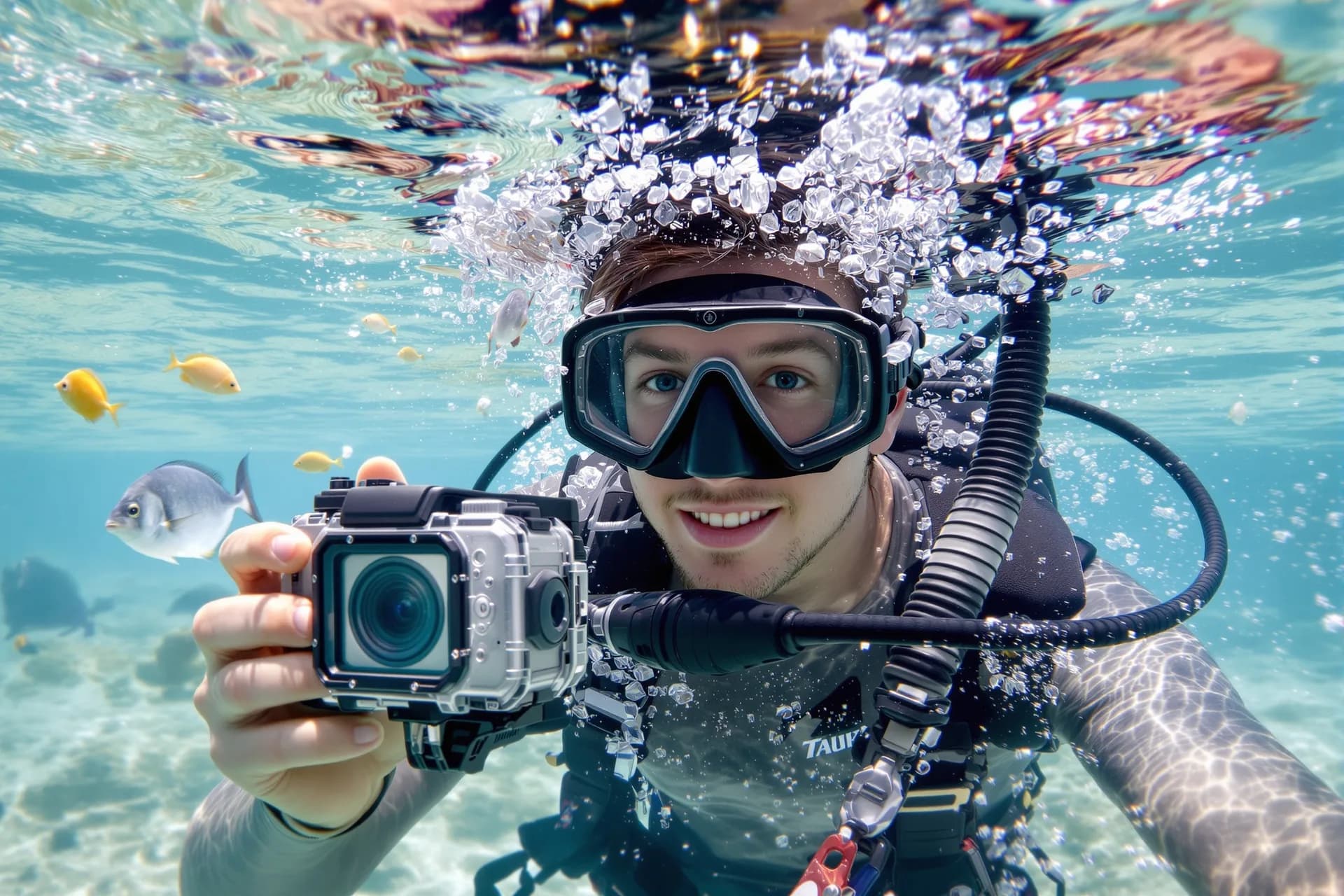
A flooded housing at a depth of 30 metres can mean damage of more than €5,000. Many photographers are lulled into a false sense of security by household contents or travel insurance. This article shows what really matters when it comes to genuine underwater camera insurance with housing.

Camera Equipment Insurance
Secure your valuable camera equipment thoroughly against damage, theft, and loss with the camera equipment insurance from nextsure. Tailored protection for professionals and hobby photographers.
Learn morePush standard insurance to its limits
Many photographers assume that their camera equipment is covered by their contents insurance. This covers damage caused by mains water in the home, but water ingress at sea is not included. The outside-home cover of a contents policy often only applies to burglary from a permanent building such as a hotel room; simple theft on the beach is usually excluded.
Travel luggage insurance also offers only limited protection. It typically only pays out if items go missing during transport by an airline or in the event of robbery. A self-inflicted loss, such as dropping the camera into the water, is not covered in nine out of ten cases. In addition, compensation amounts are often limited to the item's current value, which is far below the cost of replacing it at 4,000 euros or more. These gaps in cover make a specialist policy necessary.
Define the scope of cover for a specialist policy
A dedicated underwater camera insurance policy with housing provides all-risk cover specifically tailored to the risks of diving and travel. Unlike standard insurance policies, which often cover only a handful of specific perils, such a policy offers comprehensive protection. The key advantage is cover for user error, such as a housing that has not been closed properly.
A good policy should explicitly include the following points:
- Water damage caused by leakage in the housing, regardless of depth.
- Implosion of the housing due to water pressure.
- Damage caused by dropping it, including into the water.
- Theft, burglary and robbery worldwide, including from a car.
- Damage caused by sand, salt or moisture.
- Operating errors and clumsiness.
- Protection for accessories such as lenses, flashes and lights.
This comprehensive cover secures the replacement value of the entire equipment, which is crucial with camera equipment insurance. This minimises financial loss and keeps the passion for photography undiminished.
Analyse a damage claim in practice
Imagine a diving holiday in the Maldives. On a dive at a depth of 25 metres, you suddenly notice water seeping into your camera housing. The camera, worth €2,500, and the lens, worth €1,500, are beyond repair. The housing itself, costing €1,800, is also affected. The total loss amounts to €5,800.
Without a specialist underwater camera insurance policy, you are left to bear these costs yourself. A good policy, on the other hand, reimburses the replacement value. With an annual premium of, for example, two per cent of the equipment value, i.e. €116, the financial protection is enormous. The premium often amounts to only two to three per cent of the insured value. Such an incident shows how quickly the investment in suitable travel insurance for equipment pays for itself.
Review insurance terms and conditions in detail
When taking out insurance for your underwater camera and housing, the details in the small print matter. Make sure that the policy provides new-for-old replacement. That means that, in the event of a claim, you receive the amount required to buy a new, equivalent device. Many cheaper plans only reimburse the actual cash value, which can fall by 20 to 30 per cent after just one year.
Another important point is the area of cover. Make sure the protection applies worldwide and without any time limit when travelling. Also check the exclusions: gross negligence is a common point of dispute. Some top-tier plans waive the defence of gross negligence for claims of up to 1,500 euros. This is particularly relevant when it comes to the proper maintenance of sealing rings. Looking at the terms of worldwide sports equipment insurance can also be informative here.
Report damage correctly and quickly
In the event of damage, quick and correct action is crucial in order to receive full compensation from your insurer. A delay can extend settlement by up to 30 days. Follow a clear procedure to speed up the process.
Follow these steps for a smooth claims process:
- Document the damage immediately: Take photos or videos of the damaged equipment, ideally directly at the scene of the incident.
- Report it without delay: Contact your insurer within 48 hours by phone or via its online portal.
- Describe the incident in detail: Complete the claim notification as precisely as possible. State the location, time and cause.
- Report theft to the police: Report a theft immediately to the local police and ask for a copy of the report. 100 per cent of insurers require this.
- Obtain a quote: Have a specialist repair shop prepare a quotation for the repair or confirm the total loss.
Complete documentation is key, as is also the case with camera damage abroad.
Select the optimal protection for your equipment
Choosing the right underwater camera insurance depends on the value of your equipment and your individual usage. Compare not just the price, but above all the benefits. An insured sum of €10,000 costs around €238 per year with one provider and an excess of €250. Check whether accessories such as batteries and memory cards are also covered up to a sum of at least €500.
Look out for policies that include what is known as a precautionary clause. This means newly purchased items of equipment are automatically insured until the next premium due date, often up to a value of €10,000. This saves you from having to report every new lens immediately. For professionals and professional photographers, there are also special clauses that cover commercial use without an additional charge. At the end of the day, the best insurance is the one that helps you quickly and without complication in the event of a claim.
Frequently asked questions
- What is the difference between replacement cost compensation and actual cash value compensation?
Replacement value compensation reimburses you the amount you need to buy a new, equivalent device. Actual cash value compensation takes into account a reduction in value due to age and use, so the reimbursement amount is significantly lower. Always look out for a new-for-old replacement clause.
- Does the insurance also cover damage caused by user error?
Yes, a high-quality all-risk cover for cameras includes damage caused by user error, carelessness or improper handling. This is particularly important if, for example, the housing was not properly closed before the dive.
- What should I do if my equipment is stolen while I'm on holiday?
Report the theft to the local police immediately and file a report. Then inform your insurer about the incident straight away. The police report is a mandatory requirement for claims settlement.
- Are rented underwater cameras also insured?
Some insurers offer clauses that also insure rented or borrowed equipment up to a certain amount. However, this must be explicitly stated in the insurance terms and conditions.
- Is there an excess?
It depends on the selected plan. Many insurers offer plans with and without an excess. A plan without an excess usually has a slightly higher annual premium, but in the event of a claim you receive the full amount reimbursed.
- Is my drone also insured for underwater footage?
Standard camera insurance policies often do not usually cover drones. There are special drone hull insurance policies for drones. However, some providers do allow drones to be included in the camera policy for an additional premium.
Conclude directly online
Verified partner tariffs at no extra cost. The button takes you straight to the provider's calculator.
 Hepster
Camera insurance
Worldwide cover for new and used cameras, including original accessories.
- Coverage area:
- worldwide
- Battery-wear threshold:
- up to 60% remaining capacity, device max. 4 years old
- Minimum term:
- 3 months (monthly subscription)
- Drop, breakage, sand, and liquid damage
- Fire, explosion, power surge, short circuit, sabotage, vandalism
- Battery and screen damage, plus battery wear (where not covered by warranty)
- Operating errors and improper handling
- Theft module: theft, burglary from a car or home, robbery
Key exclusions
- Loss and forgetting outside the insured theft scenarios
- Devices without a known serial/IMEI number
- Damage covered under warranty or manufacturer's guarantee
- Gross negligence or intentional acts
Trusted Shops: 4,5/5 „Sehr gut“ (2.600 Bewertungen)
hepster insgesamt (Anbieterbewertung, alle Versicherungen)
Claims must be reported online within 14 days; theft must be reported to the police within 24 hours. Insurer: Hiscox SA, Niederlassung für Deutschland
Fact sheet: benefits, exclusions and waiting periods in detail
All details are taken from the provider's linked product page and the contract documents (IPID/policy conditions) published there; the insurer's documents prevail. Premiums, benefits and the insurance product itself may change – please verify the details directly with the partner before signing up; only the information provided there is binding.
Information last updated: July 2026 · Source: provider product information (IPID/policy conditions)