Equine Surgery Insurance & Stallion Castration: Costs & Tariffs
Does equine surgery insurance cover stallion castration? Costs, medical necessity, waiting periods, and special tariffs explained.
All details are taken from the provider's linked product page and the contract documents (IPID/policy conditions) published there; the insurer's documents prevail. Premiums, benefits and the insurance product itself may change – please verify the details directly with the partner before signing up; only the information provided there is binding.
 Katrin StraubManaging DirectorInsurance expert with over 20 years of experience in the insurance industry.
Published on
Last updated on
12 min read
Table of Contents
A regular equine surgery insurance policy only covers the cost of castrating a stallion where it is medically necessary, for example due to tumors or severe inflammation. Purely routine procedures for behavior management are excluded. Some providers, however, pay a fixed contribution toward planned operations. For the pure anesthesia risk, there are special castration insurance policies that pay out if the animal dies.

Equine surgery insurance
Horse surgery insurance via nextsure: Three flexible tariffs, reimbursement up to twice the GOT rate, and free choice of clinic worldwide. Protect your horse from high surgery costs – digital, transparent and uncomplicated.
Learn moreMedical necessity as the criterion for castration
Routine procedure versus pathological finding
Medical necessity determines whether the insurer covers the cost of a castration. A regular policy standardly excludes planned routine procedures for pure behavior management of the stallion. Insurers such as R+V clearly state in their terms that procedures without a medical indication are not reimbursable [3]. This concerns the classic castration of the stallion at the home stable or at a clinic. The exclusion applies immediately. Horse owners must bear these costs entirely themselves. An exception exists for pathological findings. If the vet diagnoses an andrological or oncological condition, the situation changes fundamentally. Inflammation of the reproductive organs or hormone-dependent tumors make the procedure strictly necessary. In these specific cases, cover applies in full. The vet must precisely document the diagnosis.
Documentation and exclusion criteria
Complete documentation by the treating vet forms the absolute foundation for the benefits review. The vet must establish the pathological change beyond doubt before the procedure and record it in detail in the patient file. Mere suspicion is not sufficient for cost coverage. Insurance companies review submitted documents very closely. They often request additional findings or lab results. This ensures correct processing. If, for example, cryptorchidism is present, where a testicle has not descended into the scrotum, many insurers classify this as a congenital developmental defect. Barmenia explicitly excludes operations due to cryptorchidism from its scope of benefits. Such details in the insurance terms show the importance of a precise tariff comparison. nextsure objectively analyzes these fine differences and filters out the suitable offers.
Cost coverage for preliminary examinations
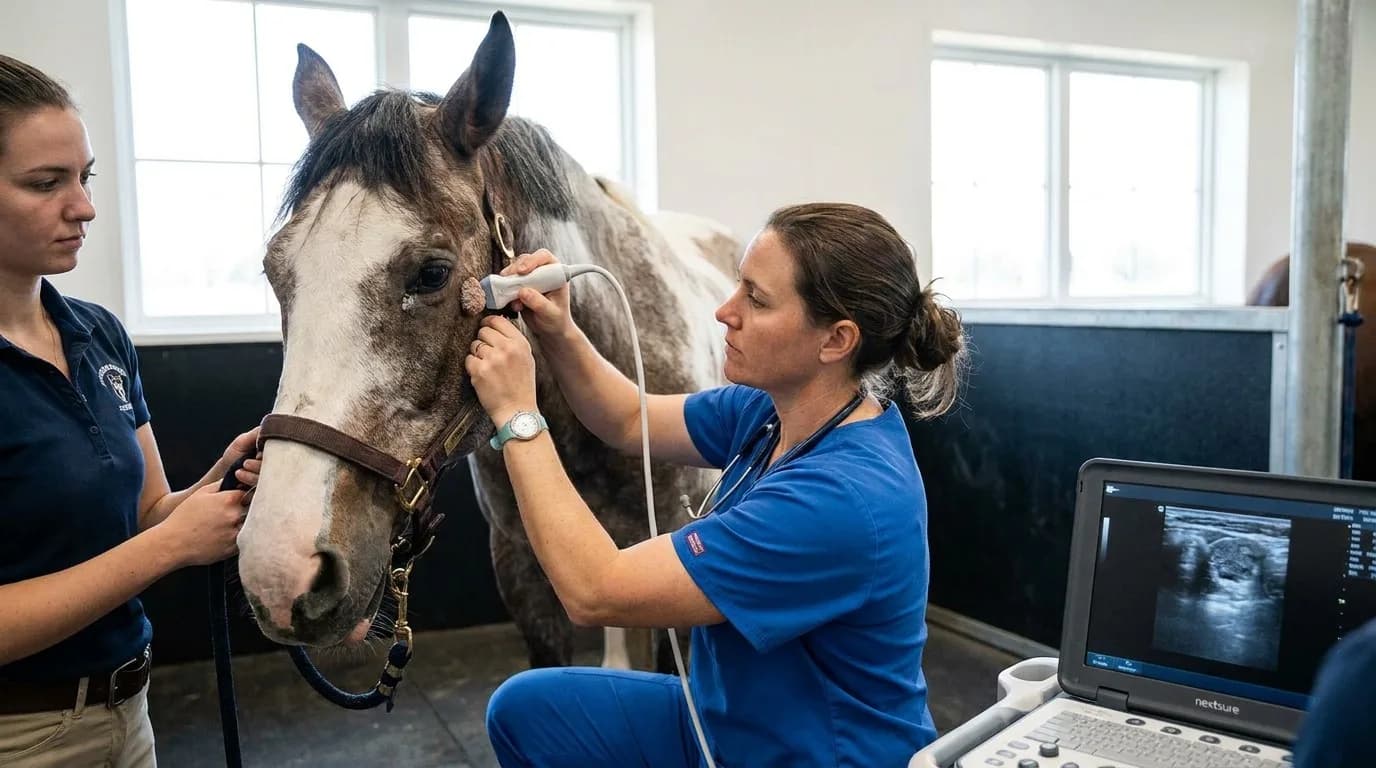
Besides the direct operation costs, preparatory examinations also come strongly into focus when billing. If a medical indication exists, companies generally also reimburse the cost of diagnostics. This includes comprehensive blood work, ultrasound examinations, or specific tissue samples. These preliminary examinations can quickly cost several hundred euros. GHV, for example, covers operation costs up to twice the rate of the fee schedule for veterinarians, provided there is a clear medical necessity [2]. In an emergency, this tariff even pays up to four times the rate. It is essential that horse owners know the exact benefit limits of their tariff. Strong equine surgery insurance protects against unexpected financial burdens in genuine cases of illness. For purely routine castrations, however, alternative financing options or special add-on modules must be found.
Tariffs with a contribution for planned procedures
Flat-rate reimbursements for routine operations
Certain tariffs offer a contribution toward planned procedures even if there is no medical necessity. While most companies fully reject routine castrations, some providers position themselves with customer-friendly add-on benefits. Uelzener Versicherung, for example, contributes a one-time 200 euros toward the surgical castration or sterilization of the horse [5]. This amount does not cover the entire operation cost but offers welcome financial relief for the horse owner. The contribution is paid regardless of the chosen surgical method. Horse owners only need to submit the veterinary invoice. Payout is generally straightforward. Such tariff components are especially attractive for owners of young stallions who have already firmly planned the procedure. Comparing providers is enormously worthwhile here.
Conditions for paying out the contribution
Payout of such a contribution is always tied to certain contractual conditions and deadlines. Generally, the insurance contract must already have existed for a certain time before the claim to the flat-rate payment arises. Insurers want to prevent policies from being taken out purely to immediately claim the benefit. The exact length of this waiting period varies by provider and tariff. Horse owners should study the insurance terms carefully. A look at the small print is essential. In addition, the procedure must be carried out by a licensed vet according to accepted veterinary practice. Insurers consistently reject invoices from unqualified persons. Submitting the original invoice with a detailed breakdown of the fee schedule line items is mandatory. Only this way can the company correctly process the claim.
Economic assessment of the contribution model
Economically assessing a tariff with a castration contribution requires a precise calculation of long-term premiums. A tariff that contributes 200 euros toward castration may have higher monthly premiums than pure emergency surgery cover. Horse owners must calculate whether the higher premium pays off over the years. Often, though, these premium tariffs also bundle other useful benefits that justify the extra cost. These include extended aftercare periods or coverage of alternative healing methods. The decision should never be made solely based on the castration contribution. A holistic view is important. nextsure makes the total cost structure of the various tariffs transparent. This helps customers find the solution that best fits their individual budget and their horse's needs.
Cost coverage for standing anesthesia and general anesthesia
Cover for different types of anesthesia
Cost coverage often includes procedures under standing anesthesia or general anesthesia, depending on the exact tariff terms. The choice of anesthesia type for a castration depends on various factors, such as the stallion's age, temperament, and anatomical situation. Many vets prefer castration on a standing horse under sedation and local anesthetic for uncomplicated cases. Modern surgery insurance explicitly covers this method. Barmenia defines an operation as a surgical procedure under anesthesia, sedation, local anesthetic, or standing anesthesia. This broad definition is a major advantage for the policyholder. That creates flexibility. When procedures under standing anesthesia are covered, the vet can choose the gentlest method for the animal without the owner needing to fear financial disadvantages. Medical indication, of course, remains a prerequisite.
Risks and costs of general anesthesia
Performing a castration under general anesthesia at an equine clinic involves considerably higher costs and risks. Lying down and standing back up carries a substantial risk of injury for the horse, which is why clinics must maintain special recovery boxes. This infrastructure is directly reflected in the veterinary invoice. The costs for anesthetics, monitoring, and clinic staff quickly add up to high amounts. If the castration takes place at the clinic under general anesthesia due to medical necessity, such as a tumor, good surgery insurance covers these costs. The coverage amounts must be chosen high enough. A tariff with no annual limit offers the greatest security here. Horse owners should make sure that the costs for imaging procedures used to prepare for the operation are also included. This prevents nasty surprises on the final invoice.
Billing anesthesia under the GOT
Billing for anesthesia services strictly follows the requirements of the current fee schedule for veterinarians. The invoice lists every step - from the preliminary examination through the injection to monitoring vital parameters - as a separate line item. Insurers meticulously check these items for legitimacy and appropriateness. A tariff that pays up to twice or three times the GOT rate is thoroughly recommended for clinic stays. Specialists and specialty clinics rarely bill at the standard rate due to their higher effort and expertise. Uelzener Versicherung, for example, covers all veterinary-medically necessary operations under general anesthesia, sedation, or local anesthetic [5]. This comprehensive cover gives the treating vet the necessary latitude. The horse owner can focus fully on their animal's recovery.
| Feature | Standing anesthesia (sedation) | General anesthesia (clinic) |
|---|---|---|
| Cost | Moderate (approx. €300 - €600) | High (approx. €800 - €1,500) |
| Risk of injury | Lower (no lying down/standing up) | Higher (recovery phase is critical) |
| Insurance cover | Often included (Barmenia) | Included (if medically necessary) |
| Location | Often possible at the home stable | Must be done at the equine clinic |
Actual costs vary depending on the GOT rate applied and individual effort.
Relevant waiting periods before the procedure
General and special waiting periods
Relevant waiting periods must be observed before the procedure so as not to jeopardize cover. Every equine surgery insurance policy works with waiting periods to protect against opportunistic sign-ups. The general waiting period for illnesses is standard in the industry at between three and six months. Different, often longer, periods apply for specific diagnoses. Barmenia, for example, provides for a special waiting period of six months for castrations that must be performed due to gynecological, andrological, or oncological conditions. If the condition occurs within these six months, there is no entitlement to benefits. The owner bears the risk. It is therefore advisable to take out the insurance as early as possible. Anyone who only looks for a policy once first symptoms appear will come away empty-handed in a claim. The contract terms are clearly worded here.
Exclusion of pre-existing conditions
Handling pre-existing conditions is a central topic when applying for equine surgery insurance. Illnesses or developmental defects that were already known at the time of application are generally excluded from cover. This also applies to congenital anomalies that only become symptomatic later, provided they were diagnosed before the contract was concluded. If a stallion has already been under veterinary treatment for testicular problems, a later castration due to this specific issue will not be reimbursed. Insurers classify this as a pre-contractual claim. To avoid typical exclusions in equine surgery insurance, the health questions in the application must be answered completely truthfully. Breaching the pre-contractual duty of disclosure can lead to the insurer immediately withdrawing from the contract. Honesty is the top priority here. nextsure supports customers in correctly preparing their health history.
Waiver of the waiting period for accidents
An important exception to the strict waiting period rules are unforeseeable accidents. If, for example, the stallion suffers a serious injury to the scrotum from a pasture accident that makes immediate castration unavoidable, the waiting period is generally waived entirely. Cover for accidents generally applies from the first day after the contract begins. The vet must, however, clearly note on the invoice that the procedure is exclusively and demonstrably attributable to the accident. An accident is defined as an event that suddenly acts on the animal's body from outside. This clear definition protects the horse owner from unexpected catastrophes. Fast, unbureaucratic help in an emergency is the core promise of good surgery cover. Documentation of how the accident occurred should still be done carefully.
Reimbursement of aftercare following the operation
Duration of insured aftercare
Reimbursement of aftercare following the operation varies considerably between the different tariff offers on the market. A castration almost always requires several days of medical monitoring and medication. Regular checks of wound healing detect infections or swelling early. Good surgery insurance defines a fixed period during which all follow-up costs of the procedure are covered. GHV offers aftercare of 3, 9, or 15 days depending on the chosen tariff [2]. R+V Versicherung includes aftercare and prescribed medication for up to 15 days from the day of the operation [3]. Uelzener goes even further and covers aftercare for up to 17 days [5]. These differences are significant. A longer aftercare period offers considerably more financial security.
Medication and consumables
Substantial costs for medication and consumables arise during the aftercare phase. Painkillers, anti-inflammatories, and antibiotics are standard after a castration. In addition, there are dressing materials, wound sprays, and sterile compresses. These items quickly add up on the veterinary invoice. The insurance terms precisely govern which of these costs are reimbursable. In principle, insurers reimburse medication if the treating vet explicitly prescribes it and it is medically necessary. Dietary feed or general vitamin supplements for strengthening, on the other hand, are usually excluded. Barmenia states this very transparently in its terms. The policyholder must submit the detailed pharmacy invoice or the vet's itemization. A clean separation between reimbursable medication and pure care products speeds up processing. This avoids unnecessary follow-up questions.
Inpatient accommodation at the equine clinic
If complications occur after castration, inpatient accommodation at the equine clinic may become necessary. Post-operative bleeding or serious infections require intensive round-the-clock monitoring. The costs for box rental, feed, and nursing care by clinic staff are high. Premium tariffs include these inpatient accommodation costs within the defined aftercare period. This is a decisive quality factor for equine surgery insurance. If the stallion has to stay at the clinic for ten days, this component protects the owner from financial ruin. Basic tariffs often exclude pure accommodation costs and only pay for purely medical services. Horse owners should pay close attention to this point when choosing a tariff. nextsure's experts routinely check these details.
Key benefits during the aftercare phase
- Veterinary wound checks and suture removal
- Prescribed painkillers and antibiotics
- Cost of consumables (dressings, syringes)
- Inpatient accommodation costs for complications
- Imaging procedures to monitor healing (e.g., ultrasound)
The exact duration of cost coverage varies by provider between 3 and 17 days.
Covering the life risk through castration insurance
How the special policy works
The life risk is covered through a special castration insurance policy that operates independently of surgery cost cover. A castration is a major intervention in the horse's body. Despite the utmost veterinary care, there is always a residual risk of fatal complications, particularly from anesthesia or postoperative bleeding. For owners of valuable stallions, the loss of the animal represents an enormous economic loss. This is where castration insurance comes in. It is a short-term, one-off life insurance policy that covers the economic loss if the stallion dies from the effects of the procedure [1]. Cover applies during the operation and for a defined period afterward, often ten days. If the horse dies during this time, the company pays out the agreed sum insured. This protects the invested capital.
Distinction from surgery cost insurance
It is essential to distinguish castration insurance from classic surgery cost insurance. Many horse owners confuse these two products. Castration insurance explicitly does not cover veterinary costs. The cost of the actual veterinary performance of the routine castration, as well as aftercare, is not included in this pure risk life insurance [1]. It only pays out on death or emergency euthanasia of the animal. Surgery insurance, by contrast, pays the vet's invoice but provides no compensation for the horse's value if it dies. Both policies must be intelligently combined for comprehensive protection. Uelzener, for example, offers such short-term castration insurance, which generally reimburses 80 percent of the agreed sum insured [4]. An independent broker explains these fine differences in detail.
Requirements for taking out the policy
Taking out castration life insurance is tied to strict health requirements. Insurers require a detailed veterinary report in advance. For cover, a veterinary certificate confirming normal sexual development of the horse must be submitted beforehand [4]. If pre-existing conditions or anatomical peculiarities such as cryptorchidism are already present, the application is generally rejected or subject to high risk surcharges. The horse must be completely healthy and fit for transport at the time of application. There are also often age limits for the procedure. Very old stallions are often no longer insurable due to the increased anesthesia risk. Carefully checking the underwriting guidelines is therefore the first step before planning the procedure. nextsure handles this preliminary check for its customers.
Veterinary costs under the current fee schedule
Structure of GOT billing
Veterinary costs are billed precisely under the current fee schedule and form the basis of every reimbursement. The fee schedule for veterinarians (GOT) is a legally binding set of rules that sets prices for veterinary services in Germany. A castration is made up of many individual line items: general examination, sedation, local anesthetic, the actual surgical procedure, injections, and dispensing medication. Depending on complexity, time required, and local conditions, the vet can bill the standard, double, or triple GOT rate. In emergency service, for example for nighttime post-operative bleeding, even four times the rate plus a flat emergency-service fee applies. Anyone who has to bear the veterinary costs for a horse with no insurance themselves feels these multipliers clearly. Good insurance cushions these peaks.
Calculating the total cost
Calculating the total cost of a castration requires a realistic assessment of all the items involved. An uncomplicated castration at the home stable under standing anesthesia usually costs between 300 and 600 euros. If, however, the procedure is carried out at a clinic under general anesthesia, costs quickly rise to 800 to 1,500 euros. If complications occur that require a longer inpatient stay, costs can explode. Amounts of 3,000 euros or more are then not uncommon. This is exactly where the value of strong surgery insurance becomes apparent. Even if the planned routine procedure is not paid for, the policy protects against the incalculable costs of a genuine medical crisis. Insurers check every invoice item for conformity with the GOT. Faulty invoices are consistently challenged.
Choosing the right GOT rate in the tariff
Choosing the right GOT rate in the insurance tariff is one of the most important decisions when signing a contract. A basic tariff that only pays up to the standard rate is often inadequate today. Most equine clinics bill at least twice the rate as standard. If the tariff is capped here, the horse owner has to pay the difference out of pocket. Premium tariffs offer reimbursement up to three or four times the rate. This ensures that invoices from highly specialized clinics are also fully covered in an emergency. R+V's equine surgery insurance, for example, pays out regardless of the billed GOT rate, up to the agreed compensation limit [3]. Such flexible models offer maximum security. The small monthly surcharge for a higher GOT rate pays off immediately in an emergency.
| Service item (GOT) | Standard rate (approx.) | Double rate (approx.) |
|---|---|---|
| General examination | €30.00 | €60.00 |
| General anesthesia incl. monitoring | €150.00 | €300.00 |
| Surgical procedure (castration) | €200.00 | €400.00 |
| Medication & consumables | €100.00 | €100.00 (fixed price) |
| Total cost (excl. aftercare) | €480.00 | €860.00 |
All amounts are estimates for illustration, excluding VAT.
Strategies for choosing the optimal tariff
Needs analysis and risk profile
Clear strategies help when choosing a tariff for the stallion in order to systematically avoid coverage gaps. Every horse owner has an individual risk profile. Anyone buying a young stallion and already firmly planning the castration should check whether a tariff with a castration contribution makes economic sense. Anyone who owns a valuable breeding stallion, on the other hand, urgently needs a high coverage amount for medically necessary procedures and possibly additional life insurance for the anesthesia risk. The difference between surgery and health insurance for horses must be clearly understood here. Full health insurance also covers conservative treatments without surgery but is considerably more expensive. The needs analysis always comes first. You must honestly assess your own financial reserves. Only this way can the optimal insurance cover be defined.
nextsure's broker approach
nextsure's broker approach offers a decisive advantage over classic comparison portals here. nextsure does not present a confusing jumble of tariffs but hand-picked solutions for special niches. The team knows the hidden clauses in the insurance terms precisely and knows which provider pays out smoothly for standing anesthesia and who immediately rejects cryptorchidism. This deep market insight saves horse owners time and stress. Advice is provided digitally, transparently, and tailored to the individual. As a licensed insurance broker under Section 34d of the German Trade, Commerce and Industry Regulation Act (Gewerbeordnung), nextsure works in the customer's interest, not the insurance company's, and compares premiums, GOT rates, and aftercare periods in detail. The goal is a contract that really works in an emergency. Paperwork and long phone calls are eliminated through our fully digital processes.
Long-term protection for the horse
Long-term protection for the horse goes far beyond the one-off question of castration. Strong surgery insurance accompanies the animal for its entire life and protects against the financial consequences of colic, bone fractures, or joint chips. It is advisable to take out the contract as early as possible, while the horse is still young and healthy. Later pre-existing conditions inevitably lead to exclusions. A tariff with no age limit and no declining reimbursement rates in old age offers the greatest planning security. Investing in a solid insurance policy is an investment in the horse's health. It ensures that medical decisions never have to be made for purely financial reasons. nextsure accompanies horse owners on this path as a reliable, digital partner.
Frequently asked questions
- Does equine surgery insurance pay for castrating a stallion?
Only if it is medically necessary, for example due to inflammation, tumors or after an accident. A purely behavior-related routine castration is not insured; some providers such as Uelzener do, however, contribute a one-off subsidy of 200 euros.
- What does castrating a horse cost without insurance?
An uncomplicated castration under standing sedation at the home stable usually costs 300 to 600 euros; in a clinic under general anesthesia, costs quickly rise to 800 to 1,500 euros. If complications requiring inpatient aftercare arise, 3,000 euros and more are possible.
- Is there a waiting period before castration?
Yes, for medically necessary castrations a special waiting period of six months often applies. Unforeseeable accidents that require an immediate operation are generally exempt from this.
Sources
Conclude directly online
Verified partner tariffs at no extra cost. The button takes you straight to the provider's calculator.
 Barmenia
Horse surgery insurance
Surgery cost cover for horses in case of illness and accidents, including diagnostics and after-care.
- Waiting period:
- 3 months (colic surgery: 5 days, accidents: none)
- Coverage abroad:
- worldwide, up to 12 months
- Maximum benefit:
- depends on the cover level, as stated in the policy
- Surgery costs for illness and accidents, including tooth extractions and root canal treatment
- Pre-surgical examination (X-ray, endoscopy, biopsy, lab work)
- After-care including acupuncture, homeopathy, physiotherapy, laser therapy
- Emergency veterinary service up to 4x the standard veterinary fee schedule (GOT) rate plus the emergency callout fee
- Premium cover: up to 5 physiotherapy sessions (max. 60 minutes each) after the after-care period ends
- Once per animal: surgery costs for a birth-related, medically necessary caesarean section
Key exclusions
- Illnesses and developmental abnormalities known at the time of application
- Hoof abscesses and hoof ulcers (exception: hoof cancer)
- Surgery due to cryptorchidism
- Neutering that isn't medically necessary
Service-Champions GOLD: Nr. 1 der Versicherer im Multikanalvertrieb (ServiceValue, 10/2024)
Barmenia (Anbieter der Pferde-OP-Versicherung)
Special waiting periods: 12 months for joint surgery (chip fragments, OC/OCD, Birkeland fractures), 6 months for medically necessary neutering; Premium cover includes a waiver of the insurer's right to cancel from the 7th insurance year.
Fact sheet: benefits, exclusions and waiting periods in detail
All details are taken from the provider's linked product page and the contract documents (IPID/policy conditions) published there; the insurer's documents prevail. Premiums, benefits and the insurance product itself may change – please verify the details directly with the partner before signing up; only the information provided there is binding.
Information last updated: July 2026 · Source: provider product information (IPID/policy conditions)