Equine Surgery Insurance for Foals: Entry Age & Tariffs
Equine surgery insurance for foals: entry age, chip requirements, waiting periods, and congenital conditions explained.
All details are taken from the provider's linked product page and the contract documents (IPID/policy conditions) published there; the insurer's documents prevail. Premiums, benefits and the insurance product itself may change – please verify the details directly with the partner before signing up; only the information provided there is binding.
 Katrin StraubManaging DirectorInsurance expert with over 20 years of experience in the insurance industry.
Published on
14 min read
Table of Contents
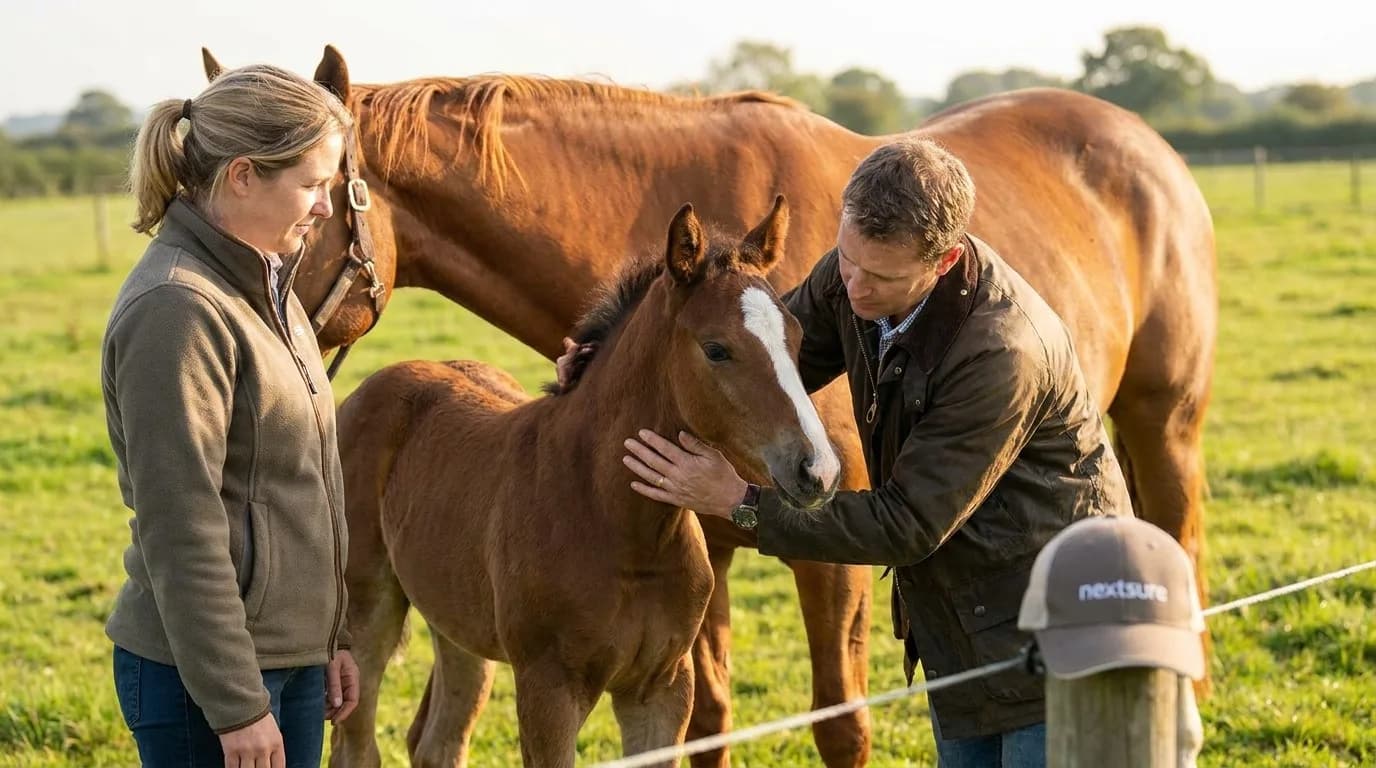
Depending on the provider, a foal can be signed up for equine surgery insurance from as early as its first day of life, or only from the third month of life. A clear identification via a chip number or passport number is mandatory for the contract. Timing matters. Signing up early pays off, since congenital developmental defects are covered as long as they were not yet known at the time of application.
Equine surgery insurance
Horse surgery insurance via nextsure: Three flexible tariffs, reimbursement up to twice the GOT rate, and free choice of clinic worldwide. Protect your horse from high surgery costs – digital, transparent and uncomplicated.
Learn moreThe ideal entry age for foal surgery insurance
Early cover from the first day of life
The optimal entry age for foal surgery insurance varies considerably between providers on the market. Some insurers offer cover right after birth. Uelzener Versicherung, for example, offers tariffs where foals can be signed up from as early as their first day of life [1]. This immediate cover is especially valuable, since young horses are extremely prone to injury on pasture or in the stable during the first weeks of life. Other providers require a considerably higher minimum age. Zurich's horse health insurance only insures foals from the third month of life [2]. Horse owners must factor these different deadlines into breeding planning and the choice of insurance cover. Signing up early prevents dangerous coverage gaps during the foal's critical rearing phase.
Avoiding exclusions due to pre-existing conditions
Signing up early offers a decisive strategic advantage for the horse's entire lifetime. Timing is crucial. The financial portal Finanztip explicitly emphasizes that signing up early for a young horse pays off, since healthy young animals can be insured without exclusions for pre-existing conditions [4]. If a foal receives a veterinary diagnosis already in its first months of life, later insurance contracts permanently exclude this specific condition from cover. Barmenia Allgemeine Versicherungs-AG consistently excludes illnesses or congenital developmental defects that were already known to the owner at the time of application. Signing up in the first weeks of life freezes the foal's health status as unblemished - and secures the full scope of benefits for the future.
Strategic tariff selection through nextsure
Johannes Müller, Head of Insurance Strategy at nextsure, and his team analyze the various entry ages and conditions of insurers in detail. Horse owners are not given a confusing jumble of tariffs but a hand-picked selection of suitable policies. If a breeder wants to insure a newborn foal, nextsure specifically filters out the providers that grant cover from the first day of life. The platform compares not only the entry age but also long-term premium development. Strong equine surgery insurance must offer reliable coverage amounts both in the foal's first months of life and in the horse's old age. That creates security. Personal expert advice ensures that the chosen tariff exactly fits the owner's individual situation and has no hidden gaps.
Advantages of signing up early for foals
- Immediate protection against high operation costs from pasture accidents in the first weeks of life.
- Avoiding exclusions by documenting a fully healthy status at the time of application.
- Securing favorable entry premiums that provide financial benefits over the entire contract term.
- Early cover for congenital developmental defects that are only diagnosed later during growth.
Signing up early secures the best terms for the horse's entire life.
Identification and requirements for the contract
Mandatory identification features for cover
Unambiguous identification of the animal is a mandatory prerequisite for coverage to begin. Insurance companies require unambiguous proof that the treated animal exactly matches the insured animal. That is crucial. Under Barmenia's General Insurance Terms, the horse must be uniquely identifiable via a passport number or a chip number. Foals generally receive this transponder in their first months of life from the vet or the relevant breeding association. Until the microchip is implanted, some insurers accept provisional identification features such as detailed markings descriptions, photos, or veterinary certificates. Horse owners must promptly submit the final chip number afterward to legally ensure full insurance cover for future operations and to avoid delays in claims settlement.
Documentation in the equine passport
The equine passport serves as the central document for recording the foal's identification data and medical history. Vets document all relevant treatments, operations, and vaccinations in this passport. When invoices for surgical procedures are submitted, insurers check that the data on the invoice exactly matches the details in the insurance contract. The veterinary invoice must include the owner's name, the animal's name, and the corresponding chip number. If this essential information is missing, payment of the insurance benefit is considerably delayed. Precise data management from the start protects the owner from administrative hurdles in an emergency and ensures smooth communication with the insurance company.
At nextsure, identification data is managed entirely digitally, transparently, and in a customer-friendly way. Owners can conveniently add their foal's chip number via the online portal as soon as the vet has implanted the transponder. This digital process eliminates error-prone paper forms and enormously speeds up updating the contract data. In a claim, the platform enables direct, uncomplicated submission of veterinary invoices by upload. The intelligent systems automatically check the completeness of required details such as diagnosis, chip number, and fee schedule line items. This speeds up processing and payment of reimbursement amounts to the horse owner or directly to the treating equine clinic: a decisive factor for liquidity in stressful situations.
| Required detail | Purpose of documentation |
|---|---|
| Name of the horse owner | Match with the policyholder in the contract |
| Chip number or passport number | Unambiguous identification of the treated foal |
| Exact diagnosis | Review of medical necessity and waiting periods |
| GOT line-item numbers | Billing according to the applicable fee schedule for veterinarians |
Complete invoices considerably speed up reimbursement by the insurer.
Waiting periods for young horses and foals
General and special waiting periods
Contractual waiting periods differ considerably depending on the diagnosis and the insurance company. The general waiting period for illnesses is exactly three months from the start of the contract with most providers, including Barmenia. If clinically relevant symptoms occur within this period, these illnesses are permanently excluded from cover. For life-threatening abdominal operations, especially for severe colic, this period is reduced to just five days. For specific joint operations involving isolated shadowing, OCD, or Birkeland fractures, however, a special waiting period of twelve months applies. Horse owners must factor these different deadlines into their planning for insurance cover, so as not to be left without financial cover in an emergency. Precise documentation of health status by the vet when the contract is concluded helps avoid later disputes about when symptoms first appeared within the waiting period.
Immediate cover for accidents
A key advantage of surgery cost insurance is immediate cover for accident-related procedures. For claims that are exclusively and demonstrably attributable to an accident, the waiting period is waived entirely. An accident is clearly defined in the terms as an event that suddenly acts on the animal's body from outside. If a foal injures itself on a fence in the paddock and needs surgical wound care under sedation, cover applies from the first day. Health damage from the unintentional ingestion of poisoned bait is also contractually treated as an accident. This rule offers owners immediate financial security for unforeseeable emergencies, which occur frequently, especially in young, boisterous horses.
Options for a seamless transition
For owners seeking immediate cover for illnesses, nextsure specifically analyzes tariffs on the market that offer customer-friendly terms. Time is crucial. Such tariffs without long waiting periods are especially interesting for breeders who want to minimize the financial risk in the foal's first months of life. In addition, the general waiting period is waived entirely if a previous policy already existed with another provider and the contract continues seamlessly. When switching insurers, nextsure's experts check in detail whether existing waiting periods can be credited. This prevents coverage gaps when switching to a stronger tariff and ensures continuous cover for the animal. A transparent comparison of waiting periods is therefore an essential part of the digital advice provided by the nextsure platform.
Overview of waiting periods (Barmenia example)
- Accident-related operations: no waiting period (immediate cover).
- Abdominal operations (colic): 5-day waiting period.
- General illnesses: 3-month waiting period.
- Medically necessary castration: 6-month waiting period.
- Joint operations (chips, OCD): 12-month waiting period.
Waiting periods vary by provider and chosen tariff.
Cover for congenital developmental defects and joint chips
Definition and inclusion of developmental defects
Cover for congenital developmental defects is a central component of high-quality foal insurance. Developmental defects are illnesses that are, according to the current state of veterinary medicine, congenital, hereditary, or developmental in nature. Barmenia does not blanket-exclude these complex conditions in its terms. Cover exists for all congenital or genetically caused anomalies, provided they were not known to the owner at the time of application. This is a massive advantage for foal owners, since many genetic defects only become visible during growth or under the first intensive strain. Signing up early ensures that the insurer fully bears later surgical corrections - with no financial setback for the owner.
Specific rules for joint chips
Osteochondrosis dissecans (OCD) and loose joint bodies are an extremely common surgical risk in young horses. Insurers handle these expensive diagnoses very differently. Barmenia covers operations to remove joint chips after a twelve-month waiting period has passed. Note that a contractual cap here only applies to the pure operation costs per day, including anesthesia. Preliminary examinations and aftercare are not counted within this cap. Other providers have set considerably stricter limits. Zurich Versicherung often caps compensation for joint chips on the day of the procedure at a fixed maximum amount, for example 1,500 euros [2]. Such caps can quickly lead to high out-of-pocket costs for complicated procedures.
Transparent benefit comparisons
The detailed comparison of these specific benefit limits is nextsure's absolute core competence. The platform transparently shows which tariffs pay out without limit for joint operations and where hidden sublimits lurk in the insurance terms. For owners of valuable young sport horses, uncapped reimbursement for chip operations is essential to restore the animal's later rideability and value without financial compromise. nextsure's licensed brokers provide independent advice and filter out the tariffs that optimally cover exactly this specific risk. This gives customers a sound basis for decision-making, far beyond pure price comparisons, and best secures their foal's future health. The digital needs analysis also takes breed predispositions into account, since certain horse breeds have a considerably higher risk of developing joint chips than others.
| Insurer | Waiting period for chips | Benefit limits |
|---|---|---|
| Barmenia | 12 months | Cap only on surgery costs per day |
| Zurich | Depends on tariff | Often capped at e.g. €1,500 on the day of surgery |
| R+V | Depends on tariff | Reimbursement independent of GOT rate possible |
The exact terms vary depending on the chosen tariff module.
Tariff variants and reimbursement rates under the GOT
Significance of the fee schedule for veterinarians
Different tariff variants offer different reimbursement rates based on the fee schedule for veterinarians (GOT). The GOT governs the binding billing rates for all veterinary services in Germany. Depending on complexity, time required, and timing of treatment, vets can bill at the standard rate up to four times that rate. Solid insurance cover must at least cover twice the rate to finance regular operations at modern equine clinics. R+V Versicherung, for example, offers strong tariffs that reimburse operation costs regardless of the billed GOT rate [3]. Such premium tariffs effectively prevent horse owners from being left with high difference costs for complicated procedures performed by specialists and having to co-fund treatment from their own resources. The recent adjustment of the GOT has noticeably raised veterinary costs across the industry, making strong cover even more essential today than in the past.
Emergency-service fees and emergency care
In acute emergencies, such as colic at night or a serious injury on the weekend, operation costs rise drastically. Equine clinics are legally required to charge a flat emergency-service fee of 50 euros in emergency service, as well as at least twice, but often three to four times, the GOT rate. This gets extremely expensive. As part of veterinary emergency service, Barmenia reimburses fees up to four times the rate as well as the full emergency-service fee. The prerequisite is that the treating vet documents the emergency on the invoice and bills the services according to the German veterinary fee schedule (GOT).
Deductibles and premium optimization
Choosing the right deductible significantly affects the monthly premium for the insurance. This decision matters. Tariffs without a deductible offer full cost coverage from the first euro but are naturally higher in monthly cost. R+V insures horses regardless of age and explicitly offers tariffs without a deductible [3]. nextsure helps horse owners use smart comparison calculators to find the optimal balance between the monthly premium and an affordable out-of-pocket share in a claim. By specifically choosing tariffs with a percentage reimbursement rate or a fixed deductible per insurance year, cover can be tailored exactly to the personal budget without having to forgo essential benefits.
Key factors when choosing a tariff
- Covered GOT rate (at least 2x recommended for regular procedures).
- Reimbursement of the 4x GOT rate in veterinary emergency service.
- Coverage of the statutory emergency-service flat fee.
- Level of the annual maximum compensation limit (ideally unlimited).
- Choice of deductible to control the monthly premium.
A tariff comparison should always take the owner's individual needs into account.
Exclusions and special rules for castration
Clear definition of exclusions
Specific exclusions define the contractual limits of cover precisely and transparently. No surgery cost insurance covers procedures that are not medically necessary. This includes cosmetic dental treatments, routine tartar removal, or operations that merely serve to achieve a particular breed standard. Dietary feed, transport costs for the horse to the equine clinic, and the preparation of veterinary expert opinions are also generally not reimbursed by insurers. Barmenia also explicitly excludes operations due to cryptorchidism (rig horses) as well as surgical procedures for hoof abscesses from cover. Horse owners must study these exclusions carefully before signing a contract to avoid false expectations in a claim. A close look at the General Insurance Terms often reveals subtle differences between providers that can decide thousands of euros in an emergency.
Medical vs. voluntary castration
Castrating colt foals is a routine procedure in horse keeping that is generally not covered by insurance. Voluntary castrations or sterilizations for pure behavior management are strictly excluded by contract. An exception exists with most providers only if the procedure is strictly medically necessary. Barmenia covers the cost of a castration if it must be performed due to gynecological, andrological, or oncological conditions. This includes severe inflammation or tumorous changes to the reproductive organs. For these medically indicated procedures, a special waiting period of six months from the start of the contract applies to protect the pool of policyholders.
The difference from full health insurance
Many horse owners confuse the scope of a pure surgery policy with that of comprehensive full insurance. Surgery cost insurance only applies when the skin or underlying tissue is cut through by more than a mere puncture under anesthesia or sedation. Conservative treatment of illnesses without a surgical procedure is not covered here. This is where the difference from classic horse health insurance helps with sound decision-making. nextsure advises customers in detail on whether pure surgery cover is sufficient for the foal's individual risk or whether comprehensive full health insurance is the better choice. The experts analyze the need and recommend the solution that offers the owner the best value for money.
Typical exclusions in equine surgery insurance
- Pre-existing conditions that were already known when the contract was concluded.
- Voluntary castrations without medical indication.
- Cosmetic procedures and treatments to achieve the breed standard.
- Transport costs to the equine clinic and the vet's travel fees.
- Special dietary feed and preventive vitamin preparations.
The exact exclusions are defined in the respective provider's insurance terms.
Aftercare and alternative healing methods for young horses
Inpatient stay and diagnostics
Comprehensive aftercare sustainably secures healing success after a serious surgical procedure. The costs of inpatient accommodation at the equine clinic quickly add up to extremely high amounts for longer stays. The financial risk is enormous. Good tariffs cover accommodation costs as well as medically necessary medications and consumables for a defined period after the operation. In addition, imaging procedures such as X-rays, CT, or MRI that are directly related to preparing for or following up on the operation are also covered. Barmenia fully reimburses these pre-operative and aftercare measures within the contractually agreed aftercare days, which considerably eases the burden on the horse owner in the critical phase after the procedure.
Integration of alternative healing methods
Modern veterinary medicine increasingly relies on complementary treatment methods to speed up horses' rehabilitation. Barmenia explicitly includes alternative healing methods such as acupuncture, homeopathy, laser therapy, and magnetic field therapy in its cover. The only requirement is that their effectiveness is backed by veterinary science and that they are billed by a licensed vet according to the fee schedule. Under Barmenia's premium cover, up to five physiotherapy treatments of up to 60 minutes each are additionally insured. These can also be carried out by recognized animal physiotherapists following a prior referral by the vet, which massively supports the foal's muscular recovery after a long period of standing and prevents long-term consequences. This is crucial. Especially after joint operations, professional physiotherapeutic muscle building is essential to gently bring the young horse back to normal exertion.
Holistic protection concepts
The integration of physiotherapy and alternative healing methods shows the clear shift toward holistic protection concepts in veterinary medicine. When selecting tariffs, nextsure focuses on providers that fully reflect this modern medical standard. Merely covering the cost of the surgical incision is no longer enough today to make the horse fully capable again. The platform precisely compares the number of insured aftercare days across different providers. This gives customers a transparent overview of which tariff delivers the best postoperative care for the foal. This protects against unexpected follow-up costs during the often lengthy and cost-intensive rehabilitation phase of the young horse.
Reimbursable aftercare benefits
- Inpatient accommodation costs at the equine clinic for the agreed period.
- Medications, dressing materials, and aids prescribed by the vet.
- Regenerative therapies such as IRAP, PRP, or stem-cell treatments (tariff-dependent).
- Alternative healing methods such as acupuncture or laser therapy by the vet.
- Physiotherapy treatments to restore mobility (under premium cover).
The duration of aftercare varies by tariff between a few days and several weeks.
Long-term contract security and waiver of termination
Protection against termination in a claim
Long-term contract security protects horse owners from surprise termination by the insurer at the worst possible moment. Normally, both contracting parties have the statutory right to terminate a policy in due time after a claim has been settled. This poses a massive financial risk if the horse develops a chronic illness and continually needs expensive operations. Under its premium cover, Barmenia offers a particularly valuable waiver of the right to terminate after a claim. That creates real security. This waiver automatically applies from the seventh year of the contract, provided the insured horse was no more than seven years old when the contract began. For foal owners, this means lifelong security once this period has passed, since the entry age is far below the limit. Such a waiver of termination is a strong signal from the insurer that it is interested in a long-term, partnership-based relationship with the customer.
Waiving the ordinary right of termination
In addition to the right to terminate after a claim, premium providers also waive their ordinary right of termination at the regular end of the insurance year. Barmenia waives this right from the seventh year of the contract, provided the horse was no more than seven years old when the contract was concluded. Exceptions exist only for serious breaches of contract, such as non-payment of premiums or breach of the pre-contractual duty of disclosure. This rule ensures that the foal remains insured even in old age - when the risk of surgery statistically rises sharply. That creates long-term security. Horse owners therefore need not worry that the insurer will unilaterally end the contract due to the animal's age or claims history.
The role of nextsure in choosing a contract
Choosing a tariff with long-term contract security is a complex process in which nextsure, as an independent broker, provides valuable support. The platform analyzes providers' General Insurance Terms in detail and filters out tariffs that include a genuine waiver of termination. This is especially important for insuring privately kept animals, since emotional and financial value are closely intertwined here. nextsure's experts transparently advise horse owners on the long-term consequences of their tariff choice and ensure that the chosen cover reliably applies not only in the foal's first years of life but over the horse's entire lifetime. That creates real security. This turns equine surgery insurance into a sustainable investment in the animal's health.
Frequently asked questions
- From what age can a foal be signed up for equine surgery insurance?
The entry age varies by insurance company. Some providers, such as Uelzener, allow sign-up from the foal's first day of life. Other insurers, such as Zurich, require a minimum age of three months. Signing up early is advisable to protect the foal immediately against pasture accidents.
- Does the foal need a chip or a passport number?
Yes, unambiguous identification of the animal is mandatory to take out equine surgery insurance. This is generally done via the 15-digit transponder number (chip) or the official passport number. Exceptions are possible. Until the chip is implanted, some insurers temporarily accept veterinary certificates or detailed markings descriptions.
- Does the three-month waiting period also apply to foals?
Yes, the general three-month waiting period for illnesses generally also applies to foals. For accident-related operations, however, this waiting period is waived entirely, so immediate cover applies. For special procedures such as colic surgery, a shortened waiting period of five days often applies, while joint chips usually require twelve months.
- Are congenital developmental defects covered if they were unknown?
In strong tariffs, congenital, genetic, or developmental defects are covered, provided they were not yet known to the owner at the time of application. If such an anomaly is only diagnosed during growth, the insurance covers the necessary operation costs under the contract terms.
- Does signing up early pay off for a young horse?
Signing up early definitely pays off. Healthy foals can be insured with no exclusions for pre-existing conditions. If an illness only occurs after the contract is concluded and the waiting period has passed, it remains permanently covered. Owners also secure favorable entry premiums and benefit long term from comprehensive cover.
- Are the costs of castrating a colt foal covered?
A voluntary castration for pure behavior management is not reimbursed by equine surgery insurance. Costs are only covered if the procedure is strictly medically necessary, for example due to severe inflammation or tumors of the reproductive organs. A special waiting period of six months generally applies here.
Sources
Conclude directly online
Verified partner tariffs at no extra cost. The button takes you straight to the provider's calculator.
 Barmenia
Horse surgery insurance
Surgery cost cover for horses in case of illness and accidents, including diagnostics and after-care.
- Waiting period:
- 3 months (colic surgery: 5 days, accidents: none)
- Coverage abroad:
- worldwide, up to 12 months
- Maximum benefit:
- depends on the cover level, as stated in the policy
- Surgery costs for illness and accidents, including tooth extractions and root canal treatment
- Pre-surgical examination (X-ray, endoscopy, biopsy, lab work)
- After-care including acupuncture, homeopathy, physiotherapy, laser therapy
- Emergency veterinary service up to 4x the standard veterinary fee schedule (GOT) rate plus the emergency callout fee
- Premium cover: up to 5 physiotherapy sessions (max. 60 minutes each) after the after-care period ends
- Once per animal: surgery costs for a birth-related, medically necessary caesarean section
Key exclusions
- Illnesses and developmental abnormalities known at the time of application
- Hoof abscesses and hoof ulcers (exception: hoof cancer)
- Surgery due to cryptorchidism
- Neutering that isn't medically necessary
Service-Champions GOLD: Nr. 1 der Versicherer im Multikanalvertrieb (ServiceValue, 10/2024)
Barmenia (Anbieter der Pferde-OP-Versicherung)
Special waiting periods: 12 months for joint surgery (chip fragments, OC/OCD, Birkeland fractures), 6 months for medically necessary neutering; Premium cover includes a waiver of the insurer's right to cancel from the 7th insurance year.
Fact sheet: benefits, exclusions and waiting periods in detail
All details are taken from the provider's linked product page and the contract documents (IPID/policy conditions) published there; the insurer's documents prevail. Premiums, benefits and the insurance product itself may change – please verify the details directly with the partner before signing up; only the information provided there is binding.
Information last updated: July 2026 · Source: provider product information (IPID/policy conditions)