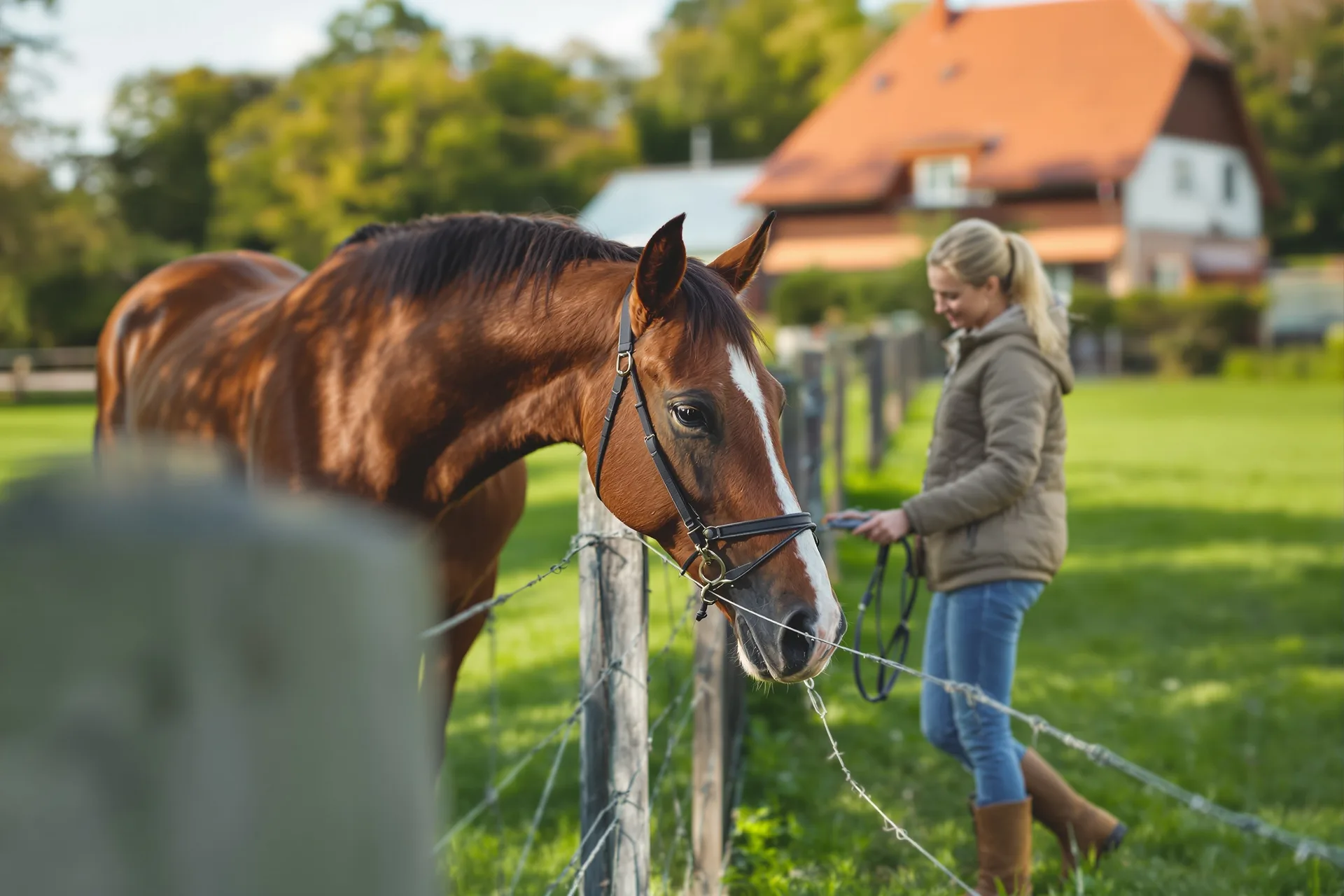
Short-term horse liability insurance for competitions
Insure your horse for the next competition. Find out everything about short-term policies and find the right cover. Find out more now!
 Katrin StraubManaging DirectorInsurance expert with over 20 years of experience in the insurance industry.
Published on
Last updated on
4 min read
Table of Contents
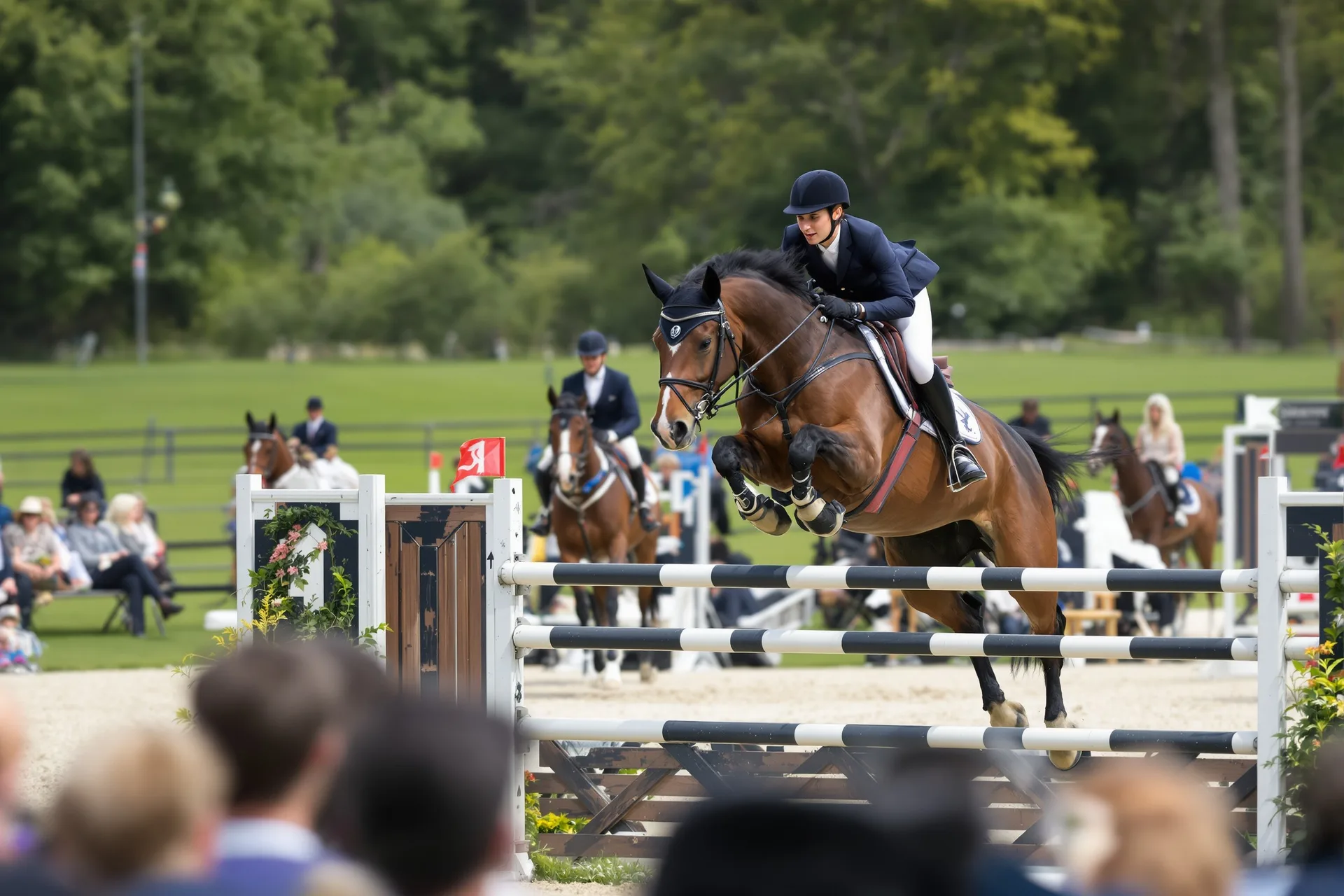
A tournament is the culmination of months of training, yet an unforeseen moment can lead to financial consequences in the six-figure range. A specialised short-term horse liability insurance policy for a tournament provides targeted protection exactly when you need it most.
Understanding strict liability under Section 833 of the German Civil Code
As a horse owner, you are fully liable with your private assets for any damage caused by your animal. The German Civil Code (BGB) regulates this in Section 833 through so-called strict liability. This means liability applies even if you are not personally at fault for the incident. For example: Your horse startles in the warm-up area, bolts and seriously injures another horse, resulting in treatment costs of more than €15,000. Your duty of care does not protect you here from the financial claims of third parties. Comprehensive horse liability insurance is therefore not an option, but a necessity. This legal basis is the decisive reason why insurance cover is particularly important in unpredictable competition situations.
Short-term cover versus annual policy: A cost-benefit analysis
Not every horse owner needs competition cover all year round. An annual policy costs between 70 and 150 euros, but usually covers all eventualities. For riders who take part in just one or two competitions a year, short-term horse liability insurance for the event can be an alternative. Some associations offer day-by-day insurance for around ten euros per horse per day. These policies are tailored specifically to the event. They provide focused cover for a fraction of the annual cost. So consider carefully how often you compete each year in order to make the right decision.
Here is a brief comparison:
- Annual policy: Offers 365 days' cover, often including competitions, liability for other riders and stays abroad.
- Short-term policy: Valid only for the duration of the event, often one to three days.
- Cost factor: An annual policy can pay for itself from participation in three competitions per year.
- Flexibility: Short-term cover is ideal for spontaneous entries or one-off participation.
Ultimately, the choice depends on your individual competition planning and your awareness of risk, as the next section on the key cover components shows.
Set a minimum coverage amount of ten million euros as standard
The sum insured is the heart of every horse liability insurance policy. If your horse causes personal injury, the costs can quickly reach seven-figure sums. Experts therefore recommend a sum insured of at least ten million euros for personal injury, property damage and financial loss. Many insurers now even offer cover of up to 50 million euros. A sum set too low can, in an emergency, lead to financial ruin. Make sure your policy also covers damage to rented property. If your horse damages, for example, the hired competition stall or a borrowed transport vehicle, these losses are often covered up to a limit of 100,000 euros. A good comparison of horse liability tariffs clearly shows these differences. These details are crucial so that you are not left to foot the bill in the event of a claim.
Review third-party rider risk and overseas starts as critical clauses
At many competitions, horses are presented by professional riders or by a riding sharer. Therefore, including third-party rider risk is essential. This clause ensures that cover also applies when you are not in the saddle yourself. Damage caused by guest riders is covered in most modern policies without naming the rider. If you are planning to compete abroad, you should check the geographical validity of your policy. As a rule, cover applies worldwide for temporary stays, but at least throughout the European Union. Our expert tip: check in advance whether the third-party rider insurance also covers claims by the rider against you as the keeper. That way, you are legally on the safe side.
Court judgments from practice: When the organiser is liable
Liability does not always lie solely with the horse owner. Competition organisers also have duties. In a judgment of the Federal Court of Justice (BGH III ZR 246/09), an organiser was held liable for damages because a defectively constructed obstacle led to the death of a horse. The court considered this a breach of the duty to provide a safe competition venue. In another case, a registration clerk was seriously injured, but the question of liability remained complex and initially led to no compensation. These cases show that the question of fault is often only clarified by the courts. A good horse owner’s liability insurance provides passive legal protection: it defends you against unjustified claims, if necessary in court as well. This protects you from the high costs of legal proceedings.
Three steps to digital protection for your tournament
Taking out the right insurance no longer has to be complicated. A short-term horse liability policy for a competition or a comprehensive annual policy can often be arranged online in just a few minutes. The process is usually divided into three simple steps. First, you enter the relevant details about your horse and the level of cover you want. In the second step, you compare the tariffs offered and select the appropriate sum insured. Once completed, you often receive your insurance confirmation by email within 30 minutes. This means that even shortly before the closing date for entries, you can still secure the cover you need. A digital platform like nextsure gives you a quick and transparent overview of your options. Request an individual risk analysis now: Have your insurance situation checked free of charge and receive specific recommendations for improvement.
Frequently asked questions
- How much does short-term horse liability insurance cost for a competition?
Costs can vary. Some equestrian associations offer daily policies for around ten euros per day and horse. Compare this with an annual policy, which is often available from 70 euros and can be worthwhile if you take part in several competitions a year.
- What level of cover is recommended for tournaments?
Due to the increased risk at tournaments, cover of at least ten million euros as a lump sum for personal injury and property damage is recommended. Many policies even offer cover of up to 50 million euros.
- Is my insurance cover also valid at tournaments abroad?
Yes, most German equine liability insurance policies offer worldwide cover, or at least EU-wide cover, for temporary stays abroad, for example for a tournament.
- What is the foreign rider risk and why is it important?
The other-rider risk covers damage that occurs while another person (e.g. a rider or riding sharer) is riding your horse. This is particularly important for competitions and should be included in every policy.
- Are damages to the hired show stable box or horse trailer insured?
Yes, these damages fall under the so-called damage to rented property. A good policy should include this cover, often with insured sums of up to 100,000 euros.
- What does 'passive legal protection' mean in horse liability insurance?
Passive legal protection means that the insurance not only pays justified claims for damages, but also defends against unjustified or excessive claims at the insurance’s expense, if necessary in court.
Sources
- [1]Laws on the Internet provides the full statutory text of Section 833 of the German Civil Code (BGB), which regulates liability for animal keepers.
- [2]The German Equestrian Federation (FN) provides the Performance Testing Regulations (LPO) for equestrian sport, an important set of rules for competitions.
- [3]On the website of the German Equestrian Federation (FN), you will find comprehensive information and guidance on competition sport.
- [4]The Federal Ministry of Food and Agriculture (BMEL) provides statistical data on livestock numbers in Germany, including horses.
- [5]The Consumer Advice Centre provides detailed information on liability insurance for pets, including horses.
- [6]The German Board for Therapeutic Riding e.V. offers information and resources on therapeutic riding.
- [7]The German Equestrian Federation (FN) is the central point of contact for comprehensive information on horses and equestrian sport in Germany.
- [8]The Federal Statistical Office (Destatis) provides official statistical information on animal husbandry and animal production in Germany.