Cat Health Insurance for Pedigree Cats: HCM & Hereditary Disease
Which tariffs cover HCM, PKD, and hip dysplasia in Maine Coons and other pedigree cats, and what to check before signing up.
All details are taken from the provider's linked product page and the contract documents (IPID/policy conditions) published there; the insurer's documents prevail. Premiums, benefits and the insurance product itself may change – please verify the details directly with the partner before signing up; only the information provided there is binding.
 Katrin StraubManaging DirectorInsurance expert with over 20 years of experience in the insurance industry.
Published on
Last updated on
11 min read
Table of Contents
Cat health insurance for pedigree cats covers breed-typical hereditary conditions like HCM, PKD, or hip dysplasia only if the diagnosis wasn't already known at sign-up and the waiting periods have been observed. Timing is what decides it. What matters is honest health disclosure, signing up early before the first symptom, and a plan with no blanket breed exclusion.
Tierkrankenversicherung
Comprehensive health protection for dogs, cats, and other pets. Discover now the tailored pet insurance from nextsure and ensure your furry companion receives the best medical care – simple and digital.
Learn moreWhat Does Cat Health Insurance Cover for a Pedigree Cat?
Treatment and Surgery at the Core
Cat health insurance for pedigree cats reimburses the veterinarily necessary costs for treatment, surgery, diagnostics, medication, and inpatient care. This also applies to breed-typical findings like HCM, PKD, or hip dysplasia, as long as they're diagnosed only after the contract begins. The exact depth of cover depends on the plan chosen. Basic plans usually cover 80 percent of costs with annual limits from €1,000; Premium plans reimburse up to 100 percent with no annual limit, depending on the terms [hepster-bedingungen].
Add-On Benefits That Matter for Pedigree Cats
For pedigree cats, it's worth looking at physiotherapy, acupuncture, laser therapy, and dental treatment. Maine Coons and British Shorthairs often develop orthopedic problems that need physiotherapy after surgery. Persian cats, in turn, have a higher need for dental treatment because of their skull shape. Premium plans reimburse up to ten physiotherapy sessions per claim and cover tooth extractions up to €400 a year [hepster-bedingungen]. That's no luxury for pedigree cats.
What's Not Included
Treatment to meet a breed standard is never covered, nor are cosmetic procedures or routine check-ups outside a defined wellness allowance [tierschutz-tvt]. Costs from pure cost estimates aren't reimbursed either. Every major provider on the market draws this same line. Knowing it in advance avoids nasty surprises in a claim.
Are Breed-Typical Hereditary Conditions Like HCM or PKD Covered?
The Central Rule: Not Known, Not Excluded
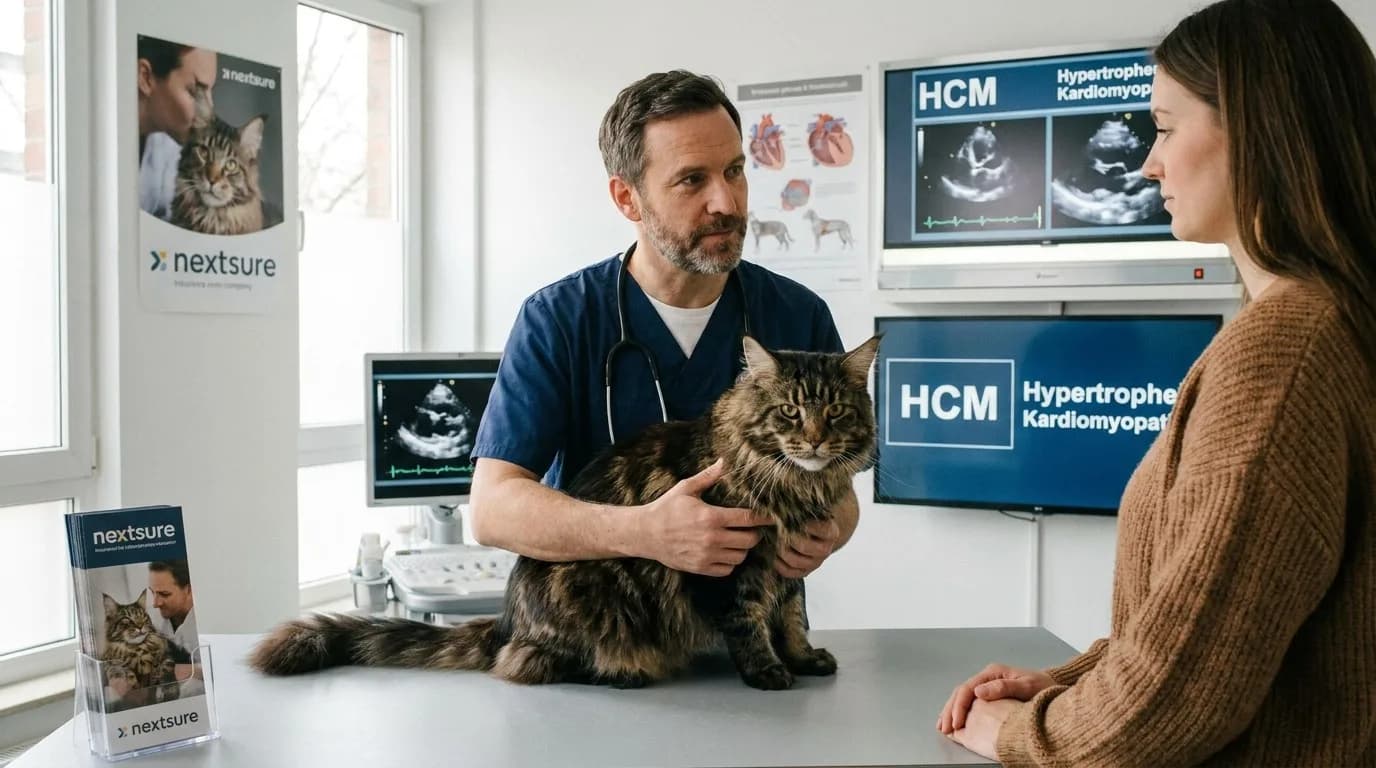
Breed-typical hereditary conditions are insurable as long as they're neither diagnosed nor symptomatic at the time of application. Hypertrophic cardiomyopathy (HCM) in Maine Coons and British Shorthairs, polycystic kidney disease (PKD) in Persians, and hip dysplasia are among the most common genetic findings in German vet practices. HCM is the single most common heart disease in cats and affects an estimated 15 percent of all cats, with prevalence considerably higher in Maine Coons. Insurers know this. Plans with a blanket breed exclusion are rare in Germany; individual risk surcharges or exclusions of specific conditions after reviewing the health questionnaire are more common.
Waiting Periods as a Second Filter
Even a valid contract doesn't protect you immediately. A one-month waiting period usually applies to general illness, while breed-typical conditions such as HCM, PKD, or hip dysplasia often carry a waiting period of three to twelve months. If the diagnosis is made within the waiting period, the condition is permanently excluded, not just until the waiting period ends [hepster-bedingungen]. This clause is strict, but it's the market standard. Signing up early, before the first suspicion arises, is therefore the single most important lever.
When the Insurer Excludes Cover Anyway
An exclusion applies permanently in three situations: a diagnosis known before the contract began, treatment within the six months before signing up, or a diagnosis made during the waiting period. Genetic tests that only show an elevated risk generally don't count as a diagnosis, as long as there are no clinical findings. Transparency prevents later disputes. Anyone with a positive HCM gene test should disclose it transparently on the application and get the insurer's response in writing. Comprehensive pet health insurance only covers these risks if the history is documented cleanly.
Which Insurers Exclude or Restrict Cover for Pedigree Cats?
Blanket Breed Exclusions Are Rare
A complete breed exclusion is uncommon in the German market. Maine Coon, British Shorthair, Persian, Ragdoll, and Bengal are insurable with most providers. Selective clauses are more common: higher premiums, longer waiting periods for certain diagnoses, or an individual exclusion after a pre-existing condition. Such clauses are found in the special policy terms, not in marketing material.
What Matters in the Fine Print
Three points deserve special attention. First: the list of special waiting periods, which are often set separately for heart disease, kidney disease, hip dysplasia, and cruciate ligament rupture. Second: whether chronic follow-on conditions are covered without limit or are capped again each year. Third: the definition of the maximum age for new sign-ups, which varies by provider between seven and ten years. For pedigree cats, these details are decisive. They can completely change the outcome of a plan comparison.
How nextsure Filters Hand-Picked Plans
nextsure doesn't list a random assortment — it lists curated providers whose terms are workable for pedigree cats. Selection follows three criteria: no blanket breed exclusions, a clear definition of breed-typical waiting periods, and reimbursement of chronic follow-on costs with no annual reset. Insurance brokers licensed under Section 34d GewO work for the customer, not the insurer [gewo-34d]. The result: fewer plans, but more reliable ones.
What Does Insurance Cost for a Maine Coon or British Shorthair?
The Premium Range at a Glance
Monthly premiums for cat health insurance for a pedigree cat range from around €25 on the Basic plan to €85 on the Premium plan with no deductible. This range comes from plan tier, deductible, reimbursement rate, and the cat's age. A young, healthy Maine Coon costs less than a seven-year-old animal with a documented history. Signing up early means paying less in the long run. The costs and benefits of pet health insurance can be estimated in advance with a needs calculator.
Maine Coon Insurance in Detail
Maine Coon insurance tends to cost more than the market average for domestic cats, due to the high prevalence of HCM and hip dysplasia. Realistic figures for a healthy, one-year-old animal run €32 to €48 a month on a mid-tier plan with a 20 percent deductible. Premium plans with no deductible start at around €65. The surcharge is justified. Maine Coons are among the most expensive breeds in veterinary care.
Insuring British Shorthairs and Persian Cats
British Shorthair health insurance is priced close to Maine Coon cover, since HCM demonstrably occurs frequently in this breed too. Insuring a Persian cat costs a similar amount because of PKD and brachycephalic airway issues, often €30 to €55 a month. Anyone keeping several pedigree cats should ask about multi-pet discounts. These range, depending on the provider, from 5 to 15 percent from the second cat onward.
| Breed | Basic plan | Mid-tier plan | Premium plan, no deductible |
|---|---|---|---|
| Maine Coon | approx. €28 | €32-48 | from €65 |
| British Shorthair | approx. €26 | €30-45 | from €60 |
| Persian | approx. €27 | €30-55 | from €62 |
| Ragdoll | approx. €25 | €28-42 | from €58 |
| Bengal | approx. €26 | €30-46 | from €60 |
Typical market ranges for 2026 based on curated plans; actual premiums vary by age, location, and health status.
How Do Health Questions Affect Premiums for Pedigree Cats?
What the Insurer Really Wants to Know
Health questions target specific diagnoses, treatments, surgeries, and medications from the past twelve to 36 months. For pedigree cats, many providers additionally ask about echocardiograms performed, kidney ultrasounds, and orthopedic findings. Anyone who has had a genetic test must disclose a positive result once it has led to a documented suspicion. Staying silent is risky. Breaching the disclosure duty can lead to the contract being contested under Section 19 of the German Insurance Contract Act (VVG).
Risk Surcharge, Exclusion, or Acceptance
Three responses are common. First: normal acceptance for an unremarkable health status. Second: acceptance with a 10 to 30 percent risk surcharge for documented risk factors without a diagnosis. Third: acceptance with the exclusion of specific conditions, such as HCM after a positive gene test with no clinical finding. Outright rejection is rare and generally limited to already manifest conditions.
Strategy for the Application
Three steps improve the outcome. Before applying, gather all vet records from the past three years. Findings and diagnoses should be explained in writing before answering the questions. For complex prior findings, a written risk inquiry before the actual application is advisable. This order protects against later disputes and provides a solid basis for the decision. A strong cat health insurance policy is only worthwhile if the acceptance is documented cleanly.
Is Cat Health Insurance Worth It for a Pedigree Cat?
The Math in a Claim
HCM diagnostics with an echocardiogram, blood test, and follow-up exams cost €400 to €800 a year without insurance. PKD treatment with a kidney diet, infusions, and check-ups adds up to €600 to €1,500 a year. Hip dysplasia surgery can cost €2,500 to €4,500, depending on the clinic and method. The veterinary fee schedule allows up to three times the standard rate in an emergency, which can quickly double the bill. It all adds up.
When Cover Pays for Itself in the First Year Alone
For an average Maine Coon on a mid-tier plan at €40 a month, annual costs run around €480. A single billable surgery pays back the premium several times over. Pedigree cats statistically carry a higher surgery risk than domestic cats, purely because of hip dysplasia and dental disease. The likelihood that insurance pays off rises with the cat's age. From age seven onward, vet bills jump sharply.
When Building Your Own Reserve Is Better
Anyone who puts €40 to €60 a month into a separate pet savings account and sticks with it consistently builds up a cushion of €4,800 to €7,200 over ten years. That covers many treatments, but rarely a chain of a chronic condition plus surgery. Insurance smooths out the financial peaks; saving doesn't. For the typical Becker family with kids, a house, and a plannable budget, insurance is the more sustainable path.
When Should a Pedigree Cat Be Insured?
The Ideal Window: Three to Six Months Old
The optimal time to sign up is between the third and sixth month of life. At this point, primary vaccinations are complete, the vet has documented a baseline health status, and breed-typical conditions generally haven't manifested yet. The premium is low. The waiting period runs before the first symptoms can appear. Anyone signing up now secures full cover for the whole range of breed-typical conditions.
Signing Up Later Is Possible, But More Expensive
For older animals, both the premium and the exclusion risk rise. From age four, many providers require detailed vet certificates; from age seven, new sign-up becomes impossible with some insurers. Anyone wanting to insure an older pedigree cat should specifically look for providers with no maximum entry age and start with a written risk inquiry. Blanket rejections are rare — but exclusions of specific diagnoses become more common with age.
Adopting or Rehoming a Pedigree Cat From a Shelter
When taking in an adult pedigree cat from a shelter, a complete medical history is often missing. In this case, an initial vet exam including a heart and kidney check is advisable before applying. The findings feed fully into the health questions. This protects against later disputes and gives the insurer a clear basis for assessment.
What to Watch For When Signing Up for Cat Health Insurance
Check the Terms, Not the Marketing Promises
Marketing copy is marketing; the terms are the contract. Before signing up, review the General Insurance Terms and Conditions, the insurance product information sheet, and the list of exclusions. Four points are decisive: waiting periods by disease group, the annual limit, the reimbursement rate, and the maximum GOT rate covered. Plans that only reimburse twice the rate often don't fully cover emergencies.
Choose the Deductible Deliberately
A 20 percent deductible noticeably lowers the premium but drives up every bill. For a €3,000 surgery, the policyholder pays €600 themselves. Anyone expecting frequent smaller bills does better with a low or no deductible. Anyone wanting to insure against major risks while covering routine costs themselves optimizes with a higher deductible. This decision is individual — it depends on the animal, its age, and the budget.
Contract Term, Cancellation, and Filing a Claim
Standard in the market are monthly and annual plans with a minimum term and a short notice period, often three business days before the end of the insurance period [hepster-bedingungen]. After a claim, both customer and insurer have a special right of cancellation. The claim should be reported without delay, and receipts should be kept in original form. Knowing these rules avoids reduced payouts.
5 Steps to the Right Plan for a Pedigree Cat
Needs Assessment and Vet Records
Step one is taking stock. Gather the vaccination record, vet findings from the past three years, any genetic test results, and an overview of ongoing medication. This documentation is essential for answering health questions honestly. Step two: define the desired scope of cover — emergencies plus chronic follow-on costs, or comprehensive cover including a wellness allowance.
Comparison and a Written Risk Inquiry
Step three is comparing plans. nextsure checks curated plans for breed-typical insurability, clear waiting-period rules, and claims practice. Step four: for documented prior findings, a written risk inquiry follows. The insurer reviews it anonymously and gives a binding answer before the HIS database (similar to a credit bureau) logs an application. This avoids a negative entry if declined.
Signing Up, Confirmation, and Filing a Claim
Step five is signing up. Online, this takes a few minutes, and the policy arrives digitally. Keep the terms, the policy document, and confirmation of the waiting periods together with the vet records. In a claim, report it without delay; submit the original invoice, the diagnosis, and, if applicable, the surgery report. Clean documentation speeds up reimbursement.
Literature
https://www.hepster.com/de-de/produkte/katzenkrankenversicherung
Frequently asked questions
- Is HCM or PKD Covered for a Maine Coon or Persian Cat?
Yes, as long as the condition was neither diagnosed nor treated at the time of application and the waiting period is observed. If the diagnosis is made during the waiting period, the condition is permanently excluded. A positive gene test with no clinical finding usually doesn't count as a diagnosis, but must still be disclosed on the application.
- What Waiting Periods Apply to Breed-Typical Conditions?
The market standard is a one-month general waiting period and special waiting periods of three to twelve months for heart disease, kidney disease, hip dysplasia, cruciate ligament rupture, and dental disease. The exact deadlines are set out in each plan's General Insurance Terms and Conditions.
- What Does Health Insurance Cost for a Maine Coon?
A healthy, one-year-old Maine Coon costs around €32 to €48 a month on a mid-tier plan with a 20 percent deductible. Premium plans with no deductible and no annual limit start at around €65. Premiums rise with age and with documented pre-existing conditions.
- Can I Still Insure a Pedigree Cat After an HCM Diagnosis?
An already diagnosed case of HCM is permanently excluded. The contract itself is still possible and covers all other conditions. A risk inquiry before applying clarifies which provider will accept the contract, and with what exclusion. Blanket rejections are rare.
- What Happens if the Health Questions Are Answered Incorrectly?
An intentional breach of the disclosure duty leads to the contract being contested under Section 19 VVG. The insurer can void the contract retroactively and refuse benefits. Premiums are partly refunded. Honest, complete disclosure is the only reliable way to receive benefits in a claim.
- Are Preventive Check-Ups and Vaccinations Covered?
Only under Premium plans with a wellness allowance, usually up to €150 a year. Basic plans cover only treatment due to illness or accident. Anyone who values full reimbursement for preventive care should specifically ask about plans with a wellness allowance.
Sources
Conclude directly online
Verified partner tariffs at no extra cost. The button takes you straight to the provider's calculator.
 Cleos Welt
Dog health insurance
Combined health and surgery cover for dogs, reimbursing vet costs up to the agreed maximum veterinary fee schedule (GOT) rate.
- Reimbursement:
- up to the agreed maximum GOT rate
- Coverage abroad:
- 12 months
- Notice period:
- 14 days before the end of the month
- Treatment for illness and accidents
- Surgery, including pre-surgical diagnostic examinations
- Pre- and post-treatment following a covered surgery
- Lab work and imaging diagnostics, plus medically necessary medication
- Coverage abroad: 12 months
Key exclusions
- Treatments and surgeries already known or recommended before the policy started
- Illnesses occurring before the waiting period ends
- War, earthquakes, floods, epidemics, and pandemics
- Damage caused intentionally
CHECK24 Tarifnote 1,0 „exzellent“
Cleos Welt Hundekrankenversicherung
FOCUS MONEY: Beste Tierkrankenversicherung (Premiumtarif), Ausgabe 14/2026
Cleos Welt Hundekrankenversicherung
ASCORE „Tarif des Monats“ 08/2025
Cleos Welt Tierkranken Hund, Rundum Plus Schutz inkl. Vorsorge & SOS-Schutz
CHECK24 Tarifnote 1,0 „exzellent“
Cleos Welt Hunde-OP-Schutz (Rundum Plus inkl. SOS-Schutz)
„Kundenfavorit“: über 50.000 geschützte Haustiere
Cleos Welt Tierversicherungen (Tierkranken Hund)
Google Rezensionen: 4,5/5 Sterne (210 Bewertungen)
Cleos Welt insgesamt (Anbieterbewertung, alle Versicherungen)
Contract term at least 1 year with automatic renewal; sum insured and deductible (Selbstbeteiligung) as stated in the policy. Insurer: Uelzener Allgemeine Versicherungs-Gesellschaft a.G.
Fact sheet: benefits, exclusions and waiting periods in detail
Cleos Welt
Cat health insurance
Combined health and surgery cover for cats, reimbursing vet costs up to the agreed maximum veterinary fee schedule (GOT) rate.
- Reimbursement:
- up to the agreed maximum GOT rate
- Coverage abroad:
- 12 months
- Notice period:
- 14 days before the end of the month
- Treatment for illness and accidents
- Surgery, including pre-surgical diagnostic examinations
- Pre- and post-treatment following a covered surgery
- Lab work and imaging diagnostics, plus medically necessary medication
- Coverage abroad: 12 months
Key exclusions
- Treatments and surgeries already known or recommended before the policy started
- Illnesses occurring before the waiting period ends
- War, earthquakes, floods, epidemics, and pandemics
- Damage caused intentionally
CHECK24 Tarifnote 1,0 „exzellent“
Cleos Welt Katzenkrankenversicherung, Tarif Rundum Plus
CHECK24 Tarifnote 1,0 „exzellent“
Cleos Welt Katzen-OP-Schutz (Rundum Plus inkl. SOS-Schutz)
Google Rezensionen: 4,5/5 Sterne (210 Bewertungen)
Cleos Welt insgesamt (Anbieterbewertung, alle Versicherungen)
Contract term at least 1 year with automatic renewal; sum insured and deductible (Selbstbeteiligung) as stated in the policy. Insurer: Uelzener Allgemeine Versicherungs-Gesellschaft a.G.
Fact sheet: benefits, exclusions and waiting periods in detail
All details are taken from the provider's linked product page and the contract documents (IPID/policy conditions) published there; the insurer's documents prevail. Premiums, benefits and the insurance product itself may change – please verify the details directly with the partner before signing up; only the information provided there is binding.
Information last updated: July 2026 · Source: provider product information (IPID/policy conditions)