Dog Surgery Insurance Compared: Plans and Costs
Dog surgery insurance compared: what really matters when it comes to cover, costs for operations and clinic stays, and which plans are worth it.
All details are taken from the provider's linked product page and the contract documents (IPID/policy conditions) published there; the insurer's documents prevail. Premiums, benefits and the insurance product itself may change – please verify the details directly with the partner before signing up; only the information provided there is binding.
 Katrin StraubManaging DirectorInsurance expert with over 20 years of experience in the insurance industry.
Published on
10 min read
Table of Contents
There is no objective test winner: of 121 dog surgery plans tested, Stiftung Warentest recommends only one in four. This comparison shows which criteria really matter, what operations cost, and how reimbursement works in practice.
Dog Health Insurance
Comprehensive dog health insurance from nextsure: Optimally protect your loyal companion against vet costs, operations, and unforeseen treatments. Get informed now and calculate your rate!
Learn moreWhat a dog surgery insurance covers and what it doesn't
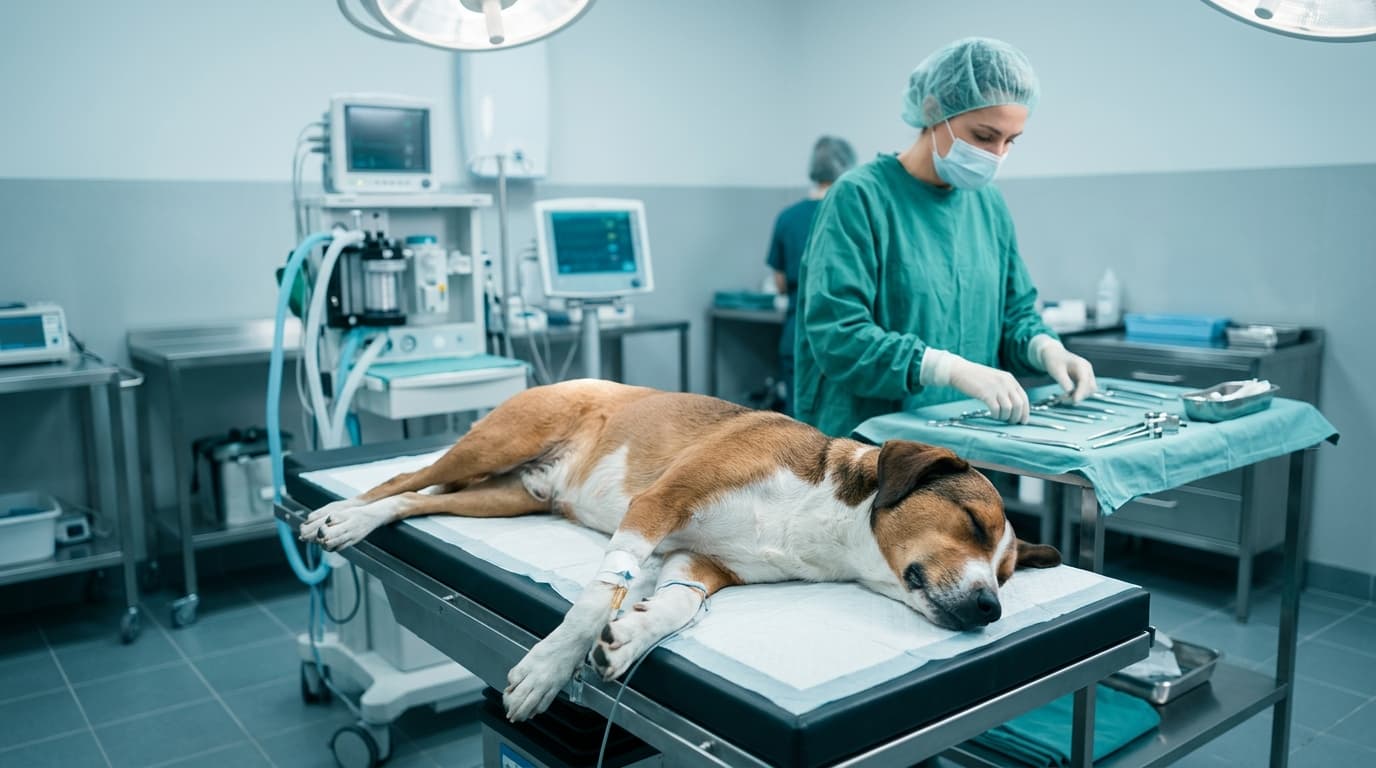
Yes, a dog surgery insurance reimburses the costs of medically necessary veterinary operations under partial or general anaesthesia or sedation, usually including the preliminary examination, aftercare and accommodation at the veterinary clinic. No, it does not pay out on every vet bill: outpatient treatments without a surgical procedure, vaccinations and routine check-ups are excluded. The distinction from dog health insurance lies in exactly that one clause: full health cover also reimburses medical treatment without surgery and, according to Stiftung Warentest, is usually several hundred euros more expensive per year.[1]
The basis for billing is the fee schedule for veterinarians (GOT), which sets out nationwide the range within which vets may bill. It defines a fee range from the simple to the threefold rate, not fixed prices; medical reasons, time involved or special circumstances such as emergency service justify the higher rate.[2] In practice, most practices bill at the threefold rate, but many insurers usually only reimburse up to the twofold rate. Exactly this gap between invoice and reimbursement is the most important comparison criterion.
What is typically not reimbursed is set out in the insurance terms and conditions. The most common exclusions include:
- Routine, preventive and voluntary examinations with no connection to illness or accident
- Pure dental care and tartar removal, and in basic tariffs sometimes even tooth extractions
- Health certificates and expert reports as well as costs for cost estimates
- Conditions that already existed before taking out the policy or whose diagnosis falls within the waiting period[3]
This exclusion list varies considerably depending on the tariff. Anyone who skips it ends up comparing premiums, but not insurance cover.
What an operation and a day at the clinic really cost
To compare tariffs realistically, you need real cost figures. The most expensive procedures in dogs regularly run into the four-figure range, depending on the surgical method, the size of the dog and the clinic:[4]
| Procedure | Typical costs |
|---|---|
| Cruciate ligament rupture | [4]1,500 to 4,000 euros |
| Gastric torsion (emergency surgery) | [4]2,000 to 5,000 euros |
| HD surgery (hip dysplasia) | [4]2,000 to 6,000 euros per hip |
On top of the surgical bill comes the inpatient stay. The daily rates of an animal clinic depend on the size of the dog and the severity of the illness. As a guide to inpatient costs per day in 2026, Tierklinik Düsseldorf quotes: cats and small dogs 150 to 200 euros, medium-sized dogs 200 to 250 euros, large dogs 250 to 300 euros and intensive care patients 300 to 400 euros.[5]
Two practical notes belong in any honest cost overview: on admission as an inpatient, a deposit of at least 50 percent of the expected costs is customary, and out-of-hours and weekend services incur higher charges because higher GOT rates may be billed there.[5] Several days at the clinic after emergency surgery can push the bill up considerably on accommodation and monitoring alone.
Worked example: cruciate ligament rupture with and without insurance
A cruciate ligament rupture is one of the most common and most expensive surgical procedures in dogs, and it shows very precisely how tariff clauses work. The scenario: cruciate ligament surgery costs 1,500 to 4,000 euros, plus several days at the clinic.[4] For our worked example we assume a bill of around 4,750 euros — surgery at the upper end of the range plus five days at the clinic.
Without insurance, you bear this sum alone. With a typical tariff it looks like this: it is usual for only 80 percent of reimbursable costs to be covered, meaning you pay a deductible of 20 percent. If a minimum deductible of 250 euros per claim is added, as provided for in the basic tariff of the dog surgery insurance, you are left with an out-of-pocket share of around 950 euros.[3]
| Item | Amount |
|---|---|
| Assumption: surgery plus five days at the clinic | around 4,750 euros |
| Reimbursement 80 percent | around 3,800 euros |
| [3]Deductible 20 percent, minimum 250 euros per claim | around 950 euros out of pocket |
| Remaining payment despite insurance | around 950 euros stay with you |
The annual maximum limit becomes decisive — that is, the maximum amount the insurer will reimburse per policy year. The basic tariff caps reimbursement at 2,000 euros per year.[3] For our example bill of around 4,750 euros, that means: the insurance pays at most 2,000 euros, and the rest of the bill stays with you despite having insurance. That is why the annual maximum limit is a comparison criterion in its own right, not a marginal detail.
The six comparison criteria that really matter
There is no blanket test winner, and Stiftung Warentest deliberately does not crown one: in its 2025 test, 121 tariff variants for dog surgery insurance were assessed against 60 test points, only one in four was rated recommendable, and very good offers cost between 216 and 403 euros per year.[1] More useful than hunting for the top grade is comparing along six criteria:
- GOT maximum rate: Up to which rate does the plan reimburse? Strong plans cover up to 4 times the rate, which is crucial for out-of-hours and weekend services, where higher rates may be billed.[6]
- Deductible: 0 or 20 percent out-of-pocket share is common, sometimes with a minimum amount per claim.
- Annual maximum limit: Low annual limits fall short precisely on the large bills the policy was designed for.
- Waiting period: For illnesses, one to three months is common; for accidents, cover usually applies without a waiting period.[1]
- Maximum entry age: The older the dog at enrollment, the smaller the choice and the higher the premium.
- Breed-typical exclusions: For conditions such as hip dysplasia, extended waiting periods of 6 to 18 months often apply; sometimes such procedures are excluded entirely.[7]
To narrow down prices: For a young, small dog, the consumer advice centre's cost overviews list annual premiums of around 160 to nearly 550 euros for a surgery insurance policy; larger and older dogs pay more. Which criteria matter most for your breed and your budget is shown by a structured comparison using the comparison criteria mentioned.
Who benefits from a dog surgery insurance
Whether taking out a policy fits your situation comes down to a simple distinction. Yes, if your dog is young and healthy: only healthy animals are insurable in principle, and the older the animal is at enrollment, the higher the premium.
Yes, if the breed carries typical surgery risks. Large breeds have an increased risk of hip dysplasia, and hip surgery costs 2,000 to 6,000 euros per hip.[4] Otherwise, breed-typical conditions may be excluded or subject to special waiting periods.[7] Enrolling early, before first symptoms are documented, is the decisive factor here.
No — or as an alternative, a savings reserve — if your budget cannot permanently sustain the premiums over many years. Both the consumer advice centre and Stiftung Warentest name the savings reserve as a legitimate alternative if you can absorb the four-figure risks yourself. From around age seven, the market offering is limited anyway.
Whether your dog is one of the cases where the cover pays off cannot be conclusively settled in a general article: breed, age, health history and your savings reserve all play a role together. The next step is a concrete plan comparison, where you can hold the six criteria above directly against your situation.
Outlook: GOT evaluation and the next step
A brief outlook: The fee schedule for veterinarians (GOT) was last comprehensively revised with effect from 22 November 2022. The Federal Ministry of Agriculture, Food and Regional Identity launched its evaluation in mid-2025; according to the BMLEH, results are expected by the end of 2026. How the fee framework — and with it premiums and plans — will develop afterwards remains open. Plans and terms and conditions change constantly, and for a future change neither the amount nor the calculation can be reliably quantified today.
For the current state of play, the comparison remains the decisive tool. The dog surgery insurance brokered by nextsure is carried by Towarzystwo Ubezpieczen Europa S.A. as the risk carrier and is available in four plan variants from Basis to Superior0. Depending on the variant, it reimburses up to 4 times the GOT rate and covers the pre-surgery examination, aftercare and clinic accommodation for up to 20 days, with a general waiting period of one month.[3]
One thing must remain open here: whether your dog will be accepted and which plan pays out in an emergency — cover always depends on the specific plan, the health declaration and the insurer's acceptance decision. If you would like to hold the cost examples above against your own dog, start the plan comparison for dog surgery insurance now and check the GOT rate, deductible, annual maximum limit and waiting period side by side.
Frequently asked questions
- How much does dog surgery insurance cost per month?
According to the consumer advice centre, dog owners pay around 160 to almost 550 euros per year for a young, small dog — roughly 13 to 46 euros per month. Very good plans in the Stiftung Warentest test cost 216 to 403 euros per year. Size, breed, age and deductible all have a significant impact on the premium.
- How much does a day at the animal clinic cost for a dog?
As a rough guide from an animal clinic, expect around 150 to 200 euros per day for small dogs, 200 to 250 euros for medium-sized dogs and 250 to 300 euros for large dogs. Intensive care patients cost 300 to 400 euros per day, and out-of-hours and weekend services carry surcharges.
- What is the best health insurance for a dog?
There is no blanket answer. Stiftung Warentest examined 121 plan variants for dog surgery insurance and recommends only one in four. So compare along concrete criteria: GOT maximum rate, deductible, annual maximum limit, waiting period, maximum entry age and breed-typical exclusions.
- What happens if I cannot pay for my dog's surgery?
For inpatient admission, animal clinics usually require a deposit of at least 50 percent of the expected costs. Without a savings reserve, you then face a difficult decision. Dog surgery insurance taken out before the emergency can close exactly this gap, though reimbursement depends on the specific plan.
- Is liability insurance for a dog worthwhile?
Yes — according to the consumer advice centre, dog owner liability insurance is a must, but it is a different product: it covers damage your dog causes to third parties, not surgery costs for your own dog. For the vet bill, you need surgery or health insurance for the dog.
- Up to which GOT rate do dog surgery insurance plans reimburse?
The fee schedule for veterinarians (GOT) allows vets a range from one to three times the standard rate, with surcharges for out-of-hours and weekend services. According to the consumer advice centre, many plans only reimburse up to twice the rate, even though most practices charge three times. So pay attention to the agreed GOT maximum rate — good plans go up to four times the rate.
- What waiting periods apply to dog surgery insurance?
For illnesses, a waiting period of one to three months from the start of the contract usually applies, while most plans pay out immediately for accidents. Only healthy animals are insurable in principle, and the older the dog is when you take out the policy, the higher the premium.
Sources
Conclude directly online
Verified partner tariffs at no extra cost. The button takes you straight to the provider's calculator.
 Hepster
Dog health insurance
Full health coverage for dogs across five tariffs; the top tariff reimburses 100% with no annual maximum.
- Reimbursement:
- 50-100% depending on the tariff
- Deductible (Selbstbeteiligung):
- 0-50% depending on the tariff
- Waiting period:
- 1 month
- GOT rate:
- up to 4x (Premium/Superior)
- Treatment and surgery for illness and accidents, reimbursed at 50-100% depending on the tariff
- Veterinary clinic stays: up to 10, 15, or 20 days depending on the tariff
- Wellness allowance: €30 (Basis), €70 (Premium), €100/year (Superior)
- From Premium: physiotherapy (up to €200 without surgery, €500 after surgery), tooth extractions, homeopathy/acupuncture
- Superior: prosthetics/orthotics allowance of up to €650
- Vet fees covered up to 3x the standard veterinary fee schedule (GOT) rate on Basis, up to 4x on Premium/Superior
Key exclusions
- Known chronic or congenital conditions
- Pregnancy, false pregnancy, and birth
- Illnesses treated in the 6 months before the policy started
- Basis tariffs: neutering/spaying that isn't medically necessary
Trusted Shops: 4,5/5 „Sehr gut“ (2.600 Bewertungen)
hepster insgesamt (Anbieterbewertung, alle Versicherungen)
Monthly subscription: minimum term 12 months, notice period 3 business days before the end of the billing period; MRI/CT scans in the Basis tariffs are covered at 50%. Insurer: Towarzystwo Ubezpieczen Europa S.A.
Fact sheet: benefits, exclusions and waiting periods in detail
 Cleos Welt
Dog health insurance
Combined health and surgery cover for dogs, reimbursing vet costs up to the agreed maximum veterinary fee schedule (GOT) rate.
- Reimbursement:
- up to the agreed maximum GOT rate
- Coverage abroad:
- 12 months
- Notice period:
- 14 days before the end of the month
- Treatment for illness and accidents
- Surgery, including pre-surgical diagnostic examinations
- Pre- and post-treatment following a covered surgery
- Lab work and imaging diagnostics, plus medically necessary medication
- Coverage abroad: 12 months
Key exclusions
- Treatments and surgeries already known or recommended before the policy started
- Illnesses occurring before the waiting period ends
- War, earthquakes, floods, epidemics, and pandemics
- Damage caused intentionally
CHECK24 Tarifnote 1,0 „exzellent“
Cleos Welt Hundekrankenversicherung
FOCUS MONEY: Beste Tierkrankenversicherung (Premiumtarif), Ausgabe 14/2026
Cleos Welt Hundekrankenversicherung
ASCORE „Tarif des Monats“ 08/2025
Cleos Welt Tierkranken Hund, Rundum Plus Schutz inkl. Vorsorge & SOS-Schutz
CHECK24 Tarifnote 1,0 „exzellent“
Cleos Welt Hunde-OP-Schutz (Rundum Plus inkl. SOS-Schutz)
„Kundenfavorit“: über 50.000 geschützte Haustiere
Cleos Welt Tierversicherungen (Tierkranken Hund)
Google Rezensionen: 4,5/5 Sterne (210 Bewertungen)
Cleos Welt insgesamt (Anbieterbewertung, alle Versicherungen)
Contract term at least 1 year with automatic renewal; sum insured and deductible (Selbstbeteiligung) as stated in the policy. Insurer: Uelzener Allgemeine Versicherungs-Gesellschaft a.G.
Fact sheet: benefits, exclusions and waiting periods in detail
Hepster
Dog surgery insurance
Surgery-only cover for dogs across four tariffs; from year 2 or 3, depending on the tariff, there is no annual maximum.
- Reimbursement:
- 80-100% depending on the tariff
- Deductible (Selbstbeteiligung):
- 0-20% depending on the tariff
- Waiting period:
- 1 month
- Surgery under anesthesia or sedation for illness and accidents
- Post-treatment: up to day 14, 15, or 20 depending on the tariff
- Neutering/spaying: up to €250 on Basis, unlimited from Premium
- From Premium: tooth extractions, post-surgery physiotherapy (up to 20 days/€500), homeopathy/acupuncture
- Superior: prosthetics/orthotics allowance of up to €650
- Vet fees covered up to 3x the standard veterinary fee schedule (GOT) rate on Basis, up to 4x on Premium/Superior
Key exclusions
- Known chronic or congenital conditions
- Illnesses that required surgery in the 6 months before the policy started
- Surgery performed to meet breed-standard appearance
- Basis: tooth extractions, root canal treatment, and dental/jaw corrections
Trusted Shops: 4,5/5 „Sehr gut“ (2.600 Bewertungen)
hepster insgesamt (Anbieterbewertung, alle Versicherungen)
Monthly subscription: minimum term 12 months, notice period 3 business days before the end of the billing period; prosthetics/orthotics have a 12-month waiting period. Insurer: Towarzystwo Ubezpieczen Europa S.A.
Fact sheet: benefits, exclusions and waiting periods in detail
Hepster Dog health insurance: Dog health insurance tariff overview
| Tariff | Reimbursement | Deductible | Annual maximum |
|---|---|---|---|
| Basis20 | 80% | 20%, min. €250 per claim | €2,500 |
| Basis50 | 50% | 50%, min. €500 per insurance year | €2,500 |
| Premium | 80% | 20% per claim | Year 1: €10,000, year 2: €15,000, from year 3: unlimited |
| Superior10 | 90% | 10% per claim | none |
| Superior0 | 100% | none | none |
Hepster Dog surgery insurance: Dog surgery insurance tariff overview
| Tariff | Reimbursement | Deductible | Annual maximum |
|---|---|---|---|
| Basis | 80% | 20%, min. €250 per claim | €2,000 |
| Premium | 80% | 20% per claim | Year 1: €2,000, year 2: €5,000, from year 3: unlimited |
| Superior10 | 90% | 10% per claim | Year 1: €5,000, from year 2: unlimited |
| Superior0 | 100% | none | Year 1: €5,000, from year 2: unlimited |
All details are taken from the provider's linked product page and the contract documents (IPID/policy conditions) published there; the insurer's documents prevail. Premiums, benefits and the insurance product itself may change – please verify the details directly with the partner before signing up; only the information provided there is binding.
Information last updated: July 2026 · Source: provider product information (IPID/policy conditions)