Getting a house hail-damage claim paid out: tips
Get a payout for hail damage to your home? Find out how to proceed with a notional settlement and avoid deductions. Find out more now!
 Katrin StraubManaging DirectorInsurance expert with over 20 years of experience in the insurance industry.
Published on
Last updated on
9 min read
Table of Contents
Claim compensation for hail damage to your home: How to secure your claim optimally
Has a hailstorm damaged your home and are you considering taking a cash settlement for the damage? This is often possible, but it does come with a few pitfalls. Find out here how to proceed and what you need to bear in mind to avoid financial disadvantages.
Understanding the basics: When is compensation for hail damage possible?
The option of having hail damage to your house paid out is not regulated uniformly. Insurers handle notional settlement differently, often based on policy terms. A payout based on a cost estimate or expert report is conceivable. However, many insurers reduce the payout amount by at least twenty per cent. This can lead to financial losses if repairs later turn out to be more expensive.
Buildings insurance is a cost insurance policy that covers repair costs. A pure cash payment without repair partially runs counter to this principle. Many providers accept notional settlement to simplify the claims process. The decisive factor is always the individual terms of your insurance policy. Check them carefully or seek professional advice. Contract details are the first step towards successful claims handling.
Payout process: From the claim notification to the notional settlement
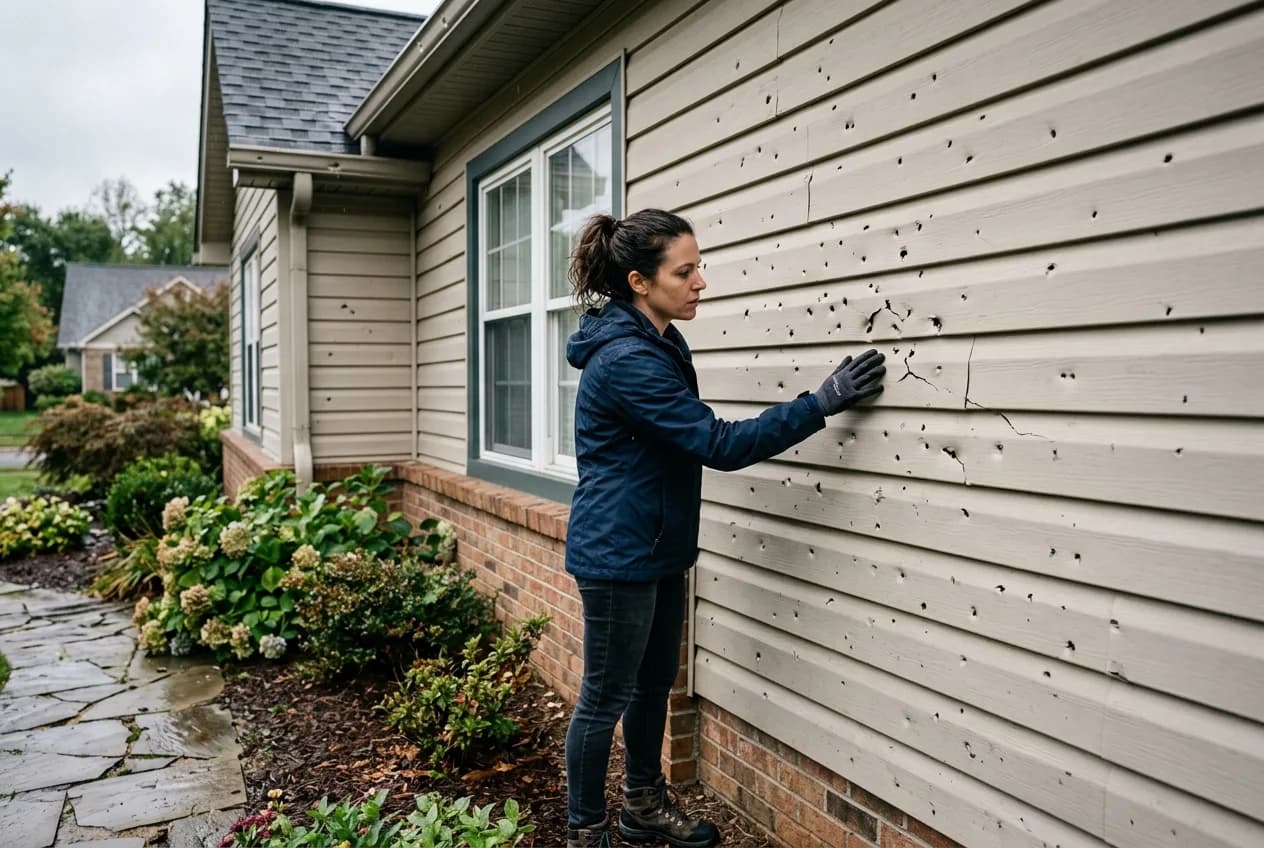
Swift action is required after hail damage. Document any damage immediately with photos and notes. Report the damage to your insurer without delay. A prompt report speeds up the settlement process. Take immediate measures to prevent further damage. This is part of your duty to mitigate loss.
The following steps are usually taken for a hypothetical settlement of hail damage:
- Obtain a cost estimate from at least one tradesperson.
- If necessary, the insurer may appoint an expert to assess the damage.
- Notify the insurer that a hypothetical settlement is desired.
- The insurer reviews the facts of the case and the cost estimate/expert report.
- Payment of the agreed amount, often less VAT and any deductions.
Our expert tip: Clarify the conditions for a hypothetical settlement with the insurer in writing. This helps prevent misunderstandings and later deductions. Transparent communication is crucial to success here.
Financial aspects: What is taken into account when making the payout?
In a notional settlement, insurers often deduct VAT. You will usually only receive the net amount of the repair costs. This is common practice, as no VAT is incurred without a tradesperson’s invoice. Reductions can amount to twenty to forty per cent of the sum.
Material and labour costs in focus
Material costs are usually less disputed than labour costs. Building material prices are easy to verify. In notional labour costs, insurers often apply lower hourly rates. These are sometimes based on the minimum wage, not on local market rates. This leads to differences between the estimate and the payout. A fifty-euro tradesperson hourly rate is common; insurers pay only fourteen euros.
Some insurers initially pay out only the replacement value. The new-for-old uplift is reimbursed after the repair and invoices. Check carefully which calculation basis your insurer uses. This directly affects the amount of your compensation. A proper claim notification is essential in this context.
Legal pitfalls: burden of proof and court rulings
The burden of proof lies with the policyholder. You must prove the hail damage and its extent. A Dresden Higher Regional Court ruling makes this clear. A claim was dismissed; the damage could not be proven beyond doubt. Hail as the cause had to be proven to the court’s full satisfaction. Mere probability is not sufficient for the court.
No supreme-court judgments compel a uniform approach to fictitious settlement. AG Recklinghausen and LG Cologne regard settlement based on a cost estimate as contradictory. Therefore, document everything without gaps. If there are discrepancies, involve a specialist lawyer. Careful reporting of the hail damage is essential.
Practical tips: How to maximise your payout
Good preparation optimises the payout for your hail damage claim. Obtain one or two detailed quotes. All items of damage must be precise and traceable. A precise itemisation minimises discussions with the insurer. The natural perils insurance may be relevant.
Here are some specific recommendations for action:
- Photograph and film all damage immediately after the hailstorm from different angles.
- Note the date and time of the event, as well as the approximate size of the hailstones.
- Report the damage to your insurer without delay and ask what to do next.
- Only commission repairs after written approval from the insurer if you want the costs reimbursed.
- Clearly state that you would like a cash settlement and clarify the conditions (e.g. deduction of VAT, reductions).
- Do not agree too quickly to the insurer's first offer; there is often room for negotiation.
- Keep all receipts and correspondence carefully.
Our expert tip: A payout can cause problems if hail damage occurs again. The insurer may then not cover the full costs. Weigh this consequence carefully. nextsure helps you find the best strategy.
Alternative: Repair instead of payout – when does that make more sense?
Fictitious settlement is not always the best solution. In the case of material damage or consequential damage, repair is unavoidable. A payout may not cover the full repair costs. Fictitious settlement often reimburses only seventy per cent of the replacement value.
Repair by specialist companies ensures restoration and preservation of the property's value. The insurer then covers verified costs including VAT. This is better in the case of more extensive damage or a lack of expertise. Weigh the pros and cons carefully. The correct use of the buildings insurance is crucial.
The decision depends on the extent of the damage, skills, finances and policy conditions. Comprehensive advice helps you find the optimal solution. This helps you avoid long-term disadvantages. nextsure is happy to assist you with this. Request your individual risk analysis now: Have your insurance situation checked free of charge and receive specific optimisation suggestions.
Frequently asked questions
- What does notional settlement mean in the event of hail damage to a house?
Notional settlement means that you have the amount of damage estimated by the insurance company paid out to you, without actually having the repair carried out or submitting invoices. The payout is usually based on a cost estimate or expert report, often reduced and excluding VAT.
- Which insurance is responsible for hail damage to the house?
For hail damage to the building itself (roof, façade, windows, permanently installed parts), the buildings insurance is responsible. Damage to movable items in the home (furniture, electronics) is covered by contents insurance.
- How do I properly document hail damage for the insurance company?
Photograph and film all damage in detail from different angles. Note the date, time of the hailstorm and the size of the hailstones. Create a list of all damaged items and areas.
- Can the insurer refuse payment for hail damage?
Yes, the insurer can refuse payment if, for example, you breach your duties (e.g. delayed notification), the damage cannot be clearly attributed to hail, or there was pre-existing damage and you cannot meet the burden of proof.
- What are the disadvantages if I opt for a cash settlement for hail damage?
The amount paid out is often lower than the actual repair costs (deductions, no VAT). In addition, if damage occurs again later, there may be issues with differentiation and, as a result, with the insurer covering the costs.
- How quickly do I need to report hail damage to my insurance company?
You should report hail damage to your insurer without delay, as quickly as possible. The exact deadlines can be found in your insurance terms and conditions, but prompt reporting is always advisable.
Sources
- [1]Statista offers data on the number of storm and hail damage claims in residential building insurance in Germany.
- [2]GDV provides information on the significant fluctuations in damage caused by storms and hail to residential buildings.
- [3]Statista provides data on the average loss amount for storm and hail damage in residential building insurance.
- [4]GDV explains why storm and hail damage are among the most expensive natural hazards.
- [5]The German Environment Agency provides information on indicators in the fields of agriculture and environmental impacts.
- [6]The German Consumer Advice Centre explains which insurance covers damage caused by rain, hail, storms and thunderstorms.
- [7]The German Consumer Advice Centre provides comprehensive information on insurance cover against natural hazards.
- [8]DWD (German Meteorological Service) provides detailed information on hail.