Financing: Roof Renovation with Solar System
Combine financing for roof renovation and solar panels. Secure KfW funding & tax benefits. Get advice now!
 Katrin StraubManaging DirectorInsurance expert with over 20 years of experience in the insurance industry.
Published on
Last updated on
11 min read
Table of Contents
A roof renovation is due and you’re thinking about solar power? Combining both projects is one of the most cost-effective decisions you can make for your home. Find out how you can save thousands of euros by financing them together and maximise government grants.
Leveraging synergies: cost savings through combined measures
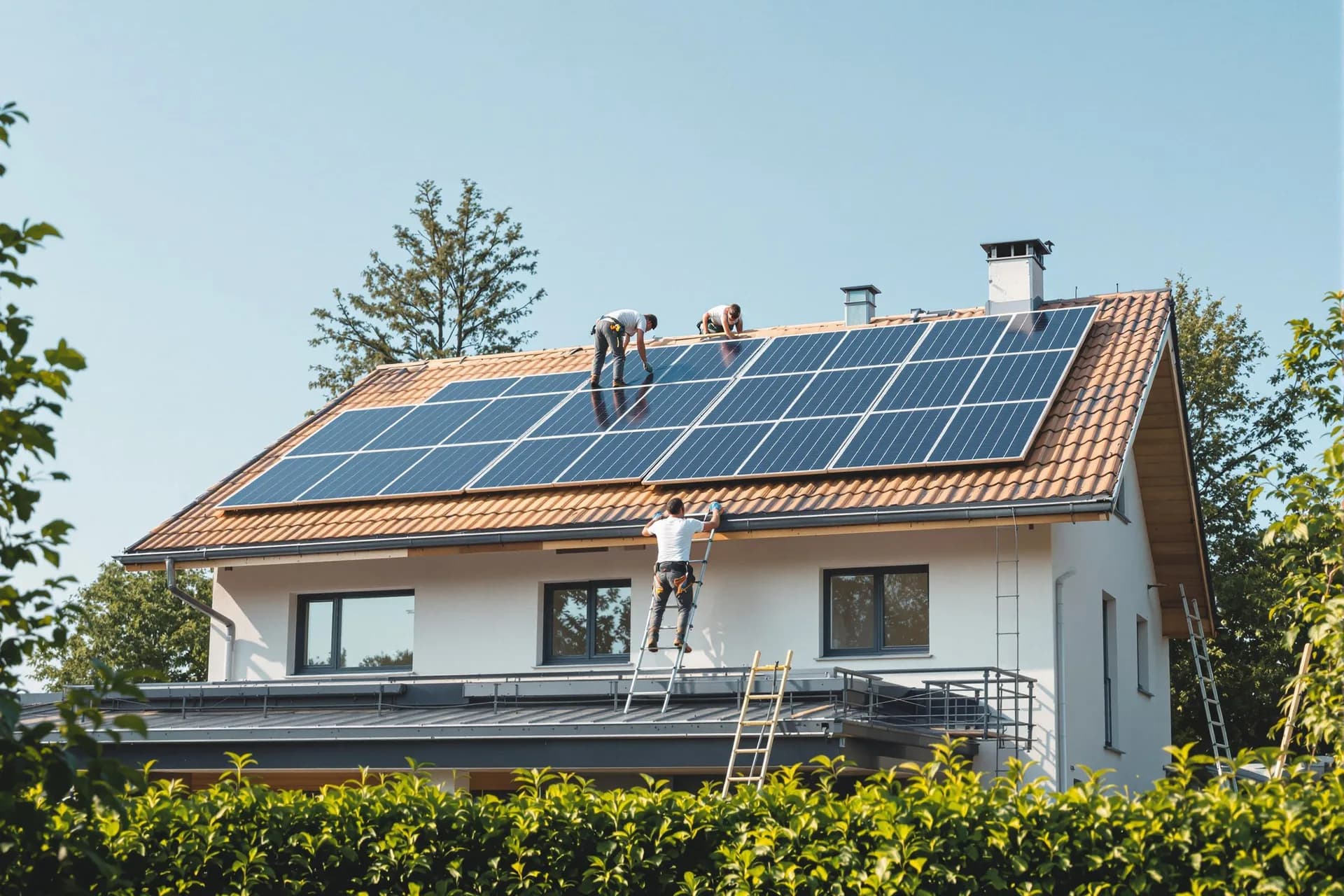
Combining roof refurbishment and PV installation creates significant financial benefits. You only need scaffolding once, which alone can save up to €2,000. Planning and labour costs for electrical work and roof coverings are also incurred only once. This bundling reduces the overall costs by up to ten per cent. A roof refurbishment also offers the perfect opportunity to prepare the roof structure and alignment ideally for the solar modules. Such integrated planning not only secures the longevity of both components for the next 25 years, but is also the basis for maximum energy yield. The combination of both projects is therefore the first step towards an optimised financing strategy.
Government funding as the foundation of your financing
Roof refurbishment with a solar installation can be significantly eased by government assistance. The federal government and the states offer low-interest loans and direct grants that reduce your investment costs. It is crucial to submit these applications before work begins. Combining different funding programmes is often possible and maximises your savings.
KfW loans: Low-cost money from the state
The Kreditanstalt für Wiederaufbau (KfW) is a central point of contact for financing. Here are the main programmes:
- KfW loan 270 "Renewable Energies – Standard": This programme offers a low-interest loan for the purchase and installation of photovoltaic systems and storage units.
- KfW loan 261 "Residential Buildings – Loan": If you carry out the roof renovation to Efficiency House standard, you can receive a loan of up to EUR 150,000 with a repayment grant of up to 20 per cent.
A solar loan can complement these funding schemes and secure the remaining financing. The right combination of these pots is the key to reducing the monthly burden.
Tax benefits: the zero tax rate as a direct gain
Since 1 January 2023, homeowners have benefited from a major tax relief. A zero per cent VAT rate applies to the delivery and installation of photovoltaic systems and the associated storage units. For a system worth 20,000 euros, you therefore save 3,800 euros directly. This advantage applies without any bureaucratic effort to systems on residential buildings.
In addition, income from the operation of PV systems with an output of up to 30 kilowatt peak (kWp) on detached houses is exempt from income tax and trade tax. This has applied retrospectively since the 2022 tax year and considerably simplifies the annual tax return. You can also claim tradesperson services for the purely roof renovation under Section 35a of the German Income Tax Act (EStG) for tax purposes. These tax incentives make the purchase of a photovoltaic system even more attractive.
Alternative financing options for maximum flexibility
Besides classic subsidised loans, there are other attractive financing models. A modernisation loan from your local bank is often straightforward and does not require a land register entry. The interest rates are usually somewhat higher than with KfW, but the process is faster. Another option is a building society savings contract. If you already have one, you can use the savings balance and the low-interest loan for the renovation. This offers a high degree of planning security over the entire term. Our expert tip: Compare the terms of a purpose-bound green loan with those of an unsecured instalment loan. Sometimes banks offer special interest advantages for sustainable projects, which can make a clear difference over a ten-year term. The choice of the right instrument depends on your financial situation and equity capital.
Worked example: How the combined investment pays off
An example calculation illustrates the potential savings. Let us assume a 120-square-metre roof:
- Cost of the roof refurbishment: For new insulation and roof covering, around 30,000 euros is required (approx. 250 euros per square metre).
- Cost of the PV system: A 10-kWp system with storage costs about 20,000 euros.
- Total costs (separate): 50,000 euros, plus separate costs for scaffolding and planning of approx. 3,000 euros.
- Total costs (combined): 50,000 euros, as scaffolding and planning are only needed once.
- Deduction of VAT (19% on PV): -3,800 euros.
- Possible KfW repayment grant (20% on refurbishment): -6,000 euros.
The remaining loan amount thus falls from 53,000 euros to around 40,200 euros. This reduction of almost 25 per cent shows how the financing of a new roof covering is optimised by combining it with solar and subsidies.
Insurance cover: The foundation for a worry-free future
A new photovoltaic system is a value-adding measure and must be reported to the insurer. Otherwise, you risk underinsurance. Most buildings insurance policies cover basic damage caused by fire, storms or hail, but not all risks. A separate photovoltaic all-risk insurance policy offers more comprehensive cover. It also covers damage caused by operating errors, short circuits or animal bites. Annual premiums for such a policy are often only between 50 and 150 euros. Our expert tip: Check whether your existing buildings insurance offers a comprehensive extension or whether a separate policy is the better option. Comprehensive cover protects your investment for the next two decades.
Conclusion: An investment that pays off many times over
The decision to combine financing for a roof renovation with a solar installation makes economic and ecological sense. You can save up to €2,000 through synergies, benefit from government subsidies and significant tax advantages. The investment not only reduces your ongoing energy costs by up to 80 per cent, but also increases the value of your property. With careful planning of the financing and insurance cover, you create a sustainable and profitable foundation for the future of your home.
Frequently asked questions
- Which loan is best for a roof renovation with a solar panel system?
The KfW loan 261 is often the best choice if you are undertaking a comprehensive energy-efficient refurbishment, as it offers a generous repayment subsidy. For a purely PV system, the KfW loan 270 is suitable. It can also be worth comparing it with renovation loans from your local bank.
- Do I need to report my new solar installation to my insurer?
Yes, absolutely. Installing a PV system represents an increase in both value and risk. Without notifying your buildings insurance provider, you risk a gap in cover in the event of a claim. In many cases, a separate solar PV insurance policy is the better solution.
- How much do I save through the zero tax rate on a PV system?
You save the full 19 per cent VAT on the purchase and installation of the system as well as the storage unit. With acquisition costs of, for example, EUR 16,000, the saving amounts to EUR 3,040.
- Can I also apply for funding retrospectively?
No, as a rule, all funding applications, especially those submitted to the KfW and the BAFA, must be submitted and approved before the contract is awarded and the construction work begins. Retroactive funding is not possible.
- Is a solar system worthwhile even without roof renovation?
Yes, if your roof is in good condition and still has a long service life ahead of it, installing a PV system can also be worthwhile without any renovation. However, the combination is more cost-effective if roof work is needed anyway.
- What does photovoltaic all-risk insurance cover?
In addition to standard risks such as fire, storm and hail, it often also covers damage caused by operating errors, vandalism, animal bites, short circuits and loss of income. The cover is therefore significantly more comprehensive than that of a purely residential buildings insurance policy.
Sources
- [1]The KfW provides detailed information on funding for photovoltaic systems as part of the renovation of existing properties.
- [2]On the KfW website, you will find information on funding for roof insulation when renovating existing properties.
- [3]The Federal Ministry for Economic Affairs provides information on the federal government's Solar Package 1 and its measures to promote solar energy.
- [4]A press release from the Federal Statistical Office (Destatis) offers relevant data and facts on the topic.
- [5]The Consumer Advice Centre provides important guidance on planning a photovoltaic system.
- [6]The German Energy Agency (dena) provides information on its support for implementing the photovoltaic strategy.
- [7]Current market data on the solar industry in Germany is available from the German Solar Industry Association (BSW).
- [8]The Market Master Data Register (MaStR) of the Federal Network Agency is used to register energy installations.
- [9]The Federal Ministry of Finance answers frequently asked questions about funding for photovoltaic systems.