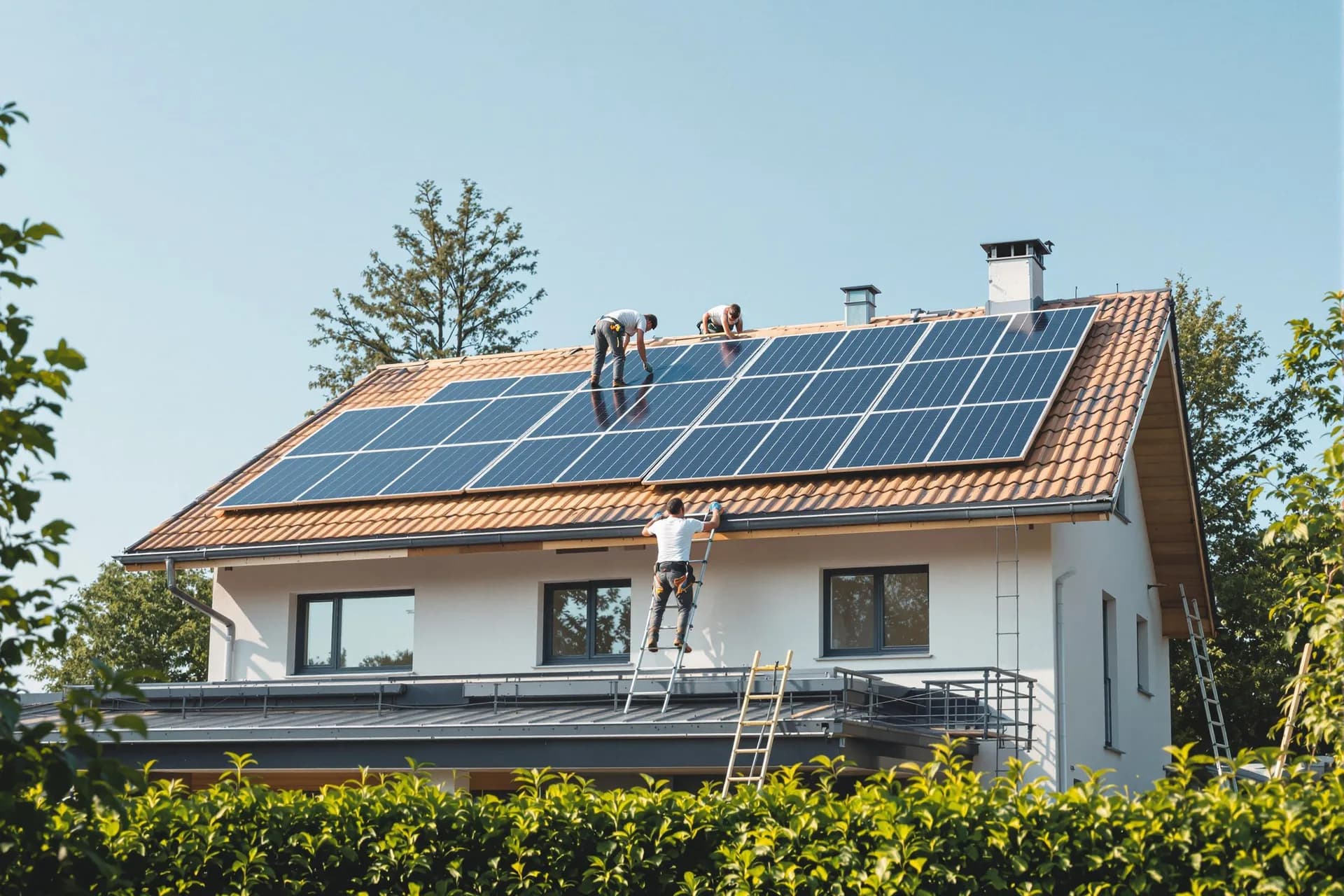
Solar loan for rooftop photovoltaic system
Find out how to finance your photovoltaic system with a solar loan. Information on KfW, interest rates & insurance. Get advice now!
 Katrin StraubManaging DirectorInsurance expert with over 20 years of experience in the insurance industry.
Published on
Last updated on
4 min read
Table of Contents
Financing a rooftop photovoltaic system with a solar loan: your guide for 2025
Do you dream of independence from rising electricity prices with your own photovoltaic system? The high upfront costs of up to €29,000 are often the biggest hurdle. A tailored solar loan makes the investment possible and profitable without requiring significant equity.
Cover investment costs of up to €29,000 with the right loan
A modern photovoltaic system with ten kilowatt-peak (kWp) output and battery storage costs between €17,000 and €29,000 in 2025. A solar loan is designed to bridge this sum, often even as 100% financing without any equity. Banks such as SWK Bank offer such loans with terms of five to twenty years. The feed-in tariff often serves as security for the bank, enabling favourable terms. A loan for a PV system with storage is therefore a common and secure route to energy self-sufficiency. However, the exact terms depend on several factors that you should carefully assess.
Secure returns by reviewing key loan terms
A low interest rate alone does not make a good loan agreement. Look for the option of making free special repayments of up to 50 per cent of the outstanding balance. Many banks waive a land registry entry for a solar loan, saving you several hundred euros in notary fees. Our expert tip: choose an interest rate fixation period of at least ten years to protect yourself against market fluctuations. Most providers also allow repayment-free initial years, which preserves your liquidity in the start-up phase. A home improvement loan without a land registry entry offers similar advantages and can be an alternative. This flexibility is crucial for adapting the financing to government subsidy programmes.
Use government KfW funding to reduce the interest burden
The Kreditanstalt für Wiederaufbau (KfW) supports your project with the “Renewable Energy – Standard 270” programme. This programme covers up to one hundred per cent of the investment costs, including the planning and installation of a battery storage system. The interest rates for the KfW loan 270 currently range from around five to eleven per cent, depending on creditworthiness and term. The application is not made directly to KfW, but always via your local bank, which acts as an intermediary. A list of eligible measures includes:
- Purchase and installation of the photovoltaic system
- Expansion of existing systems
- Costs for planning and project development
- Purchase and retrofitting of battery storage systems
- Financing for associated wall boxes for electric cars
An eco-loan with an interest-rate advantage can be a useful addition to or alternative to KfW funding. The combination of loan and funding is often the key to maximum economic viability, especially if further renovation measures are planned.
Creating synergies through combined refurbishment projects
Often, installing a PV system is the ideal time for a roof renovation. Many homeowners choose to combine both projects to save costs, for example because the scaffolding only has to be erected once. Such a combined measure can often be financed through a single, larger loan. This not only simplifies administration, but can also lead to better overall terms. By combining them, you can increase the value of your property by up to 15 per cent. If you are planning long term, a building savings contract for future renovations can also be a strategic option. Once the system has been financed and installed, protecting the valuable technology takes centre stage.
Protect financed investments with targeted insurance cover
There is no legal requirement for photovoltaic systems to be insured, however most lending banks require it. A good level of cover is essential to protect an investment of several tens of thousands of euros. The cost of a separate photovoltaic insurance policy is only around 70 to 120 euros per year. Alternatively, the system can be included in the existing buildings insurance, which increases the value of the house. Important risks covered are:
- Damage caused by storm, hail, fire and power surges
- Short circuits, operating errors and gross negligence
- Damage caused by animal bites (e.g. by martens) to cables
- Theft of modules or other components
- Loss of income for up to twelve months in the event of an insured loss
A special all-risk photovoltaic insurance policy offers the most comprehensive protection. This secures your investment against almost all eventualities and the financing is on a solid foundation.
Frequently asked questions
- What documents do I need to apply for a solar loan?
As a rule, you will need a detailed quote from the installer, your personal proof of income for the last three months, a copy of your identity card and your tax ID. For the KfW loan, the application is completed together with your local bank.
- How quickly does a financed photovoltaic system pay for itself?
The payback period for a 10 kWp system with storage is around eleven to thirteen years. The exact duration depends on the total costs, the level of loan interest rates, the development of electricity prices and your self-consumption share.
- Is insurance for the battery storage included in the solar loan?
The solar loan finances the battery storage, but does not insure it. Insurance cover for the storage system must be arranged separately via photovoltaic insurance or an add-on to the residential building insurance. Many policies already cover the storage system or offer it as an option.
- What happens when the feed-in tariff expires but the loan has not yet been paid off?
The feed-in tariff is guaranteed for twenty years, while solar loans often have terms of ten to twenty years. The financing should be planned so that the loan is repaid before, or when, the tariff expires. After that, you continue to benefit from the significant savings from self-consumed electricity.
- Can I also get a solar loan for a used photovoltaic system?
Most banks, and especially KfW, primarily support the purchase and installation of new systems. Financing used systems is unusual and is often associated with stricter requirements or higher interest rates, as the remaining service life and warranties are harder to assess.
- Can I get a solar loan without a land registry entry?
Yes, most banks that offer special solar loans waive the need for a costly land registry entry. Instead, the assignment of feed-in tariff claims or the system itself serves as collateral.
Sources
- [1]The Federal Statistical Office (Destatis) provides comprehensive information on photovoltaics in the context of environment and energy in Germany and Europe.
- [2]A press release from the Federal Statistical Office (Destatis) from 2024 provides current data and facts on photovoltaics in Germany.
- [3]The Fraunhofer Institute for Solar Energy Systems ISE presents current facts on photovoltaics in Germany in a PDF file.
- [4]Statista offers various statistics, data and market information on photovoltaics on a topic page.
- [5]Statista presents a statistic on the share of photovoltaics in electricity generation in Germany.
- [6]Wikipedia provides an overview of the technology, expansion and importance of photovoltaics in Germany.
- [7]The German Solar Industry Association (BSW) provides market data and information on the photovoltaics industry.
- [8]A 'Figure of the Week' press release from the Federal Statistical Office (Destatis) from 2023 contains interesting facts and statistics on photovoltaics.