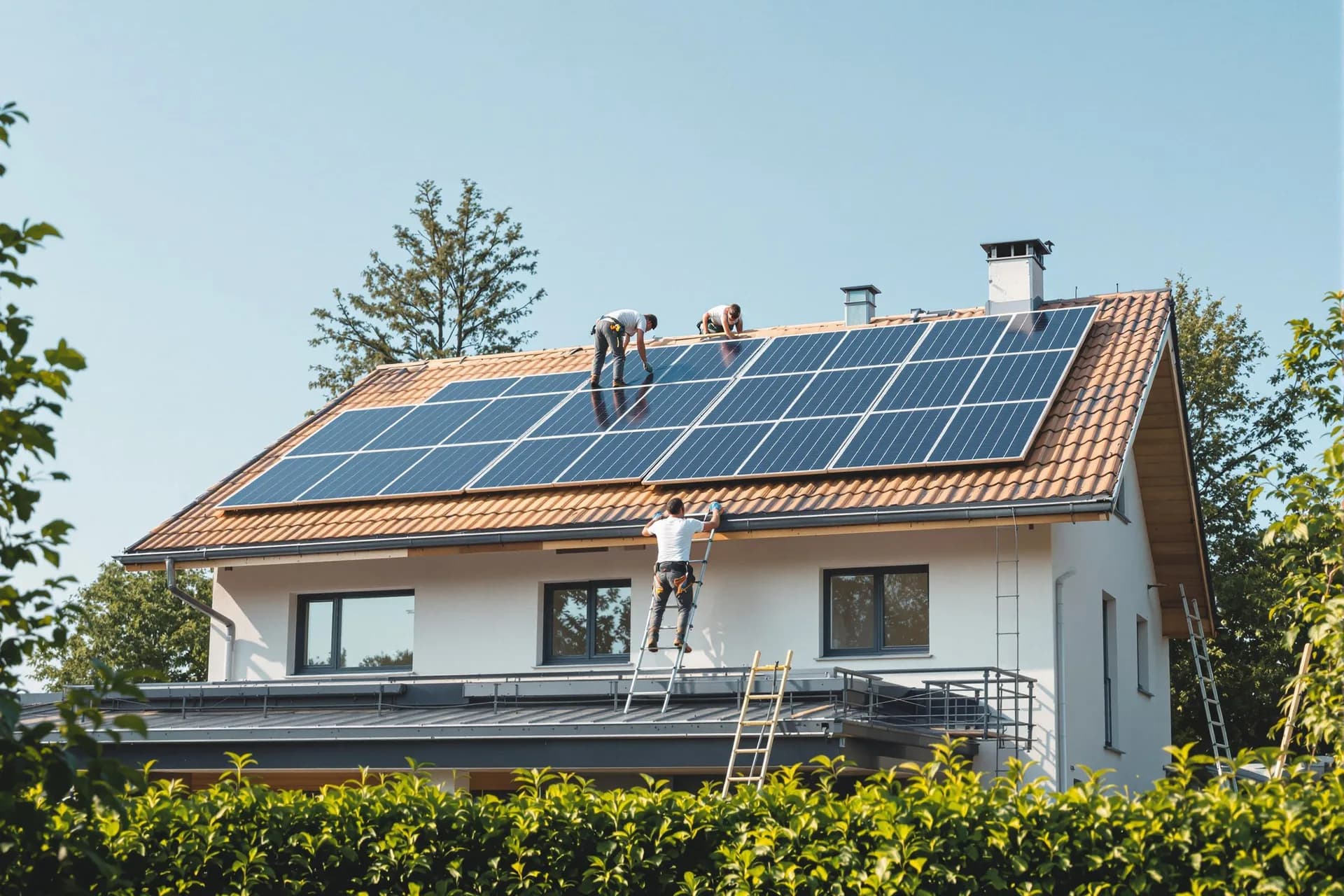
Loan for solar PV system & battery storage
Find the best loan for your solar PV system with battery storage. Information on costs, KfW funding and interest rates. Get advice now!
 Katrin StraubManaging DirectorInsurance expert with over 20 years of experience in the insurance industry.
Published on
Last updated on
4 min read
Table of Contents
Loan for a photovoltaic system with storage: Your guide to the best financing in 2025
Purchasing a photovoltaic system with battery storage is a significant investment in your energy independence. But what is the best way to finance a project costing more than €20,000? This article guides you through the process, from choosing the right loan to securing the necessary insurance for your system.
Market overview: costs and financing options at a glance
A typical solar PV system with ten kilowatt-peak (kWp) output and a suitable battery storage system costs around 25,000 euros in 2025. There are essentially three ways to finance it: the KfW development loan, special solar loans from banks, or a standard instalment loan. Interest rates for development loans such as the KfW 270 programme are often around 4.6 per cent. Thanks to the guaranteed feed-in tariff and the savings on electricity costs, the system partly pays for itself. The payback period is typically between ten and 15 years, depending on your own consumption. A solar loan for your system is often available without a land registry entry for amounts of up to 50,000 euros. These figures provide the basis for your financing decision.
Practical example: This is how the financing for a detached house works out
The starting point: the Schmidt family is planning for the future
The Schmidt family uses 4,500 kilowatt-hours of electricity per year and wants to become more independent. They are planning to purchase a 10 kWp system with a 10 kWh battery storage unit for 25,000 euros. As they want to use their equity elsewhere, they decide to opt for full financing. Choosing the right loan can make a difference of several thousand euros over the term.
Loan comparison: KfW loan versus bank loan
A conventional instalment loan is offered at an interest rate of 5.5 per cent, while the eco loan with an interest-rate advantage via KfW costs only 4.6 per cent. Over a term of ten years, the Schmidt family saves more than 1,200 euros in interest costs solely thanks to the lower interest rate. Regional grants of up to 1,000 euros can further reduce the loan amount. The route to the loan follows clear steps.
- Obtaining at least three quotes from tradespeople.
- Checking regional funding pots before submitting the application.
- Submitting the loan application to the house bank (also for KfW loans).
- Bank review of the loan documents.
- Disbursement of the loan after the contract has been concluded.
With the right financing in place, the legal and funding-related details move into focus.
Expert knowledge: funding, taxes and legal frameworks
The KfW Programme 270 in Detail
The KfW Programme “Renewable Energies – Standard (270)” is the classic financing option. It supports the installation, expansion and acquisition of photovoltaic systems, including the associated storage units. Loan amounts of up to 100,000 euros are possible, with terms of up to 20 years. Our expert tip: Ask your local authority about local grants, which can often be combined with the KfW loan. In Cologne, for example, grants of up to 2,500 euros are possible.
Tax Aspects of the Loan
If you operate your system as a business with the intention of making a profit, you can claim the loan interest for tax purposes as business expenses. This reduces your tax burden and improves the overall return. In return, the income from the feed-in tariff must be taxed. Careful planning, possibly in combination with a financing for a roof renovation, is crucial here. Securing this significant investment is the next logical step.
Protecting your investment: These insurance policies are essential
A loan to purchase a photovoltaic system with storage also means an obligation to the bank. Lenders therefore often require proof of adequate insurance cover. A missing policy can, in the event of a claim, jeopardise not only the system but also your financing. While solar modules can last up to 30 years, risks such as severe weather or technical defects remain. Comprehensive protection consists of several components.
- Photovoltaic all-risk insurance: It covers damage caused by hail, storms, short circuits or animal bites. Annual costs are around €80 to €120. A good photovoltaic all-risk insurance policy is the basis.
- Operator liability insurance: If a module comes loose from the roof and causes damage, this insurance protects you. Check whether your private liability insurance covers this or whether a separate policy is needed.
- Battery storage insurance: The storage unit is an expensive component with its own technology. A special battery storage insurance policy covers risks such as deep discharge or electronic damage.
Once financing and insurance are in place, it is important to avoid long-term mistakes.
Long-term planning: Avoid common financing mistakes
The joy of a new solar installation can quickly be clouded by unforeseen costs. Forward planning helps avoid the most common pitfalls. Many underestimate the annual operating costs, which amount to around one per cent of the investment sum. You should factor this into your profitability calculation from the outset. Another point is sizing the system correctly. A system that is too small will not make full use of your savings potential, while one that is too large will pay for itself more slowly.
Pay attention to these points to ensure long-term success:
- Compare quotes: Obtain at least three detailed quotes from different specialist contractors.
- Allow for additional costs: Costs for changing the meter (up to €200) or registering with the grid operator are often overlooked.
- Check the maintenance contract: A maintenance contract secures your returns, but it should be reasonably priced.
- Flexibility with the loan: Look out for the option of special repayments so you can pay back the loan more quickly when cash flow is good.
A well-considered, long-term strategy, such as a home savings contract for future renovations, helps secure the value of your investment.
Frequently asked questions
- How much does a loan for a photovoltaic system with storage cost?
The costs depend on the interest rate and the term. For a loan amount of €20,000 and an annual percentage rate of 4.89 per cent over six years, the interest costs, for example, amount to around €3,000.
- What documents do I need for the loan application?
You will usually need the installer’s quote, a cost-effectiveness calculation, proof of income for the last three months and a copy of your identity card.
- How long does it take to get approval for a solar loan?
After submission of all documents, the review and approval process at most banks takes between three and seven working days.
- Is a special repayment possible for the photovoltaic loan?
Yes, most solar and eco loans allow free special repayments or even early full repayment, which further reduces the interest burden.
- What happens to the loan if I sell my house?
As a rule, the loan is repaid from the proceeds of the sale. Alternatively, after a credit check, the new owner can take over the loan agreement, which can increase the value of the property.
- What is the service life of the plant components?
Solar panels have a lifespan of 20 to 30 years. The inverter often has to be replaced after 10 to 15 years, and a battery storage system lasts about 10 years.
Sources
- [1]KfW provides information on support for photovoltaic systems as part of the energy-efficient refurbishment of existing properties.
- [2]Federal Network Agency provides statistics on renewable energies, including photovoltaics.
- [3]HTW Berlin publishes the Electricity Storage Inspection 2024, a study of electricity storage systems in connection with photovoltaic systems.
- [4]Fraunhofer ISE offers a study on the expansion of photovoltaics and battery storage in Germany.
- [5]Wikipedia provides a comprehensive article on photovoltaics, its fundamentals, technology and applications.
- [6]BMWK (Federal Ministry for Economic Affairs and Climate Action) presents the Photovoltaics Strategy 2023.
- [7]Consumer Advice Centre provides important information on planning a solar system (photovoltaics).
- [8]dena (German Energy Agency) provides information on the development of building-integrated photovoltaics in Germany.
- [9]German Solar Association (BSW) publishes current market data on the solar industry.
- [10]Wikipedia provides an article on the Renewable Energy Sources Act (EEG).