Eye Doctor Check-ups and Health Insurance: Costs & Tips
Find out which preventive eye doctor check-ups are covered by your health insurance and when IGeL services make sense.
 Katrin StraubManaging DirectorInsurance expert with over 20 years of experience in the insurance industry.
Published on
Last updated on
4 min read
Table of Contents
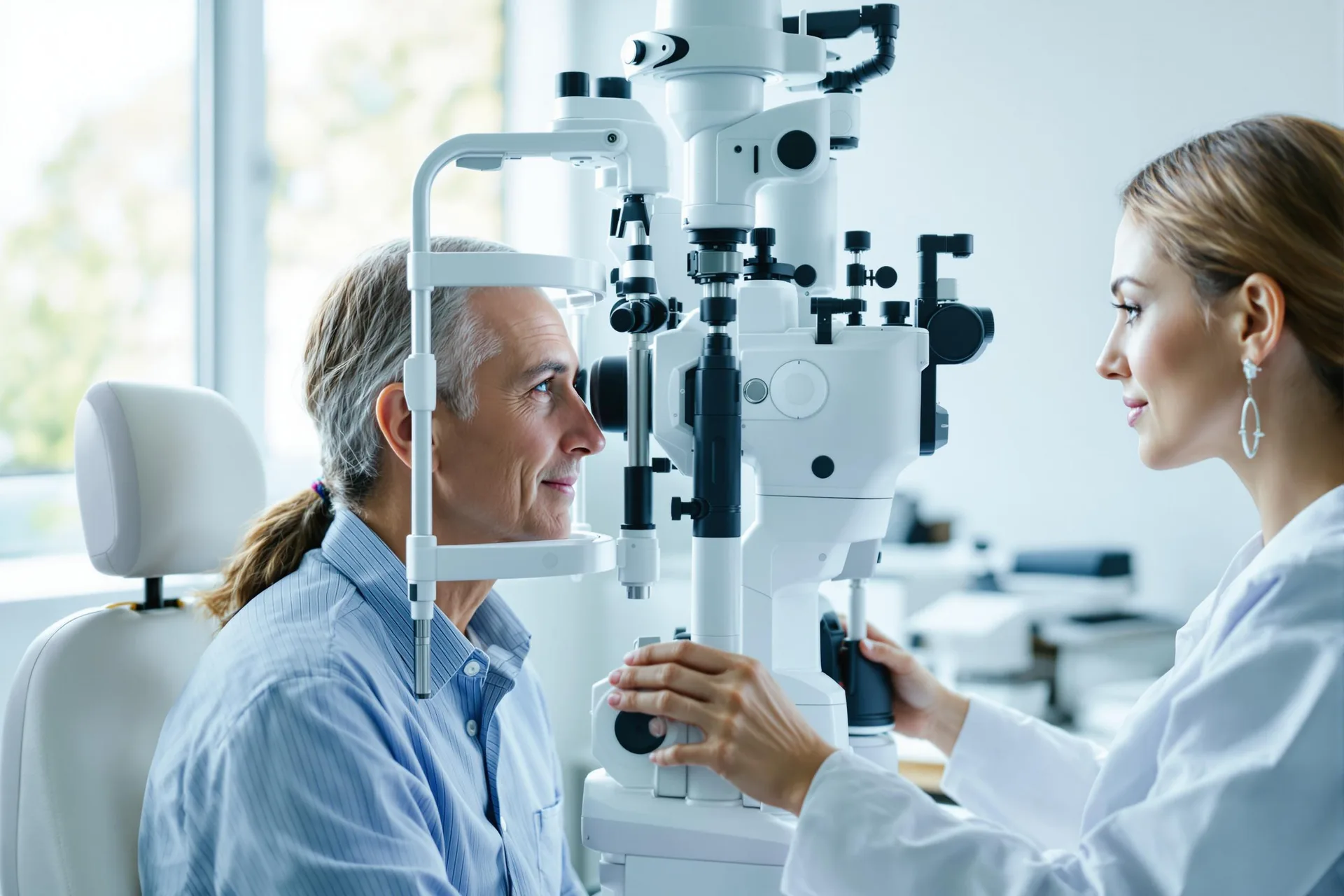
Your eye health is very important, but which preventive check-ups are covered by health insurance? Many people are unsure what costs are involved for preventive eye doctor services. This article looks at what the health insurance provider covers and shows when you need to take action yourself.
Basics of eye care: What health insurance actually covers
The statutory health insurance fund (GKV) covers the costs of ophthalmological examinations if there is a specific suspicion of illness or medical complaints are present. A routine eye examination purely for preventive care in adults without specific risk factors or symptoms is often not included in the standard benefits catalogue. Many preventive services, such as glaucoma early detection for people under forty without risk factors, are among the Individual Health Services (IGeL). The cost of such IGeL can vary; a glaucoma early detection examination can cost between twenty and one hundred and forty euros, for example. It is therefore important to find out in advance about the scope of your insurer’s health benefits. The precise distinction between a benefit covered by the insurer and a self-pay service is a key issue for many patients.
IGeL at the ophthalmologist: Necessary investment or an expensive extra?
Individual health services (IGeL) are additional medical services that go beyond the benefits catalogue of statutory health insurance and must be paid for by the patient themselves. At the ophthalmologist, these often include early detection measures, such as the retinal check to help prevent degeneration, which can cost between twenty-five and one hundred and twenty euros. Extended glaucoma screening using special measurement procedures is also often included. The IGeL monitor assesses some of these services critically; for example, ophthalmoscopy with intraocular pressure measurement for early glaucoma detection is classified as “tends to be negative”, as the benefit is not always clearly proven. An open discussion with your ophthalmologist about the medical necessity and the individual benefit of an IGeL service is therefore essential before you accept a cost estimate.
Here are some frequently offered IGeL services at the ophthalmologist and their approximate costs:
- Intraocular pressure measurement for early glaucoma detection: twenty to forty euros.
- Optical coherence tomography (OCT) for retinal examination (outside specific diagnoses): eighty to one hundred and fifty euros.
- Retinal check for macular degeneration screening: twenty-five to one hundred and twenty euros.
- Eye check for road users (visual acuity, visual field, twilight vision): twenty-five to one hundred euros.
- Contact lens fitting and follow-up: costs vary widely, often from thirty euros.
These costs are only intended as guidelines and may vary depending on the practice and the extent of the examination. Always clarify the exact costs in advance.
Glaucoma screening: when the insurer covers it and when you pay yourself
Glaucoma, also known as green star, is a group of eye diseases that damage the optic nerve and can lead to blindness if left untreated. The condition often goes unnoticed for a long time. Statutory health insurance covers the cost of diagnostic tests if there is a justified suspicion of glaucoma or if a diagnosis has already been made. These include measuring intraocular pressure, assessing the optic disc and visual field testing. A purely preventative examination for early glaucoma detection without specific symptoms or risk factors, as recommended for example from the age of forty, is generally an individual health service and must be paid for privately.
The German Association of Ophthalmologists (BVA) recommends glaucoma screening from the age of forty every two years. For people at increased risk, such as those with a family history or people with dark skin, earlier screening from the age of thirty is advised. A health check-up insurance policy can help cover such costs. Assessing your personal risk is crucial here.
Age-related macular degeneration (AMD): Understanding prevention and cost coverage
Age-related macular degeneration (AMD) is a condition that affects the point of sharpest vision (macula) and is the most common cause of severe visual impairment in older age. Statutory health insurance covers the costs of early detection examinations if AMD is already suspected, symptoms occur or specific risk factors such as a family history are present. Optical coherence tomography (OCT) is an important examination method and has been covered by statutory health insurers since January 2020 for patients with wet AMD and diabetic macular oedema for up to six examinations per eye per year. If there are no individual risk factors, the early detection examination for AMD, recommended from the age of 60, is usually charged privately as an IGeL service. A supplementary health insurance can be a sensible addition here.
An AMD screening examination may include the following steps:
- Medical history and assessment of risk factors.
- Vision test to check current visual acuity.
- Amsler grid test for the early detection of distortions.
- Slit-lamp examination to assess the anterior and middle parts of the eye.
- Fundoscopy (examination of the back of the eye) to inspect the retina and macula.
- If necessary, an OCT examination for detailed cross-sectional images of the macula.
Early detection is crucial for treatment success.
Children’s eyes in focus: These preventive check-ups are crucial
The development of vision in children is a complex process, and undetected visual impairments can have far-reaching consequences for development. The costs of the general preventive check-ups (U-examinations) with the paediatrician, which also include basic eye tests, are covered by statutory health insurance. Since two thousand and seventeen, the Child Health Directive has included new provisions for the early detection of visual disorders as part of the U-examinations, for example tests for squinting or cataracts at U4 to U7. Specific ophthalmological preventive examinations, such as an amblyopia screening, may be covered by health insurance under certain conditions (e.g. a family history), but they are often self-pay services.
The professional association of ophthalmologists recommends an initial eye examination at six months for children at increased risk (e.g. premature birth, squinting in the family) and for all children between the thirty-first and forty-second month of life. A vision aid insurance can also cover the costs of special children's glasses. Timely ophthalmological assessment in children is of great importance for the healthy development of vision.
Expert tips: How to navigate eye care optimally
Deciding for or against an IGeL preventive examination with the ophthalmologist can be difficult. Our expert tip: speak openly with your ophthalmologist about your individual risk profile and the necessity of the recommended examinations. Always clarify the costs in advance and ask about possible alternatives that may be covered by your health insurance provider. It may be sensible to consider private health insurance or suitable supplementary health insurance that also covers IGeL services. You are best placed to make an informed decision after comprehensive advice.
Ask your ophthalmologist the following questions to gain clarity:
- What specific benefit does this preventive examination have for me personally?
- Are there any risk factors that make this examination particularly urgent for me?
- What exact costs will I incur, and is there a detailed basis for billing (GOÄ codes)?
- Are there alternative examination methods that are covered by statutory health insurance?
- At what intervals do you recommend this preventive examination for me?
- What happens if an abnormal finding is discovered during the examination? What follow-up costs could arise?
Good preparation for your appointment with the doctor helps you make the right decisions for your eye health.
Conclusion: Forward planning for healthy eyes
Eye specialist check-ups are an important building block for the long-term preservation of your eyesight. While the health insurer covers necessary medical treatments and examinations when there is a specific suspicion, many purely preventive measures fall into the category of IGeL. A precise understanding of the services provided by your health insurer and open communication with your eye specialist are crucial. This allows you to make informed decisions and develop the preventive strategy that is right for you. Remember that investing in your eye health pays off in the long term, often more than the treatment costs alone of perhaps just one hundred euros per year. nextsure supports you in finding the right cover for your individual needs.
Frequently asked questions
- Does my health insurer cover the cost of a glaucoma screening?
Statutory health insurance covers the costs of a glaucoma examination if there is a specific suspicion or risk factors are present. A purely preventive examination without a medical indication is usually an IGeL and must be paid for by yourself.
- What are IGeL services at the eye doctor?
IGeL (Individual Health Services) are examinations or treatments that are not part of the benefits covered by statutory health insurance funds. At the ophthalmologist, these are often extended preventive examinations such as special retinal scans (OCT without diagnosis), detailed glaucoma early detection or vision tests for specific requirements (e.g. driving licence eye test).
- At what age should you get checked for macular degeneration?
A screening examination for the early detection of age-related macular degeneration (AMD) is generally recommended from the age of 60 onwards. In the case of a family history or other risk factors, this may also be advisable from the age of 50.
- Are eye examinations for children free?
The eye tests carried out as part of the U examinations at the paediatrician are covered by statutory health insurance benefits. Specific ophthalmological preventive examinations or screenings for children may, depending on the insurer and the indication, incur additional costs or be considered IGeL.
- How can I protect myself from high costs for preventive eye specialist check-ups?
Speak to your doctor before any examination about whether it is necessary and how much it will cost. Clarify whether it is a standard health insurance benefit or an IGeL service. Private supplementary health insurance can help cover or reduce the cost of IGeL services.
- Does health insurance pay for a new pair of glasses?
Statutory health insurers only grant adults a fixed subsidy for spectacle lenses in exceptional cases, e.g. in the event of severe visual impairment (over six dioptres) or certain eye conditions. Children and young people under 18 usually receive a subsidy. You can find more information in our article on glasses from health insurance.
Sources
- [1]Wikipedia offers a comprehensive overview of ophthalmology.
- [2]The Techniker Krankenkasse (TK) provides information on the reimbursement of vision tests as a statutory health insurance benefit.
- [3]The Verbraucherzentrale critically examines the billing of vision tests in ophthalmology practices.
- [4]gesundheitsinformation.de, published by IQWiG, provides detailed information on various eye examinations.
- [5]The German Association for the Blind and Visually Impaired (DBSV) provides current figures and facts on visual impairment in Germany.
- [6]The initiative Week of Sight provides statistics on eye diseases in Germany.
- [7]The German Medical Journal publishes an article on the prevalence of visual impairment in the adult population.
- [8]Statista offers statistics on eye diseases in children and adolescents, broken down by gender.
- [9]augeninfo.de, a joint initiative of the Professional Association of German Ophthalmologists (BVA) and the German Ophthalmological Society (DOG), provides comprehensive information on eye health.
Free advice on this topic
Our experts advise you without obligation and find the right cover: online or by phone.
- Free & non-binding
- 100% digital