
Dental Insurance for Root Canals: Costs & Reimbursement
Statutory health insurance doesn't cover it all. See how dental insurance pays 100% for root canals and modern endodontics.
All details are taken from the provider's linked product page and the contract documents (IPID/policy conditions) published there; the insurer's documents prevail. Premiums, benefits and the insurance product itself may change – please verify the details directly with the partner before signing up; only the information provided there is binding.
 Katrin StraubManaging DirectorInsurance expert with over 20 years of experience in the insurance industry.
Published on
12 min read
Table of Contents
A strong dental supplementary insurance policy reimburses the cost of root canal treatment at 75% to 100%, depending on the tariff. It covers expensive private services such as electronic length measurement, the use of a surgical microscope, and modern pain management that statutory health insurance doesn't pay for. That saves a lot of money. It's important to look for tariffs with no waiting periods and to submit the cost estimate to the insurer before treatment begins.
dental supplementary insurance
Find the right dental supplementary insurance at nextsure. Comprehensive protection, digital processing, and tailor-made rates for your most beautiful smile.
Learn moreStatutory Insurance Limits for Root Canal Treatment
Strict Requirements From Insurers
The limits of statutory health insurance for root canal treatment often force patients into high out-of-pocket costs, since statutory benefits are heavily regulated. Statutory health insurance covers the cost of endodontic therapy only under strict conditions. The dentist must be able to guarantee that the root canal can be prepared and filled close to the root tip [1]. If this outlook is uncertain because of strongly curved or narrowed canals, statutory insurance refuses to pay at all. In such cases, the patient is left with a choice between extracting the tooth or paying for treatment privately. A strong dental supplementary insurance policy effectively closes this gap and protects the patient from losing their own tooth. It protects against unexpected bills. The financial burden of private endodontics can put massive strain on a monthly household budget, which is why taking out the right tariff early is essential.
When a Molar Is Worth Saving
The guidelines of the Federal Joint Committee (Gemeinsamer Bundesausschuss) precisely define when a tooth counts as worth saving and therefore falls under the statutory insurers' benefits catalog. For molars, statutory cover only applies if the tooth sits in a closed row of teeth, prevents a one-sided gap at the end of the row, or supports existing, functional dentures. If the affected tooth doesn't meet these criteria, statutory insurance classifies the root canal treatment as a purely private service. Patients then receive no subsidy at all for the dental procedure. The full cost of the therapy therefore falls back on the policyholder. This affects tens of thousands of treatments in German dental practices every year, where patients are suddenly confronted with bills running into four figures. Detailed disclosure by the treating dentist is legally required in these situations, but it doesn't change the financial burden.
Modern Procedures Excluded
Even when statutory insurance approves basic care, it covers only standard procedures, which don't always reflect the latest scientific findings. Modern techniques such as electrometric length measurement of the root canals or the use of a high-resolution surgical microscope count as private additional services. These innovative methods significantly increase the success rate of saving a tooth, but patients have to pay for them themselves. Quality has its price. Co-payments for these medically sensible extras quickly add up to several hundred euros per tooth. Private cover cushions this financial burden and provides access to optimal medical care. Investing in modern endodontics pays off in the long run, since keeping the natural tooth is always the best solution for jaw stability and overall oral health.
Cost Factors in Endodontics
Anatomical Complexity
The cost factors in endodontics vary considerably depending on the anatomical complexity of the affected tooth and the dental procedure chosen. A front tooth usually has only one straight root canal, which minimizes the time the dentist needs and keeps treatment costs relatively low. Molars, by contrast, often have three to four strongly curved or branching canals. These anatomical features require special instruments and considerably more treatment time to remove all the bacteria completely. Depending on the complexity and method used, a root canal treatment costs between €300 and €2,500 [2]—a wide price range. Specialized endodontists who exclusively perform root canal treatment often charge rates at the upper end of this scale, given their expertise and elaborate technical equipment. A well-researched tariff comparison protects against these financial risks.
Technological Equipment
A major cost driver is the use of modern technology during the microsurgical procedure. Using a surgical microscope lets the dentist locate the finest branches in the root canal system, but it's billed separately under the private fee schedule for dentists (Gebührenordnung für Zahnärzte, GOZ). The same applies to ultrasound-assisted rinsing to disinfect the canals, which reliably eliminates deep-seated bacteria. These procedures maximize the chance of permanently saving the tooth and minimize the risk of painful inflammation flaring up again. However, they quickly push the total bill into four figures. Patients without supplementary cover bear this financial risk alone and often decide against the best possible therapy for cost reasons. A policy taken out in good time decouples medical decisions from the state of your bank account.
Advanced Pain Management
Besides the direct treatment costs, additional fees for pain relief often push up the total price of the therapy further. Statutory health insurance covers standard local anesthesia, but special methods such as twilight sleep or laughing gas sedation require private co-payments. For anxious patients especially, these options are crucial for stress-free, successful treatment. The cost of laughing gas treatment averages €100 to €150 per session, which adds up considerably for root canal treatments spread over several sessions. General anesthesia costs €250 to €400 per hour. High-quality tariffs cover these expenses. Advigon's tariffs, for example, include advanced pain management covering acupuncture, general anesthesia, laughing gas, and twilight sleep, reimbursing these at 75% or 100% depending on the tariff level.
Key Cost Drivers in Root Canal Treatment
- Number and degree of curvature of the affected root canals
- Use of a surgical microscope for precise visualization
- Electrometric length measurement instead of classic X-rays
- Machine-assisted preparation with highly flexible nickel-titanium files
- Additional pain management such as laughing gas or general anesthesia
These services are billed under the private fee schedule for dentists (GOZ).
Benefits of Dental Supplementary Insurance
Covering Private Services
The benefits of dental supplementary insurance go far beyond simply covering basic endodontic care that statutory insurance refuses to pay. An excellent tariff reimburses the cost of medically necessary root canal treatment even when statutory health insurance makes no prior contribution at all. This includes the use of state-of-the-art methods such as machine-assisted canal preparation with highly flexible nickel-titanium files, which prevent instruments from breaking off inside the canal. Root canal treatment preserves natural tooth structure and avoids the need for expensive dentures [3]. The focus is on saving the tooth. Covering these specialized services ensures the dentist uses the best possible method, without the patient having to compromise on treatment quality for financial reasons.
Follow-Up Surgical Procedures
Another important benefit feature is coverage for follow-up surgical procedures that may become necessary after an unsuccessful initial root canal treatment. If a primary root canal treatment doesn't achieve the desired success and the root tip becomes inflamed again, an apicoectomy (root tip resection) often becomes necessary. When taking out dental supplementary insurance, make sure apicoectomy is included in coverage [4]. Good policies fully cover these microsurgical procedures. They also reimburse the cost of a retrograde root filling, in which the canal is sealed bacteria-tight from the root tip. These surgical measures are often the last chance to save the tooth from extraction, and they come with high private-dentist fees that a strong tariff cushions.
Comparing Reimbursement Rates
The reimbursement amount depends on the tariff's chosen percentage benefit rate and the agreed tariff maximums. Premium tariffs cover 100% of the private costs incurred, while basic tariffs often reimburse only 70% to 80%. nextsure analyzes individual needs and filters the market for tariffs that offer exactly the desired level of benefit. The digital platform enables a transparent comparison of reimbursement rates for endodontic treatment. This helps policyholders find the optimal cover for their dental health. A decisive factor when choosing a tariff is also whether the insurer covers the cost of accompanying diagnostics such as digital volume tomography (DVT), which provides a three-dimensional view of the tooth roots and massively improves treatment planning. Such imaging procedures are expensive, but essential for complex revisions.
Tariff Comparison: Advigon AZM and AZL
Basic Cover vs. Premium Cover
Comparing the Advigon AZM and AZL models illustrates the substantial differences in reimbursement amount and included additional benefits. The Dental Medium (AZM) tariff offers solid basic cover and reimburses 75% of the cost of dental treatment and dentures. The premium Dental Luxus (AZL) tariff, by contrast, covers 100% of the costs incurred, providing complete cost protection. Neither tariff has a waiting period, allowing direct entitlement to benefits from day one. Both cover modern treatment techniques above the statutory insurance level. The choice depends on your budget. For young adults up to age 25, the AZM tariff starts at an affordable €5.69 a month, while the more comprehensive AZL tariff costs €9.20 a month for this age group.
Reimbursement Caps in the First Years
A closer look at the reimbursement caps in the first years of the policy reveals further differences that matter when planning expensive treatment. Under the AZM tariff, reimbursement is capped at a maximum of €600 in the first year and €2,400 in the fourth year. The AZL tariff offers significantly higher amounts: €1,000 in the first year and up to €4,000 in the fourth year. These caps no longer apply at all under either tariff after month 48, or for accident-related dental treatment. Recognized prior insurance time of at least 48 months with another provider can also lead to these limits being waived immediately, provided the switch is seamless and the level of benefits is comparable.
Preventive Care and Pain Management
The two Advigon tariffs also differ significantly in preventive care and pain management. The difference is clear. The AZM tariff subsidizes professional teeth cleaning with up to €90 a year, while the AZL tariff provides a generous €140. For advanced pain management, covering acupuncture, general anesthesia, laughing gas, and twilight sleep, AZM reimburses 75% and AZL a full 100%. This innovative pain management is an enormous benefit especially for people with dental anxiety, and makes going in for root canal treatment considerably easier. nextsure transparently brokers these hand-picked tariffs and helps customers find the policy that best matches their individual risk profile and financial means.
| Benefit feature | Dental Medium (AZM) | Dental Luxus (AZL) |
|---|---|---|
| Dental treatment & dentures | 75% reimbursement | 100% reimbursement |
| Preventive care (teeth cleaning) | up to €90 / year | up to €140 / year |
| Pain management (anesthesia, laughing gas) | 75% reimbursement | 100% reimbursement |
| Reimbursement cap, 1st year | max. €600 | max. €1,000 |
| Reimbursement cap, 4th year | max. €2,400 | max. €4,000 |
Neither tariff has a waiting period. Reimbursement caps no longer apply after an accident or with recognized prior insurance.
Waiting Periods and Ongoing Treatment
Immediate Cover With No Blocking Periods
Waiting periods at many insurers often delay entitlement to benefits by up to eight months, which is a problem for acute conditions. Anyone with acute tooth pain, however, needs immediate cover and can't put off root canal treatment for months. Fortunately, the market offers tariffs with no waiting period, which apply right after the policy is taken out and offer immediate cost certainty. Advigon's AZM and AZL tariffs do away entirely with these contractual blocking periods. Patients can use dental services immediately after the policy takes effect. This is a decisive advantage. Especially with unforeseeable inflammation of the tooth nerve, which requires quick action, a tariff that grants full coverage under the agreed terms from day one of the policy proves its worth.
Handling Already Recommended Treatment
A critical situation arises when the dentist has already documented the need for root canal treatment in the patient file before the insurance was taken out. Newly taken-out dental supplementary policies don't reimburse ongoing root canal treatment, or treatment already recommended before the policy was taken out [5]. Most insurers strictly exclude known insured events, to protect themselves from adverse risk selection. However, there are rare specialty tariffs that make it possible to take out a policy despite treatment already recommended. These tariffs are often more expensive and have strict benefit caps, but in individual cases they can be the only way to cushion at least part of the high treatment costs to come.
The Importance of the Health Questions
To avoid disputes when a claim is made, insurers often scrutinize the dental records very closely for bills submitted soon after the policy starts. They request excerpts from the patient file to establish exactly when the diagnosis was made and whether the patient knew about it when applying. nextsure advises customers in detail on the different insurers' underwriting rules and helps them answer the application questions correctly. Answering the health questions in the application honestly is essential for later coverage. False statements inevitably lead to a loss of benefits and can even result in the contract being retroactively voided for breach of the pre-contractual duty to disclose. Transparency is the top priority here for reliable cover.
Modern Treatment Methods
Precision Through Surgical Microscopes
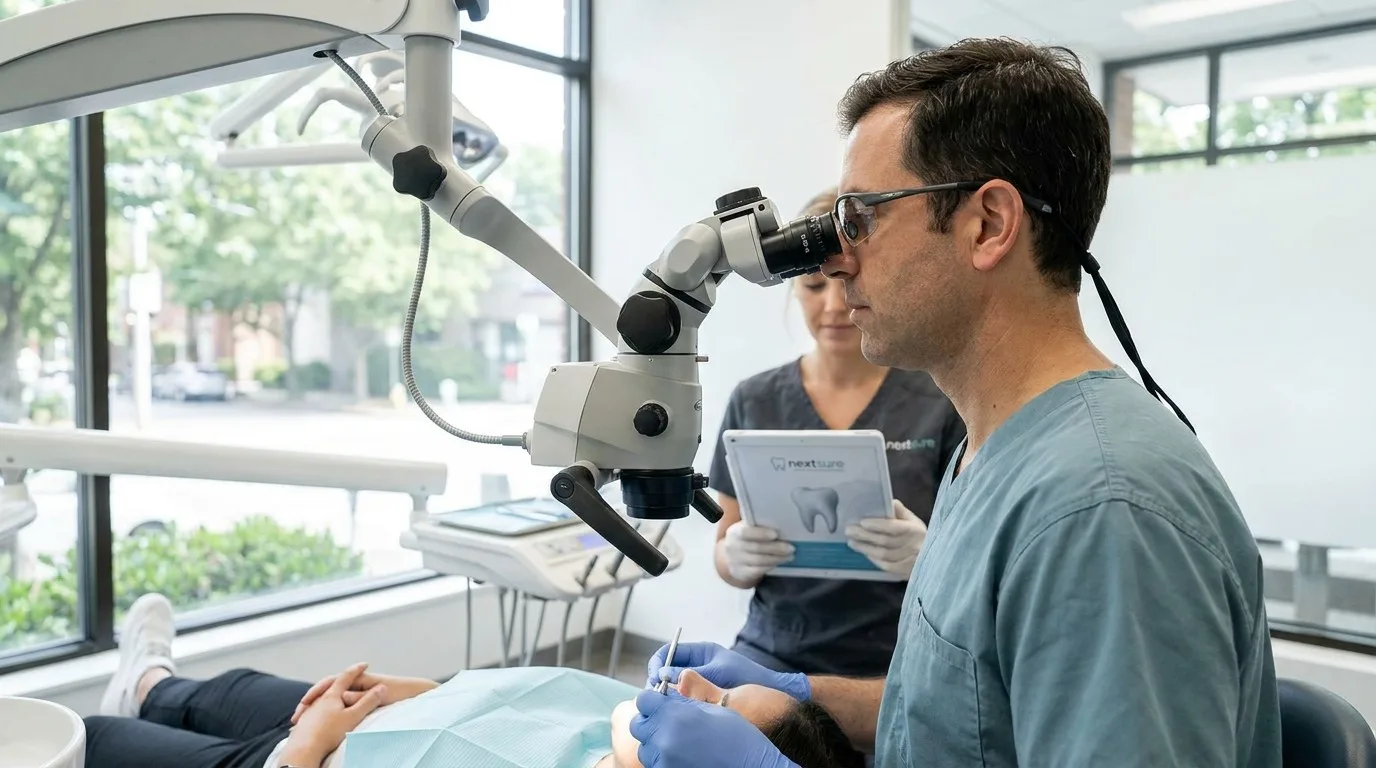
Modern treatment methods significantly increase the success rate of endodontics and make it possible to save badly damaged teeth. Modern techniques such as surgical microscopes, machine-assisted preparation, and electronic length measurement allow for precise, gentle treatment [1]. The surgical microscope magnifies the working field up to 25 times and illuminates the root canal optimally with extremely bright light. This lets the dentist find even hair-thin canals and anatomical branches invisible to the naked eye. Precision increases enormously. This visual control ensures no inflamed tissue is left in the tooth, which is the main cause of later complications and the need for revision treatment. In addition, the strong magnification allows for the gentle removal of broken instruments or old root filling material during revision treatment.
Electrometry and Machine-Assisted Preparation
Electronic length measurement (electrometry) replaces or complements the classic X-ray for determining the exact length of the root canal. A small measuring device determines the precise distance to the root tip via the tissue's electrical resistance. This method reduces the patient's radiation exposure and delivers highly precise values, essential for a root filling that seals tightly at the edges. Machine-assisted preparation with rotating files made from a highly flexible nickel-titanium alloy produces an even, tapered shape in the canals. This makes it easier to subsequently fill them densely with gutta-percha. These instruments adapt to the natural curvature of the root and minimize the risk of perforating the canal wall during the procedure.
Laser Disinfection for Maximum Freedom From Bacteria
Laser technology is increasingly used to disinfect the root canal system and effectively complements chemical rinsing solutions. The concentrated light eliminates bacteria even in deep lateral canals and dentinal tubules that conventional rinsing solutions can't reach. A high-quality dental supplementary policy covers the cost of these innovative but expensive procedures without objection, provided they're medically indicated. Investing in these techniques pays off through the long-term preservation of your own tooth. An implant as an alternative would be considerably more expensive and involve a far more invasive surgical procedure on the jawbone. Preserving the natural tooth root is always the biomechanically superior solution.
Cost Estimate and Reimbursement Process
Certainty Through the Treatment and Cost Plan
The cost estimate gives the patient financial clarity before treatment begins and protects against unexpected costs. For extensive root canal treatment, the dentist draws up a detailed treatment and cost plan (Heil- und Kostenplan, HKP) that precisely lists all planned GOZ fee items and material costs. It's strongly recommended to submit the dentist's cost estimate in advance, to get binding confirmation of the exact reimbursement amount from the insurer. Claims handlers check the plan for medical necessity and compliance with the tariff. This creates planning certainty. Especially for bills exceeding €1,000, many insurance companies require a treatment and cost plan to be submitted before dental treatment begins anyway.
Digital Processing When You Make a Claim
The reimbursement process at digital brokers like nextsure is fast, transparent, and entirely paperless. Policyholders simply photograph the dentist's invoice with their smartphone and upload it via a secure customer portal or app. Processing time at modern insurers is often just a few working days, so the policyholder doesn't have to front the money for long. After a successful review, the company transfers the tariff-agreed amount directly to the policyholder's account. This digital process minimizes administrative effort and ensures high customer satisfaction when a claim is made. Digital interfaces considerably speed up communication between patient, broker, and insurer. Many insurers also now offer portals where processing status can be tracked in real time. This builds trust and gives the policyholder control over their submitted documents at all times.
Watch the Tariff Limits
When taking out dental supplementary insurance, tariffs with no waiting period and the exact reimbursement limits of the benefit scale are decisive [5]. These caps in the first years apply even to cost estimates submitted correctly and in the proper form. If the planned treatment exceeds the tariff limit for the relevant policy year, the patient has to cover the difference themselves, regardless of the tariff's percentage reimbursement rate. That can get expensive. Transparent communication from the insurer about these limits protects against nasty surprises. nextsure places great importance on clearly communicating these tariff-specific details already during advisory conversations, so customers have realistic expectations of what their policy can deliver.
Follow-Up Costs: Dentures After Root Canal Treatment
Stabilization Through Crowning
Patients often underestimate the follow-up costs after successful root canal treatment, or forget about them when budgeting. A tooth that has had root canal treatment is no longer vital, no longer has blood supply, and over time loses moisture and elasticity. This makes the tooth structure brittle and considerably increases the risk of fractures when chewing hard food. To stabilize the tooth long term, crowning or a lab-made inlay is necessary in most cases. The cost of a subsequent dental crown quickly reaches €600 to €1,200—a substantial cost block. Without adequate cover, the next big dentist's bill is looming.
Comprehensive Cover Through Premium Tariffs
A strong dental supplementary policy covers not just the endodontic procedure but also comprehensively covers the subsequent dentures. Advigon's AZL tariff, for example, reimburses 100% of the cost of crowns, bridges, and inlays made from high-quality materials such as all-ceramic or gold alloys. The AZM tariff still covers 75% of these expenses, massively reducing the out-of-pocket share. That's worth it. This comprehensive cover ensures the saved tooth is restored perfectly, both visually and functionally. Double benefit: the patient keeps their natural tooth and gets a durable restoration—without touching their savings.
Material Choice and Aesthetics
Choosing the right material for the crown enormously affects the tooth's longevity and appearance in the visible area. All-ceramic crowns offer natural translucency and blend in color perfectly with the natural neighboring teeth. They're biocompatible and don't cause dark margins at the gumline, as is often the case with cheaper metal-ceramic crowns. Statutory health insurance only pays a fixed, finding-based subsidy for crowns, based on the simple, often unaesthetic standard care option. The patient covers the rest. With a strong supplementary policy, policyholders can always choose the medically and aesthetically best solution. Investing in high-quality dental work pays off, since all-ceramic crowns can last decades with good care and provide optimal support for the chewing system.
Frequently asked questions
- Does Dental Supplementary Insurance Cover Root Canal Treatment?
Yes, strong dental supplementary insurance covers the cost of root canal treatment. This applies especially to private additional services such as electrometric length measurement or the use of a surgical microscope, which statutory health insurance doesn't pay for. Premium tariffs often reimburse these costs at 100%.
- What Doesn't Statutory Insurance Cover for Root Canal Treatment?
Statutory health insurance only pays for basic care and refuses to pay entirely if the chances of success are unclear. Modern procedures such as machine-assisted canal preparation, laser disinfection, or special pain management like laughing gas and general anesthesia are purely private services and aren't subsidized by statutory insurance.
- Is Treatment Reimbursed at 100%?
The reimbursement amount depends on the tariff chosen. Premium tariffs such as Advigon's Dental Luxus (AZL) reimburse 100% of the cost of dental treatment. Basic tariffs such as Dental Medium (AZM) cover 75%. It's important to compare the exact policy terms before signing up.
- Does Dental Supplementary Insurance Have a Reimbursement Cap?
In the first years of the policy, almost all tariffs have what's known as a benefit scale, which caps the maximum reimbursement amount. Under the AZL tariff, this limit is €1,000 in the first year, rising to €4,000 by the fourth year. After month 48, these caps no longer apply at all.
- Are Modern Procedures Such as Machine-Assisted Preparation Covered?
Yes, high-quality dental supplementary insurance covers modern endodontic procedures. This includes machine-assisted preparation with nickel-titanium files, electronic length measurement, and the use of a surgical microscope. These techniques significantly increase the success rate of saving a tooth and are reimbursed without issue by good policies.
- Can I Take Out Insurance If Treatment Has Already Been Recommended?
Ongoing treatment, or treatment already recommended by a dentist, is excluded from coverage under most regular tariffs. However, there are special, usually more expensive, tariffs on the market that still pay out even for treatment already recommended. Answering the health questions honestly is mandatory in this case.
Sources
Conclude directly online
Verified partner tariffs at no extra cost. The button takes you straight to the provider's calculator.
 Advigon
Supplemental dental insurance
Four supplemental dental tariffs ranging from basic cover to full protection, including children's tariffs with orthodontics.
- Dental Medium premium:
- €5.69-32.30/month depending on age
- Dental Luxus premium:
- €9.20-54.50/month depending on age
- Waiting period:
- none (AZM/AZL)
- Dental treatment: 75% (Dental Medium) or 100% (Dental Luxus)
- Dentures/crowns (Zahnersatz): 75% (AZM; 100% for standard care) or 100% (AZL)
- Preventive dental care: 100% up to €90/year (AZM) or up to €140/year (AZL)
- No waiting periods in Dental Medium and Dental Luxus
- Children's tariffs with orthodontics (KFO): Dental Clever €9.68/month, Dental Premium €18.76/month
- Stiftung Warentest rated Dental Premium "very good" (1.5) (Finanztest 2/25)
Key exclusions
- Reimbursement caps in the first 48 months: AZM €600-2,400, AZL €1,000-4,000 (tiered)
- No explicit benefit exclusions are stated in the available documentation
Stiftung Warentest „SEHR GUT (0,6)“, Finanzen 07/2025 (285 Tarife im Test)
Advigon Zahnzusatzversicherung Dental Luxus (AZL)
MORGEN & MORGEN M&M Rating Zahnzusatz: 5 Sterne „Ausgezeichnet“ (08/2023)
Advigon Versicherung AG, Dental Luxus (AZL)
Reimbursement caps do not apply in the case of an accident, after month 48, or with a recognized prior policy.
Fact sheet: benefits, exclusions and waiting periods in detail
 die Bayerische
Supplemental dental insurance
Supplemental dental cover in three tariffs (Smart, Komfort, Prestige) with no waiting period; the top tariff reimburses 100%.
- Reimbursement:
- 75-100% depending on the tariff
- Waiting period:
- none
- Teeth cleaning:
- €80-200/year depending on the tariff
- Zahn Sofort module:
- €29.90/month, ends after 2 years
- Dentures/crowns and dental treatment: Smart 75%, Komfort 80-100%, Prestige 100%
- Professional teeth cleaning in all tariffs (€80-200 per calendar year)
- No waiting periods in any of the three tariffs
- Orthodontics: €1,500 (including statutory health insurance benefit) or €2,000 (without statutory health insurance benefit) in Komfort and Prestige
- Prestige includes teeth whitening and a Happybrush sonic toothbrush
- Stiftung Warentest 07/2025: Zahn Prestige rated test winner with "very good" (0.5)
Key exclusions
- Treatments recommended or started before the policy began (only covered via the Zahn Sofort module)
- A flat 40% deduction for dentists without statutory-insurance accreditation
- Reimbursement capped at up to 3.5x the dental fee schedule (GOZ) rate
- Abroad, reimbursement is capped at the domestic benefit level
Stiftung Warentest „SEHR GUT (0,5)“, Ausgabe 07/2025 (285 Tarife im Test)
die Bayerische, Tarif ZAHN Prestige
ASCORE „Tarif des Jahres 2024“ (Krankenzusatz Zahn)
die Bayerische, Zahn Prestige 2023
Levelnine Rating „EXZELLENT“ (Stand 11/2024, gültig bis 11/2025)
die Bayerische, Tarif ZAHN Prestige
Benefit tiering: €500 in year 1 (Smart), €1,250 (Komfort), or €1,500 (Prestige); unlimited from calendar year 5; caps also do not apply in the case of an accident.
Fact sheet: benefits, exclusions and waiting periods in detail
Advigon Supplemental dental insurance: Benefits: Dental Medium (AZM) and Dental Luxus (AZL)
| Benefit | Dental Medium (AZM) | Dental Luxus (AZL) |
|---|---|---|
| Dental treatment | 75% | 100% |
| Pain therapy | 75% | 100% |
| Preventive dental care | 100% up to €90/year | 100% up to €70 per treatment, up to €140/year |
| Dentures/crowns | 75% (100% for standard care) | 100% |
| Monthly premium by age | €5.69-32.30 | €9.20-54.50 |
die Bayerische Supplemental dental insurance: Tariff comparison: Smart, Komfort, Prestige
| Benefit | Smart | Komfort | Prestige |
|---|---|---|---|
| Dentures/crowns (above standard care) | 75% | 80-90% | 100% |
| Dentures/crowns (up to standard care) | 75% | 100% | 100% |
| Dental treatment | 75% | 100% | 100% |
| Professional teeth cleaning | €80/calendar year | €100 per treatment, max. €150/year | €100 per treatment, max. €200/year |
| Orthodontics | not included | €1,500 (incl. statutory insurance) / €2,000 (excl. statutory insurance) | €1,500 (incl. statutory insurance) / €2,000 (excl. statutory insurance) |
| Teeth whitening | not included | not included | included |
| Example annual premium (age 33) | €152.40 | €244.80 (rural) / €321.60 (urban) | €405.60 (rural) / €529.20 (urban) |
All details are taken from the provider's linked product page and the contract documents (IPID/policy conditions) published there; the insurer's documents prevail. Premiums, benefits and the insurance product itself may change – please verify the details directly with the partner before signing up; only the information provided there is binding.
Information last updated: July 2026 · Source: provider product information (IPID/policy conditions)