

Dental Insurance for Inlays: Costs, Reimbursement & Tariffs
An analysis of dental insurance reimbursement for inlays: costs, benefit tiers, and tariffs with no waiting period.
All details are taken from the provider's linked product page and the contract documents (IPID/policy conditions) published there; the insurer's documents prevail. Premiums, benefits and the insurance product itself may change – please verify the details directly with the partner before signing up; only the information provided there is binding.
 Katrin StraubManaging DirectorInsurance expert with over 20 years of experience in the insurance industry.
Published on
12 min read
Table of Contents
Depending on the tariff chosen, supplementary dental insurance for an inlay reimburses between 75 and 100 percent of the total costs incurred. While statutory health insurance only pays a small fixed subsidy of about €40, strong tariffs close the remaining gap of often over €450 per tooth. The difference is enormous. In the first few contract years, a tariff-specific reimbursement limit, the so-called tiered scale (Zahnstaffel), usually applies, capping the maximum payout.
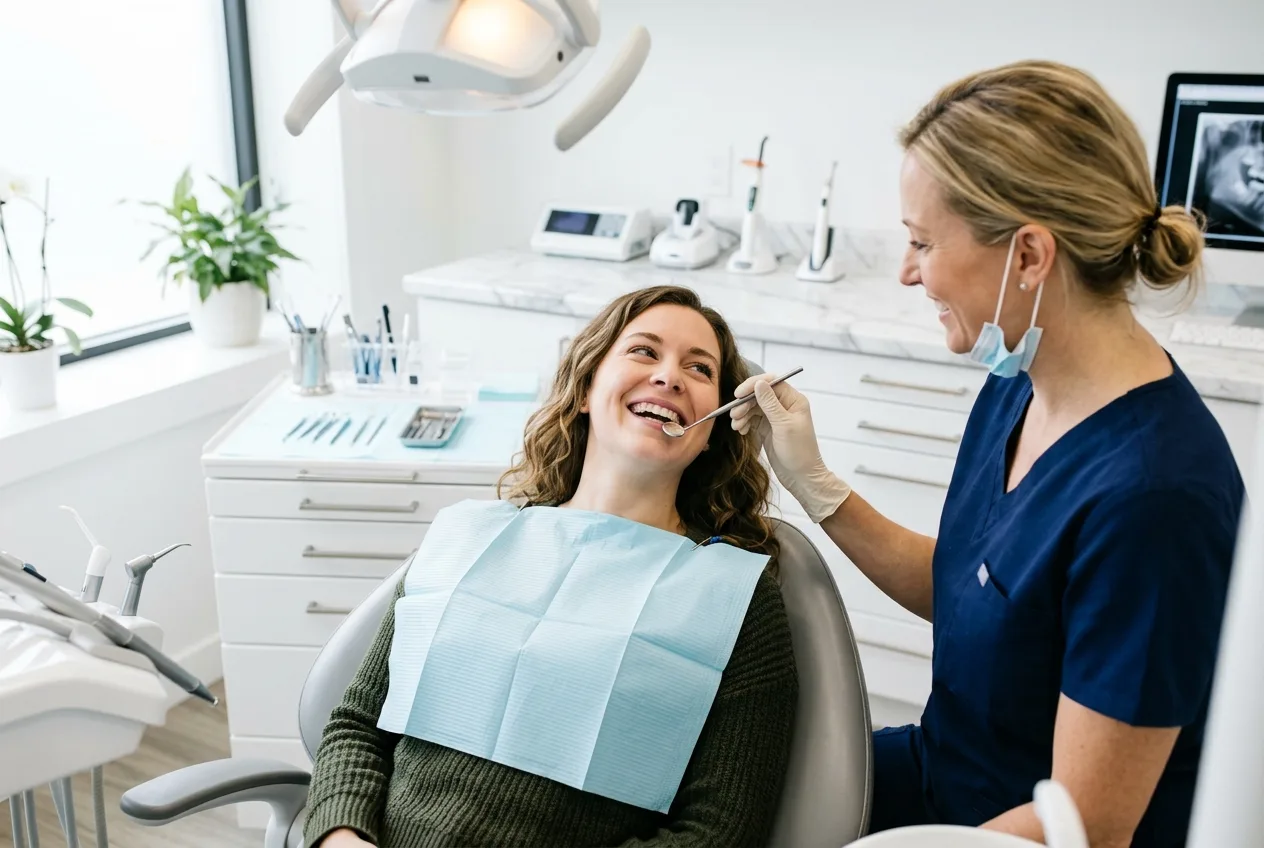
dental supplementary insurance
Find the right dental supplementary insurance at nextsure. Comprehensive protection, digital processing, and tailor-made rates for your most beautiful smile.
Learn moreCost structure for inlays and the statutory-fund subsidy
Billing under the fee schedule
The cost structure for inlays illustrates the massive financial gaps in statutory health insurance very precisely. If a dentist bills an inlay filling covering more than two surfaces, the dentists' fee schedule (Gebührenordnung für Zahnärzte, GOZ) necessarily applies. Item GOZ 2170 regulates this specific service in detail [3]. At an average multiplier of 2.3, the dentist's fee alone comes to around €221. Depending on the complexity, the dentist can apply multipliers from 1.0 to 3.5 times the base rate [3]. A higher multiplier applies, for example, for particularly hard-to-reach teeth or complex cavity preparation.
On top of that come considerable material and lab costs for custom-making the ceramic. These dental lab services often make up the largest part of the total bill. Overall, patients need to expect total costs of around €500 for a single ceramic inlay. Statutory health insurance only covers the cost of a simple amalgam filling as standard care. The system is rigid. Private co-payments are unavoidable for modern filling materials.
The statutory funds' small fixed subsidy
This fixed subsidy from statutory health insurance is extremely small for inlay treatment. For total costs of €500, the fund often pays only around €40 as the basic benefit [5]. Statutory health insurance covers 60 percent of the cost of simple standard care by default, which barely matters for inlays [4]. With an unbroken bonus booklet (Bonusheft) kept for five years, the statutory fund's fixed subsidy rises to 70 percent [4]. After ten years of unbroken documentation, this rises to a maximum of 75 percent of standard care [4]. High-quality treatment such as inlays or implants is not part of standard care, which is why private supplementary insurance makes sense [4]. Without private cover, an out-of-pocket cost of over €450 per tooth thus remains. With several affected teeth, these amounts quickly add up to several thousand euros. Strong supplementary dental insurance is therefore essential. It protects the budget.
Financial planning for treatment
To avoid these high co-payments, many patients check the cost of high-quality ceramic inlays and look for a suitable tariff. The financial burden can be drastically reduced through targeted cover. A detailed treatment and cost plan from the dentist forms the basis for the exact calculation. Patients should always check this plan carefully. The difference between the actual costs and the statutory fund's subsidy defines the necessary insurance cover. Anyone who signs up for cover early protects their personal wealth from unexpected dental expenses. Investing in a good tariff often pays for itself with the first major procedure. A single inlay often covers the annual premium. Careful calculation before treatment begins prevents surprises later when the invoice arrives. Dentists are required to inform patients in advance about the expected out-of-pocket costs.
A comparison of supplementary dental insurance reimbursement models
Different levels of cover
Insurers' reimbursement models differ considerably in their percentage scope of benefits. The market offers tariffs that cover between 70 and 100 percent of the total cost of inlay fillings. A good example of this differentiation is Advigon insurance with its two main tariffs. The Dental Medium (AZM) tariff reimburses 75 percent of the cost of dental treatment and dentures. The Dental Luxus (AZL) tariff, by contrast, offers full reimbursement of 100 percent. These percentage differences directly affect the patient's remaining out-of-pocket cost. Besides inlays, these tariffs also cover crowns, bridges, post crowns, dentures, and implants. Choosing a model requires weighing a cheaper monthly premium against maximum cost certainty. A tariff comparison is worthwhile.
A concrete worked example for five inlays
A concrete worked example illustrates the financial impact of these different reimbursement models very precisely. Suppose a patient needs five inlays, causing total costs of €4,778. In this scenario, statutory health insurance contributes only €218. Under the AZM tariff (75 percent), the insurer reimburses €3,584, leaving an out-of-pocket cost of €1,412. Under the AZL tariff (100 percent), the tariff reimbursement comes to €4,778. The out-of-pocket cost drops to zero. Without any dental inlay insurance at all, the patient would have to pay the remaining €4,560 entirely out of pocket. This example shows the enormous leverage of the right policy. The financial relief for extensive restorations is substantial. This lets patients opt for the best medical solution.
Premium trends by age group
Monthly premiums for these reimbursement models are tiered by age group and change over the term. For young adults up to age 25, the AZM tariff starts at an affordable €5.69 a month. The premium AZL tariff starts at €9.20 a month for this age group. As people get older, the risks for dental procedures rise, which is reflected in the premiums. For the 26-to-35 age group, premiums rise to €14.98 for AZM and €27.90 for AZL. For the 36-to-50 age group, AZM costs €22.60 and AZL €36.90 a month. For policyholders aged 51 to 55, Advigon charges €27.10 for AZM and €43.90 for AZL. Between ages 56 and 60, the rates are €29.80 and €48.00 respectively. From age 61, premiums reach €32.30 and €54.50 respectively. This calculation ensures the tariffs' long-term stability. The premiums are transparent.
| Cost item | AZM tariff (75%) | AZL tariff (100%) | Without supplementary insurance |
|---|---|---|---|
| Statutory fund subsidy | €218 | €218 | €218 |
| Tariff reimbursement | €3,584 | €4,778 | €0 |
| Remaining out-of-pocket cost | €1,412 | €0 | €4,560 |
Calculation example based on Advigon insurance's tariffs.
Benefit limits in the first few contract years
How the tiered scale works
Benefit limits in the first few years protect the pool of policyholders from extreme costs right after signing up. This so-called tiered scale defines maximum amounts that the insurer will pay out in the first 12 to 48 months. Under Advigon's Dental Medium (AZM) tariff, the limit in the first year is €600. In the second year, this amount rises to €1,200. After 36 months, €1,800 is available, and in the fourth year it's €2,400. From month 49 onward, these limits fall away entirely. This industry-standard mechanism prevents customers from signing up for a policy only for an imminent major procedure and then canceling afterward. The system stays fair. Without this cap, monthly premiums for all policyholders would have to rise drastically.
Higher limits in premium tariffs
Premium tariffs naturally offer considerably higher limits within these initial benefit caps. The Dental Luxus (AZL) tariff already provides €1,000 for treatment in the first contract year. Within the first 24 months, this amount doubles to €2,000. After three years, patients can draw up to €3,000, and in the fourth year the limit is €4,000. Here too, the cap falls away entirely after month 48. For patients looking for tariffs with no initial waiting period soon, these amounts are decisive. They determine how much of the first big bill is actually covered. A limit of €1,000 in the first year is often easily enough to cover two high-quality ceramic inlays.
Exceptions to the limit
However, there are important exceptions where these tariff reimbursement limits fall away immediately. The most important exception is accident-related treatment. If an inlay becomes necessary due to a proven accident, the AZM and AZL tariffs pay out the full tariff amount from day one. Another exception is crediting prior insurance periods when switching providers. Anyone who has already had cover for a long time doesn't have to start again from zero. This offers huge advantages for customers wanting to switch. The exact conditions for waiving the tiered scale are clearly defined in the insurance conditions and should be checked before switching. Accident cover is essential. Sports injuries in particular often cause unforeseen costs for dentures that need to be covered immediately.
Reimbursement limits under the Advigon tariffs
- Months 1–12: max. €600 (AZM) / €1,000 (AZL)
- Months 1–24: max. €1,200 (AZM) / €2,000 (AZL)
- Months 1–36: max. €1,800 (AZM) / €3,000 (AZL)
- Months 1–48: max. €2,400 (AZM) / €4,000 (AZL)
- From month 49: unlimited tariff benefits
For accident-related treatment, the limit falls away immediately.
Material choice and modern procedures for inlays
Advantages of ceramic inlays
The choice of material for inlays has a direct effect on the durability and appearance of the dental restoration. Inlays offer considerably longer durability than conventional composite fillings [1]. While amalgam or simple composites often need to be replaced after a few years, high-quality inlay fillings made of ceramic or gold often last decades. Ceramic has become the standard for visible areas, since it perfectly matches natural tooth color. Gold inlays are extremely durable but are chosen less often for aesthetic reasons. Good dental inlay insurance covers the material costs for these premium restorations. Patients don't have to compromise on quality. Investing in durable materials protects tooth structure in the long run, since less frequent drilling is needed.
The computer-assisted Cerec method
Modern treatment techniques such as the Cerec method are revolutionizing how inlay fillings are made at the dental practice. The Cerec method enables computer-assisted production of ceramic inlays in a single dentist appointment [1]. The dentist scans the prepared tooth with a 3D camera, designs the inlay on screen, and mills it immediately from a ceramic block. This spares the patient the unpleasant silicone impression and having to wear a temporary. Modern tariffs such as ERGO Dental-Schutz 100 reimburse 100 percent of the cost of inlays and onlays, including such innovative procedures [2]. The technology justifies the higher cost through enormous convenience. The patient leaves the practice with the final restoration already in place. A second appointment for fitting is no longer needed.
Micro-invasive caries infiltration
Besides treatment with inlays, modern tariffs also cover preventive and micro-invasive procedures. One example is micro-invasive caries infiltration, which allows painless treatment of cavities at an early stage with no drilling. This technique stops the decay process before a larger hole forms that would require an inlay. Advigon's AZM and AZL tariffs explicitly include such treatments beyond the statutory-fund level. The focus shifts from pure repair to long-term tooth preservation. Patients benefit from gentle methods. The insurance covers the cost of these advanced dental innovations. Fissure sealants and special periodontal treatments are also part of the benefits scope of these modern policies. Prevention is the best protection.
Pain therapy and accompanying benefits under supplementary dental insurance
Extended methods of pain relief
Pain therapy is a decisive criterion for many patients when choosing supplementary dental insurance. Especially for elaborate preparation for inlays or onlays, classic local anesthesia isn't enough for some patients. High-quality tariffs offer innovative pain therapies here as an additional benefit. These include acupuncture, treatment under general anesthesia, the use of laughing gas, or twilight sleep. These options are ideal for people with a pronounced fear of the dentist. The AZL tariff reimburses these pain therapies at 100 percent, while AZM covers 75 percent of the cost. Anxious patients thus get the support they need. Statutory health insurance only pays for general anesthesia in absolute exceptional cases, for example for severe physical or psychological conditions. For a normal statutory-fund patient, laughing-gas sedation is a purely private service, which can quickly cost over €100 per session. Comfort increases enormously.
Preventive care as a basic benefit
Besides pain therapy, regular preventive care forms the foundation for lasting dental health and protecting inlays. Professional teeth cleaning (PZR) removes hard plaque and bacteria that could cause secondary decay at the edges of inlay fillings. Advigon's tariffs provide fixed annual budgets for this. Under the AZM tariff, policyholders can draw up to €90 a year for preventive care; under AZL, it's €140. A maximum of €70 is reimbursed per treatment. These budgets encourage regular preventive checkups. In the long run, this considerably lowers the risk of expensive follow-up treatment. A PZR costs between €80 and €120 depending on the effort involved and the practice's location. With the AZL tariff, two professional cleanings a year can thus be largely financed with no issue.
Functional analysis and functional therapy
Another important element when fitting inlays is dental functional analysis and functional therapy. If inlay fillings are not precisely matched to the patient's bite, this can lead to jaw joint complaints or tension. Functional analysis precisely measures jaw movements to optimally design the dentures. Statutory health insurance generally does not cover these benefits. Premium tariffs include functional analysis as an accompanying benefit to dentures. The fit of the inlay is significantly improved through this holistic approach to treatment. Bite splints and night guards prescribed for teeth grinding (bruxism) also fall under these tariff benefits. They protect expensive ceramic inlays from excessive mechanical strain at night. The protection is comprehensive.
Prior insurance periods and switching providers
Waiving the tiered scale
Prior insurance periods play a central role when patients want to switch from an old provider to a new, more comprehensive tariff. Switching is especially worthwhile when the new insurer recognizes the previous contract term. Advigon offers exactly this advantage: anyone switching from another dental policy to AZM or AZL does not lose their valuable prior insurance period. This recognition can lead to the reimbursement limits (tiered scale) being waived immediately. The customer enjoys full insurance cover with no cap from day one. This is a huge competitive advantage. Many older tariffs on the market offer only inadequate benefits for inlays or implants. Upgrading to a 100 percent tariff is possible through this switching option with no financial disadvantage in the first few years.
Requirements for recognition
However, clear requirements must be met for this recognition, which the policyholder has to prove. The prior policy must have run for a minimum of 48 months and transition seamlessly into the new contract. In addition, the old tariff must have offered minimum benefits for dental treatment and dentures of 75 percent (for switching to AZM) or 100 percent (for AZL). The old contract must no longer have had its own reimbursement limits. If these criteria are met, the new insurer treats the customer as if they had already been insured there for four years. The switching process requires care. A broker provides valuable support here. The old contract's notice periods must be precisely coordinated with the start of the new policy to avoid coverage gaps.
Handling ongoing treatment
A critical point in any switch is how already-recommended or ongoing dental treatment is handled. Anyone wanting to sign up for supplementary dental insurance despite treatment already having been recommended often runs into rejection or benefit exclusions. Most insurers, even for tariffs with no waiting period, exclude procedures that were diagnosed before the contract began. It is therefore essential to complete the switch during a phase when the teeth are in good condition and there are no acute diagnoses. The health questions on the application must be answered completely truthfully. False statements lead to loss of cover. If the dentist has already drawn up a treatment and cost plan for an inlay, it's usually too late for a regular new sign-up. Special tariffs for already-recommended treatment are often very expensive.
Requirements for recognizing the prior insurance period
- At least 48 months of uninterrupted cover with the previous insurer.
- A seamless transition with no gap in time to the new tariff.
- Minimum reimbursement of 75% (for AZM) or 100% (for AZL) under the old contract.
- No active reimbursement limits remaining under the old tariff.
Only if all criteria are met does the tiered scale fall away under the new contract.
Choosing a tariff via a digital insurance platform
Curated tariffs instead of a grab-bag
Choosing a tariff in the German market is confusing, which is why a digital insurance platform such as nextsure offers clear added value. Instead of flooding customers with hundreds of unsuitable tariffs, nextsure relies on hand-picked, curated products. This approach avoids the classic grab-bag effect of large comparison portals. The platform analyzes the user's specific needs and only suggests tariffs that offer genuine depth of cover, such as the Advigon or ERGO models. The focus is on niche and specialized insurance products tailored exactly to customers' requirements. Quality clearly beats quantity here. A tariff that reimburses inlays at only 50 percent isn't even recommended in the first place. This pre-selection saves consumers valuable research time.
The digital broker approach
nextsure's digital broker approach combines technological efficiency with legal certainty for the consumer. As a licensed insurance broker under Section 34d of the German Trade Regulation Act (GewO), the platform acts on the customer's behalf, not as an extension of a single insurance company. iMatch GmbH operates nextsure and is listed in the intermediary register with the German Chamber of Industry and Commerce (DIHK) under registration number D-4ZF9-E88H6-53. Comparison, advice, and signing up online are completely free for the end customer. Compensation is paid transparently through commissions from insurers. This process makes it possible to sign up for a complex product such as dental inlay insurance in a legally sound way within minutes. Paperwork is eliminated. Customers manage their policies centrally in a digital dashboard. All contract documents can be found there in one clear place. The digital infrastructure completely replaces the classic filing folder.
Submitting cost estimates digitally
Another advantage of digital administration shows up in a claim, when invoices or plans need to be reviewed. Patients can submit their treatment and cost plan to the insurer in advance to get absolute cost certainty before the procedure. The digital infrastructure considerably speeds up this approval process. Documents are simply submitted by upload, and the claims department reviews the GOZ items promptly. This reduces financial uncertainty for the patient to a minimum. Efficient claims service is a key quality feature of a modern insurance platform. Technology here directly serves the customer's benefit. Once the inlay is fitted, the final invoice is likewise just photographed with a smartphone and uploaded. Reimbursement then usually happens within a few days, directly to the policyholder's account.
Frequently asked questions
- Does statutory health insurance pay for a ceramic inlay?
Statutory health insurance only pays for a ceramic inlay the fixed subsidy set for a simple amalgam filling (standard care). This amount is usually around €40 to €50. The remaining costs, often over €450, stay as an out-of-pocket cost unless private supplementary insurance is in place.
- How much does good supplementary dental insurance reimburse for inlays?
Strong supplementary dental policies reimburse between 75 and 100 percent of the total cost of inlays. Advigon's Dental Luxus (AZL) tariff, for example, covers 100 percent of the cost, while the Dental Medium (AZM) tariff reimburses 75 percent. The exact amount always depends on the terms of the tariff chosen.
- Is there a waiting period for inlays after signing the contract?
Many modern tariffs, such as those from Advigon or ERGO, do away entirely with initial waiting periods. The entitlement to insurance benefits applies from day one. However, a reimbursement limit (tiered scale) generally applies in the first few contract years, capping the maximum payout amount.
- What is the tiered scale and how long does it apply?
The tiered scale is a contractual reimbursement limit in the first few years after signing up. It caps the maximum payout, for example at €1,000 in the first year and €4,000 over the first four years. From the fifth contract year (month 49) onward, this limit generally falls away entirely.
- Can I get around the tiered scale by switching providers?
Yes, some insurers waive the tiered scale when switching seamlessly from an equivalent prior insurer. The usual requirement is that the old contract ran for at least 48 months, no longer had its own limits, and offered a similar level of benefits (e.g. 75% or 100% reimbursement).
- Are modern procedures such as Cerec also reimbursed?
Yes, premium supplementary dental policies cover modern, computer-assisted procedures such as the Cerec method. Here, the ceramic inlay is milled and fitted directly at the practice in a single appointment. The material and lab costs for these innovative techniques are included in the high-quality tariffs.
Sources
Conclude directly online
Verified partner tariffs at no extra cost. The button takes you straight to the provider's calculator.
 Advigon
Supplemental dental insurance
Four supplemental dental tariffs ranging from basic cover to full protection, including children's tariffs with orthodontics.
- Dental Medium premium:
- €5.69-32.30/month depending on age
- Dental Luxus premium:
- €9.20-54.50/month depending on age
- Waiting period:
- none (AZM/AZL)
- Dental treatment: 75% (Dental Medium) or 100% (Dental Luxus)
- Dentures/crowns (Zahnersatz): 75% (AZM; 100% for standard care) or 100% (AZL)
- Preventive dental care: 100% up to €90/year (AZM) or up to €140/year (AZL)
- No waiting periods in Dental Medium and Dental Luxus
- Children's tariffs with orthodontics (KFO): Dental Clever €9.68/month, Dental Premium €18.76/month
- Stiftung Warentest rated Dental Premium "very good" (1.5) (Finanztest 2/25)
Key exclusions
- Reimbursement caps in the first 48 months: AZM €600-2,400, AZL €1,000-4,000 (tiered)
- No explicit benefit exclusions are stated in the available documentation
Stiftung Warentest „SEHR GUT (0,6)“, Finanzen 07/2025 (285 Tarife im Test)
Advigon Zahnzusatzversicherung Dental Luxus (AZL)
MORGEN & MORGEN M&M Rating Zahnzusatz: 5 Sterne „Ausgezeichnet“ (08/2023)
Advigon Versicherung AG, Dental Luxus (AZL)
Reimbursement caps do not apply in the case of an accident, after month 48, or with a recognized prior policy.
Fact sheet: benefits, exclusions and waiting periods in detail
 die Bayerische
Supplemental dental insurance
Supplemental dental cover in three tariffs (Smart, Komfort, Prestige) with no waiting period; the top tariff reimburses 100%.
- Reimbursement:
- 75-100% depending on the tariff
- Waiting period:
- none
- Teeth cleaning:
- €80-200/year depending on the tariff
- Zahn Sofort module:
- €29.90/month, ends after 2 years
- Dentures/crowns and dental treatment: Smart 75%, Komfort 80-100%, Prestige 100%
- Professional teeth cleaning in all tariffs (€80-200 per calendar year)
- No waiting periods in any of the three tariffs
- Orthodontics: €1,500 (including statutory health insurance benefit) or €2,000 (without statutory health insurance benefit) in Komfort and Prestige
- Prestige includes teeth whitening and a Happybrush sonic toothbrush
- Stiftung Warentest 07/2025: Zahn Prestige rated test winner with "very good" (0.5)
Key exclusions
- Treatments recommended or started before the policy began (only covered via the Zahn Sofort module)
- A flat 40% deduction for dentists without statutory-insurance accreditation
- Reimbursement capped at up to 3.5x the dental fee schedule (GOZ) rate
- Abroad, reimbursement is capped at the domestic benefit level
Stiftung Warentest „SEHR GUT (0,5)“, Ausgabe 07/2025 (285 Tarife im Test)
die Bayerische, Tarif ZAHN Prestige
ASCORE „Tarif des Jahres 2024“ (Krankenzusatz Zahn)
die Bayerische, Zahn Prestige 2023
Levelnine Rating „EXZELLENT“ (Stand 11/2024, gültig bis 11/2025)
die Bayerische, Tarif ZAHN Prestige
Benefit tiering: €500 in year 1 (Smart), €1,250 (Komfort), or €1,500 (Prestige); unlimited from calendar year 5; caps also do not apply in the case of an accident.
Fact sheet: benefits, exclusions and waiting periods in detail
Advigon Supplemental dental insurance: Benefits: Dental Medium (AZM) and Dental Luxus (AZL)
| Benefit | Dental Medium (AZM) | Dental Luxus (AZL) |
|---|---|---|
| Dental treatment | 75% | 100% |
| Pain therapy | 75% | 100% |
| Preventive dental care | 100% up to €90/year | 100% up to €70 per treatment, up to €140/year |
| Dentures/crowns | 75% (100% for standard care) | 100% |
| Monthly premium by age | €5.69-32.30 | €9.20-54.50 |
die Bayerische Supplemental dental insurance: Tariff comparison: Smart, Komfort, Prestige
| Benefit | Smart | Komfort | Prestige |
|---|---|---|---|
| Dentures/crowns (above standard care) | 75% | 80-90% | 100% |
| Dentures/crowns (up to standard care) | 75% | 100% | 100% |
| Dental treatment | 75% | 100% | 100% |
| Professional teeth cleaning | €80/calendar year | €100 per treatment, max. €150/year | €100 per treatment, max. €200/year |
| Orthodontics | not included | €1,500 (incl. statutory insurance) / €2,000 (excl. statutory insurance) | €1,500 (incl. statutory insurance) / €2,000 (excl. statutory insurance) |
| Teeth whitening | not included | not included | included |
| Example annual premium (age 33) | €152.40 | €244.80 (rural) / €321.60 (urban) | €405.60 (rural) / €529.20 (urban) |
All details are taken from the provider's linked product page and the contract documents (IPID/policy conditions) published there; the insurer's documents prevail. Premiums, benefits and the insurance product itself may change – please verify the details directly with the partner before signing up; only the information provided there is binding.
Information last updated: July 2026 · Source: provider product information (IPID/policy conditions)