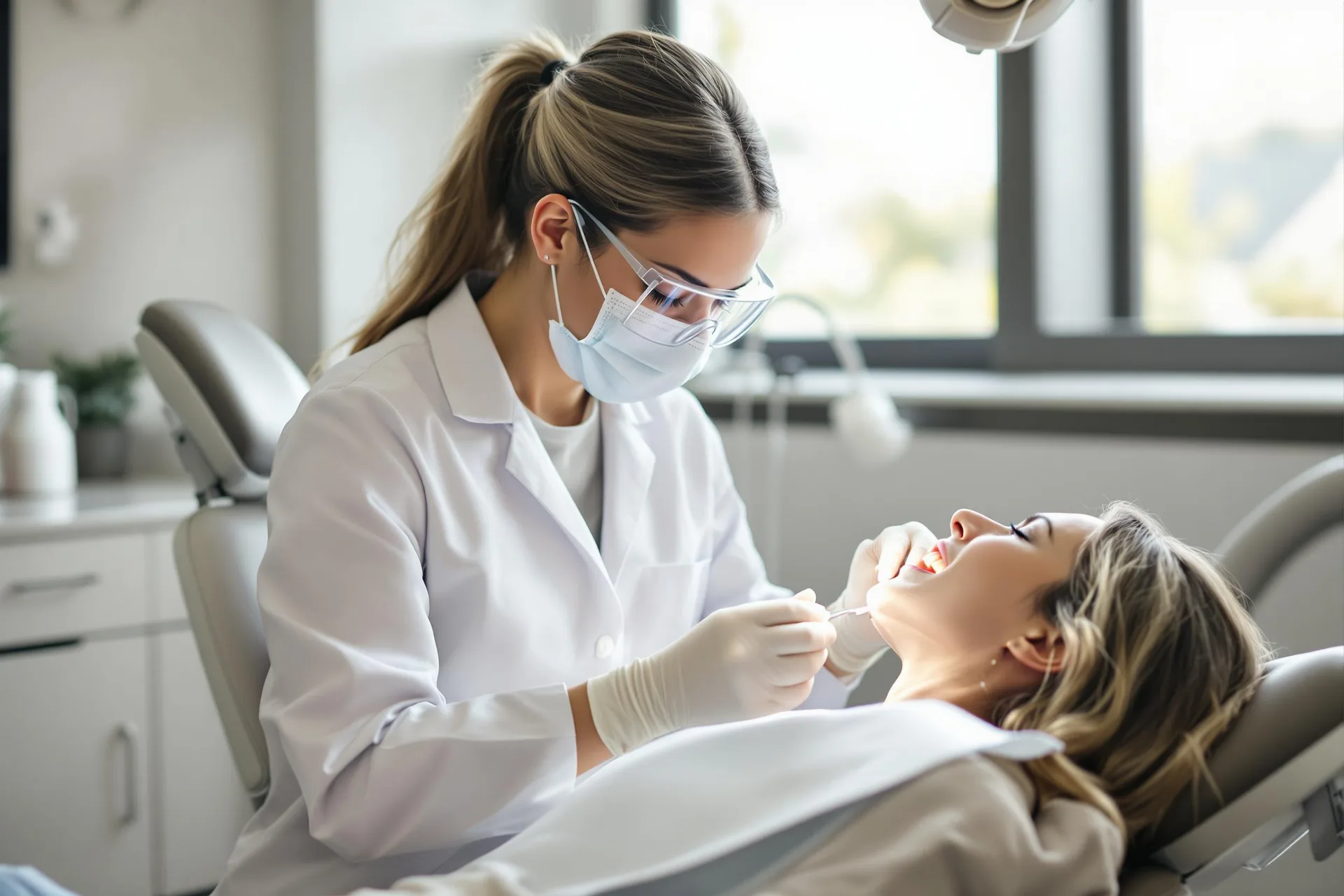
Dental cleaning private health insurance
Find out how your private health insurance covers the costs of dental cleaning. Find out more and optimise now at nextsure!
 Katrin StraubManaging DirectorInsurance expert with over 20 years of experience in the insurance industry.
Published on
Last updated on
7 min read
Table of Contents
Dental cleaning and private health insurance: optimising costs, maximising benefits
A professional dental cleaning is essential for healthy teeth, but the costs can vary. Find out how your private health insurance can support you in the best possible way and which plans offer the best benefits.
Quick Facts: Understanding dental cleaning and private health insurance benefits
Professional teeth cleaning (PZR) thoroughly removes bacterial deposits. It effectively prevents tooth decay and periodontitis. Many private health insurers cover the costs. They pay for one or two PZR sessions per year. The exact scope depends heavily on the chosen tariff. Statutory health insurers often only pay a small subsidy. Private health insurance usually offers much better terms here. A PZR usually takes between forty-five and sixty minutes. This investment in your dental health pays off in the long term. Knowing these basics helps you to make full use of the benefits of your insurance.
Analysing the costs and reimbursement of dental cleaning by private health insurance
The cost of a professional dental cleaning is usually between eighty and one hundred and twenty euros. In large cities or where more effort is involved, prices can exceed one hundred and fifty euros. Billing is carried out in accordance with the Scale of Fees for Dentists (GOZ). In most cases, code one hundred and forty is used. The dentist can adjust the multiplier. A factor of 2.3 is standard. Many tariffs of private health insurance reimburse these costs. Often this is up to one hundred per cent. You submit the invoice to your insurer. You then receive the amount back. Check the exact terms and conditions of your tariff in advance. The level of reimbursement can vary considerably. Secure the best possible cost coverage.
Key factors in cost reimbursement
Reimbursement for dental cleaning depends on several factors. You should be aware of these:
- Tariff agreements: The level of reimbursement is set out in the tariff.
- Frequency: Many tariffs limit the number of reimbursable dental cleanings. Often the limit is one to two per year.
- GOZ multiplier: The insurer may only reimburse up to a certain multiplier. Examples are 2.3 times or 3.5 times.
- Dental allowance schedule: In the first years of the policy, a dental allowance schedule may limit the amount reimbursed.
- Excess: An agreed excess can reduce the reimbursement amount.
A precise understanding helps avoid surprises when billing. Next, we will look at frequency and tariff selection.
Ensure the optimal frequency and tariff selection for dental cleaning
Dentists generally recommend one to two professional dental cleanings per year. This frequency helps to maintain oral health at an optimal level. Many private health insurance plans cover these one to two treatments. When choosing your dental supplementary insurance plan, look for PZR coverage. Pay attention to the reimbursement amount per treatment. Some plans set upper limits here. A good plan covers at least one hundred euros per PZR. Also compare whether PZR is counted towards premium refunds. This affects the plan’s attractiveness. Choosing the right plan ensures your long-term satisfaction.
Understanding the legal framework and GOZ billing
Professional teeth cleaning is billed according to the Schedule of Fees for Dentists (GOZ). The relevant code is usually GOZ one hundred and forty. This code assesses the service per tooth. It also applies to the interdental space or implant. The dentist can multiply the basic fee rate. The two point three-fold rate is common for average effort. For increased effort, up to the three point five-fold rate may be charged. However, this requires justification. Transparency is important here: Ask for a cost estimate in advance. The costs of private health insurance can be influenced by such details. The GOZ was last revised in two thousand and twelve. Understanding these basics helps when checking your dental bill. This ensures correct billing.
Expert tips: Make full use of dental cleaning and private health insurance benefits
Make the most of the benefits of your private health insurance. Please note a few points. Before treatment, clarify cost coverage with your insurer. Always submit invoices in full and promptly. Make full use of your plan’s PZR intervals. These are usually once or twice a year. Compare dental supplementary insurance without a waiting period if your private health insurance has gaps. Our expert tip: document agreements and estimates carefully. Some plans even offer higher reimbursements with certain contracted dentists. Ask your insurer about such networks. Good planning secures you the best benefits. This highlights the importance of individual advice.
Important aspects for your decision
When choosing and using your private health insurance for dental cleanings, you should consider the following points:
- Check the exact wording in the insurance policy regarding preventive care.
- Find out the maximum number of reimbursable PZR treatments per year.
- Clarify up to which GOZ rate the costs are covered.
- Pay attention to any waiting periods or initial benefit limitations (dental scale).
- Find out whether PZR costs affect any possible premium refunds.
- Compare whether a dental supplementary insurance could be worthwhile.
These considerations help you make the most of the benefits of your private health insurance. The right cover is an important building block for your health.
The role of dental cleaning in long-term oral health
Professional dental cleaning is more than just a cosmetic measure. It removes plaque and tartar from hard-to-reach areas. This significantly reduces the risk of caries and periodontitis. Regular professional dental cleaning helps avoid costly follow-up treatments. These include fillings or dentures. Studies suggest that regular users of professional dental cleaning need dentures less often. Professional dental cleaning is an investment in the long-term preservation of your teeth. The cost of supplementary dental insurance quickly pays for itself here. Your private health insurance supports you with this important preventive service. That way, your smile stays beautiful and healthy.
Differences compared with statutory health insurance (GKV) for dental cleaning
Unlike private health insurance, professional teeth cleaning is not a standard benefit of statutory health insurance. Statutory health insurers often do not cover the costs, or only partially. Subsidies are often only between twenty-five and seventy euros a year. Some insurers offer professional teeth cleaning through bonus programmes or contracted dentists. Those with private insurance benefit from more comprehensive benefits here. Private health insurance usually reimburses professional teeth cleaning at eighty to one hundred per cent. The frequency of cost coverage is often more generously regulated in private health insurance. This difference makes the private health insurance more attractive for dental preventive care. The choice of system directly affects your dental health and your wallet.
Benefit from personalised advice for optimal protection
The range of private health insurance plans is diverse. Comprehensive niche insurance policies and tailored cover solutions are our speciality. We help you find the right plan. A professional dental cleaning is an important building block for your health. With the right cover, you needn’t worry about costs. Our mission: to provide you with tailored, easy-to-understand solutions. An individual risk analysis shows you specific optimisation suggestions. Let us review your insurance situation free of charge. We are happy to support you in securing the best protection for your teeth.
Frequently asked questions
- Does my private health insurance fully cover the cost of dental cleaning?
Whether your private health insurance covers the costs in full depends on your specific tariff. Many tariffs reimburse one hundred per cent, while others provide for percentage shares or maximum amounts. A look at your policy terms or an enquiry with us will clarify this.
- How do I submit the invoice for the dental cleaning to my private health insurance?
You first pay the invoice yourself at the dentist. You then submit the original invoice to your private health insurance provider for reimbursement, usually by post or digitally via an app.
- Will I have to pay an excess for the dental cleaning?
This depends on your private health insurance tariff. Some tariffs have a general annual excess or specific excesses for dental services. Please check this in your documents.
- What happens if my dentist charges a higher GOZ rate than usual?
A multiplier above the 2.3-fold rate must be justified in writing by the dentist if they bill at up to the 3.5-fold rate. Please clarify in advance with your insurer up to which rate the costs are covered. At nextsure, we will be happy to advise you on such details.
- Can I claim the cost of dental cleaning as a tax deduction?
Expenses for medically necessary treatments that are not reimbursed by the insurance may, in some circumstances, be claimed for tax purposes as extraordinary burdens. This also applies to private dental supplementary insurance. The best thing to do is to speak to your tax adviser about this.
- Is dental supplementary insurance worth it despite good private health insurance benefits for dental cleaning?
It depends on your individual needs and the scope of cover provided by your private health insurance. A dental supplementary insurance can be useful if your private health insurance, for example, has gaps in dentures or orthodontics (children’s braces insurance), or if you have specific requirements that go beyond professional dental cleaning (PZR).
Sources
- [1]The Federal Dental Association provides a comprehensive statement on professional dental cleaning as a preventive measure against caries and periodontal disease.
- [2]Statista provides data on consumer price trends for oral care products in Germany.
- [3]The IGeL-Monitor of the AOK Federal Association assesses professional dental cleaning in terms of its benefits.
- [4]The Federal Statistical Office (Destatis) provides detailed information on healthcare expenditure in Germany.
- [5]On the Federal Statistical Office's website, you will find tables on the types of healthcare expenditure.
- [6]The Federal Ministry of Health provides data and facts on health in Germany for 2022.
- [7]Further data and facts on health from 2021 are also available on the website of the Federal Ministry of Health.
Free advice on this topic
Our experts advise you without obligation and find the right cover: online or by phone.
- Free & non-binding
- 100% digital