
Claim dental supplementary insurance as a tax deduction
Find out how you can claim your private dental supplementary insurance as a tax deduction and save money. Find out more at nextsure now!
All details are taken from the provider's linked product page and the contract documents (IPID/policy conditions) published there; the insurer's documents prevail. Premiums, benefits and the insurance product itself may change – please verify the details directly with the partner before signing up; only the information provided there is binding.
 Katrin StraubManaging DirectorInsurance expert with over 20 years of experience in the insurance industry.
Published on
Last updated on
4 min read
Table of Contents
Can you deduct contributions for your private dental supplementary insurance from your taxes and thus reduce your financial burden? Yes, this is possible under certain conditions. Find out here how you can claim your dental supplementary insurance for tax purposes and save real money.
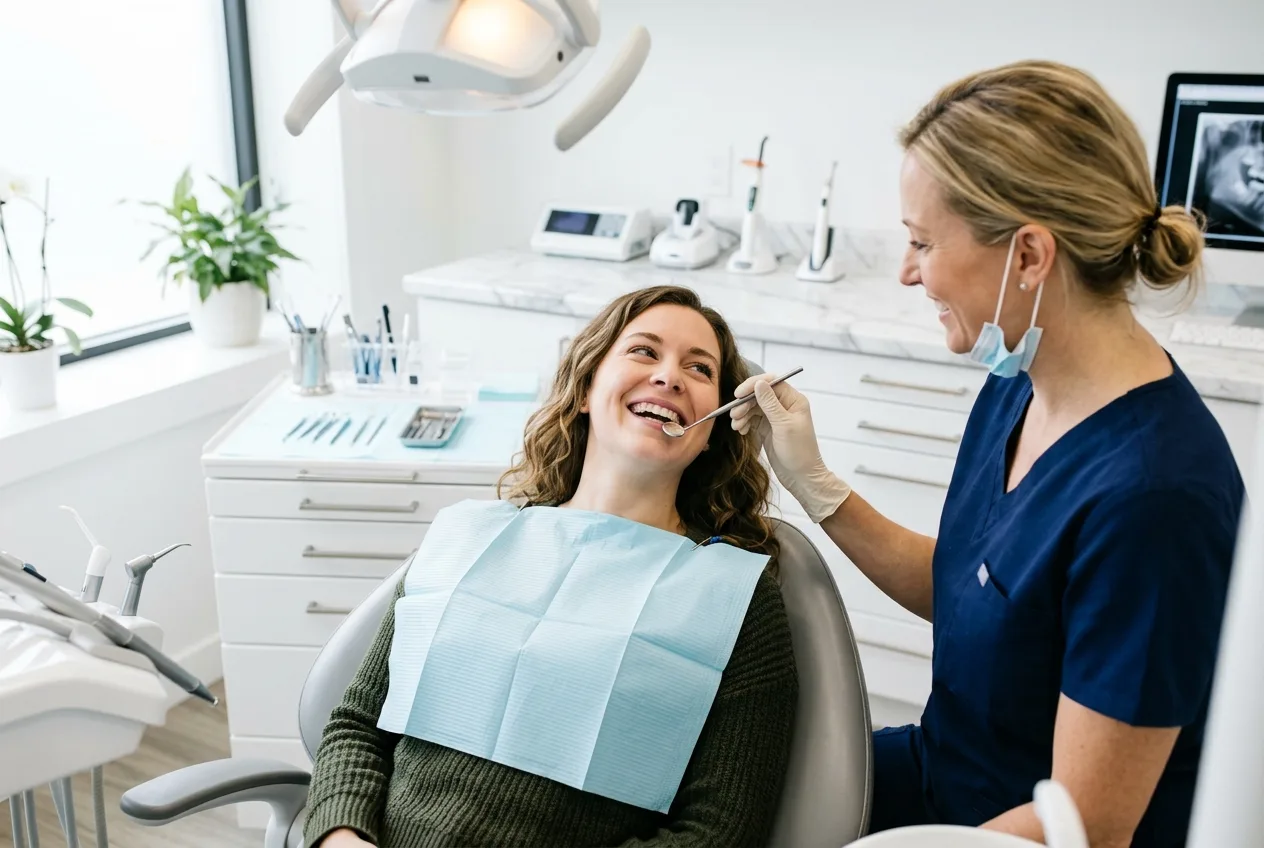
dental supplementary insurance
Find the right dental supplementary insurance at nextsure. Comprehensive protection, digital processing, and tailor-made rates for your most beautiful smile.
Learn moreUnderstanding the basics of tax deductibility
Contributions to private dental supplementary insurance are counted among other retirement provisions. You can declare these in your income tax return. This option has existed since two thousand and eight. What is decisive is that the maximum amounts for retirement provisions are not exceeded. These vary depending on the group of people. For many employees, this maximum amount is often already reached through contributions to health and long-term care insurance. Nevertheless, it is worth taking a close look at your individual situation. The dental supplementary insurance offers financial benefits.
Maximum amounts for pension provision expenses in detail
For tax deductibility, annual maximum amounts are relevant. For employees and pensioners, this amount is €1,900. Self-employed people benefit from a higher amount of €2,800. This distinction takes into account that self-employed people bear their insurance contributions in full themselves. For married couples, these amounts can be doubled or combined, depending on their employment situation. For example, the maximum amount for married couples in which both partners are employees is €3,800. A precise understanding of these limits is important for the deductibility of insurance premiums.
Who benefits the most?
Tax deductibility is particularly advantageous for certain groups of people. Students often pay low health and long-term care insurance contributions. This leaves more room before the maximum amount is reached. Low earners can also benefit more often. Family-insured dependants without their own health insurance contributions often do not make full use of the maximum amount. For these groups, claiming dental supplementary insurance can mean a noticeable tax saving. The cost of dental supplementary insurance is thereby reduced.
Practical guide: Enter dental supplementary insurance in your tax return
Contributions to supplementary dental insurance belong in the retirement provision expenses annex. This annex is part of your income tax return. For those insured under the statutory scheme, line twenty-two is relevant (as of tax year two thousand and twenty-three). Privately insured persons enter their contributions in line twenty-seven. In the ELSTER programme, you will find the section under “Optional services and supplementary insurance”. Please ensure that you only state the contributions actually paid, less any contribution refunds. Careful documentation is essential here. Information on entering insurance policies can help further.
The following points should be noted when completing the form:
- Use the correct annex: the retirement provision expenses annex.
- Note the correct line number: varies for statutory and privately insured persons.
- Take contribution refunds into account: enter only the net amount.
- Observe deadlines: usually 31 July of the following year.
- Keep supporting documents ready: for any queries from the tax office.
These steps ensure your expenses are declared correctly.
Expert knowledge: special cases and additional savings opportunities
In addition to contributions to dental supplementary insurance, dental treatment costs themselves can also be tax-deductible. These fall under extraordinary expenses. The tax office checks whether a reasonable burden threshold applies. This threshold depends on income, marital status and number of children. Our expert tip: Collect all receipts for healthcare costs. Sometimes it makes sense to bundle treatments in a single calendar year. That way you are more likely to exceed the reasonable burden threshold. Costs for eyeglass insurance may also be relevant.
Civil servants and students: Special rules
The maximum amount of 1,900 euros also applies to civil servants. As they receive benefits, their own health insurance contributions are often lower. This can create room for deducting dental supplementary insurance. Students usually pay low health insurance contributions. As a result, it is highly likely that they have not yet used up the maximum amount. It is often particularly worthwhile for students to claim it.
Married couples: Make use of joint assessment
Married couples who are assessed jointly can add together their maximum amounts. If both partners are employees, the joint maximum amount is 3,800 euros. If one partner is self-employed and the other an employee, it is 4,700 euros. If both are self-employed, the amount rises to 5,600 euros. This rule often offers significant advantages. A health supplementary insurance policy can also be taken into account here.
Strategies for maximising your tax savings
To get the most out of your tax return, careful planning is important. Check each year whether your retirement-related expenses reach the maximum deductible amount. Take all deductible insurance policies into account, not just supplementary dental insurance. A supplementary dental insurance without a waiting period can provide immediate cover. Also consider the deductibility of out-of-pocket medical expenses as exceptional burdens. Good organisation of your documents throughout the year is worth its weight in gold. This way, you will not forget any deductible items.
Here are some recommendations for action:
- Check your annual contributions to health and long-term care insurance.
- Determine the remaining room up to the maximum amount for other retirement-related expenses.
- List all contributions for supplementary insurance policies (e.g. dental, accident and personal liability insurance).
- Collect receipts for out-of-pocket medical expenses (dentist, glasses, physiotherapy).
- Check whether bundling treatments in one year makes sense.
- If filing jointly as a married couple, make use of the combined maximum amounts.
- Only declare contributions actually paid after deducting reimbursements.
Careful preparation can significantly reduce your tax burden.
Conclusion: Tax deductibility as an important advantage
The opportunity to deduct private dental supplementary insurance for tax purposes offers considerable savings potential. Even if the maximum amounts are often already used up by basic cover, certain groups such as students or low earners benefit. A careful review of your own situation and knowledge of the correct entry in the tax return are crucial. The nextsure experts will be happy to help you choose the right dental supplementary insurance and advise you on your options. Bear in mind that even high out-of-pocket costs for dental treatment may, in some circumstances, be claimed as extraordinary expenses. Make use of these options to optimise your financial burden.
Frequently asked questions
- What is the maximum amount for retirement provision expenses for employees?
For employees, pensioners and civil servants, the maximum amount for other provision expenses, which includes supplementary dental insurance, is one thousand nine hundred euros per year.
- What if I receive a premium refund from my supplementary dental insurance?
If you receive a premium refund, you must deduct this amount from the contributions you have paid. Only the actual expenses incurred are tax-deductible.
- Do married couples particularly benefit from deductibility?
Yes, married couples who are jointly assessed can add together their maximum allowances for pension provision expenses. Depending on their professional situation, the joint maximum allowance can rise to as much as EUR 5,600.
- Do I have to submit proof of supplementary dental insurance with my tax return?
As a rule, you do not need to submit the supporting documents directly with your tax return. However, the tax office may request them later. You should therefore keep the contribution certificates from your insurer in a safe place.
- Which line is relevant for dental supplementary insurance in ELSTER?
In the ELSTER programme, you will find the relevant section for dental supplementary insurance under the item „Optional services and supplementary insurance“ in the Vorsorgeaufwand annex.
- What are exceptional burdens in connection with dental costs?
Exceptional expenses are private costs that inevitably arise and significantly affect financial capacity. This can include medical expenses paid out of pocket, such as high dental bills, if they exceed an individually calculated reasonable burden threshold.
Sources
- [1]The Federal Ministry of Finance offers detailed information on the deduction of special expenses for pension provisions.
- [2]The Finance Office of North Rhine-Westphalia provides information on assumed contributions to health and long-term care insurance.
- [3]The Federal Statistical Office (Destatis) provides statistical data on health insurance coverage in Germany.
- [4]The Federal Ministry of Health provides information about private health insurance.
- [5]The Consumer Advice Centre highlights the risks and benefits of supplementary dental insurance.
- [6]The Federal Fiscal Court offers insights into decisions of Germany’s highest court for tax and customs matters.
- [7]The German Pension Insurance provides information on tax law for insured persons and retirees.
- [8]gesund.bund.de provides comprehensive information on dental prevention and oral hygiene.
Conclude directly online
Verified partner tariffs at no extra cost. The button takes you straight to the provider's calculator.
 Advigon
Supplemental dental insurance
Four supplemental dental tariffs ranging from basic cover to full protection, including children's tariffs with orthodontics.
- Dental Medium premium:
- €5.69-32.30/month depending on age
- Dental Luxus premium:
- €9.20-54.50/month depending on age
- Waiting period:
- none (AZM/AZL)
- Dental treatment: 75% (Dental Medium) or 100% (Dental Luxus)
- Dentures/crowns (Zahnersatz): 75% (AZM; 100% for standard care) or 100% (AZL)
- Preventive dental care: 100% up to €90/year (AZM) or up to €140/year (AZL)
- No waiting periods in Dental Medium and Dental Luxus
- Children's tariffs with orthodontics (KFO): Dental Clever €9.68/month, Dental Premium €18.76/month
- Stiftung Warentest rated Dental Premium "very good" (1.5) (Finanztest 2/25)
Key exclusions
- Reimbursement caps in the first 48 months: AZM €600-2,400, AZL €1,000-4,000 (tiered)
- No explicit benefit exclusions are stated in the available documentation
Stiftung Warentest „SEHR GUT (0,6)“, Finanzen 07/2025 (285 Tarife im Test)
Advigon Zahnzusatzversicherung Dental Luxus (AZL)
MORGEN & MORGEN M&M Rating Zahnzusatz: 5 Sterne „Ausgezeichnet“ (08/2023)
Advigon Versicherung AG, Dental Luxus (AZL)
Reimbursement caps do not apply in the case of an accident, after month 48, or with a recognized prior policy.
Fact sheet: benefits, exclusions and waiting periods in detail
 die Bayerische
Supplemental dental insurance
Supplemental dental cover in three tariffs (Smart, Komfort, Prestige) with no waiting period; the top tariff reimburses 100%.
- Reimbursement:
- 75-100% depending on the tariff
- Waiting period:
- none
- Teeth cleaning:
- €80-200/year depending on the tariff
- Zahn Sofort module:
- €29.90/month, ends after 2 years
- Dentures/crowns and dental treatment: Smart 75%, Komfort 80-100%, Prestige 100%
- Professional teeth cleaning in all tariffs (€80-200 per calendar year)
- No waiting periods in any of the three tariffs
- Orthodontics: €1,500 (including statutory health insurance benefit) or €2,000 (without statutory health insurance benefit) in Komfort and Prestige
- Prestige includes teeth whitening and a Happybrush sonic toothbrush
- Stiftung Warentest 07/2025: Zahn Prestige rated test winner with "very good" (0.5)
Key exclusions
- Treatments recommended or started before the policy began (only covered via the Zahn Sofort module)
- A flat 40% deduction for dentists without statutory-insurance accreditation
- Reimbursement capped at up to 3.5x the dental fee schedule (GOZ) rate
- Abroad, reimbursement is capped at the domestic benefit level
Stiftung Warentest „SEHR GUT (0,5)“, Ausgabe 07/2025 (285 Tarife im Test)
die Bayerische, Tarif ZAHN Prestige
ASCORE „Tarif des Jahres 2024“ (Krankenzusatz Zahn)
die Bayerische, Zahn Prestige 2023
Levelnine Rating „EXZELLENT“ (Stand 11/2024, gültig bis 11/2025)
die Bayerische, Tarif ZAHN Prestige
Benefit tiering: €500 in year 1 (Smart), €1,250 (Komfort), or €1,500 (Prestige); unlimited from calendar year 5; caps also do not apply in the case of an accident.
Fact sheet: benefits, exclusions and waiting periods in detail
Advigon Supplemental dental insurance: Benefits: Dental Medium (AZM) and Dental Luxus (AZL)
| Benefit | Dental Medium (AZM) | Dental Luxus (AZL) |
|---|---|---|
| Dental treatment | 75% | 100% |
| Pain therapy | 75% | 100% |
| Preventive dental care | 100% up to €90/year | 100% up to €70 per treatment, up to €140/year |
| Dentures/crowns | 75% (100% for standard care) | 100% |
| Monthly premium by age | €5.69-32.30 | €9.20-54.50 |
die Bayerische Supplemental dental insurance: Tariff comparison: Smart, Komfort, Prestige
| Benefit | Smart | Komfort | Prestige |
|---|---|---|---|
| Dentures/crowns (above standard care) | 75% | 80-90% | 100% |
| Dentures/crowns (up to standard care) | 75% | 100% | 100% |
| Dental treatment | 75% | 100% | 100% |
| Professional teeth cleaning | €80/calendar year | €100 per treatment, max. €150/year | €100 per treatment, max. €200/year |
| Orthodontics | not included | €1,500 (incl. statutory insurance) / €2,000 (excl. statutory insurance) | €1,500 (incl. statutory insurance) / €2,000 (excl. statutory insurance) |
| Teeth whitening | not included | not included | included |
| Example annual premium (age 33) | €152.40 | €244.80 (rural) / €321.60 (urban) | €405.60 (rural) / €529.20 (urban) |
All details are taken from the provider's linked product page and the contract documents (IPID/policy conditions) published there; the insurer's documents prevail. Premiums, benefits and the insurance product itself may change – please verify the details directly with the partner before signing up; only the information provided there is binding.
Information last updated: July 2026 · Source: provider product information (IPID/policy conditions)