

Claim dental supplementary insurance as a tax deduction
Find out how you can claim your supplementary dental insurance as a provision expense on your tax return and what the maximum amounts are. Find out more now!
All details are taken from the provider's linked product page and the contract documents (IPID/policy conditions) published there; the insurer's documents prevail. Premiums, benefits and the insurance product itself may change – please verify the details directly with the partner before signing up; only the information provided there is binding.
 Katrin StraubManaging DirectorInsurance expert with over 20 years of experience in the insurance industry.
Published on
Last updated on
7 min read
Table of Contents
A good dental insurance policy protects you from high costs, but did you know that you can get part of your contributions back from the tax office? Many policyholders miss out on this opportunity because the rules seem complex. We’ll show you how to claim dental insurance as a tax deduction and what really matters.
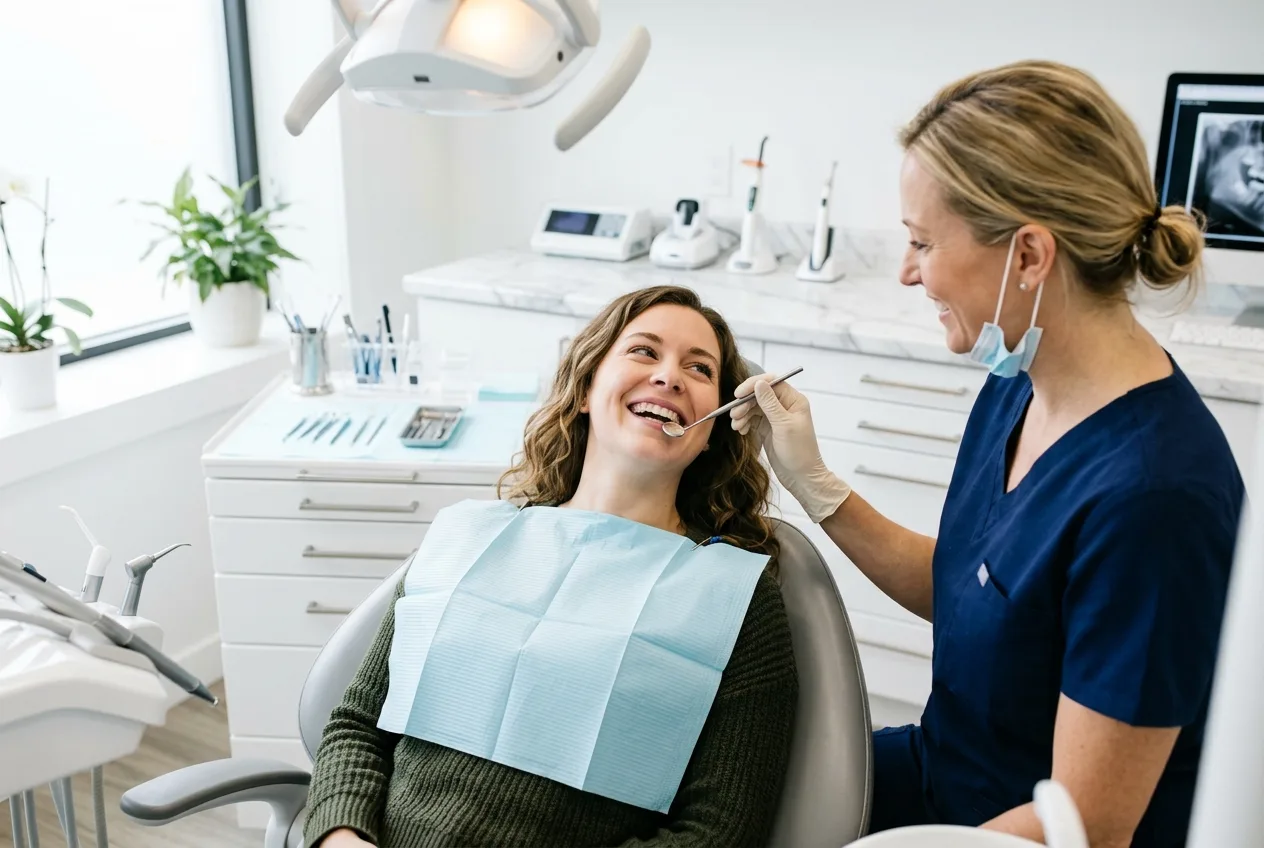
dental supplementary insurance
Find the right dental supplementary insurance at nextsure. Comprehensive protection, digital processing, and tailor-made rates for your most beautiful smile.
Learn moreBasics: How the tax office treats your insurance
Contributions for dental supplementary insurance are treated for tax purposes as “other precautionary expenses” in accordance with Section ten of the Income Tax Act (EStG). They therefore fall into the same category as, for example, contributions to liability or accident insurance. The tax office clearly distinguishes these from contributions to basic, health and long-term care insurance, which are almost always fully deductible. However, there are strict annual limits for other precautionary expenses, which often restrict the tax benefit. Understanding this system is the first step in assessing your potential tax savings. Correct classification is crucial for the next steps in your insurance and tax.
This distinction is the reason why deductibility does not automatically lead to a direct tax refund in every case. It depends on how much “room” remains below the statutory maximum amounts after your primary insurance contributions have been taken into account.
Limiting factor: The annual maximum amounts
The decisive factor in deductibility is the statutory maximum amounts for other insurance expenses. For employees, civil servants and pensioners, this limit is EUR 1,900 per year. Self-employed people who pay their health insurance contributions in full themselves can claim up to EUR 2,800. In most cases, these amounts are already fully used up by contributions to statutory health and long-term care insurance alone. An employee with a gross income of EUR 45,000 already pays more than EUR 4,000 a year for health insurance alone and therefore easily reaches the maximum amount. Therefore, declaring supplementary dental insurance often results in no additional tax saving for many taxpayers.
For married couples who are assessed jointly, the maximum amounts are doubled accordingly to EUR 3,800 (both employed) or up to EUR 5,600 (both self-employed). Despite the higher limits, the challenge remains the same, as the joint contributions to basic cover are correspondingly higher. A precise review of which insurance policies are tax-deductible is therefore essential.
Practical scenarios: Four cases where a write-off is worthwhile
Although the maximum limits present an obstacle, there are four typical scenarios in which you can claim your dental supplementary insurance for tax purposes. Low earners and those insured free of charge often benefit in particular. In these cases, the contributions for basic cover are so low that the maximum limit of 1,900 euros is not reached.
Here are four examples in which tax relief is likely to apply:
- Students: They often pay reduced health insurance contributions, leaving room for supplementary insurance below the maximum limit of 1,900 euros.
- Family members insured free of charge: Spouses or children who are co-insured with the statutory health insurance provider do not pay their own contributions and can use the full maximum limit for their private supplementary insurance.
- Civil servants entitled to allowances: Since the allowance covers a large portion of medical expenses, contributions to private health insurance are often low enough not to exceed the threshold.
- Mini-job workers: Anyone in a mini-job who pays flat-rate social insurance contributions may also have individual pension-related expenses below the 1,900-euro limit.
These examples show that a blanket statement is not possible and that an individual review is always worthwhile.
Expert tips for correctly entering information in the tax return
Correct information in your tax return is crucial to preserve the chance of tax savings. The contributions to dental supplementary insurance belong in the „Anlage Vorsorgeaufwand“. The tax office needs this information to check the deductible amounts, even if no refund is ultimately due. Incorrect entries can lead to queries or an incorrect calculation.
Here is how to enter the values correctly:
- Statutorily insured persons: Use line 22 of the Anlage Vorsorgeaufwand for „Contributions to health insurance that exceed basic cover“.
- Privately insured persons: Line 27 is intended for them to enter the contributions for optional and supplementary benefits.
- Check data transmission: Contributions to basic health and long-term care insurance are transmitted electronically to the tax office directly by your health insurance provider.
Our expert tip: Request a certificate of the contributions paid from your insurer for the tax office. Many insurers now provide this automatically in the customer portal. This document lists the deductible optional and supplementary benefits separately and makes it much easier for you to enter them. This ensures that you know where the insurance policies should be entered.
Legal Framework and Optimisation Strategies
The tax treatment of pension expenses is governed by section ten of the Income Tax Act (EStG). This Act defines precisely which expenses count towards basic provision and which are regarded as “other” expenses. Case law, for example rulings by the Federal Fiscal Court, regularly confirms that purely comfort- or optional benefits such as a private supplementary dental insurance policy do not count as tax-favoured basic cover. As a result, these costs can only be taken into account within the limits of the applicable maximum amounts.
Our expert tip: If you are privately insured, check the structure of your tariff. Some contracts combine basic and supplementary benefits. Ask your insurer for a breakdown of the premium components. Only then can you ensure that the basic portion is correctly applied in full and the supplementary portion is taken into account within the maximum amounts. A clear separation is crucial for maximising your tax savings.
Conclusion: Sensible protection with a potential tax benefit
The ability to claim dental supplementary insurance as a tax deduction is a welcome bonus, but should not be the main reason for taking out a policy. Its primary value lies in protection against high out-of-pocket costs, which can quickly run into several thousand euros. For most employees on an average income, claiming the deduction does not lead to a direct tax refund because the maximum thresholds have already been used up. Nevertheless, certain groups such as students, those covered by family insurance or civil servants benefit noticeably. Regardless of the tax effect, it is always advisable to declare the premiums on your tax return. The tax office checks the allowance automatically, so you will not be at a disadvantage. The real question is not what dental supplementary insurance costs, but what financial protection it provides.
Ultimately, protecting your dental health is an important investment in your well-being. The potential tax advantage is a welcome side benefit that rounds off your financial planning.
Frequently asked questions
- What is the maximum amount that can be deducted for dental supplementary insurance?
The maximum amount applies to all other provision expenses combined. It is EUR 1,900 per year for employees, pensioners and civil servants and EUR 2,800 for self-employed people and freelancers.
- Do I need to send the tax office proof of the contributions?
No, usually not. The data on your basic health insurance contributions are transmitted electronically. For supplementary insurance, an entry in the tax return is sufficient. However, to be on the safe side, request a contribution statement from your insurer so that you have the correct figures to hand.
- What is the difference between precautionary expenses and exceptional burdens?
Provision expenses are your insurance contributions that you pay to cover risks such as illness. Extraordinary burdens, by contrast, are actual medical expenses you had to pay yourself, such as the patient’s share of a dental bill.
- Do married couples benefit from higher allowances?
Yes, in the case of joint tax assessment, the maximum amounts are added together. If both partners are employed, the joint maximum amount is €3,800. However, the joint contributions to basic provision are also offset against this.
- I am a student. Is it worth providing that for me?
Yes, for students it is often worthwhile. As the contributions to student health insurance are relatively low, the maximum amount of 1,900 euros is generally not reached, which means that contributions to supplementary dental insurance can have a tax-reducing effect.
- Where can I find the exact amounts for my tax return?
Your health insurance provider and your private supplementary insurance provide you with a certificate every year listing all relevant amounts for your tax return. You can usually find this in the online customer portal.
Sources
- [1]The Federal Ministry of Finance offers appendices to the Income Tax Act (EStH) for 2022, in particular Appendix 1a, Section II-1.
- [2]The NRW tax office informs private individuals about the tax treatment of contributions to health and long-term care insurance in a family context.
- [3]The Federal Statistical Office (Destatis) provides a PDF document on the methods and fundamentals of health expenditure accounting.
- [4]The Federal Statistical Office (Destatis) offers tables on various types of benefits in the area of health expenditure.
- [5]The Federal Ministry of Health provides information on dental treatment.
- [6]The Federal Government's administrative portal provides a service description for a specific service.
- [7]The consumer advice centre provides information on the patient's own contribution and fixed grant for dentures and the services provided by the health insurance fund.
- [8]The gesund.bund.de portal provides information on dental services.
- [9]The Taxpayers' Association explains how insurance contributions can be tax-advantaged.
Conclude directly online
Verified partner tariffs at no extra cost. The button takes you straight to the provider's calculator.
 Advigon
Supplemental dental insurance
Four supplemental dental tariffs ranging from basic cover to full protection, including children's tariffs with orthodontics.
- Dental Medium premium:
- €5.69-32.30/month depending on age
- Dental Luxus premium:
- €9.20-54.50/month depending on age
- Waiting period:
- none (AZM/AZL)
- Dental treatment: 75% (Dental Medium) or 100% (Dental Luxus)
- Dentures/crowns (Zahnersatz): 75% (AZM; 100% for standard care) or 100% (AZL)
- Preventive dental care: 100% up to €90/year (AZM) or up to €140/year (AZL)
- No waiting periods in Dental Medium and Dental Luxus
- Children's tariffs with orthodontics (KFO): Dental Clever €9.68/month, Dental Premium €18.76/month
- Stiftung Warentest rated Dental Premium "very good" (1.5) (Finanztest 2/25)
Key exclusions
- Reimbursement caps in the first 48 months: AZM €600-2,400, AZL €1,000-4,000 (tiered)
- No explicit benefit exclusions are stated in the available documentation
Stiftung Warentest „SEHR GUT (0,6)“, Finanzen 07/2025 (285 Tarife im Test)
Advigon Zahnzusatzversicherung Dental Luxus (AZL)
MORGEN & MORGEN M&M Rating Zahnzusatz: 5 Sterne „Ausgezeichnet“ (08/2023)
Advigon Versicherung AG, Dental Luxus (AZL)
Reimbursement caps do not apply in the case of an accident, after month 48, or with a recognized prior policy.
Fact sheet: benefits, exclusions and waiting periods in detail
 die Bayerische
Supplemental dental insurance
Supplemental dental cover in three tariffs (Smart, Komfort, Prestige) with no waiting period; the top tariff reimburses 100%.
- Reimbursement:
- 75-100% depending on the tariff
- Waiting period:
- none
- Teeth cleaning:
- €80-200/year depending on the tariff
- Zahn Sofort module:
- €29.90/month, ends after 2 years
- Dentures/crowns and dental treatment: Smart 75%, Komfort 80-100%, Prestige 100%
- Professional teeth cleaning in all tariffs (€80-200 per calendar year)
- No waiting periods in any of the three tariffs
- Orthodontics: €1,500 (including statutory health insurance benefit) or €2,000 (without statutory health insurance benefit) in Komfort and Prestige
- Prestige includes teeth whitening and a Happybrush sonic toothbrush
- Stiftung Warentest 07/2025: Zahn Prestige rated test winner with "very good" (0.5)
Key exclusions
- Treatments recommended or started before the policy began (only covered via the Zahn Sofort module)
- A flat 40% deduction for dentists without statutory-insurance accreditation
- Reimbursement capped at up to 3.5x the dental fee schedule (GOZ) rate
- Abroad, reimbursement is capped at the domestic benefit level
Stiftung Warentest „SEHR GUT (0,5)“, Ausgabe 07/2025 (285 Tarife im Test)
die Bayerische, Tarif ZAHN Prestige
ASCORE „Tarif des Jahres 2024“ (Krankenzusatz Zahn)
die Bayerische, Zahn Prestige 2023
Levelnine Rating „EXZELLENT“ (Stand 11/2024, gültig bis 11/2025)
die Bayerische, Tarif ZAHN Prestige
Benefit tiering: €500 in year 1 (Smart), €1,250 (Komfort), or €1,500 (Prestige); unlimited from calendar year 5; caps also do not apply in the case of an accident.
Fact sheet: benefits, exclusions and waiting periods in detail
Advigon Supplemental dental insurance: Benefits: Dental Medium (AZM) and Dental Luxus (AZL)
| Benefit | Dental Medium (AZM) | Dental Luxus (AZL) |
|---|---|---|
| Dental treatment | 75% | 100% |
| Pain therapy | 75% | 100% |
| Preventive dental care | 100% up to €90/year | 100% up to €70 per treatment, up to €140/year |
| Dentures/crowns | 75% (100% for standard care) | 100% |
| Monthly premium by age | €5.69-32.30 | €9.20-54.50 |
die Bayerische Supplemental dental insurance: Tariff comparison: Smart, Komfort, Prestige
| Benefit | Smart | Komfort | Prestige |
|---|---|---|---|
| Dentures/crowns (above standard care) | 75% | 80-90% | 100% |
| Dentures/crowns (up to standard care) | 75% | 100% | 100% |
| Dental treatment | 75% | 100% | 100% |
| Professional teeth cleaning | €80/calendar year | €100 per treatment, max. €150/year | €100 per treatment, max. €200/year |
| Orthodontics | not included | €1,500 (incl. statutory insurance) / €2,000 (excl. statutory insurance) | €1,500 (incl. statutory insurance) / €2,000 (excl. statutory insurance) |
| Teeth whitening | not included | not included | included |
| Example annual premium (age 33) | €152.40 | €244.80 (rural) / €321.60 (urban) | €405.60 (rural) / €529.20 (urban) |
All details are taken from the provider's linked product page and the contract documents (IPID/policy conditions) published there; the insurer's documents prevail. Premiums, benefits and the insurance product itself may change – please verify the details directly with the partner before signing up; only the information provided there is binding.
Information last updated: July 2026 · Source: provider product information (IPID/policy conditions)