Financing an energy-efficient roof renovation
How to finance your energy-efficient roof renovation in the best way: take advantage of BAFA grants, KfW loans & tax benefits. Find out more now!
 Katrin StraubManaging DirectorInsurance expert with over 20 years of experience in the insurance industry.
Published on
Last updated on
10 min read
Table of Contents
An energy-efficient roof refurbishment can reduce your heating bills by up to 20 per cent, but the initial investment is high. We'll show you how to structure the financing optimally with government support. Discover the most cost-effective ways to your new roof.
Cost analysis: What an energy-efficient roof renovation really costs
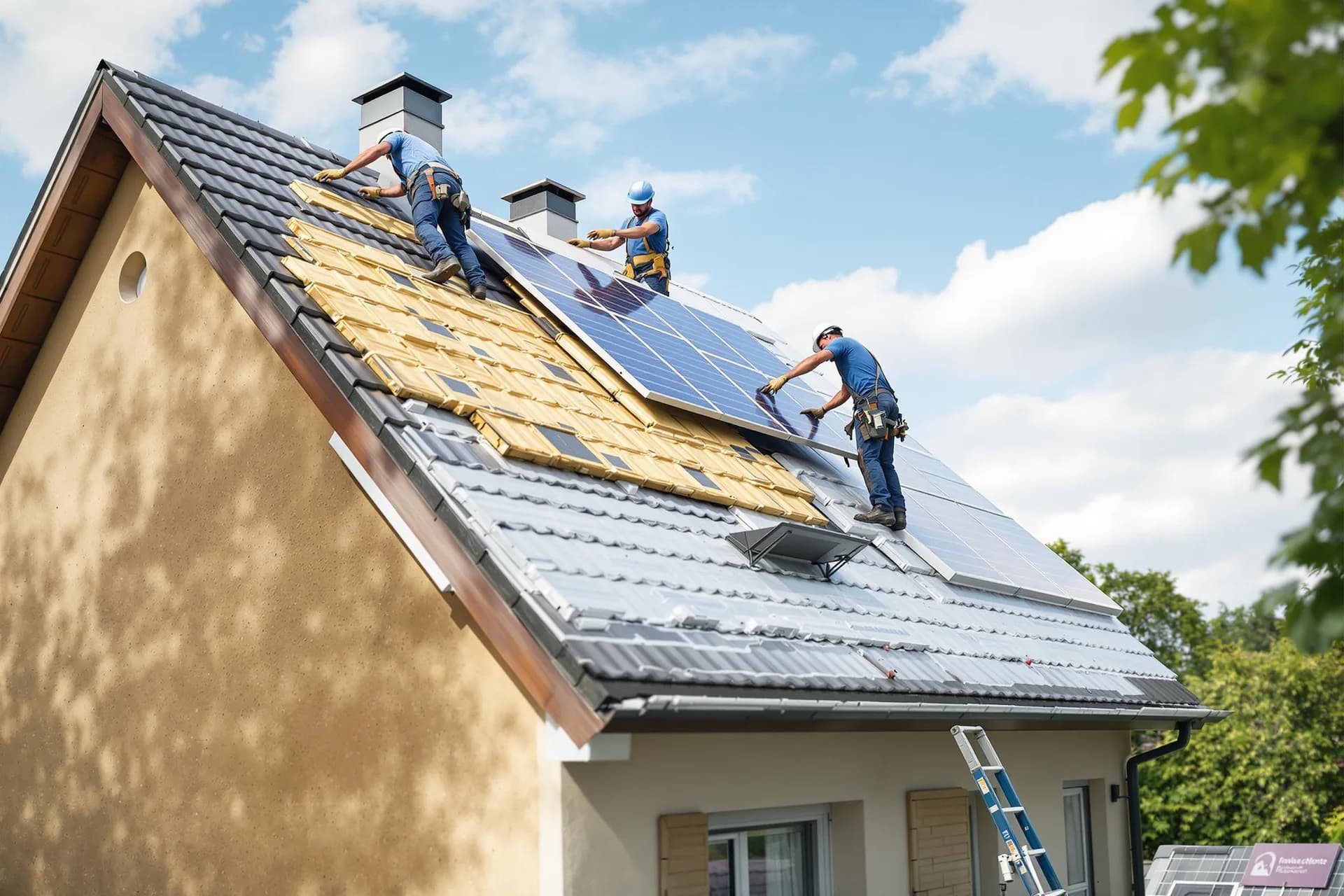
The cost of an energy-efficient roof renovation varies greatly depending on the scope and materials. Expect prices between 150 and 300 euros per square metre. For an average detached house with 120 square metres of roof area, this means an investment of 18,000 to 36,000 euros. The most expensive, but also the most effective, method is insulation above the rafters, which alone costs 90 to 150 euros per square metre. More affordable alternatives such as insulation between the rafters cost around 50 to 100 euros per square metre. Bear in mind that up to 20 per cent of heating energy can be lost through an uninsulated roof. A detailed cost breakdown is the first step towards developing the right financing strategy.
Securing grants: BAFA funding as a financial foundation
The Federal Office for Economic Affairs and Export Control (BAFA) is your first point of contact for direct grants. Under the Federal Funding for Efficient Buildings (BEG), you receive a basic grant of 15 per cent for individual measures such as roof insulation. The eligible costs are capped at EUR 30,000 per dwelling unit, which corresponds to a grant of EUR 4,500. Our expert tip: Have an individual refurbishment roadmap (iSFP) drawn up in advance. With an iSFP, the funding rate increases to 20 per cent and the eligible costs rise to EUR 60,000, enabling you to receive a grant of up to EUR 12,000. The commissioning of an energy-efficiency expert for the iSFP is also subsidised at 50 per cent. Remember to submit the application before the construction work begins. These grants provide a solid basis for your financing for roof renovation.
Check credit options: take advantage of low-interest loans from KfW
When grants are not enough, the Kreditanstalt für Wiederaufbau (KfW) offers attractive loans. The top-up loan (KfW 358/359) is specifically intended for renovators who already have BAFA approval for a single measure. You can take out up to 120,000 euros as a low-interest loan per residential unit to cover the remaining costs. For owner-occupiers with a household income of up to 90,000 euros per year, there are additional interest advantages of up to 2.5 per cent. If you are planning a comprehensive renovation to an efficiency house, the KfW 261 loan is relevant, combining loan amounts of up to 150,000 euros with high repayment grants. A repayment grant reduces the loan amount you have to repay and is essentially free money. A favourable building loan is therefore within easy reach. The combination of BAFA grant and KfW loan is a strong duo for your financing.
Realising tax advantages: An alternative to direct funding
If you have missed the application deadlines for grants, there is another option: tax deductibility. Under Section 35c of the Income Tax Act (EStG), you can deduct 20 per cent of your renovation costs from tax over three years. The maximum tax reduction is 40,000 euros per property. The breakdown is as follows:
- In the year of completion: seven per cent of the costs (max. 14,000 euros)
- In the following year: seven per cent of the costs (max. 14,000 euros)
- In the third year: six per cent of the costs (max. 12,000 euros)
It is important that the property is more than ten years old and that you live in it yourself. Double funding, i.e. combining the tax bonus and BAFA/KfW funding for the same measure, is excluded. This rule makes tax deduction a valuable alternative if you want to optimise the financing of your energy-efficient roof renovation retrospectively.
Practical example: How the Schmidt family optimises their financing
Imagine the Schmidt family wanting to renovate their 140-square-metre roof. The total costs amount to EUR 42,000. An energy consultant draws up an individual renovation roadmap (iSFP). Thanks to the iSFP bonus, the Schmidt family qualifies for the increased BAFA grant of 20 per cent. They therefore receive EUR 8,400 as a direct grant. They finance the remaining EUR 33,600 through the KfW supplementary loan. As their household income is below EUR 90,000, they benefit from the maximum interest subsidy. By combining advice, grants and loans intelligently, the family reduces its financial burden by more than 20 per cent. This example shows how a structured approach successfully answers the question: “What is the best way to finance an energy-efficient roof renovation?”
Step by step to financing: A roadmap to success
Good planning is crucial to make full use of all available funding. Proceed systematically to avoid mistakes. Here is a proven sequence:
- Bring in energy efficiency experts (EEE): A certified consultant is mandatory for most grants and helps you get the maximum benefit. The costs of project supervision are subsidised at 50 per cent.
- Obtain quotes from specialist contractors: Get at least two to three detailed quotes for the roof renovation.
- Submit funding applications (BAFA/KfW): Submit all applications before signing a contract with a tradesperson.
- Wait for financing approval: Do not start construction work until you have received the grant approval notice.
- Carry out the renovation: Make sure all invoices are documented cleanly.
- Submit evidence and receive payment: Once the measure is complete, submit the documents to the funding body.
This structured process secures your financing and prevents you from being left out of pocket. A modernisation loan without land register entry can be a flexible addition here.
Frequently asked questions
- What is the best way to finance an energy-efficient roof renovation?
The best financing solution usually combines a BAFA grant (up to 20 per cent) with a low-interest KfW supplementary loan. Alternatively, the tax bonus is an option if no direct subsidies have been applied for. A consultation with an energy efficiency expert helps to find the optimal strategy for your project.
- What funding is available for roof renovation in 2025?
In 2025, you can make use of the Federal Funding for Efficient Buildings (BEG). This includes grants from BAFA for individual measures and low-interest loans from KfW, such as the supplementary loan 358/359 or the 261 loan for energy-efficient house renovations.
- What is the grant amount for a new roof covering?
A pure re-roofing without any energy efficiency improvement is not subsidised. The grant is only awarded if the measure improves energy efficiency, i.e. primarily for roof insulation. The roof covering can then also be subsidised as part of the total costs.
- Can I apply for funding for the roof renovation retrospectively?
No, funding from BAFA and KfW must always be applied for before renovation work begins. Retrospective applications are not possible. The only exception is the tax bonus, which you can claim in your income tax return after completing the measure.
- What is an individual renovation roadmap (iSFP)?
The iSFP is a detailed plan created by an energy efficiency expert that analyses the energy performance of your property and sets out sensible refurbishment steps. With an iSFP, you receive an additional five per cent funding bonus from BAFA.
- Which costs are eligible for funding for a roof refurbishment?
Eligible costs include all costs directly related to the energy-related improvement. These include material costs for insulation, tradesperson services, the new roof covering (as part of the insulation work), new roof windows, as well as planning and consultancy services provided by an energy efficiency expert.
Sources
- [1]The KfW provides detailed information on funding for energy-efficient refurbishment, in particular roof insulation.
- [2]Further KfW funding programmes support the energy-efficient refurbishment of existing properties.
- [3]The Federal Ministry for Economic Affairs and Climate Action provides the draft legislation for the Buildings Energy Act (GEG).
- [4]The Federal Government provides information on the new Buildings Energy Act.
- [5]The Federal Statistical Office (Destatis) provides statistics on energy consumption in sectors and companies.
- [6]The Federal Environment Agency provides data on the energy consumption of private households.