
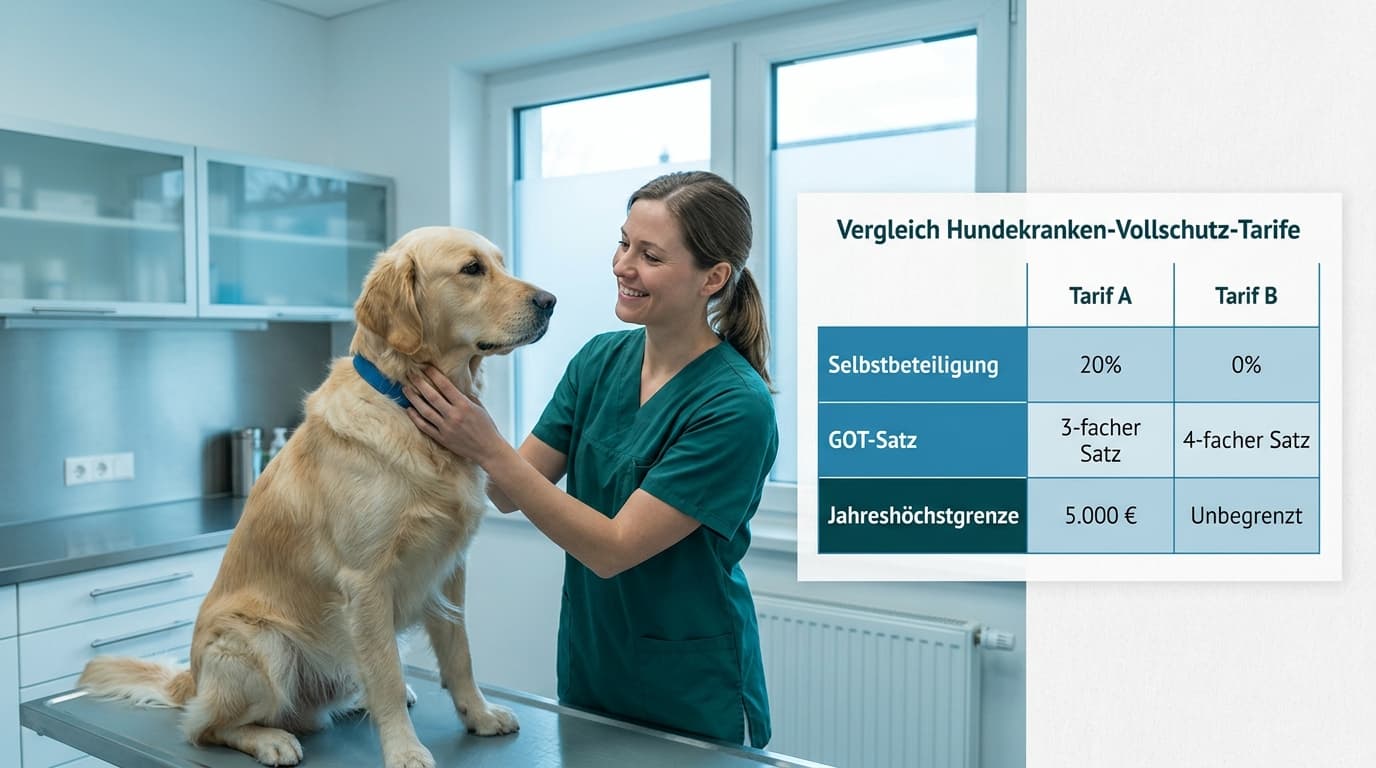
Full coverage comparison: deductibles and reimbursement for dogs
Dog health insurance full coverage comparison: how deductible, GOT rate and annual maximum interact - with a worked example.
All details are taken from the provider's linked product page and the contract documents (IPID/policy conditions) published there; the insurer's documents prevail. Premiums, benefits and the insurance product itself may change – please verify the details directly with the partner before signing up; only the information provided there is binding.
 Katrin StraubManaging DirectorInsurance expert with over 20 years of experience in the insurance industry.
Published on
10 min read
Table of Contents
When comparing full coverage plans for your dog, the monthly premium is not what decides the outcome — it is how the deductible, the GOT reimbursement tier and the annual maximum interact. Two equally priced plans can end up thousands of euros apart when it matters.

Dog Health Insurance
Comprehensive dog health insurance from nextsure: Optimally protect your loyal companion against vet costs, operations, and unforeseen treatments. Get informed now and calculate your rate!
Learn moreWhat really matters in a full coverage comparison
A comparison is worthwhile — but not on the monthly premium alone. In the full coverage comparison in 2026, three levers decide the outcome: the deductible model, the reimbursement tier up to the GOT rate and the annual maximum. What is ultimately reimbursed is decided in these three details, not in the premium.
Full coverage means: the plan reimburses not only surgery costs but also veterinary treatment without surgery — for example diagnostics, medication and a stay at the animal clinic. Its counterpart is pure surgery cover, which leaves exactly these everyday treatments uncovered and therefore deserves its own consideration: surgery cover or full coverage.
- Deductible model: your fixed share per claim or your percentage share of every invoice.
- Reimbursement tier: up to which rate of the fee schedule (GOT) the plan covers vet fees.
- Annual maximum: the cap on reimbursement per insurance year, tiered up to unlimited.
The market here is opaque: according to the Verbraucherzentrale (consumer advice centre), a reimbursement of 80 percent of eligible costs is standard, meaning you usually bear a 20 percent deductible.[1] At the same time, most veterinary practices charge three times the fee schedule rate, while insurers often only reimburse twice that rate.
How big the quality differences are is shown by Stiftung Warentest: in its 2025 test, only around one in four of the 121 tariff variants examined was rated recommendable.[2] Which four criteria make for a robust comparison is explained in our article on comparing four criteria.
Fixed or percentage deductible: the decisive difference
The deductible is the amount you bear yourself from every reimbursement. The market offers two models, and they behave completely differently with large bills.
- Fixed amount per claim: for example, 250 euros. Your share is capped, no matter how high the bill turns out.
- Percentage share: for example, 20 percent of the bill. Your share grows with the bill and has no cap of its own.
- Combinations: some tariffs deduct 20 percent, but at least 250 euros per claim.
Worked example: a 3,500-euro bill
Assumptions: a cruciate ligament rupture surgery costs 3,500 euros — a magnitude within the typical total cost of cruciate ligament rupture treatment of 2,700 to 4,850 euros.[3] All items are eligible for reimbursement, and the tariff reimburses within its reimbursement rate. With a 20 percent percentage share, you pay 700 euros yourself. With a fixed share of 250 euros per claim, it stays at exactly those 250 euros, even if the bill rises further due to complications.
Fixed deductibles are common in the market, though with different reference bases: with the pet health insurance from Uelzener, which you can take out via DEVK, you choose a deductible of 0, 250 or 500 euros per insurance year for dogs and cats.[4] Barmenia's horse surgery insurance works with 250, 500 or 1,000 euros per claim; how the Barmenia deductible is calculated exactly is explained in our article on it. The difference: there, the share is due per claim, not per year.
Which model works out cheaper depends on the individual case, not the tariff name. It depends on how often and how expensive your veterinary cases are likely to be, and how much of a financial cushion you can set aside for your share. There is no general answer here.
Reimbursement tier: up to which GOT rate does the tariff pay
GOT stands for the fee schedule for veterinarians (Gebührenordnung für Tierärztinnen und Tierärzte), a nationwide legal provision by which vets bill their services. It does not set fixed prices, but a fee range from the single to three times the rate, in steps.[5]
In emergency service — that is, at night, on weekends or on public holidays — billing up to four times the fee rate is permitted, plus an emergency service fee of 50 euros.[6] The reimbursement tier determines up to which of these rates your tariff covers the fees. The rate scales the bill amount directly: the higher the clinic bills, the larger the gap a tariff with a low tier leaves open.
| Tariff level (example Cleos Welt) | Reimbursement of veterinary fees up to |
|---|---|
| Basis | [7]3 times the fee rate (GOT) |
| Rundum | [7]4 times the fee rate (GOT) |
| Rundum Plus | [7]4 times the fee rate (GOT) |
The cut bites exactly when the bill is most expensive: at night or on weekends, when the clinic charges the higher rate. A tariff that only reimburses up to two or three times the rate then trims every single item, even though it formally covers it. How reimbursement works after the 2022 GOT reform is explained separately: GOT reimbursement after the reform.
Annual maximum: 3,000 euros, 10,000 euros or unlimited
The annual maximum is the upper limit on how much the insurer reimburses in total per insurance year. It decides whether a tariff carries a serious illness through to the end or cuts off at a certain amount. The market shows a clear tiering:
| Tariff level (example Cleos Welt) | Annual maximum of reimbursement |
|---|---|
| Basis | [8]up to 3,000 euros per year |
| Rundum | [8]up to 10,000 euros per year |
| Rundum Plus | [8]unlimited |
Both extremes also appear in the brokered tariff comparison: annual maximums of 2,000 euros or 10,000 euros stand alongside tariffs with no annual limit at all.
Why this limit matters in a real emergency: expensive emergency surgeries, for example for an intestinal obstruction, can produce bills running into several thousand euros. With a limit of 3,000 euros, a large part of the bill then stays with you, even if the tariff formally reimburses 100 percent.
Also note the tiering across the years: some tariffs lower the limit only in the first insurance year and pay unlimited from the second or third year onwards.[9] Stiftung Warentest, by contrast, notes: very good and good tariffs do not cap their sum insured at a specific amount.[2] Which criteria to use when pitting tariffs with and without an annual limit against each other is shown in our article on assessing full coverage tariffs.
Preventive care budget and the quiet differences in premium
The preventive care budget is a standalone module for vaccinations, deworming, dental prophylaxis and similar routine services. It runs separately from the annual maximum and is often only available in higher tariff levels or for an extra premium. Its range is wide:
- Cleos Welt: optional preventive care module with up to 250 euros per year, among other things for vaccinations, parasite medication and dental prophylaxis.[7]
- Uelzener via DEVK: preventive care module up to 500 euros per insurance year.[4]
- Internal tariff examples: health flat rate of 30 euros to 100 euros per insurance year.
Your check: if you want preventive care covered as well, you must compare the module explicitly. According to the Verbraucherzentrale, vaccinations often do not fall under basic protection.[10]
Whether your dog would be sensibly covered by a full coverage tariff with a preventive care module only becomes clear in the concrete tariff terms and conditions. A tariff comparison puts the criteria side by side: start your tariff comparison.
Conclusion: how to compare full coverage tariffs properly
Compare full coverage tariffs along four criteria: deductible model, GOT reimbursement tier, annual maximum and preventive care budget. The monthly premium is the result of these levers, not the quality verdict. The fact that only around one in four of 121 tariff variants tested was recommendable shows how much depends on the fine print.[2]
Your case is decided by the distinction this article has shown step by step: a fixed contribution that is capped upwards, or a percentage one that grows with the bill. Plus the question of whether your tariff has an annual limit or pays unlimited.
A general article cannot settle your specific case: your dog's age, breed and pre-existing conditions as well as your health declaration all feed into the premium and the acceptance decision. Cover always depends on the specific tariff and the insurer's decision to accept the policy.
A deliberately open outlook: tariffs, GOT rates and conditions change constantly. The figures in this article reflect the situation at the time of publication; future premium developments cannot be extrapolated from them.
The dog health insurance from nextsure compares tariffs across several levels and takes you through a fully digital sign-up. nextsure is a marketplace and broker, not an insurer. You conclude the contract directly with the insurer. For your dog, check the combination of deductible and reimbursement tier and start the tariff comparison.
Frequently asked questions
- What is the difference between a fixed and a percentage deductible in dog health insurance?
A fixed deductible is an amount per claim, for example 250 or 500 euros, and is therefore capped. A percentage deductible is a share of the invoice, typically 20 percent, and grows with the bill: the more expensive the treatment, the more you pay yourself. Some tariffs combine both, for example 20 percent but at least 250 euros per claim.
- What does a 20 percent deductible mean on a high invoice?
Your share grows proportionally: one fifth of every invoice stays with you, no matter how high it is. A concrete calculation example with all assumptions (invoice amount, deductible model) is in the section on deductibles – there you can also see how a fixed deductible compares. The key point: with a percentage deductible there is no cap of its own.
- Up to which GOT rate do full coverage tariffs reimburse?
The fee schedule for veterinarians (GOT) provides a framework from 1 to 3 times the rate on a sliding scale; in an emergency service, 4 times the rate is permitted. Basic tariffs often reimburse only up to 3 times the rate, higher tariff levels up to 4 times. A low rate cuts your reimbursement precisely when the invoice is most expensive.
- How high are typical annual maximums in full coverage?
The range runs from 3,000 euros via 10,000 euros to unlimited, depending on the tariff level. Some tariffs lower the limit only in the first insurance year and pay unlimited afterwards. The limit matters in expensive cases: a single costly emergency treatment can break through a 3,000-euro limit and leave a large part of the invoice uncovered.
- Is full coverage without a deductible worth it?
That cannot be said across the board. If you want predictable costs, a zero-euro deductible is the calmer choice, especially since Stiftung Warentest observes that the price difference between variants with and without a deductible is small among recommendable tariffs. If you have savings, a deductible can lower your premium – but you accept that high invoices become proportionally more expensive.
- Are vaccinations and deworming included in full coverage?
Usually not automatically. Vaccinations, deworming and dental prophylaxis are handled in many tariffs through a separate preventive care module with its own budget, for example up to 250 or 500 euros per year. If you want preventive care covered too, check this module explicitly in the comparison, because it makes seemingly equally priced tariffs differently valuable in the fine print.
Sources
Conclude directly online
Verified partner tariffs at no extra cost. The button takes you straight to the provider's calculator.
 Hepster
Dog health insurance
Full health coverage for dogs across five tariffs; the top tariff reimburses 100% with no annual maximum.
- Reimbursement:
- 50-100% depending on the tariff
- Deductible (Selbstbeteiligung):
- 0-50% depending on the tariff
- Waiting period:
- 1 month
- GOT rate:
- up to 4x (Premium/Superior)
- Treatment and surgery for illness and accidents, reimbursed at 50-100% depending on the tariff
- Veterinary clinic stays: up to 10, 15, or 20 days depending on the tariff
- Wellness allowance: €30 (Basis), €70 (Premium), €100/year (Superior)
- From Premium: physiotherapy (up to €200 without surgery, €500 after surgery), tooth extractions, homeopathy/acupuncture
- Superior: prosthetics/orthotics allowance of up to €650
- Vet fees covered up to 3x the standard veterinary fee schedule (GOT) rate on Basis, up to 4x on Premium/Superior
Key exclusions
- Known chronic or congenital conditions
- Pregnancy, false pregnancy, and birth
- Illnesses treated in the 6 months before the policy started
- Basis tariffs: neutering/spaying that isn't medically necessary
Trusted Shops: 4,5/5 „Sehr gut“ (2.600 Bewertungen)
hepster insgesamt (Anbieterbewertung, alle Versicherungen)
Monthly subscription: minimum term 12 months, notice period 3 business days before the end of the billing period; MRI/CT scans in the Basis tariffs are covered at 50%. Insurer: Towarzystwo Ubezpieczen Europa S.A.
Fact sheet: benefits, exclusions and waiting periods in detail
 Cleos Welt
Dog health insurance
Combined health and surgery cover for dogs, reimbursing vet costs up to the agreed maximum veterinary fee schedule (GOT) rate.
- Reimbursement:
- up to the agreed maximum GOT rate
- Coverage abroad:
- 12 months
- Notice period:
- 14 days before the end of the month
- Treatment for illness and accidents
- Surgery, including pre-surgical diagnostic examinations
- Pre- and post-treatment following a covered surgery
- Lab work and imaging diagnostics, plus medically necessary medication
- Coverage abroad: 12 months
Key exclusions
- Treatments and surgeries already known or recommended before the policy started
- Illnesses occurring before the waiting period ends
- War, earthquakes, floods, epidemics, and pandemics
- Damage caused intentionally
CHECK24 Tarifnote 1,0 „exzellent“
Cleos Welt Hundekrankenversicherung
FOCUS MONEY: Beste Tierkrankenversicherung (Premiumtarif), Ausgabe 14/2026
Cleos Welt Hundekrankenversicherung
ASCORE „Tarif des Monats“ 08/2025
Cleos Welt Tierkranken Hund, Rundum Plus Schutz inkl. Vorsorge & SOS-Schutz
CHECK24 Tarifnote 1,0 „exzellent“
Cleos Welt Hunde-OP-Schutz (Rundum Plus inkl. SOS-Schutz)
„Kundenfavorit“: über 50.000 geschützte Haustiere
Cleos Welt Tierversicherungen (Tierkranken Hund)
Google Rezensionen: 4,5/5 Sterne (210 Bewertungen)
Cleos Welt insgesamt (Anbieterbewertung, alle Versicherungen)
Contract term at least 1 year with automatic renewal; sum insured and deductible (Selbstbeteiligung) as stated in the policy. Insurer: Uelzener Allgemeine Versicherungs-Gesellschaft a.G.
Fact sheet: benefits, exclusions and waiting periods in detail
Hepster
Dog surgery insurance
Surgery-only cover for dogs across four tariffs; from year 2 or 3, depending on the tariff, there is no annual maximum.
- Reimbursement:
- 80-100% depending on the tariff
- Deductible (Selbstbeteiligung):
- 0-20% depending on the tariff
- Waiting period:
- 1 month
- Surgery under anesthesia or sedation for illness and accidents
- Post-treatment: up to day 14, 15, or 20 depending on the tariff
- Neutering/spaying: up to €250 on Basis, unlimited from Premium
- From Premium: tooth extractions, post-surgery physiotherapy (up to 20 days/€500), homeopathy/acupuncture
- Superior: prosthetics/orthotics allowance of up to €650
- Vet fees covered up to 3x the standard veterinary fee schedule (GOT) rate on Basis, up to 4x on Premium/Superior
Key exclusions
- Known chronic or congenital conditions
- Illnesses that required surgery in the 6 months before the policy started
- Surgery performed to meet breed-standard appearance
- Basis: tooth extractions, root canal treatment, and dental/jaw corrections
Trusted Shops: 4,5/5 „Sehr gut“ (2.600 Bewertungen)
hepster insgesamt (Anbieterbewertung, alle Versicherungen)
Monthly subscription: minimum term 12 months, notice period 3 business days before the end of the billing period; prosthetics/orthotics have a 12-month waiting period. Insurer: Towarzystwo Ubezpieczen Europa S.A.
Fact sheet: benefits, exclusions and waiting periods in detail
Hepster Dog health insurance: Dog health insurance tariff overview
| Tariff | Reimbursement | Deductible | Annual maximum |
|---|---|---|---|
| Basis20 | 80% | 20%, min. €250 per claim | €2,500 |
| Basis50 | 50% | 50%, min. €500 per insurance year | €2,500 |
| Premium | 80% | 20% per claim | Year 1: €10,000, year 2: €15,000, from year 3: unlimited |
| Superior10 | 90% | 10% per claim | none |
| Superior0 | 100% | none | none |
Hepster Dog surgery insurance: Dog surgery insurance tariff overview
| Tariff | Reimbursement | Deductible | Annual maximum |
|---|---|---|---|
| Basis | 80% | 20%, min. €250 per claim | €2,000 |
| Premium | 80% | 20% per claim | Year 1: €2,000, year 2: €5,000, from year 3: unlimited |
| Superior10 | 90% | 10% per claim | Year 1: €5,000, from year 2: unlimited |
| Superior0 | 100% | none | Year 1: €5,000, from year 2: unlimited |
All details are taken from the provider's linked product page and the contract documents (IPID/policy conditions) published there; the insurer's documents prevail. Premiums, benefits and the insurance product itself may change – please verify the details directly with the partner before signing up; only the information provided there is binding.
Information last updated: July 2026 · Source: provider product information (IPID/policy conditions)