Equine Surgery Insurance & Eye Surgery for Moon Blindness
Does equine surgery insurance cover eye surgery for moon blindness (ERU)? Waiting periods, pre-existing conditions, and GOT billing.
All details are taken from the provider's linked product page and the contract documents (IPID/policy conditions) published there; the insurer's documents prevail. Premiums, benefits and the insurance product itself may change – please verify the details directly with the partner before signing up; only the information provided there is binding.
 Katrin StraubManaging DirectorInsurance expert with over 20 years of experience in the insurance industry.
Published on
Last updated on
12 min read
Table of Contents
Equine surgery insurance covers the cost of eye surgery for moon blindness (equine recurrent uveitis, ERU), provided the condition was not yet known when the contract was taken out. Procedures such as vitrectomy under general or standing anesthesia are covered by contract. The general waiting period is three months. Chronic pre-existing conditions generally lead to a coverage exclusion for the affected eye. Signing up in good time protects against operation costs averaging over nine thousand euros.
Equine surgery insurance
Horse surgery insurance via nextsure: Three flexible tariffs, reimbursement up to twice the GOT rate, and free choice of clinic worldwide. Protect your horse from high surgery costs – digital, transparent and uncomplicated.
Learn moreMoon blindness as a cause of eye surgery in horses
Clinical picture and prevalence of ERU
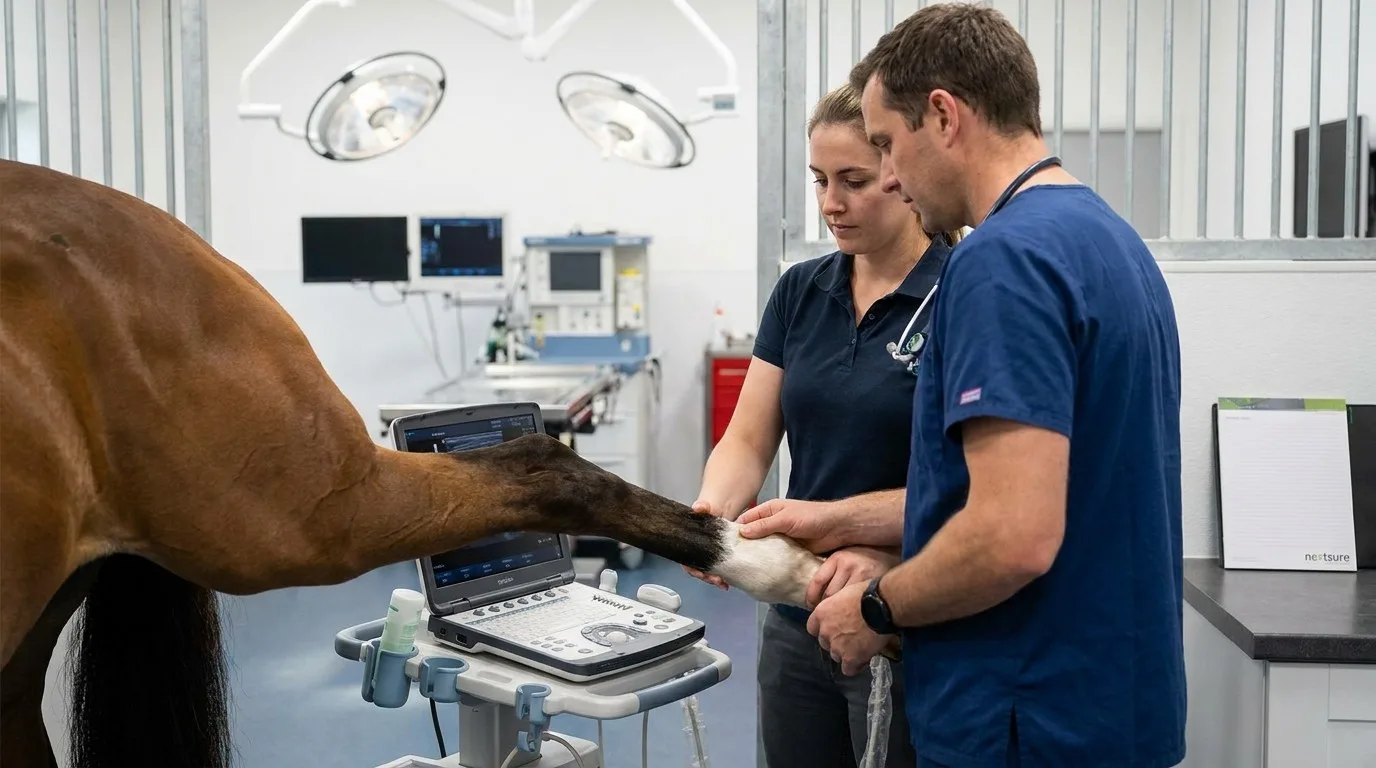
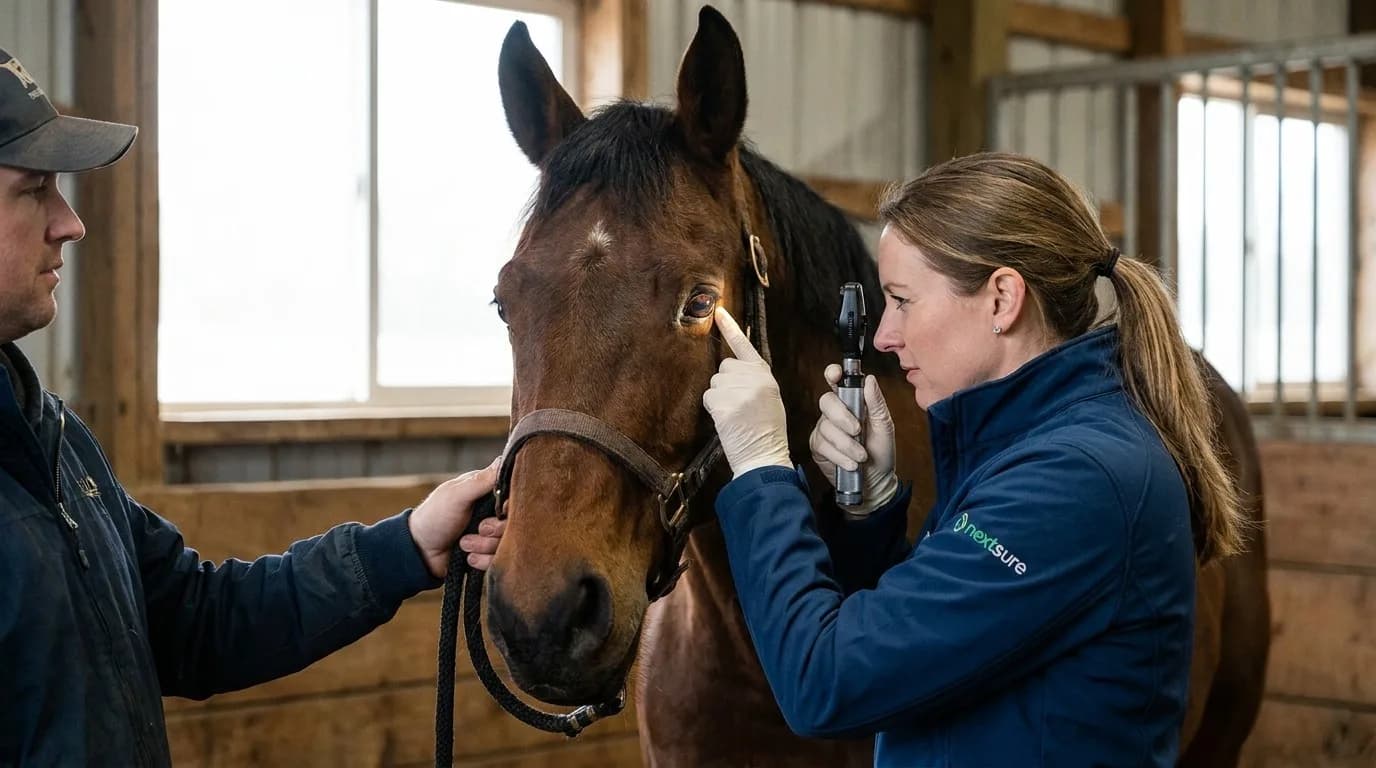
Moon blindness is a common cause of surgical procedures in equine medicine. This periodic eye inflammation affects an estimated eight to twelve percent of the global horse population [1]. This chronic disease progresses in irregular flare-ups and severely damages the eye's internal structures. A one-sided case spreads to the other eye in thirty to thirty-five percent of cases [1]. Veterinarians often recommend surgery to preserve eyesight in the long term. Without surgery, the animal risks total blindness. Diagnosis requires a precise examination by a specialized veterinarian. Imaging techniques such as ultrasound are used here. Tonometry to measure intraocular pressure also provides important data. Early intervention is the key to success.
Surgical procedures: vitrectomy and implants
A vitrectomy removes the vitreous body under general anesthesia to eliminate the bacteria causing inflammation [2]. This procedure requires the utmost surgical precision at a specialized equine clinic. A prerequisite for the operation is that the eye has been free of inflammation for at least three weeks [2]. The horse's eyesight can only be preserved through a vitrectomy if the lens and retina have not yet suffered permanent damage [2]. Alternatively, vets use cyclosporine implants to locally suppress the inflammatory response. Both procedures are established methods in modern eye surgery. The choice of method depends on the individual findings. The vet decides this on a case-by-case basis. The implants release the active ingredient continuously over a long period. This significantly reduces the frequency of inflammatory flare-ups.
Recognizing symptoms and acting fast
Early recognition of symptoms considerably improves the prognosis for the affected horse. Watery eyes, extreme light sensitivity, and a clouded cornea are typical early signs of an acute flare-up. These symptoms require immediate veterinary consultation. Every delay increases the risk of irreparable tissue damage in the eye. Medication eases the acute pain but does not stop the disease's chronic course. Ultimately, surgery often remains the only path to lasting freedom from pain. Sound knowledge of this disease helps owners in decision-making. Education about the risks is essential. Time is a critical factor.
Typical symptoms of an acute ERU flare-up
- Heavily watering eye (epiphora) and squinting of the eyelids
- Extreme light sensitivity (photophobia) in daylight
- Visible clouding of the cornea (bluish-white haze)
- Constricted pupil (miosis) despite a darkened environment
- Swelling of the conjunctiva and redness of the eyeball
If these symptoms occur, immediate emergency veterinary treatment is essential.
Cost of eye surgery and billing under the GOT
Financial risk for horse owners
The cost of such a procedure puts a heavy strain on the budget and requires solid planning. According to insurer statistics, eye surgery in a horse can cost around 9,370 euros on average [1]. This sum is made up of various line items from the fee schedule for veterinarians (GOT). Veterinary services include preliminary examinations, the actual surgical procedure, anesthesia monitoring, and inpatient stay. Specialized eye surgeons often bill their services at two or three times the standard fee rate. This quickly drives up the total bill. Horse owners frequently underestimate this financial risk. The preliminary examination alone can cost up to six hundred euros. The financial risk: substantial.
Structure of the fee schedule for veterinarians (GOT)
The fee schedule for veterinarians forms the legal basis for every invoice in Germany. In emergency service, equine clinics even charge up to four times the fee rate plus a flat emergency-service fee. The exact amount of the high veterinary costs for operations varies depending on the complexity and duration of the procedure. Complications during anesthesia or an extended recovery phase result in additional fees. The medications and special surgical instruments used also factor into the final invoice. A transparent cost breakdown from the clinic is therefore essential. A detailed cost estimate before the procedure protects against surprises. This protects against surprises. The emergency-service fee applies for treatment at night or on weekends.
Protection through unlimited coverage amounts
Solid insurance cover effectively absorbs these extreme financial burdens and secures treatment. R+V's surgery cost insurance, for example, pays out regardless of the amount of the billed GOT rate [3]. Other tariffs limit reimbursement to two or three times the rate. Choosing the right tariff can mean the difference of thousands of euros in out-of-pocket costs in an emergency. nextsure analyzes the various tariff structures in detail and recommends policies with an unlimited coverage amount for surgical procedures. Under-insurance inevitably leads to massive co-payments for complex eye operations. Financial protection secures the best possible medical care for the animal. The coverage amount must be chosen high enough. The choice of tariff determines the co-payment.
| Service item (GOT) | Estimated cost range (incl. VAT) |
|---|---|
| Preliminary examination & diagnostics (ultrasound, tonometry) | €300 - €600 |
| Anesthesia induction, monitoring & recovery phase | €800 - €1,500 |
| Surgical procedure (vitrectomy) | €3,500 - €5,000 |
| Inpatient stay & intensive care (7-14 days) | €1,500 - €3,000 |
| Medication & consumables | €500 - €1,000 |
Actual costs vary depending on the clinic, complication rate, and the GOT rate applied.
Scope of cover under equine surgery insurance for eye procedures
Definition of a surgical procedure
The scope of cover defines exactly what costs the insurance company assumes in a claim. The benefits of equine surgery insurance include veterinary-medically necessary surgical procedures on or in the body of the insured animal. The procedure must cut through the skin or underlying tissue by more than a mere puncture. Equine surgery insurance covers the cost of vitrectomy surgery to preserve eyesight in cases of periodic eye inflammation [4]. The implantation of drug carriers also falls under surgical coverage. Preparatory examinations such as ultrasound or blood work are generally also covered. This applies provided the operation is actually carried out. The definition in the terms is absolutely binding here. The definition: strict.
Types of anesthesia: general vs. standing anesthesia
The type of anesthesia plays an important role for reimbursement under the terms. Operations under standing and general anesthesia are covered at one hundred percent under good tariffs [4]. Many modern eye procedures are performed on a standing, sedated horse to minimize anesthesia risk. Such procedures under standing anesthesia are explicitly covered by contract. The insurance terms define operations as procedures under anesthesia, sedation, or local anesthetic. Reimbursement also covers monitoring of vital functions throughout the procedure. The horse's safety is the priority when choosing the type of anesthesia. This considerably reduces the anesthesia risk. Standing anesthesia is often the gentler alternative.
Reimbursement limits and material costs
Reimbursement limits vary greatly between individual insurers and their respective tariff lines. Some basic tariffs only cover operations under general anesthesia and exclude standing anesthesia. Premium tariffs, on the other hand, offer comprehensive cover without such restrictions. nextsure examines the insurance terms closely for hidden limitations on specific surgical methods. The cost of the surgical material used and the medications administered are also part of the insurance benefit. Direct billing between the equine clinic and the insurance company greatly simplifies the process. This means the horse owner does not have to advance the money. Liquidity is thus fully preserved. Liquidity protection through direct billing.
Pre-existing conditions and exclusions in the insurance terms
Handling known diagnoses
Pre-existing conditions significantly affect coverage at the time the contract is concluded, and permanently for the entire term of the contract. Chronic pre-existing conditions must be disclosed when applying and usually lead to an exclusion of that specific condition [5]. If the horse already suffers from moon blindness, the affected eye is excluded from cover. Coverage for chronic pre-existing conditions requires a precise health assessment by the insurer. Concealed diagnoses jeopardize the entire contract and lead to the insurer being released from its obligation to pay. The pre-contractual duty of disclosure demands absolute honesty from the policyholder. False statements entitle the insurer to withdraw from the contract immediately. In the case of fraudulent misrepresentation, the obligation to pay lapses entirely. The pre-contractual duty of disclosure: uncompromising.
Clearly defined exclusions
The insurance terms clearly define which treatments are not reimbursed and where the limits lie. Carefully reviewing typical exclusions in the insurance terms before signing up is essential. Illnesses, accidents, or congenital developmental defects that were already known at the time of application are excluded. Routine examinations, cosmetic procedures, or dietary feed likewise are not covered. Operations due to epidemics or pandemics are explicitly excluded in many terms and conditions. Alternative healing methods such as gold acupuncture are also frequently excluded from the scope of cover. Reading the small print carefully protects against nasty surprises in a claim. The terms and conditions are decisive. Every exclusion is listed there in detail.
The importance of signing up in good time
Signing up in good time, before the first symptoms appear, is essential for seamless cover. If the condition only occurs after the waiting period has expired, the insurance pays out in full. A diagnosis of periodic eye inflammation then no longer means financial ruin. nextsure supports horse owners in correctly answering the health questions in the application process. Clean documentation of the veterinary history prevents later disputes during the benefits review. In a claim, insurers often request the patient file from the treating vet. Transparency from the outset ensures smooth cost coverage. The history must be fully documented. Prevention pays off financially.
Common exclusions in equine surgery insurance
- Pre-existing conditions that had already been diagnosed by a vet or were obvious at the time of application.
- Operations that do not serve to restore health but to meet a breed standard.
- Treatment of hoof abscesses or hoof ulcers (hoof cancer is often excepted).
- Castrations without medical indication (e.g., without a tumor present).
- Travel fees, waiting fees, and travel costs of the treating vet.
The exact exclusions vary by insurer. Checking the AVB is essential.
Waiting periods and tariff differences in equine surgery insurance
General and special waiting periods
Waiting periods protect the pool of policyholders from opportunistic sign-ups for conditions the animal already has. The general waiting period for illnesses is three months under most tariffs, while colic often has shorter waiting periods [5]. If moon blindness occurs within these three months, there is no entitlement to reimbursement. For certain joint operations, such as for OCD or bone chips, a special waiting period of twelve months often applies. For accidents, the waiting period is generally waived entirely. The exact deadlines differ depending on the chosen tariff and insurance company. Comparing the terms is worthwhile. The deadlines are contractually fixed. Deadlines: binding.
Differences between basic and premium tariffs
The tariff landscape offers different levels of cover for the varying needs and budgets of horse owners. Basic tariffs often have an annual maximum compensation limit or a percentage-based deductible. Premium tariffs waive these limitations and offer unlimited cover. The insurance offers protection with no age limit and, depending on the tariff, no deductible [3]. Some providers waive their ordinary right of termination after a certain contract term. This secures lifelong cover for the horse owner, even if the animal needs frequent surgery. Choosing the right tariff requires a detailed analysis of individual risk tolerance. Cheap is often not good. A premium tariff offers maximum security.
Switching insurers and health questions
Switching insurers is possible but requires caution regarding renewed health questions. In the case of a seamless transition from a previous policy, some providers waive the general waiting period. However, this only applies to benefits that were already covered under the previous contract. nextsure analyzes existing policies and uncovers coverage gaps or outdated tariff structures. Upgrading to a stronger tariff is often more sensible than switching providers entirely. The digital platform enables a transparent comparison of current market offers. This helps horse owners find the optimal cover for their animal. Expert advice is essential here. The market is highly dynamic.
| Event / diagnosis | Regular waiting period |
|---|---|
| Accident-related operations (e.g., fracture from a kick) | No waiting period |
| Colic operations (abdominal surgery) | 5 to 7 days |
| General illnesses (incl. moon blindness) | 3 months |
| Castration for medical reasons (e.g., tumor) | 6 months |
| Joint operations (OC, OCD, chips) | 12 months |
In the case of a seamless switch of insurer, these waiting periods can partly be waived.
Aftercare and clinic stay following eye surgery
Cost coverage for inpatient treatment
Aftercare is a decisive factor for the long-term success of eye surgery. Aftercare costs are covered for up to fifteen days from the day of the operation [3]. This period varies between five and twenty days depending on the insurance terms. Reimbursement covers inpatient accommodation at the equine clinic as well as necessary medication. Veterinary follow-up examinations to check on healing progress also fall under this component. Intensive medical care in the first few days after the procedure prevents serious complications. Clinic stays drive up total costs enormously without insurance cover. Every day at the clinic costs money. Clinic days drive up costs.
Regenerative therapies and physiotherapy
Modern tariffs increasingly integrate advanced therapeutic measures into covered aftercare. Some tariffs also cover regenerative therapies and accommodation at the equine clinic [4]. Premium cover variants sometimes even reimburse physiotherapy treatments after the regular aftercare period has ended. The policy covers alternative healing methods such as acupuncture or laser therapy when prescribed by a vet. These holistic approaches support the horse's recovery after a serious procedure. The exact definition of reimbursable aftercare services can be found in the General Insurance Terms. Checking the terms and conditions provides clarity here. The small print governs the details. The effectiveness of the methods must be scientifically proven.
Direct billing with the equine clinic
Billing arrangements with the equine clinic enormously ease the administrative burden for the owner. Many insurers offer direct billing with the treating clinic. The horse owner only has to sign an assignment declaration and delegate the invoicing. This prevents liquidity shortfalls, since amounts running into several thousand euros do not need to be advanced. nextsure supports customers through fully digital processes when handling a claim. Fast review and approval of cost coverage eases the nerves in an already stressful situation. A smooth process is the hallmark of good insurance. Digital submission speeds up the process. Service makes the difference.
Contract optimization for horse owners through nextsure
Curated tariffs instead of a confusing jumble
Contract optimization means tailoring cover exactly to the individual needs of the horse. nextsure positions itself as a specialized digital broker for niche insurance in the DACH region. The platform offers hand-picked tariffs instead of a confusing jumble of standard policies. Horse owners get a transparent needs analysis and a clear tariff recommendation without hours of research. Broker advice under Section 34d of the German Trade, Commerce and Industry Regulation Act (Gewerbeordnung) ensures an independent, professionally sound recommendation. The focus is on strong products that reliably cover even complex procedures such as eye operations. Quality clearly beats quantity here. The selection includes over seventy products. Curation over volume.
Digital administration and transparency
Digital policy administration considerably simplifies insurance management in the horse owner's daily life. Customers have access to their contract data, terms, and claims at any time. Combining equine surgery insurance and animal owner liability insurance in one clear dashboard creates transparency. nextsure is continually working to expand its portfolio with specialized niche products. The platform targets digitally savvy private customers who expect fast processes and clear answers. Doing away with paperwork and long phone calls fits modern consumer behavior. Efficiency and security go hand in hand here. That saves valuable time. Data can always be securely retrieved.
Personal expert advice in a claim
Despite the digital focus, personal expert advice remains a central part of the concept. For complex questions about pre-existing conditions or specific surgical methods, knowledgeable contacts are available. This hybrid approach combines the speed of an online portal with the reliability of a traditional broker. Compensation is transparently based on commissions from the insurance companies, with no additional cost to the end customer. nextsure proves that specialty insurance can be brokered digitally and in a customer-friendly way. Protecting the valuable animal is always at the center of the advice. Broker liability provides additional security. The broker works for the customer.
Frequently asked questions
- Does equine surgery insurance pay for eye surgery for moon blindness (ERU)?
Yes, provided the condition did not already exist when the contract was concluded and the general waiting period of three months has passed. The insurance covers medically necessary procedures such as vitrectomy.
Sources
Conclude directly online
Verified partner tariffs at no extra cost. The button takes you straight to the provider's calculator.
 Barmenia
Horse surgery insurance
Surgery cost cover for horses in case of illness and accidents, including diagnostics and after-care.
- Waiting period:
- 3 months (colic surgery: 5 days, accidents: none)
- Coverage abroad:
- worldwide, up to 12 months
- Maximum benefit:
- depends on the cover level, as stated in the policy
- Surgery costs for illness and accidents, including tooth extractions and root canal treatment
- Pre-surgical examination (X-ray, endoscopy, biopsy, lab work)
- After-care including acupuncture, homeopathy, physiotherapy, laser therapy
- Emergency veterinary service up to 4x the standard veterinary fee schedule (GOT) rate plus the emergency callout fee
- Premium cover: up to 5 physiotherapy sessions (max. 60 minutes each) after the after-care period ends
- Once per animal: surgery costs for a birth-related, medically necessary caesarean section
Key exclusions
- Illnesses and developmental abnormalities known at the time of application
- Hoof abscesses and hoof ulcers (exception: hoof cancer)
- Surgery due to cryptorchidism
- Neutering that isn't medically necessary
Service-Champions GOLD: Nr. 1 der Versicherer im Multikanalvertrieb (ServiceValue, 10/2024)
Barmenia (Anbieter der Pferde-OP-Versicherung)
Special waiting periods: 12 months for joint surgery (chip fragments, OC/OCD, Birkeland fractures), 6 months for medically necessary neutering; Premium cover includes a waiver of the insurer's right to cancel from the 7th insurance year.
Fact sheet: benefits, exclusions and waiting periods in detail
All details are taken from the provider's linked product page and the contract documents (IPID/policy conditions) published there; the insurer's documents prevail. Premiums, benefits and the insurance product itself may change – please verify the details directly with the partner before signing up; only the information provided there is binding.
Information last updated: July 2026 · Source: provider product information (IPID/policy conditions)