Musical instrument insurance when travelling
Protect your instrument optimally when travelling. Find out why household contents insurance often doesn’t cover it and how to find the best protection.
 Katrin StraubManaging DirectorInsurance expert with over 20 years of experience in the insurance industry.
Published on
Last updated on
4 min read
Table of Contents
One wrong moment on tour, and your valuable instrument is damaged or stolen. Many musicians have a false sense of security with household contents or travel baggage insurance. This article shows you how specialised musical instrument insurance really protects you when travelling, and which clauses are crucial.
Standard insurance when travelling: A risky misjudgement
Many musicians believe that their household contents insurance also sufficiently protects their instrument when they are on the move. However, the so-called outside cover often applies for a maximum of three months and usually only covers burglary from a securely locked building such as a hotel room. A theft from a car or simple damage in transit is not covered in nine out of ten cases. A standard travel baggage insurance policy is hardly better, as it often only reimburses the current value and has maximum limits, for example €500 for electronics. This gap in cover can mean a financial loss of several thousand euros in the event of a claim. The consequence is that musicians travelling without a specialist musical instrument insurance policy bear the full financial risk. This brings us to the question of what a specialised policy does differently.
All-risk cover: the core of a true instrument insurance policy
The decisive advantage of a specialised musical instrument insurance policy is all-risks cover. This means: everything that is not explicitly excluded in the terms and conditions is covered. This includes the most common risks when travelling, which are often missing from other policies. A typical case is the instrument being dropped while unloading, which can quickly lead to repairs costing more than €1,000. Here is a list of the damage typically covered:
- Damage caused by dropping or knocking over
- Loss through being left behind or mixed up
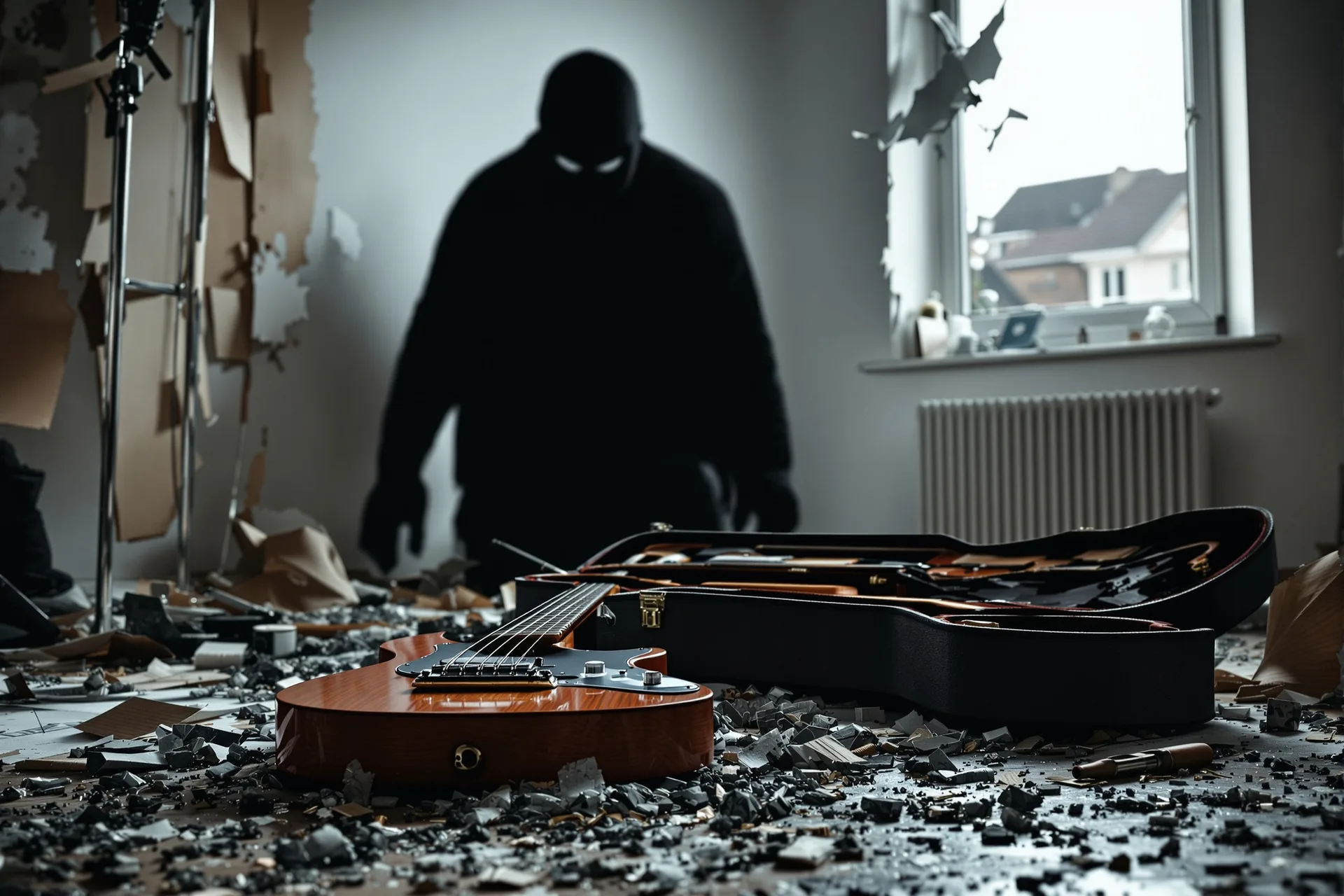
- Theft from the car, rehearsal room or stage
- Damage caused by leaking windows in the hotel or rehearsal room
- Transport damage on a plane, train or in a car
- Robbery and vandalism
The cover generally applies worldwide and around the clock, which is essential for touring musicians. With this comprehensive cover behind you, you can focus on what matters most, but the devil is often in the detail of the policy clauses.
Expert insight: You need to know these contractual clauses
Even with all-risk cover, there are important clauses that can limit protection. A critical example is the “night-time clause”. It often excludes damage if the instrument is left in a motor vehicle between 10 p.m. and 6 a.m. A musician who leaves their cello in the car overnight after a late gig could therefore lose their insurance cover. Our expert tip: Look for policies that waive this clause or allow it to be cancelled. Another point is the territorial scope; check whether cover applies across Europe or worldwide. You should also clarify whether the instrument is insured for replacement value or only for current market value, to avoid underinsurance in the event of a total loss. These details are crucial for seamless protection on your next trip.
Correct action in the event of a claim abroad
If damage occurs abroad, prompt and correct action is crucial for reimbursement. Document the damage immediately with photos from several angles. In the event of theft or vandalism, a local police report is essential; obtain a copy of the report for the insurer. Notify your insurer without delay, often within three days, by telephone or via its online portal. A well-known German violinist suffered damage of €4,000 to his instrument in the USA and, thanks to prompt reporting and full documentation, received his money within 14 days. Keep all receipts for repairs or necessary replacement purchases carefully. A well-documented case significantly speeds up settlement and ensures you are not left to bear the costs.
Costs and benefits: When the investment pays off
Travel insurance for musical instruments is not a question of "whether", but of value and use. Stiftung Warentest recommends such insurance as soon as an instrument is used regularly outside the home. The costs are often manageable. The annual premium is often between one and one and a half per cent of the instrument’s value. For a guitar worth €2,000, that means a premium of around €30 per year. A single avoided claim, such as a €250 repair after a fall, already makes the investment worthwhile. Consider not only the material value, but also the emotional value and the potential loss of income. This cover provides financial security that far outweighs the small annual contribution. In this way, the insurance becomes an indispensable part of your travel and leisure planning.
Special case for air travel: What you need to know before check-in
Transport by air poses a particular risk. Airlines strongly recommend transporting instruments in a hard case. Smaller instruments such as a violin, whose case does not exceed dimensions of 80 by 45 by 25 centimetres, can often be taken on board as hand luggage. For larger instruments such as a cello, an extra seat often has to be booked, which must be registered with the airline in advance. A specialised musical instrument insurance policy covers transport damage that is often only inadequately covered, or not covered at all, by the airline's liability. Always confirm the terms for taking the instrument on board in writing with the airline at least 48 hours before departure. This way, you avoid costly surprises at the airport and make sure your instrument arrives safely.
Frequently asked questions
- What should you do in the event of damage abroad?
Document the damage immediately with photos. Report theft or vandalism to the local police without delay and ask for a report. Then inform your insurer immediately and submit all supporting documents.
- Are borrowed instruments also insured?
In many policies, borrowed or rented instruments are also covered. However, this should be explicitly checked in the insurance terms and noted in the contract if necessary.
- Does the insurance cover damage on the plane?
Yes, a good musical instrument insurance policy covers transport damage that occurs on an aeroplane. This is important cover, as airlines’ liability is often limited and does not cover all damage.
- What is the night-time clause?
The night-time clause excludes insurance cover for instruments left overnight (usually between 10 p.m. and 6 a.m.) in an unattended vehicle. Look for policies that waive this clause.
- Is the replacement value or the current value reimbursed?
Good policies reimburse the replacement value of the instrument. This means that, in the event of a claim, you receive the sum needed to purchase a new, equivalent instrument. This is much better than the actual cash value, which takes age and wear and tear into account.
- Are accessories such as cases or bows covered as well?
Yes, as a rule, the accessories belonging to the instrument are also insured, provided they are listed in the policy schedule. These include cases, bows, stands and similar items.
Sources
- [1]The Federal Statistical Office provides official statistical information and press releases on the economy and society in Germany.
- [2]On the pages of the Federal Statistical Office you will find detailed information and statistics on the hospitality industry and tourism in Germany.
- [3]test.de, the online portal of the Stiftung Warentest, offers a detailed test report on musical instrument insurance and its costs.
- [4]The Federal Foreign Office provides up-to-date travel and security advice for countries worldwide, which is important for travellers.
- [5]The GDV (German Insurance Association) provides comprehensive information on musical instrument insurance, including important aspects of insurance cover.