Children’s glasses insurance in the event of damage
Protect yourself from high costs if your children’s glasses break. Find out which insurance pays when. Learn more now!
 Katrin StraubManaging DirectorInsurance expert with over 20 years of experience in the insurance industry.
Published on
Last updated on
8 min read
Table of Contents
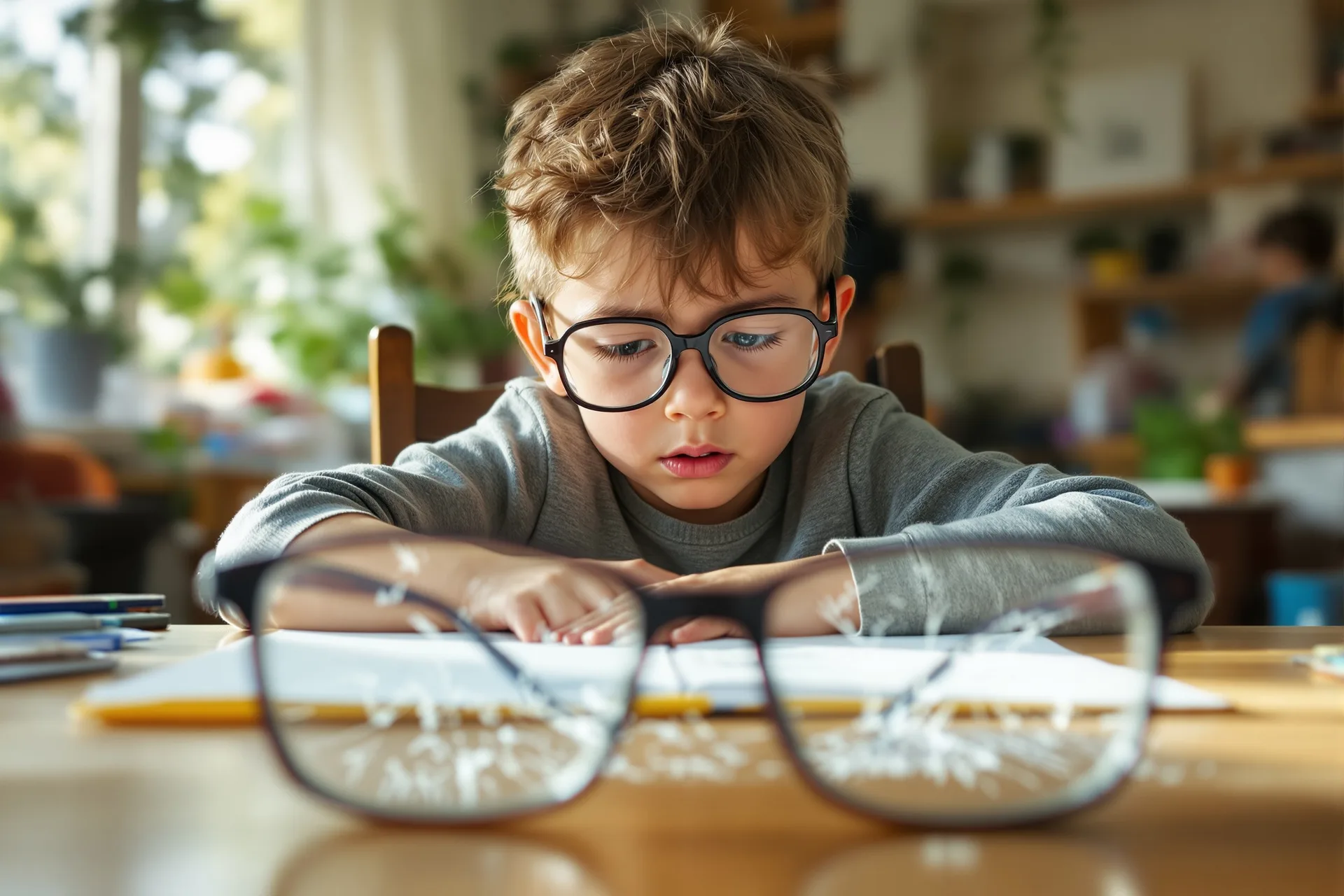
An inattentive moment on the school playground and the expensive children’s glasses are broken. Many parents believe that liability or health insurance will cover the damage – an expensive mistake. We show you which insurance pays when, and how special children’s glasses insurance covering damage provides financial security.
Cost analysis: What a broken pair of children’s glasses really costs
The cost of a child's glasses can quickly rise from €50 to over €300. While basic models are cheaper, sturdy frames and anti-reflective, shatter-resistant lenses are crucial for safety, especially for children. An average repair after a fall often already costs €75. Many parents underestimate that statutory health insurance only covers fixed amounts for the lenses, not for the frame. You have to cover the difference, which is often more than €150, yourself. A good glasses insurance policy can fill this gap. This initial cost overview illustrates why a careful look at the insurance benefits is so important.
Understanding the limits of statutory health insurance
The statutory health insurance scheme (GKV) covers the cost of lenses for children and young people under the age of 18 – but only up to a fixed set amount. This amount rarely covers the full cost; often, an out-of-pocket contribution of 50 per cent or more remains. In most cases, the insurers do not pay anything towards the frames. If the prescription changes by at least 0.5 dioptres, there is once again an entitlement to a subsidy for the lenses. Loss or damage alone without a change in prescription is not covered by the GKV. These rules show the clear limits of statutory cover. As a supplement, private spectacle insurance may be useful.
Liability insurance vs. glasses insurance: a crucial difference
A common misconception is that private liability insurance steps in when your own child’s glasses break. That is incorrect. Liability insurance only covers damage caused to third parties. So if your child destroys a friend’s glasses, your insurance applies (provided children who are not legally liable are also insured). However, if your child damages their own glasses while playing, liability insurance does not pay. The same applies to damage within the family, for example if a sibling breaks the glasses. This is exactly where children’s glasses insurance against damage comes in, which covers damage to your own property. The following overview clarifies the responsibilities:
- Liability insurance: Pays if your child damages someone else’s glasses.
- Statutory accident insurance: Provides benefits in the event of an accident at school or nursery.
- Children’s glasses insurance: Covers damage to the child’s own glasses, regardless of who caused it.
- No insurance: Applies in the event of loss if this is not explicitly covered.
This distinction is the basis for choosing the right insurance cover.
Checking the features of a good children’s glasses insurance policy
A comprehensive children's glasses insurance policy should cover more than just repairs. When choosing, pay attention to the details in the policy, as the differences are often greater than ten per cent in the premium. Important criteria are a low or even no excess and a straightforward claims process. A good policy reimburses the replacement value of the glasses, not just the current value. The sum insured should be at least 300 euros to also cover high-end models. A comprehensive children's accident insurance policy can sometimes also include visual aids, which is worth checking. A precise knowledge of the policy details prevents surprises when making a claim.
Expert tips on contract drafting and claims reporting
When selecting the right plan, there are a few legal details to bear in mind. You can find the statutory basis for the GKV benefit in Book Five of the Social Code (SGB V). A private insurance policy goes far beyond this. Our expert tip: Choose a contract with a term of no more than twelve months to remain flexible. This way, you can check annually whether the cover still matches your child’s eyesight and needs. In the event of a claim, prompt notification is crucial. Document the damage with photos and keep the broken glasses until the insurer gives approval for the repair. Good preparation significantly speeds up reimbursement.
Calculating cost-effectiveness: When does insurance pay off?
A simple calculation shows whether children’s glasses insurance is worthwhile. The annual premium for good insurance is often between 20 and 50 euros. The average cost of a new pair of children’s glasses is around 150 euros. If the glasses only break once every three years, premiums of 60 to 150 euros will almost cover the cost. For active children, where one claim per year is realistic, an insurance policy with a 50-euro premium saves you 100 euros straight away. The insurance acts like an airbag against unexpected expenses of up to 300 euros. This calculation shows that the cover is often cheaper than a single repair. This way, you protect yourself against financial strain.
Conclusion: Targeted protection for a carefree childhood
Children’s glasses are a valuable everyday companion, and their protection should not be left to chance. Statutory health insurance offers only basic cover, while private liability insurance does not cover damage to your own property. A specialised children’s glasses insurance against damage effectively closes this gap and protects you from unexpected costs amounting to several hundred euros. With an annual premium that is often lower than the cost of a single repair, it offers predictable and sensible protection. This means your child can play freely without you having to worry about finances.
Request an individual risk analysis now: Have your insurance situation reviewed free of charge and receive concrete optimisation suggestions.
Frequently asked questions
- What exactly does a children's glasses insurance cover?
Good policies cover breakage and damage to the frame and lenses, regardless of how the damage occurred. Loss and theft are often also included. Please pay attention to the exact terms of your policy.
- Is there an excess with the children’s glasses insurance?
That depends on the provider and the plan. There are contracts with no excess, but also those where you cover a small part yourself, for example ten per cent of the damage. Compare the offers carefully.
- What happens if my child's vision changes?
If your prescription changes by usually 0.5 dioptres or more, the statutory health insurance fund will again provide a subsidy for new lenses. Some private glasses insurance policies also offer subsidies when your prescription changes.
- What is the difference between current value and replacement value in reimbursement?
Time value takes into account the wear and tear of the glasses and is therefore lower than the original purchase price. New-for-old reimbursement, the better option, replaces the cost of an equivalent new pair of glasses without deductions.
- How do I properly report damage to my child’s glasses?
Contact your insurer immediately. Take photos of the damage, locate the purchase receipt and submit everything together with the claim report. Wait for the insurer’s cost approval before arranging the repair.
- Can I still take out glasses insurance if the glasses have already been bought?
Yes, with most providers you can also take out insurance a few weeks or months after purchasing the glasses. However, there is often a waiting period before the full insurance cover takes effect.
Sources
- [1]Statista offers a topic page on child health in Germany with relevant statistics and information.
- [2]On Kindergesundheit-info.de you will find comprehensive data and facts on child health.
- [3]The Deutsches Ärzteblatt publishes an article on the prevalence and changes of myopia among children and adolescents.
- [4]Augeninfo.de provides detailed information about short-sightedness (myopia).
- [5]On Augeninfo.de you will find explanations of long-sightedness (hyperopia).
- [6]The AOK Nordwest provides information in a press release on glasses for primary school children in Westphalia-Lippe.
- [7]Zeiss provides information on the increasing short-sightedness among children and adolescents.