Homeowner and property owner liability claim examples
Find out, using claims examples, when home and property owners’ liability insurance applies and how nextsure protects you from high costs. Find out more now!
All details are taken from the provider's linked product page and the contract documents (IPID/policy conditions) published there; the insurer's documents prevail. Premiums, benefits and the insurance product itself may change – please verify the details directly with the partner before signing up; only the information provided there is binding.
 Katrin StraubManaging DirectorInsurance expert with over 20 years of experience in the insurance industry.
Published on
Last updated on
11 min read
Table of Contents
A loose roof tile, an icy pavement – as a property owner, you can quickly be liable for damage to third parties. Find out, using real claims examples, why house and property owners’ liability insurance can be vital and how you can protect yourself optimally.

Personal liability insurance
Your everyday shield: nextsure's personal liability insurance reliably protects you from the financial consequences of damage you cause to others.
Learn moreThe underestimated risk: Common claims at a glance
Many property owners are not aware of the full liability risk associated with their property. A moment of inattention or an overlooked defect can quickly lead to substantial claims for damages. Third-party liability insurance for house and property owners steps in precisely here. It is essential for owners of rented properties, undeveloped land and owners’ associations.
A classic example is a passer-by slipping on an uncleared pavement in winter. Claims of over 9,000 euros for medical expenses and compensation for pain and suffering can arise very quickly. Falling roof tiles that damage a parked car are also not uncommon. Such incidents make it clear how quickly damage can threaten financial security.
The insurance assesses the question of liability, defends against unjustified claims and covers the costs in the event of legitimate claims. In this way, it provides an important protective shield. In the following, we take a closer look at specific areas of risk.
Winter maintenance: duties and liability risks in snow and ice
Winter clearance and gritting obligations are one of the most common causes of liability claims for homeowners and property owners. As a rule, as the owner you are responsible for the safety of the pavements on your property. Although this duty can often be transferred to tenants by means of a tenancy agreement, you still remain under a duty to monitor and supervise.
Failures can be costly: if a pedestrian falls because of icy conditions, claims including compensation for pain and suffering and loss of earnings can quickly reach five-figure sums. A ruling by the Hamm Higher Regional Court (OLG Hamm) awarded a tenant who had fallen on a broken stair tread EUR 8,000 in compensation for pain and suffering because the landlord had neglected their duty of supervision. The home and property owners’ liability insurance covered this loss.
Please note the municipal bylaws, which usually set the winter maintenance period from 7 a.m. to 8 p.m. The Federal Court of Justice (BGH) has also clarified that not every isolated icy patch, but rather “general ice formation”, triggers the gritting obligation. A solid private liability insurance policy is an important addition here, but it does not cover all risks for landlords.
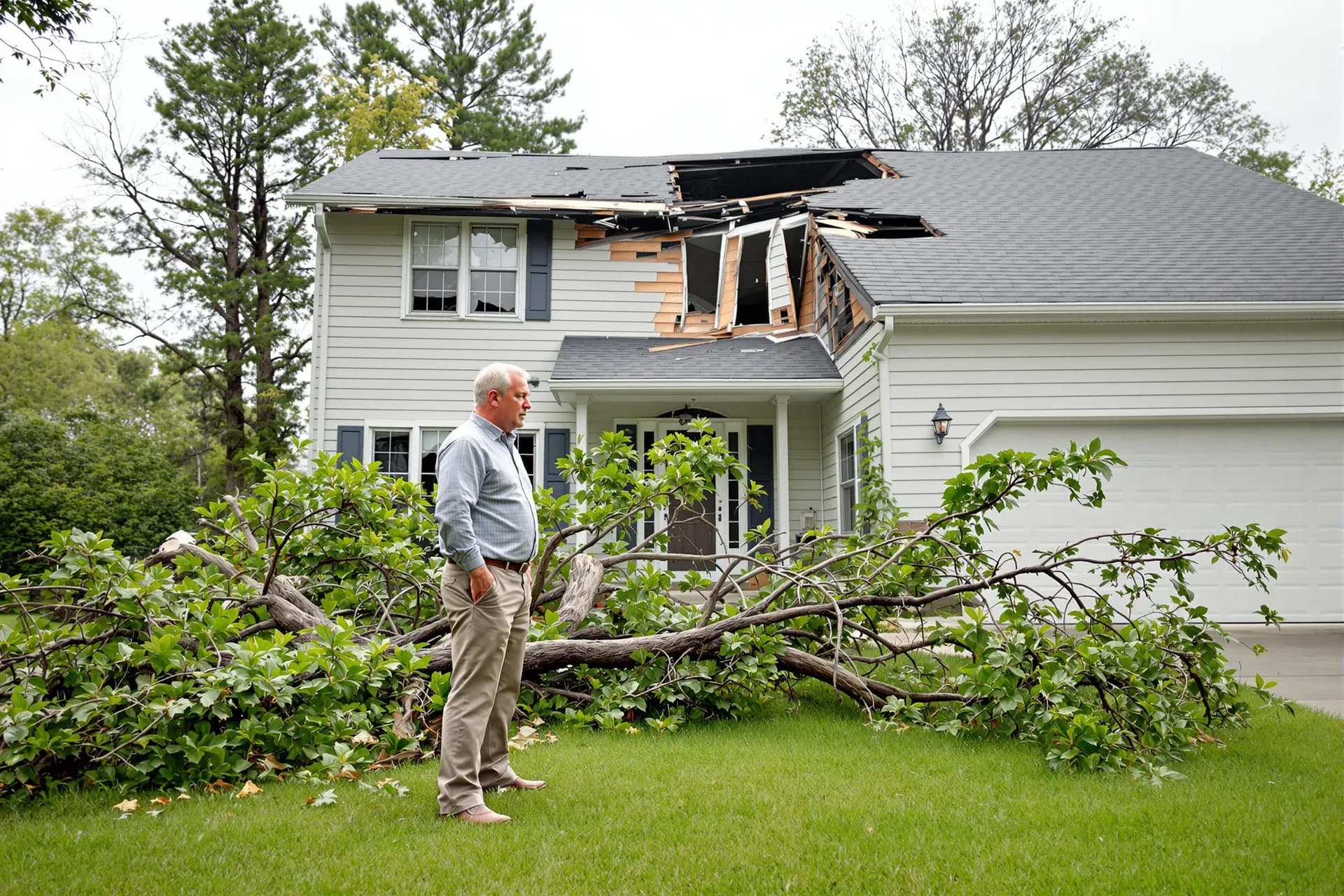
Tree on neighbouring property: Who pays for storm damage?
A falling tree can cause significant damage to a neighbouring property. The question of liability depends crucially on the condition of the tree and the cause of it falling. If the owner has breached their duty of care by, for example, failing to secure or fell an obviously diseased or rotten tree adequately, they are liable for the damage caused. Such a case can quickly lead to repair costs of, for example, €3,400 if branches fall onto the neighbouring building.
The obligation to carry out regular tree inspections arises from Section 823 of the German Civil Code (BGB). Here are some aspects of tree care and liability:
- Regular visual inspections for stability and dead wood are essential, at least twice a year (in leaf and out of leaf).
- If damage is suspected, a specialist (tree inspector or tree care professional) should be consulted.
- Carefully document inspections carried out and maintenance measures taken.
- If a healthy tree falls due to force majeure (e.g. a storm of wind force eight), the injured neighbour’s buildings insurance will usually apply.
Home and property owners’ liability insurance applies if a breach of duty by the tree owner is proven. It then covers the costs of personal injury and property damage. Without this protection, the financial consequences can be considerable.
Landlords, take note: typical sources of damage in rental properties
As a landlord, you bear a special responsibility under Article 14 of the Basic Law: “Property entails obligations.” Damage suffered by tenants or third parties due to defects in the rented property falls within your area of liability. Landlord liability insurance is therefore a must. It is often included in property owners' liability insurance or available as an optional add-on.
A common scenario is water damage caused by a defective pipe in the rented flat, which damages the flat below. Personal injury is also relevant: if a tenant suffers an electric shock due to faulty electrical installation, the landlord is liable if they have neglected their maintenance obligations. Such cases can result in medical expenses, compensation for pain and suffering and even pension payments.
Our expert tip: Carry out regular inspections of your rental properties and document them. Pay particular attention to safety-relevant components such as electrical systems, water pipes and stair railings. This not only helps prevent damage, but also strengthens your position in the event of a liability claim. Knowing which insurance policies you need as a landlord is fundamental here.
Legal foundations: provisions every owner should know
The liability of house and property owners is clearly regulated in the German Civil Code (BGB). Two sections are of central importance here. Section 836 BGB deals with the liability of the owner of land in the event of the collapse of a building or detachment of parts. This means that if, for example, roof tiles fall and damage a car, the owner is liable if the damage is attributable to defective construction or poor maintenance.
The owner can only exonerate themselves if they prove that they have observed the care required in the course of trade. This underlines the importance of regular inspections and maintenance measures. A well-known Federal Court of Justice (BGH) ruling concerned a fire that was triggered by roof work and spread to a neighbouring house, with the owner’s liability being the focus.
In addition, Section 823 BGB, the general duty to pay damages, is relevant. This section applies whenever someone culpably unlawfully injures the life, body, health, freedom, property or another right of another person. The breach of duties to ensure safety, such as the duty to grit, typically falls under this. Sound knowledge of these basics helps to assess risks correctly and recognise the need for comprehensive home and property advice.
Expert tips for minimising risk and optimal protection
In addition to taking out comprehensive home and property owners’ liability insurance, you can do a great deal yourself to minimise risk. A proactive approach not only protects against damage, but can also have a positive effect on your insurance costs. Here are some practical recommendations:
- Carry out a thorough inspection of your property and grounds at least twice a year. Pay attention to loose parts, cracks in the masonry, the condition of trees and the functionality of lighting and paths.
- Carefully document all inspections and any maintenance and repair work carried out, including dates and photos. This serves as important evidence in the event of a claim.
- Regularly check whether your duty of care obligations (e.g. winter maintenance, leaf clearance) are being reliably fulfilled, even if they have been delegated to third parties. Spot checks are often sufficient here.
- Make sure your home and property owners’ liability insurance has an adequate sum insured. Experts recommend at least ten million euros cover in total for personal injury, property damage and financial loss.
- Find out about specific risks such as oil tanks or photovoltaic systems and check whether these are included in your insurance cover or require additional cover.
Our expert tip: Have your existing insurance policies reviewed regularly, for example every three to five years, by an independent adviser. This ensures that your cover is still up to date and ideally suited to your situation. The question what you need liability insurance for should always be at the centre of this.
What to do in the event of a claim? The right steps after an incident
Despite all precautions, a claim can still occur. In such a situation, acting quickly and correctly is crucial to limit the damage and make the claims process with the insurer easier. Stay calm and proceed systematically. Document the damage immediately and comprehensively with photos or videos from different angles. Make a note of the date and exact time of the incident, as well as the contact details of any potential witnesses.
Report the damage to your homeowners’ and property owners’ liability insurance without delay. Most insurers provide a 24-hour hotline or an online portal for this. Complete the claim notification truthfully and as detailed as possible. Do not admit liability without consulting your insurer. The insurer will first check whether, and to what extent, you are liable for the damage.
Provide first aid if anyone has been injured, and secure the scene to avoid any consequential damage. For example, if a branch has fallen, you should cordon off the area. These initial measures are important before the insurer gives any further instructions. The question of whether the private liability insurance increases after a claim is relevant for personal liability insurance, but the principle of reporting a claim remains similar.
Costs and Services: What You Should Look Out for When Comparing
The cost of a house and property owner’s liability insurance policy varies depending on the type of property, size, location and desired scope of cover. A detached house is usually cheaper to insure than an apartment building with several residential units. Vacant plots of land often have the lowest premiums. Comparing different providers is always worthwhile in order to find the best value for money. Pay attention not only to the price, but above all to the benefits included and the level of cover limits.
Important elements of cover, in addition to a high sum insured (at least ten million euros), also include cover for damage caused by gradual deterioration (e.g. damp), damage to rented items (if letting out), and cover for owner-builder risks up to a certain amount if minor renovations are planned. Also check whether children who are not yet legally liable are co-insured, in case they are on the property and could cause damage. Many tariffs also include cover for uninsured losses. This applies if a third party causes you damage but is unable to pay for it and does not have their own liability insurance.
Our expert tip: Take advantage of our free service for a tailored risk analysis. We review your existing insurance situation and show you specific optimisation suggestions so that you are well protected if the worst comes to the worst. For example, a lost key to a locking system can result in high costs; check whether this is covered in your liability insurance for lost keys or should be included in house and property owner’s liability insurance.
Frequently asked questions
- Is house and property owner liability insurance legally required?
No, it is not legally required, but due to the owner’s unlimited liability for damage arising from their property, it is strongly recommended and can be vital to financial security.
- How much does house and property owners’ liability insurance cost approximately?
Costs depend on various factors, such as the type and size of the property, the number of residential units and the desired scope of services. For a single-family home, annual contributions often start at under 50 euros, while they are higher for multi-family homes.
- Can I pass on the costs of house and property owners' liability insurance to my tenants?
Yes, the costs of house and landowner liability insurance can be passed on to tenants as operating costs, provided this is agreed in the tenancy agreement.
- What level of cover is sensible for homeowners and property owners liability insurance?
Experts recommend a cover amount of at least ten million euros in total for personal injury, property damage and financial losses, to ensure adequate protection even in the event of very large losses.
- What is the difference compared with personal liability insurance?
Private liability insurance covers damage you cause to others as a private individual. Homeowner's and property owners' liability insurance, on the other hand, covers risks specifically associated with owning and letting real estate and land.
- What happens if I do not fulfil my duty to ensure safety?
If you breach your duty of care obligations (e.g. the duty to clear and grit in winter, building maintenance) and someone is injured as a result, you are liable with your entire assets. In such cases, homeowners' and property owners' liability insurance covers justified claims for compensation.
Sources
- [1]Wikipedia provides a comprehensive overview of homeowners' and property owners' liability insurance in Germany.
- [2]The Bund der Versicherten offers independent guides and information on homeowners' and property owners' liability insurance from a consumer perspective.
- [3]The VDIV (Verband der Immobilienverwalter Deutschland) publishes specialist articles and publications dealing with duties and safety in property management.
- [4]The Federal Court of Justice (BGH) provides official press releases and judgments on case law relevant to property owners and their liability.
- [5]The GDV (Gesamtverband der Deutschen Versicherungswirtschaft) offers comprehensive statistics and analyses on the German insurance industry, including data on claims development in residential property insurance.
Conclude directly online
Verified partner tariffs at no extra cost. The button takes you straight to the provider's calculator.
 Hepster
Private liability insurance
Private liability cover in three tariffs (Basis, Premium, Superior) with worldwide protection for you and your family.
- Tariffs:
- Basis, Premium, Superior
- Coverage area:
- worldwide; unlimited in Europe, up to 5 years outside Europe
- Sum insured:
- as stated in the insurance certificate
- Damage as a pedestrian, cyclist, or while doing sports
- Drones and model aircraft: up to 250g (Basis/Premium) or up to 5kg (Superior)
- Owners of tame pets, tamed small animals, and bees are covered
- From Premium: loss of third-party keys and damage in vacation accommodation
- Superior: key loss including keycards, safe keys, and vehicle keys
- Additional persons are co-insured (e.g. spouse/partner, children)
Key exclusions
- Professional activities
- Keeping dogs or horses (separate cover required)
- Driving motor vehicles subject to mandatory insurance
- Damage caused intentionally
Trusted Shops: 4,5/5 „Sehr gut“ (2.600 Bewertungen)
hepster insgesamt (Anbieterbewertung, alle Versicherungen)
Monthly subscription: minimum term 12 months, notice period 3 business days before the end of the billing period. Insurer: andsafe Aktiengesellschaft
Fact sheet: benefits, exclusions and waiting periods in detail
All details are taken from the provider's linked product page and the contract documents (IPID/policy conditions) published there; the insurer's documents prevail. Premiums, benefits and the insurance product itself may change – please verify the details directly with the partner before signing up; only the information provided there is binding.
Information last updated: July 2026 · Source: provider product information (IPID/policy conditions)