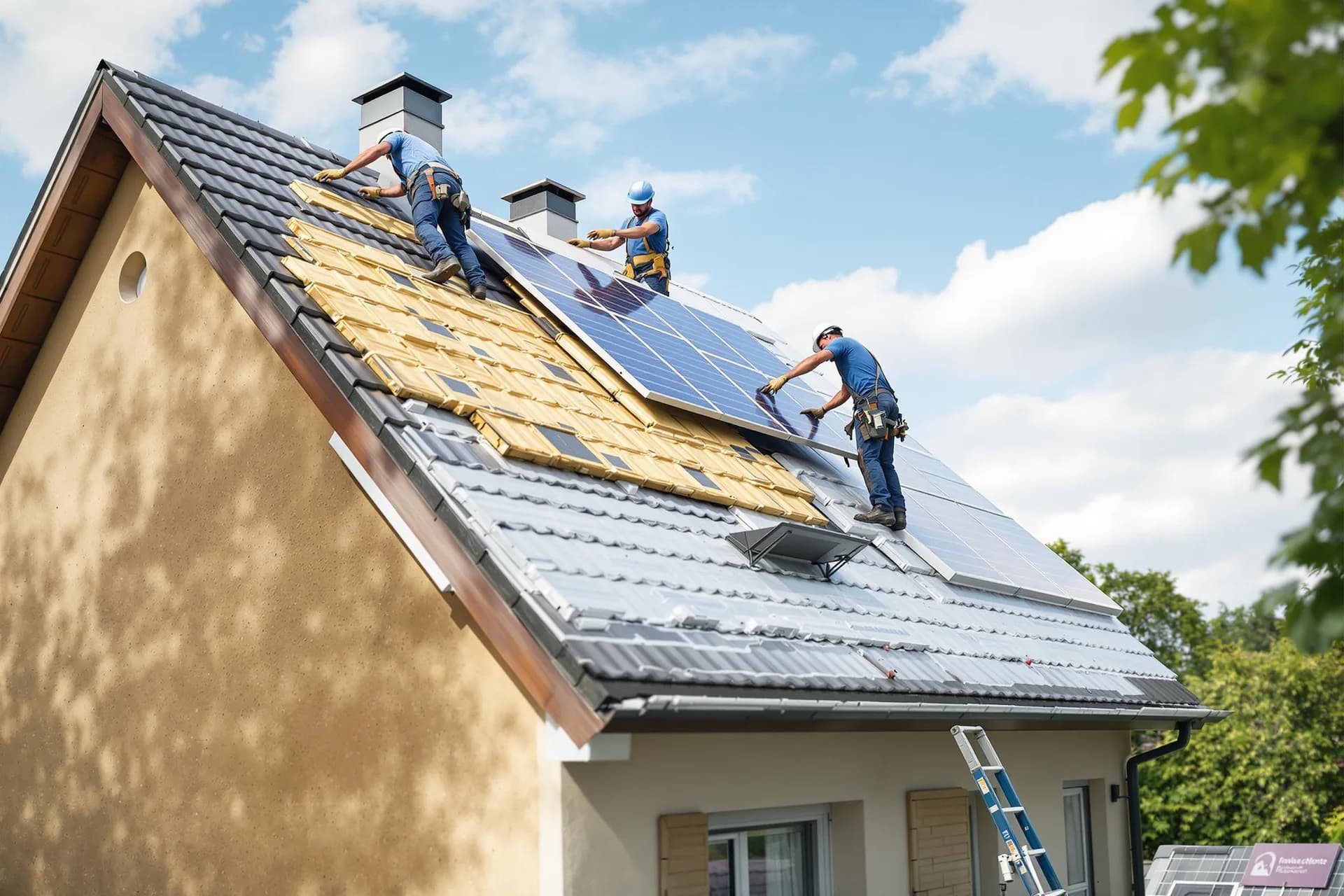
Financing for conservatories & patio roofs
Planning a patio cover or a conservatory? Discover the best financing options and secure a free analysis now.
 Katrin StraubManaging DirectorInsurance expert with over 20 years of experience in the insurance industry.
Published on
Last updated on
4 min read
Table of Contents
Financing for a patio cover or conservatory: Your path to the dream extension
For many people, a conservatory is the very epitome of quality living, but the cost can be a hurdle. This article shows you how to make your dream of a glass room or a sheltered terrace a reality with the right financing strategy. We guide you through the options, from flexible loans to government grants, and provide you with tried-and-tested practical tips.
Calculating costs realistically: The basis for your financing
Before you apply for financing for your patio cover or conservatory, a precise cost breakdown is essential. Simple aluminium patio covers are available from around €2,000. An unheated conservatory, which is not heated, costs between €8,000 and €25,000 depending on size and material. For a fully insulated conservatory that can be used all year round, you should expect costs from €20,000, with projects over €70,000 by no means uncommon. Always allow a buffer of at least ten to fifteen per cent for unforeseen expenses. These costs include not only materials and installation, but also the foundations, planning permission and any extras such as shading or ventilation. A detailed plan protects you from financial surprises and forms the basis for discussions with your bank.
Compare credit options: Find the right option for your budget
There are several ways to finance your extension, which differ significantly in interest rates and flexibility. A careful review of the terms could save you several thousand euros. Here are the most common options:
- Instalment loan for unrestricted use: This option is straightforward and quickly available, as no proof of purpose is required. However, the interest rates are often one to two percentage points higher than for purpose-bound loans. Such a loan for unrestricted use is suitable for amounts of up to around €50,000.
- Home improvement loan: As a property owner, you receive significantly better terms here. Many banks waive the costly land registry entry for sums of up to €75,000.
- Mortgage financing: For very large and expensive projects over €75,000, a classic mortgage financing with land registry entry is often the cheapest solution. It offers the lowest interest rates, but involves more administrative effort.
- Building savings contract: If you are planning the build in a few years, a building savings contract could be a good option. This secures fixed, low loan interest rates for the future.
The choice depends heavily on the project cost and your timeframe, which is why a detailed comparison of the offers is crucial.
Modernisation loan: Secure up to €75,000 without a land register entry
A modernisation loan is the ideal solution for most projects. As you, as the owner, are liable with your property, banks offer interest rates that are often more than twelve per cent below those of standard personal loans. The biggest advantage is the waiver of a land registry entry for sums of up to 75,000 euros, which saves several hundred euros in notary and land registry fees. The process is therefore significantly faster than with a traditional property finance arrangement. The requirement is that you are the owner of the property and can demonstrably use the money for a measure that increases its value. Proof is often already provided by quotations from the tradespeople. Some institutions even offer loans of up to 90,000 euros without registration. This form of financing therefore combines favourable terms with an uncomplicated process and is thus the first choice for most conservatories and patio roofs.
Check government funding: use grants for energy-efficient extensions
If your conservatory is designed as a heated living space and contributes to the home’s energy efficiency, you can take advantage of government funding. The Kreditanstalt für Wiederaufbau (KfW) and the Federal Office for Economic Affairs and Export Control (BAFA) offer attractive programmes. Through the Federal Funding for Efficient Buildings (BEG), grants of up to twenty per cent of the eligible costs are possible, capped at 60,000 euros per residential unit. Alternatively, the KfW offers low-interest loans such as the “Climate-Friendly New Build” programme (297). Our expert tip: an energy efficiency expert must be involved before the contract is awarded in order to confirm eligibility for funding. Another option is tax deductibility: under Section 35c of the German Income Tax Act (EStG), you can deduct twenty per cent of the renovation costs (up to 40,000 euros) from your tax over three years if you do not use any other funding.
This option is particularly interesting if you have missed the application deadlines for funding.
Observe building regulations: clarify permit requirements depending on the federal state
A frequently underestimated aspect is the building permit, the need for which depends on the respective federal state. As a general rule: a heated residential conservatory always requires planning permission, as it extends the living space. For unheated cold conservatories and patio canopies, there are exceptions based on size. In North Rhine-Westphalia, for example, extensions of up to 25 square metres of floor area do not require planning permission; in Brandenburg, the limit is 20 square metres. In federal states such as Bavaria or Baden-Württemberg, however, you will almost always need a permit. Be sure to find out about the local state building regulations from your responsible building authority before planning. You also generally have to maintain a minimum distance of three metres from the neighbouring property. Clarifying these legal framework conditions at an early stage will save you from costly fines or even having to dismantle it.
Adjust your insurance cover: Insure the new value of your property
A conservatory or a high-quality patio canopy can significantly increase the value of your property. It is therefore essential to adjust your insurance cover. Notify your buildings insurance of the extension to avoid underinsurance. The sum insured, which is often calculated on the basis of the living area or the notional 1914 value, must be increased. The standard buildings insurance covers damage caused by storms (from wind force eight), hail and fire. For glass breakage caused by other reasons, such as a child playing ball, you will usually need separate glass insurance. Given the increasing frequency of extreme weather, you may also want to consider natural hazards insurance, which covers damage caused by heavy rain or flooding. Comprehensive cover protects your investment of several tens of thousands of euros in the long term. At nextsure, we can help you optimally adapt your insurance cover to the new situation.
Request an individual risk assessment now: Have your insurance situation reviewed free of charge and receive specific recommendations for optimisation.
Frequently asked questions
- Which financing option is best for a patio cover?
For a patio cover, which usually costs between €3,000 and €15,000, a renovation loan is ideal for property owners. It offers better interest rates than a standard personal loan and is straightforward to apply for.
- Do I need to register the financing of a conservatory in the land register?
Not necessarily. Many banks offer modernisation loans of up to €75,000 without the need to register a charge over the property. This saves time and costs for the notary and land registry office.
- Are there government grants for a patio cover?
For a simple patio roof, there are generally no direct grants. Funding from KfW or BAFA is tied to energy-efficient renovation measures, which is more likely to apply to a heated and thermally insulated conservatory.
- How does a conservatory affect my buildings insurance?
A conservatory increases the value and the floor area of your property. You must notify your insurer of the extension in order to adjust the sum insured and avoid underinsurance. In many cases, additional glass insurance is sensible.
- Do I always need planning permission for a conservatory?
For a heated conservatory, yes, in all federal states. For unheated cold conservatories, there are exceptions depending on the state and size. It is always advisable to enquire with the local building authority before planning.
- Can I deduct the cost of the conservatory from my taxes?
Yes, if you do not claim KfW or BAFA funding, you can claim tradesperson services and energy-efficient refurbishment measures for tax purposes. Under Section 35c of the German Income Tax Act (EStG), twenty per cent of the costs (max. EUR 40,000) can be deducted.
Sources
- [1]KfW provides detailed information on funding for existing properties for private individuals.
- [2]Federal Association of Conservatories e.V. provides comprehensive information and experts on the topic of conservatories.
- [3]The Federal Ministry of Justice and Consumer Protection offers the Building Code (BauGB) online for consultation.