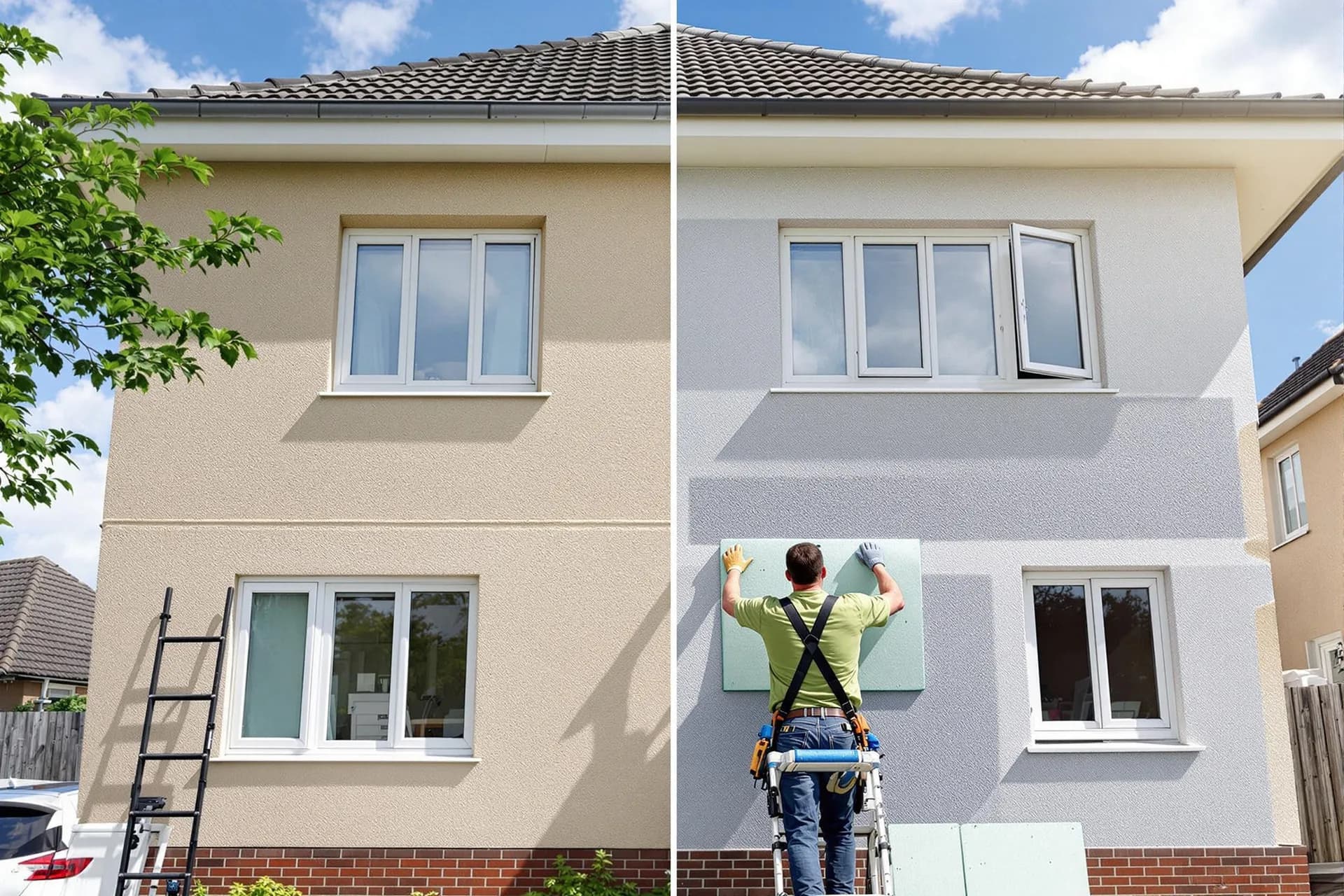
Financing façade insulation
Planning a façade insulation project? Discover all financing options, from BAFA grants to KfW loans. Get advice now!
 Katrin StraubManaging DirectorInsurance expert with over 20 years of experience in the insurance industry.
Published on
Last updated on
7 min read
Table of Contents
External wall insulation can reduce your heating costs by up to forty per cent. However, the initial investment is high. Discover how you can significantly reduce the costs and increase the value of your property through government grants and smart financing models.
Costs and benefits of façade insulation at a glance
An investment in façade insulation often pays for itself after just a few years thanks to lower energy costs. The costs vary considerably depending on the method and range from 20 to 350 euros per square metre. An external thermal insulation composite system (ETICS), for example, costs between 120 and 200 euros per square metre. For a façade area of 100 square metres, this corresponds to an investment of 12,000 to 20,000 euros. Through insulation, however, you can save up to 40 per cent on your heating costs. The Buildings Energy Act (GEG) also requires insulation as soon as you renew more than ten per cent of the façade area. A well-planned property financing is therefore the first step towards making it a reality. The investment not only protects against high energy costs, but also secures the value of your property for the future.
Government subsidies: The Federal Subsidy for Efficient Buildings (BEG)
The state supports your project with attractive grants through the Federal Funding for Efficient Buildings (BEG). The Federal Office for Economic Affairs and Export Control (BAFA) provides a grant of 15 per cent for individual measures such as façade insulation. The eligible costs are capped at 30,000 euros per dwelling unit per year, which corresponds to a maximum grant of 4,500 euros. Our expert tip: Use an individual renovation roadmap (iSFP). This increases the funding rate to 20 per cent, and the eligible costs double to 60,000 euros. This means you can receive a grant of up to 12,000 euros. Hiring an energy efficiency expert is mandatory for the application, but is also subsidised at 50 per cent. You must apply for these grants before the construction work begins. Proper planning is crucial to secure the maximum funding for your home and living.
Credit options for financing the remaining costs
Even after deducting the grants, there is often still a significant financing requirement. For this purpose, the Kreditanstalt für Wiederaufbau (KfW) offers special subsidised loans. Since 2024, the BAFA grant can be combined with the KfW supplementary loan (358/359), which provides up to EUR 120,000 per residential unit. There are additional interest advantages for owner-occupiers with a household income of up to EUR 90,000. As an alternative to the grant, you can use the KfW 261 loan for a comprehensive renovation to an Efficiency House, which can include a repayment grant of up to EUR 67,500. Another option is a classic modernisation loan for energy-efficient renovation, which is often granted without a land registry entry. Comparing the terms is essential in order to find the right financing solution.
Tax depreciation as an alternative to direct funding
If you do not claim any direct grants or subsidised loans, you can claim the costs of façade insulation for tax purposes. You can deduct 20 per cent of the expenditure from your tax liability over a period of three years. The maximum tax reduction is 40,000 euros per property. In the first and second years, seven per cent of the costs each year (maximum 14,000 euros) and in the third year six per cent (maximum 12,000 euros) can be deducted. It is important to note that this tax incentive cannot be combined with other public subsidies such as BAFA grants or KfW loans. You therefore have to choose one option. This option is particularly suitable for owners who finance the renovation entirely from their own funds and have a high tax burden. From 2025, new standard certificates are also intended to simplify the tax process.
Step-by-step guide to optimal financing
A structured approach is the key to success. With these four steps, you can secure the best possible financing for your façade insulation:
- Obtain energy advice: Commission a certified energy-efficiency expert. They will review your project, prepare the required refurbishment schedule (iSFP) for the higher subsidy rate, and confirm the technical requirements.
- Compare quotes: Obtain at least two to three quotes from specialist contractors for the insulation work. Compare not only the price, but also the proposed materials and the scope of services.
- Apply for funding: Submit the application for a grant (BAFA) or loan (KfW) before you sign a contractor agreement or order materials. The contract should include a suspensive clause that makes it contingent on the funding approval.
- Secure and implement financing: Once the funding approval has been granted, conclude the loan agreement, for example for a solar loan, if you are combining the insulation with photovoltaics. Only then should construction work begin.
This systematic planning ensures that you do not miss any deadlines and make full use of all financial benefits.
Expert tips for maximum savings
To make full use of the potential of your financing, you should be familiar with some advanced strategies. Our expert tip: combine measures to achieve higher funding limits. If, in addition to the façade, you also insulate the roof or install new windows, you can claim the eligible costs for each individual measure separately and thus maximise the overall subsidy. A green loan for sustainable investments can be a useful addition here. Also note the U-value: for funding to apply, the thermal transmittance coefficient of the new insulation must not exceed 0.20 W/(m² K). More generous limits apply to listed buildings. Long-term planning, for example through a building savings contract for future renovations, can also provide financial security and make implementation easier.
Conclusion: An investment that pays off many times over
Financing façade insulation is a wise decision for the future of your property. It not only sustainably reduces your energy costs by up to 40 per cent, but also increases living comfort and the value of the building. By cleverly combining BAFA grants, KfW loans and tax advantages, the initial investment costs of up to EUR 20,000 for an average detached house can be significantly reduced. A professional consultation helps you find the optimal financing mix for your project and make full use of all funding opportunities. This makes the energy-efficient refurbishment a financially attractive proposition.
Frequently asked questions
- How much funding is available for external wall insulation?
You receive a basic subsidy of 15 per cent from BAFA. With an individual renovation roadmap (iSFP), the subsidy increases to 20 per cent of the eligible costs of up to 60,000 euros, which corresponds to funding of up to 12,000 euros.
- What loans are available for facade insulation?
KfW offers the supplementary loan (358/359) of up to €120,000, which can be combined with the BAFA grant. Alternatively, for complete refurbishments there is the KfW 261 loan with repayment grants.
- Do I need to hire an energy consultant to receive the grant?
Yes, involving a certified energy efficiency expert is a mandatory requirement for applying for the Federal Funding for Efficient Buildings (BEG). The costs for this advice are also subsidised by 50 per cent.
- What is the iSFP bonus?
The iSFP bonus is an additional funding incentive. If façade insulation is part of an individual refurbishment roadmap (iSFP) prepared beforehand, the subsidy rate increases from 15 to 20 per cent and the eligible costs rise from 30,000 to 60,000 euros.
- Can I claim façade insulation as a tax deduction?
Yes, alternatively to BAFA/KfW funding, you can deduct 20 percent of the renovation costs (maximum 40,000 euros) from your tax bill over three years. However, combining this with other grants is excluded.
- What technical requirements are there for funding?
To be eligible for funding, the insulated façade must achieve a thermal transmittance coefficient (U-value) of no more than 0.20 W/(m²K). Different, less stringent requirements apply to listed buildings.
Sources
- [1]The KfW provides detailed information on funding for façade insulation as part of the energy-efficient refurbishment of existing properties for private individuals.
- [2]The German Environment Agency provides up-to-date data on energy consumption for buildings as an important environmental indicator.
- [3]On Gesetze im Internet you can find the full text of the Buildings Energy Act (GEG), which regulates the energy requirements for new builds and refurbishments.
- [4]The Consumer Advice Centre provides comprehensive information on thermal insulation for roofs, façades and basements for effective energy savings.
- [5]The Federal Statistical Office (Destatis) provides tables on the energy consumption of private households.
- [6]The German Energy Agency (dena) offers a modernisation guide with valuable tips on energy-efficient refurbishment.
- [7]The Federal Ministry for Economic Affairs and Climate Action (BMWK) answers frequently asked questions about thermal insulation.
- [8]The German Environment Agency provides a document with questions and answers on the topic of thermal insulation.