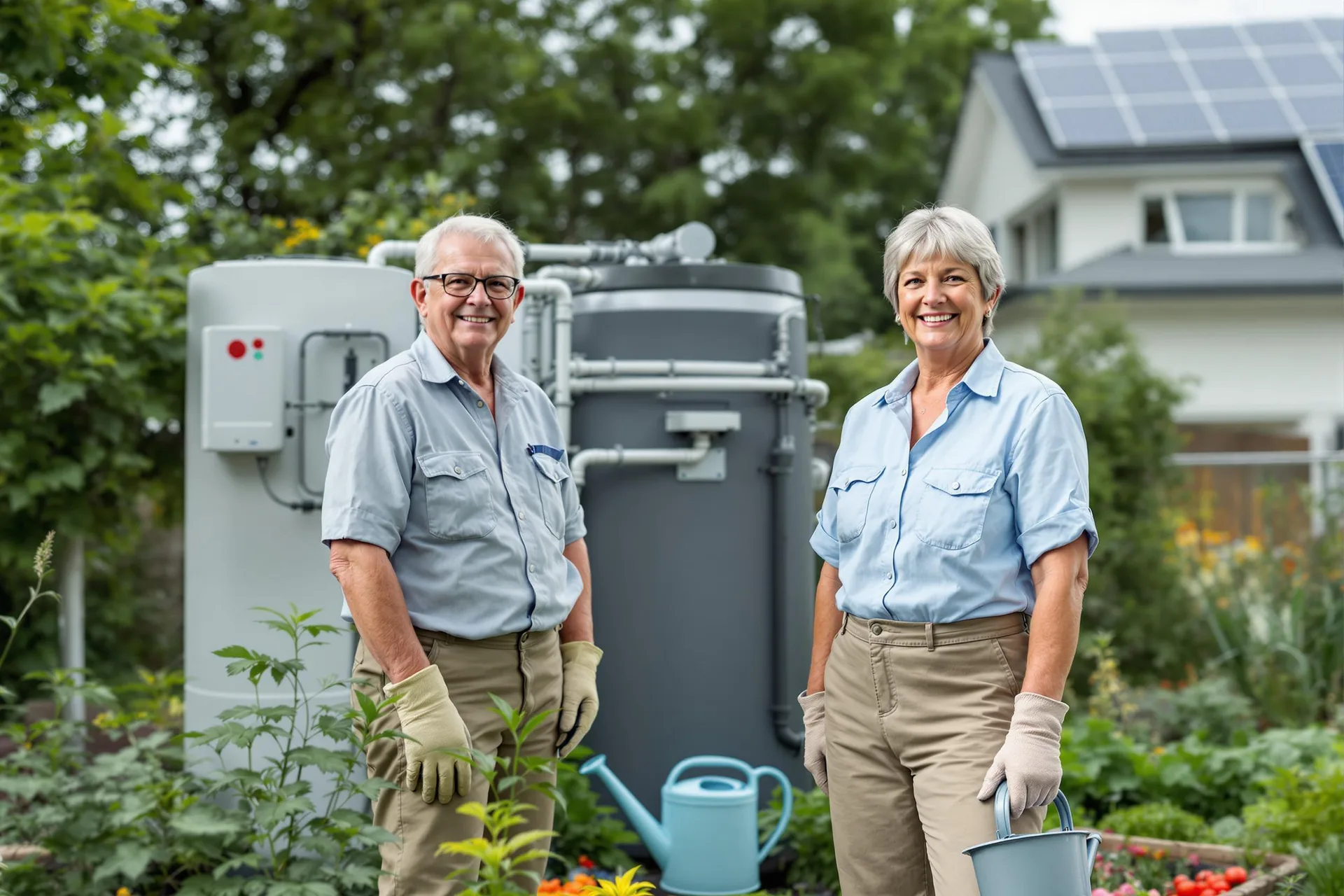
Financing rainwater harvesting system
Guide to financing a rainwater harvesting system for the garden. Information on costs, loans and grants. Request your analysis now!
 Katrin StraubManaging DirectorInsurance expert with over 20 years of experience in the insurance industry.
Published on
Last updated on
10 min read
Table of Contents
Rising water prices putting a strain on your household budget? A rainwater harvesting system for the garden can significantly reduce your costs. Find out how to finance the investment wisely and benefit from government grants.
Costs and profitability: When an investment pays off
The purchase of a rainwater harvesting system is an investment that pays off over the years. Depending on the size and your own labour, the cost of a complete system is between 2,500 and 5,000 euros. This includes the storage tank, filter, pump and the necessary pipework. Annual maintenance costs around 100 euros.
Against this is significant savings potential. A household of four can reduce its drinking water consumption by around 40 cubic metres per year. At an average water price of over two euros per cubic metre, this results in annual savings of at least 80 euros for garden irrigation alone. Many local authorities also waive the stormwater charge, which further increases the savings.
The payback period depends greatly on local water charges. The more expensive drinking water is in your area, the faster the system pays for itself. With a suitable garden loan, you can manage the initial investment and the system starts saving you money straight away. Analysing the costs and savings potential is the first step towards making a decision.
Check funding: Secure state and municipal grants
A uniform nationwide subsidy for financing a rainwater harvesting system for the garden is unfortunately not currently available. However, there are numerous ways to obtain financial support. Many federal states and especially local authorities offer their own funding programmes to promote the sustainable use of water.
For example, the City of Hamburg subsidises the installation of rainwater storage tanks with up to 1,500 euros for private individuals. Even smaller municipalities such as Königswinter support systems whose costs exceed 500 euros. It is worth drawing up a list of possible funding sources:
- Grants from the city or municipality
- Reduction in stormwater fees
- Low-interest loans from state banks
- Programmes from local water suppliers
Our expert tip: Enquire directly with your local environmental or building authority about current funding pots. As a rule, the application must be submitted before construction work begins. An green loan can be a useful addition to cover the remaining costs. With the right combination of grants and financing, the system becomes even more economical.
Choosing the right loan: From green to renovation loans
For the remaining financing after deducting any available grants, various loan options are available. A classic personal loan often offers quick availability and flexible terms of twelve to 120 months. Specialised eco-loans reward sustainable projects such as a rainwater harvesting system with particularly favourable interest rates.
If you are planning a larger modernisation anyway, the system can be part of a more comprehensive project. In this case, a modernisation loan without a land register entry is an excellent choice. These loans are earmarked and offer better terms than unsecured loans.
The Kreditanstalt für Wiederaufbau (KfW) supports cisterns as part of larger renovations for climate adaptation, for example through the environmental programme (240, 241). A stand-alone system for the garden is less often directly subsidised. Therefore, compare the terms of at least three different banks to find the best offer. The right financing structure is crucial for the overall cost of your project.
Law and Insurance: What You Need to Know Before Building
Before you start building, legal aspects must be clarified. A building permit is usually not required for a cistern, but its installation must be reported to the local water supplier. The most important regulation is the strict separation of rainwater and drinking water systems to avoid contamination.
Local drainage regulations specify how the cistern overflow must be handled. In most cases, a connection to the sewer system is required to prevent flooding. All rainwater pipes and draw-off points must be permanently marked as such.
Insurance cover is another important point. A cistern is considered part of the building and is generally covered by buildings insurance. Check your policy carefully: damage caused by escaping cistern water is not automatically included in every contract. A suitable buildings insurance policy protects you from unforeseen costs. This means your investment is secured in the long term.
Frequently asked questions
- What financing options are available for a rainwater harvesting system?
You can finance the system through a standard instalment loan, a special eco-loan with interest advantages, or, as part of a larger refurbishment, through a modernisation loan. You should also always first check the regional funding programmes offered by your local authority.
- How can I find out whether my municipality supports the construction of a cistern?
The best points of contact are the environmental office or the building department of your city or municipality. A direct enquiry there, or a look at the municipality’s official website, will quickly provide information on current funding guidelines and subsidy amounts.
- Is a cistern automatically covered by my buildings insurance?
Not always fully covered. While the cistern itself is often insured as part of the building against fire or storm, damage caused by escaping water (water damage from burst pipes or leaks) is not covered in all policies. Checking your insurance policy or asking your insurer is essential.
- Do I need to get approval for installing a rainwater harvesting system?
A building permit is generally not required. However, you are obliged to notify the installation of the system to your local water supplier and, in some cases, the health department.
- How big should the rainwater storage tank for my garden be?
The size depends on the roof area, local rainfall and your water requirements. For garden irrigation alone for an average detached house (approx. 150 m² garden), a tank with a volume of 3,000 to 5,000 litres is often sufficient.
- Which roofs are not suitable for rainwater harvesting?
Roofs made of copper or zinc, as well as roofs sealed with roofing felt or bitumen, should not be used to collect rainwater. These materials can release substances into the water that may be harmful to plants.
Sources
- [1]The Federal Environment Agency offers environmentally friendly tips on using rainwater in everyday life, especially for gardens and leisure.
- [2]The Federal Environment Agency provides comprehensive information on rainwater management.
- [3]A guide from the Federal Environment Agency offers detailed fact sheets on rainwater use as a PDF document.
- [4]The Town of Königswinter provides information about its funding programme for rainwater use systems.
- [5]Klimakoffer.NRW provides information on grants for rainwater use in North Rhine-Westphalia.
- [6]The Bremen Service Portal explains the application process for funding rainwater use systems in Bremen.
- [7]The Berlin Rainwater Agency provides information on funding for rainwater management in Berlin.
- [8]Wikipedia offers a comprehensive article on rainwater, including a section on rainwater use.