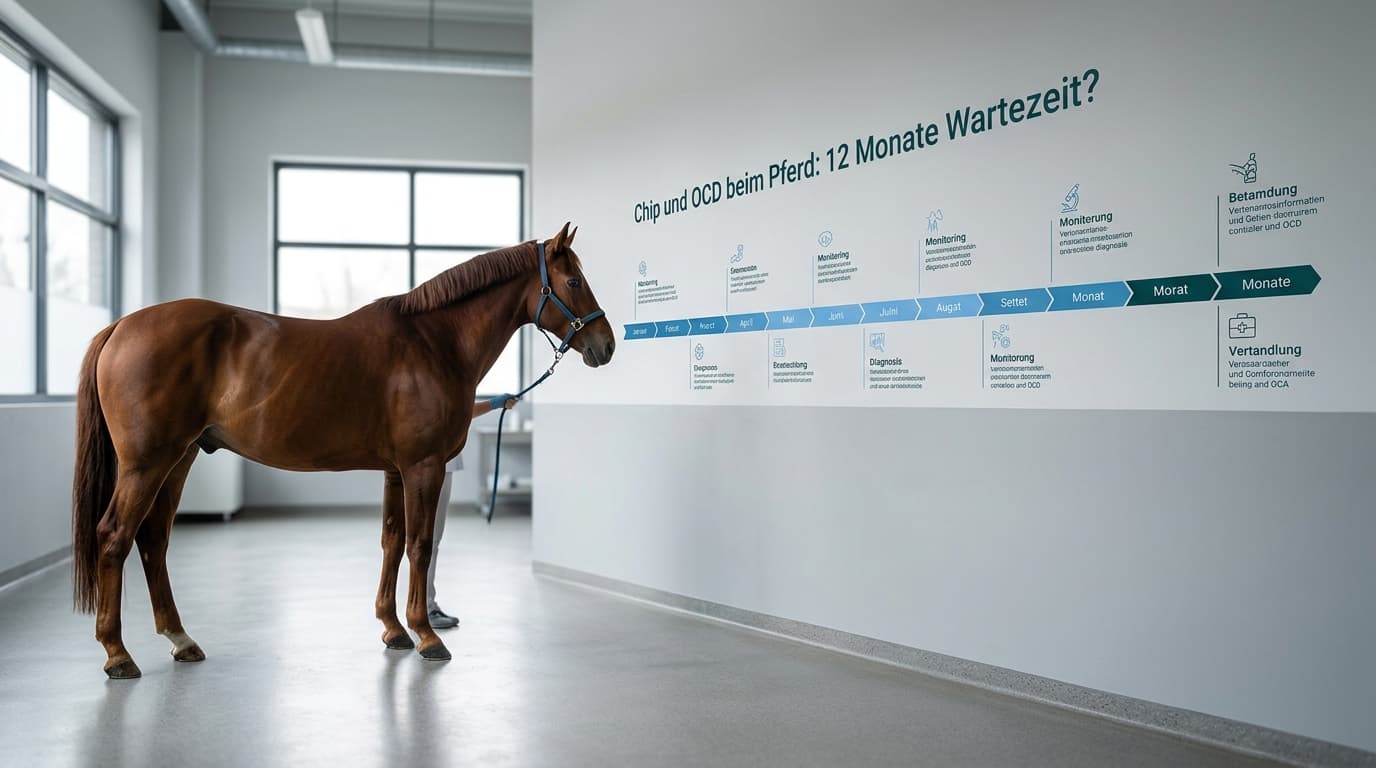
Chips and OCD in horses: a 12-month waiting period?
Joint surgery for chips and OCD carries 12 months' waiting time at Barmenia. Why the first examination, not the operation, decides the claim.
All details are taken from the provider's linked product page and the contract documents (IPID/policy conditions) published there; the insurer's documents prevail. Premiums, benefits and the insurance product itself may change – please verify the details directly with the partner before signing up; only the information provided there is binding.
 Katrin StraubManaging DirectorInsurance expert with over 20 years of experience in the insurance industry.
Published on
8 min read
Table of Contents
The Barmenia horse surgery policy imposes a special waiting period of 12 months for these bone fragments. If the diagnosis is made inside that window, cover falls away permanently.
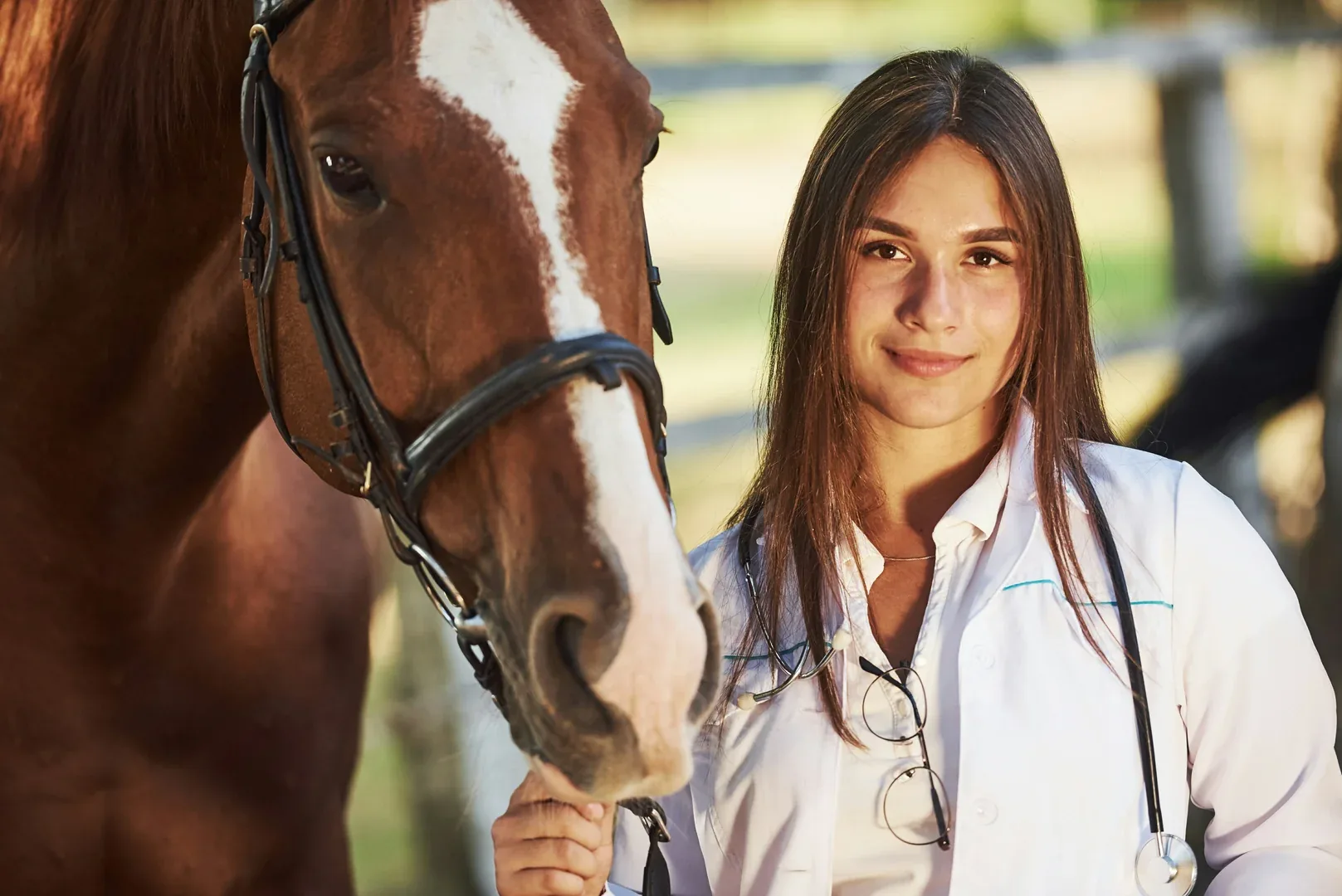
Equine surgery insurance
Horse surgery insurance via nextsure: Three flexible tariffs, reimbursement up to twice the GOT rate, and free choice of clinic worldwide. Protect your horse from high surgery costs – digital, transparent and uncomplicated.
Learn moreWhat are chips and OCD in horses?
Osteochondrosis dissecans (OCD) is the medical term for a developmental disturbance in how growing cartilage turns to bone. During the intense skeletal growth of a foal, parts of the joint cartilage can go short of nutrients, so that areas of cartilage die off or crack. Where those damaged fragments of cartilage or bone eventually break away completely, loose bodies form in the joint space — known colloquially in equine medicine as chips or joint mice.
How loose bodies in the joint arise
Research shows that around 25 per cent of the European warmblood and thoroughbred population already has osteochondrosis dissecans at a young age. The causes are multifactorial: alongside a genetic predisposition, rapid growth in height, feed-related imbalances in mineral supply and biomechanical overload out in the field all play a central part. If such a chip wedges between the opposing joint surfaces, the result can be painful cartilage damage, inflammation of the joint capsule and creeping arthritis.
- Where they form: chips arise mostly in the joints of the legs, most often in the hock and fetlock, less commonly in the coffin, stifle and carpal joints.
- Clinical signs: a pulsing, filled joint (a gall), heat, sensitivity to pressure or phases of unexplained lameness.
- How it is confirmed: X-rays or ultrasound make the shadows in the joint visible.
Where there is clinical impairment, or lasting cartilage damage threatens, arthroscopy (keyhole surgery) is the medical standard. In this minimally invasive chip operation the surgical team removes the fragments under general anaesthetic and smooths the cartilage bed, to preserve the joint's function long term.
What chip surgery costs under the current GOT
Surgery on horses has become noticeably more expensive since the revised scale of fees for veterinary surgeons (GOT) took effect. For planned joint operations, owners face a transparent but detailed cost structure, because a good many diagnostic and aftercare items are billed alongside the surgical fee itself.
What makes up the bill
Chip surgery costs several thousand euros, because the procedure happens under general anaesthetic and the horse needs several days at the clinic. In practice, equine clinics routinely bill specialist arthroscopic work at two to four times the GOT rate. Counting anaesthesia, theatre time, imaging and the inpatient stay, owners have reported invoices of between 3,000 and 4,000 euros for chip surgery since the GOT reform.
| Item under the GOT | Fee at the single GOT rate | How it is billed in practice |
|---|---|---|
| Sedation of the horse | €20.53 | Preparatory calming before injectable or intubation anaesthesia |
| General anaesthesia / induction | €86.13 | Demanding monitoring of vital signs throughout the procedure |
| Arthroscopy (the procedure) | €551.23 | The surgical fee for removing the chips alone |
| X-rays (per image) | €31.57 | Joint images to locate the fragment precisely before and after surgery |
| Inpatient stay per day | €34.90 | Clinic stay including monitoring and basic care |
| Wound closure | €24.44 | Primary suture of the portals into the joint |
Rather than find those sums from savings, owners can rely on cover: our guide to what horse surgery insurance costs sets out the detail. What decides whether the insurer pays in a given case, though, is exactly when the contract started.
Barmenia's 12-month waiting period
The conditions for equine surgery cover from Barmenia Allgemeine Versicherungs-AG (as at 01.01.2024, document A 3726-02) govern liability for joint procedures precisely. Ordinary illness carries a shorter deadline, but developmental changes to cartilage and bone are treated separately.
Clause 2.2.3.1 in the conditions
Under clause 2.2.3.1, insured events involving joint operations for isolated radiographic shadows, OC, OCD, Birkeland fractures or chips carry a special waiting period of 12 months. That year runs from the agreed commencement date of cover for the horse in question.
| Condition / reason for surgery | Waiting period under the conditions | Governing clause |
|---|---|---|
| Abdominal surgery (colic) | 5 days | Clause 2.2.2 |
| General illness | 3 months | Clause 2.2.2 |
| Castration (medically indicated) | 6 months | Clause 2.2.3.2 |
| Chips, OC, OCD, shadows in the joint | 12 months | Clause 2.2.3.1 |
The reason for the block lies in protecting everyone else in the pool: because OCD findings are often laid down while a horse is still a foal or youngster, insurers guard against claims arising shortly after signing from a defect that was already present. The maximum reimbursement also varies by policy, and must not be confused with what the clinic actually charges: on the Top policy a sublimit caps compensation for a joint operation for chips at 1,500 euros, whereas Premium cover pays without limit once the deadline has run. If the invoice comes to more, a Top policyholder carries the difference. Owners should therefore check carefully which waiting period and which reimbursement ceiling their contract sets for chip surgery.
A diagnosis inside the waiting period means no cover
The costliest misunderstanding concerns when an insured event legally begins. Many owners assume it is enough for the date of the operation to fall after the 12-month deadline. Barmenia's conditions, though, tie cover to strict timing.
The first examination triggers the insured event
Under clause 2.1.2.1, the insured event begins with the examination that leads to the diagnosis on which the operation ultimately rests. So if X-rays are taken, or clinical symptoms are recorded in the vet's report, during the first 12 months of the contract, the event that triggers the claim falls inside the waiting period.
- Permanent exclusion: where clinically relevant symptoms or the diagnosis predate the contract or fall inside the waiting period, that illness and its consequences are permanently outside cover (clause 2.2.1).
- Later surgery uncovered too: because clause 2.2.1 leaves the illness and its consequences permanently uninsured, an operation carried out years afterwards attracts no benefit either if the first diagnosis fell inside the blocked period.
- Veterinary records: diagnoses, suspicions or incidental findings from a pre-purchase examination are stored in the clinical file and reviewed by the insurer at claim stage.
For that reason, owners should not rush into routine X-rays with no acute medical reason while the waiting period is still running. The contract also defines precisely when the insured event ends after treatment, so that aftercare deadlines are cleanly bounded.
Exceptions: when the waiting period falls away
The conditions do allow narrowly drawn exceptions under which the 12-month block can be shortened or dropped entirely. The bar is high, though, and every element has to be evidenced.
Previous cover and the accident clause in practice
The exception that matters most in practice is a seamless switch from existing cover under clause 2.2.4.2. Where the contract follows on from a previous policy with no gap in time, the waiting period falls away to the extent that the old contract provided comparable cover.
- Seamless continuation: the previous contract must have run up to the start of the new policy and must have covered joint surgery for OCD.
- The same scope: if the previous insurer excluded chips, cover under the new contract can only respond once the 12 months have run.
- Fragments from an accident: clause 2.2.4.1 waives the waiting period after an accident. Since OCD is a developmental condition, however, the accident clause almost never applies here.
Owners switching insurer should therefore check the previous policy carefully for what it included, because under clause 2.2.4.2 the waiting period only falls away where comparable cover existed and the benefit was part of the previous contract.
Insuring in good time with nextsure
Avoiding a nasty surprise over a large vet's bill comes down to planning ahead. Because OCD develops quietly, taking cover out early — while the horse is a foal, or immediately on purchase — pays off directly.
What owners should do before any diagnosis
If the policy is in place before the first restriction in movement shows, or before X-rays are taken as part of a pre-purchase examination, the 12 months pass without drama. By the time the horse is backed as a three- or four-year-old, the blocked period is behind you, and a joint operation needed then falls within cover, because the waiting period starts running from the agreed commencement date.
As a digital marketplace, nextsure offers clear orientation in a thicket of specialist policies. Through nextsure you can compare tailored Barmenia policies easily and buy fully online, so your horse is dependably protected against surgery costs nobody saw coming.
Frequently asked questions
- Does the Barmenia horse surgery policy cover chips with no waiting period?
No. Joint operations for isolated radiographic shadows, OC, OCD and chips carry a special waiting period of 12 months. By comparison, clause 2.2.2 sets the general waiting period for other illness at just three months, and only five days for life-threatening colic surgery.
- What if OCD is diagnosed inside the 12-month waiting period?
Where the first clinical symptoms or the diagnosis fall inside the contractual waiting period, clause 2.2.1 leaves that illness and its consequences permanently outside cover. Barmenia will not pay for the operation or the aftercare at any later point either.
- What should I budget for chip surgery on a horse?
Since the scale of fees for veterinary surgeons (GOT) was updated, veterinary procedures have become markedly more expensive. For arthroscopic chip surgery including the clinic stay, owners have reported invoices of between 3,000 and 4,000 euros since the reform, against around 1,200 euros beforehand.
- Can the 12-month waiting period for OCD be waived?
Clause 2.2.4.2 allows it where the horse was continuously insured with another insurer beforehand. The condition that matters is that the previous contract offered comparable cover and already included OCD operations.
- Do the work-up and aftercare belong to the insured event?
Yes, absolutely. Where a veterinarily necessary operation is carried out, the diagnostics preparing for it count too. Barmenia's cover also includes aftercare up to the 15th day after the operation, provided the waiting period passed beforehand without symptoms.
- Does the insurer pay for routine OCD screening?
No. Preventive treatment, voluntary screening or special dietary and supplementary feed that is not directly part of treating a specific surgical case is strictly excluded from reimbursement under clause 3.2.
Sources
Conclude directly online
Verified partner tariffs at no extra cost. The button takes you straight to the provider's calculator.
 Barmenia
Horse surgery insurance
Surgery cost cover for horses in case of illness and accidents, including diagnostics and after-care.
- Waiting period:
- 3 months (colic surgery: 5 days, accidents: none)
- Coverage abroad:
- worldwide, up to 12 months
- Maximum benefit:
- depends on the cover level, as stated in the policy
- Surgery costs for illness and accidents, including tooth extractions and root canal treatment
- Pre-surgical examination (X-ray, endoscopy, biopsy, lab work)
- After-care including acupuncture, homeopathy, physiotherapy, laser therapy
- Emergency veterinary service up to 4x the standard veterinary fee schedule (GOT) rate plus the emergency callout fee
- Premium cover: up to 5 physiotherapy sessions (max. 60 minutes each) after the after-care period ends
- Once per animal: surgery costs for a birth-related, medically necessary caesarean section
Key exclusions
- Illnesses and developmental abnormalities known at the time of application
- Hoof abscesses and hoof ulcers (exception: hoof cancer)
- Surgery due to cryptorchidism
- Neutering that isn't medically necessary
Service-Champions GOLD: Nr. 1 der Versicherer im Multikanalvertrieb (ServiceValue, 10/2024)
Barmenia (Anbieter der Pferde-OP-Versicherung)
Special waiting periods: 12 months for joint surgery (chip fragments, OC/OCD, Birkeland fractures), 6 months for medically necessary neutering; Premium cover includes a waiver of the insurer's right to cancel from the 7th insurance year.
Fact sheet: benefits, exclusions and waiting periods in detail
All details are taken from the provider's linked product page and the contract documents (IPID/policy conditions) published there; the insurer's documents prevail. Premiums, benefits and the insurance product itself may change – please verify the details directly with the partner before signing up; only the information provided there is binding.
Information last updated: July 2026 · Source: provider product information (IPID/policy conditions)