Birkeland fracture in horses: waiting period and costs
Arthroscopy for a Birkeland fracture costs 1,000 to 6,200 euros. Why the 12-month waiting period decides whether the insurer reimburses it.
All details are taken from the provider's linked product page and the contract documents (IPID/policy conditions) published there; the insurer's documents prevail. Premiums, benefits and the insurance product itself may change – please verify the details directly with the partner before signing up; only the information provided there is binding.
 Katrin StraubManaging DirectorInsurance expert with over 20 years of experience in the insurance industry.
Published on
6 min read
Table of Contents
A Birkeland fracture usually calls for prompt arthroscopy, and the cost can run into several thousand euros. The Barmenia horse surgery policy reimburses the procedure, provided the special waiting period of 12 months has been met.
Equine surgery insurance
Horse surgery insurance via nextsure: Three flexible tariffs, reimbursement up to twice the GOT rate, and free choice of clinic worldwide. Protect your horse from high surgery costs – digital, transparent and uncomplicated.
Learn moreWhat is a Birkeland fracture in a horse?
A Birkeland fracture is the avulsion of a small cartilage-and-bone fragment at the back (palmar or plantar) upper margin of the pastern bone, in the area between the sesamoid bones and the insertion of the distal oblique sesamoidean ligaments — that is, inside the fetlock joint; the finding is described predominantly in the hind limbs. Unlike a classic fracture, it does not break the weight-bearing long bone through its substance, but shows up as an isolated chip in the joint space. Such fragments typically arise from mechanical overload, microtrauma or a disturbance of ossification during growth.
In insurance terms, a Birkeland fracture therefore sits in the same category as classic joint chips and osteochondrosis dissecans (OCD). That classification matters to affected owners, because policies covering chip surgery group these findings together in their own clause with a special waiting period.
- Where it occurs: most often at the fetlock joint, the sesamoid bones or the flexor joints.
- How it differs from a fracture: not a break through the main bone, but a chipped-off fragment of cartilage and bone.
- Medical classification: treated in the policy conditions in the same way as joint chips and OCD.
Typical symptoms and how the diagnosis is made
A fragment loose in the joint does not always cause acute trouble straight away. Symptoms often stay mild for a long time and amount to little more than increased fluid in the joint; they become conspicuous above all in horses whose joints are heavily loaded and constantly irritated in racing and riding sport. Once the fragment irritates the joint lining, the horse shows shifting lameness, local pain on pressure and windgalls from the extra joint fluid produced.
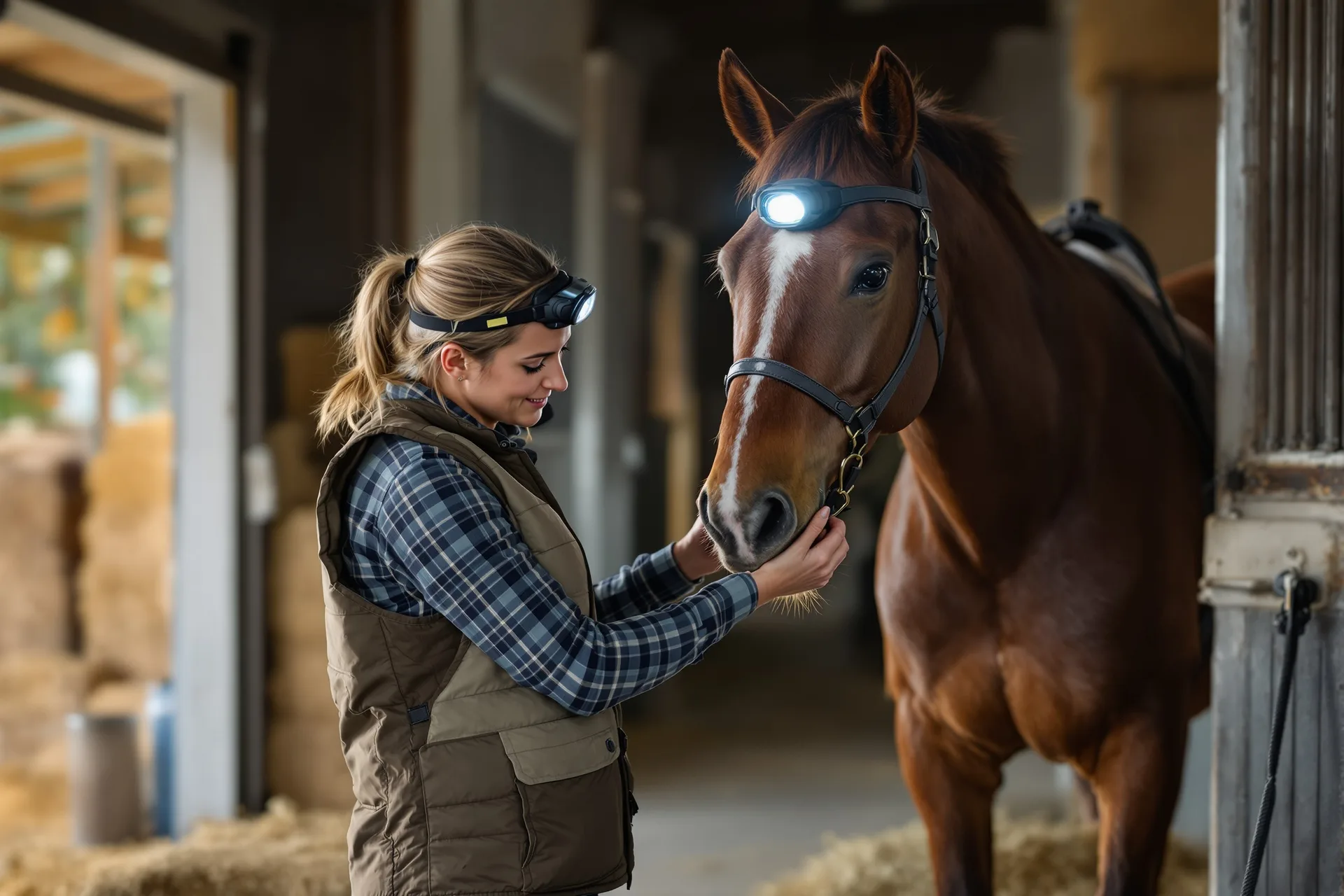
To confirm the diagnosis, the vet performs a thorough orthopaedic examination including a lameness assessment and diagnostic nerve blocks. What settles it is radiography: a sudden increase in fluid in the hock or fetlock joint (a "gall") should always be investigated on X-ray to judge the position and size of the fragment. A strong surgery policy covers these preliminary examinations, provided they lead directly to the diagnosis on which the operation rests.
- Weight-bearing lameness: often only visible under a rider or on hard ground.
- Windgalls: warm, tightly filled swellings around the fetlock joint.
- Imaging: radiography to locate the detached fragment precisely.
How arthroscopy works and what it costs
A Birkeland fracture is removed today by minimally invasive joint arthroscopy, generally under general anaesthesia. Through two portals about a centimetre across, the surgeon introduces an arthroscope with a camera along with the instruments and removes the loose fragment. The bone and cartilage surfaces are then smoothed and the joint flushed thoroughly, to avoid cartilage damage later on.
What it costs depends on the veterinary billing rate. At the single GOT rate, the arthroscopy alone comes to 551.23 euros. Including anaesthesia, medication, the work-up and the inpatient stay, the total for a straightforward chip operation on one joint runs to 1,000 to 3,500 euros. Where several joints are affected, the chip sits awkwardly or a higher GOT multiple is applied, Allianz quotes a range of 4,000 to 6,200 euros. The two ranges do not contradict each other: one describes the simple procedure, the other the demanding multi-joint case.
| Element / total cost | Cost range (GOT) | Source |
|---|---|---|
| Arthroscopy alone (single GOT rate) | €551.23 | ipzv-versicherungen.de |
| Total for a straightforward procedure on one joint | €1,000 to €3,500 | ipzv-versicherungen.de |
| Total for several joints / demanding cases | €4,000 to €6,200 | allianz.de |
Barmenia's 12-month waiting period
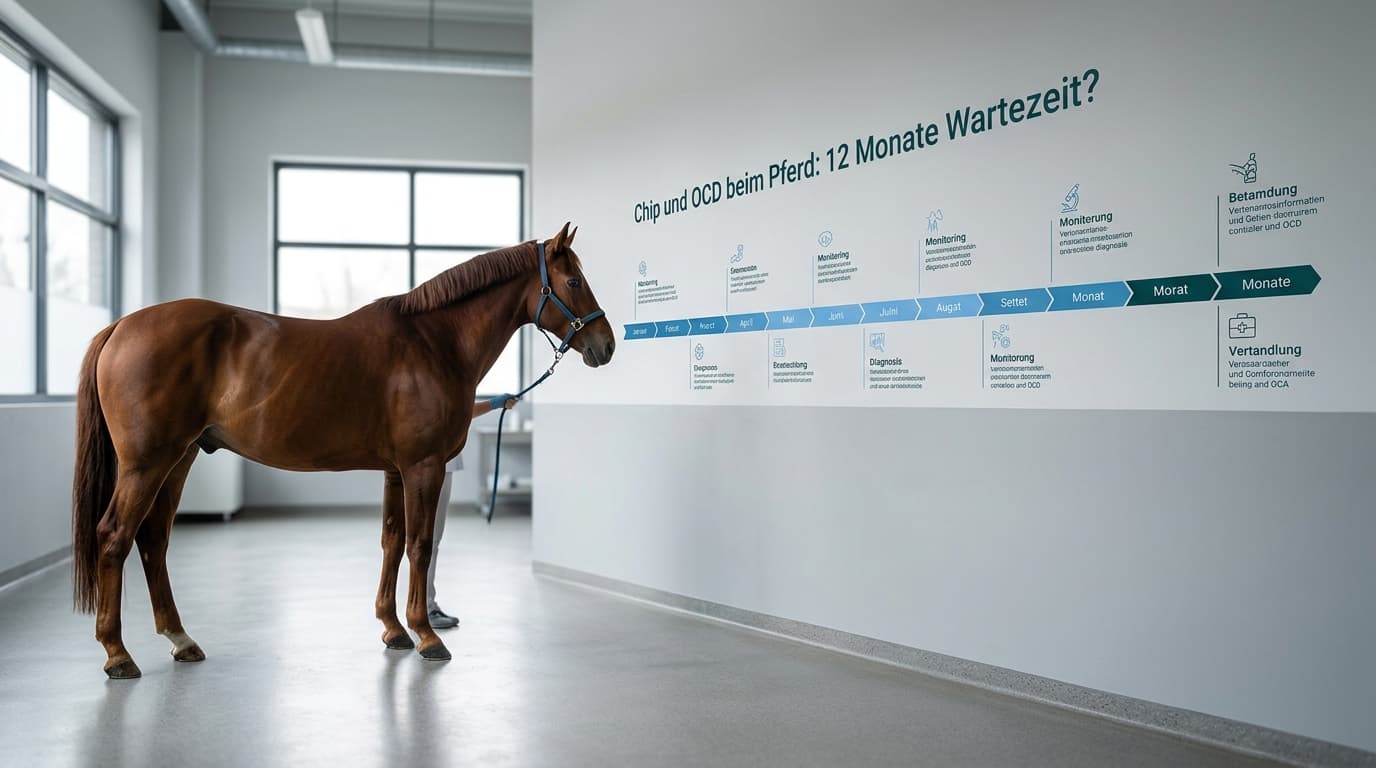
Anyone taking out a Barmenia horse surgery policy needs to keep the contractual deadlines for joint procedures in mind. General illness-related surgery carries a waiting period of 3 months and abdominal surgery (colic) only 5 days, but clause 2.2.3.1 sets a special waiting period of 12 months for joint operations involving isolated radiographic shadows, OC, OCD, Birkeland fractures and chips.
The pre-existing condition clause is the critical one: if clinically relevant symptoms are recorded, or a Birkeland fracture is diagnosed, before those 12 months have run, that condition and every consequence of it are permanently outside cover. Insuring early — right after purchase, or while the horse is still a foal — is therefore essential.
- Standard waiting period: 3 months for general illness-related surgery.
- Special waiting period: 12 months for Birkeland fractures, chips and OCD findings.
- Pre-existing conditions: symptoms inside the deadline mean a permanent exclusion.
What is covered: the operation and the aftercare
Once the 12-month waiting period has run, Barmenia's policy covers the veterinarily necessary cost of the operation. That includes the procedure under general or standing anaesthesia, consumables, painkillers and anti-inflammatories. Post-operative wound care is part of the standard cover too.
Cover also extends to the inpatient stay at the equine clinic and to immediate aftercare up to the number of days the policy defines. Comprehensive health policies sometimes carry clinic stays for as long as 15 days after the operation. Owners should always check which aftercare deadline was agreed, so that follow-up costs are reimbursed in full.
- Surgery costs: reimbursed under the scale of fees for veterinary surgeons up to the rate recorded in the policy schedule.
- Clinic stay: accommodation covered for the period fixed in the contract.
- Aftercare: wound care, suture removal and prescribed medication.
Prognosis and rehabilitation after the procedure
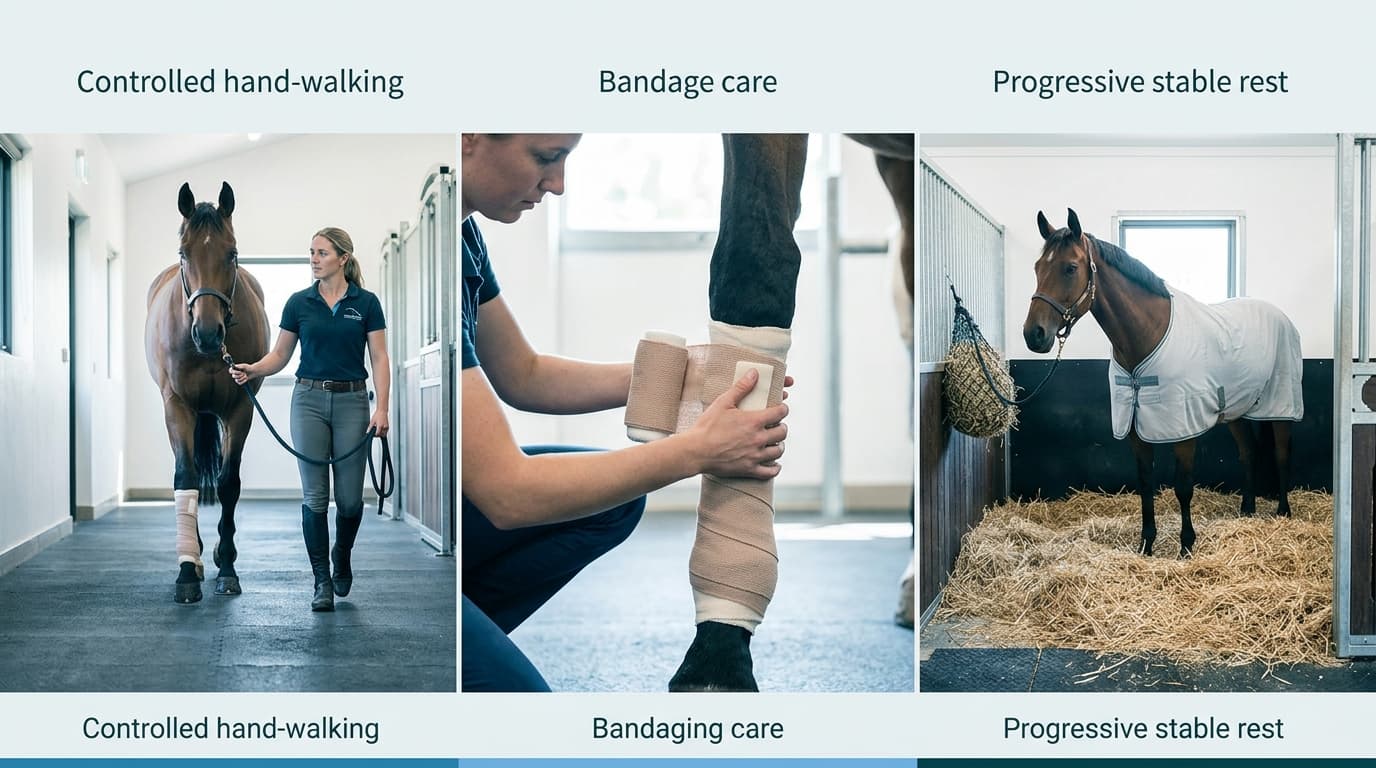
Removing a Birkeland fracture arthroscopically carries an excellent prognosis, provided the joint shows no advanced cartilage damage. Rehabilitation as a whole generally runs to 8 to 12 weeks. After the clinic stay comes strict box rest for two to three weeks, to protect the small sutures and the joint capsule.
A gradually increasing exercise programme follows: three to four weeks of controlled walking, with the horse led in walk for 20 to 30 minutes a day. Only once the vet gives the go-ahead again may fitness work slowly resume. As a digital marketplace, nextsure helps owners compare policies transparently and take out dependable surgery cover for the procedures nobody sees coming.
Frequently asked questions
- What exactly is a Birkeland fracture in a horse?
It is a particular kind of fracture in which fragments of bone or cartilage break away, much as with a chip. The fetlock joint or the sesamoid bone is very often affected, which leads to painful inflammation and lameness.
- What does surgery for a Birkeland fracture cost?
The cost of minimally invasive removal by arthroscopy varies widely. The procedure alone starts at 551.23 euros at the single GOT rate, while a straightforward operation on one joint including anaesthesia and the work-up costs 1,000 to 3,500 euros. Where several joints are affected or the work is demanding, figures of 4,000 to 6,200 euros are quoted.
- How long is Barmenia's waiting period for Birkeland fractures?
Under the conditions of the Barmenia horse surgery policy, joint operations for Birkeland fractures, isolated radiographic shadows or chips carry a special waiting period of 12 months from the start of the contract.
- What happens if the fracture occurs during the waiting period?
If clinically relevant symptoms appear, or the diagnosis is made, before the 12-month waiting period has run, the Birkeland fracture and everything arising from it are permanently outside cover.
- Does the insurer pay for the X-rays as well?
Yes. Pre-operative examinations such as X-rays on the day before or the day of surgery are covered, provided the operation follows directly and is veterinarily necessary.
- How long does recovery take after fracture surgery?
Once the fragments have been removed, the horse generally needs strict box rest for two to three weeks. A controlled walking programme follows. After around eight weeks in total, most horses are back in work.
Sources
Conclude directly online
Verified partner tariffs at no extra cost. The button takes you straight to the provider's calculator.
 Barmenia
Horse surgery insurance
Surgery cost cover for horses in case of illness and accidents, including diagnostics and after-care.
- Waiting period:
- 3 months (colic surgery: 5 days, accidents: none)
- Coverage abroad:
- worldwide, up to 12 months
- Maximum benefit:
- depends on the cover level, as stated in the policy
- Surgery costs for illness and accidents, including tooth extractions and root canal treatment
- Pre-surgical examination (X-ray, endoscopy, biopsy, lab work)
- After-care including acupuncture, homeopathy, physiotherapy, laser therapy
- Emergency veterinary service up to 4x the standard veterinary fee schedule (GOT) rate plus the emergency callout fee
- Premium cover: up to 5 physiotherapy sessions (max. 60 minutes each) after the after-care period ends
- Once per animal: surgery costs for a birth-related, medically necessary caesarean section
Key exclusions
- Illnesses and developmental abnormalities known at the time of application
- Hoof abscesses and hoof ulcers (exception: hoof cancer)
- Surgery due to cryptorchidism
- Neutering that isn't medically necessary
Service-Champions GOLD: Nr. 1 der Versicherer im Multikanalvertrieb (ServiceValue, 10/2024)
Barmenia (Anbieter der Pferde-OP-Versicherung)
Special waiting periods: 12 months for joint surgery (chip fragments, OC/OCD, Birkeland fractures), 6 months for medically necessary neutering; Premium cover includes a waiver of the insurer's right to cancel from the 7th insurance year.
Fact sheet: benefits, exclusions and waiting periods in detail
All details are taken from the provider's linked product page and the contract documents (IPID/policy conditions) published there; the insurer's documents prevail. Premiums, benefits and the insurance product itself may change – please verify the details directly with the partner before signing up; only the information provided there is binding.
Information last updated: July 2026 · Source: provider product information (IPID/policy conditions)