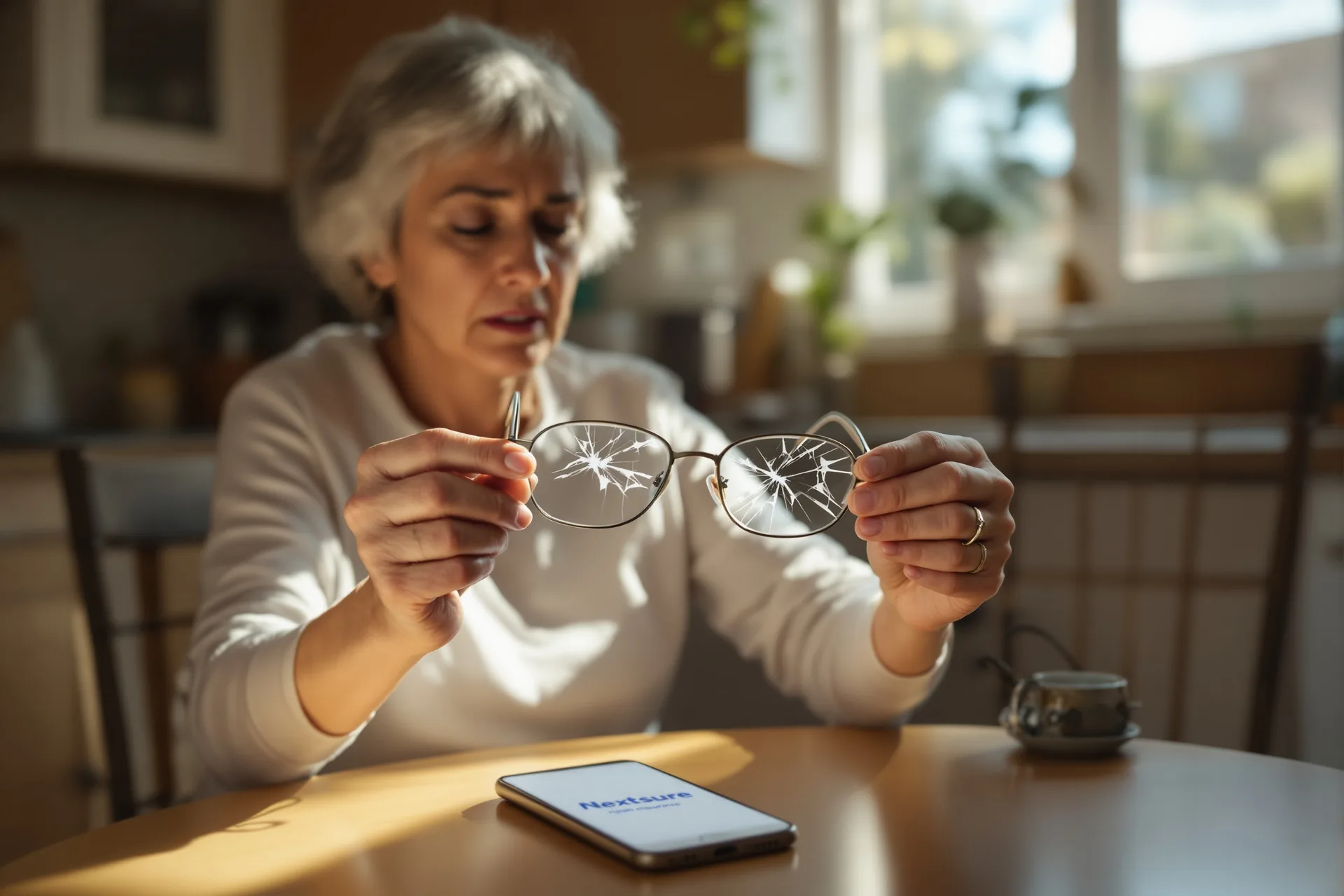
Spectacle insurance in the event of loss
Lost your glasses? Find out when glasses insurance covers loss and how it differs from contents insurance. Find out more now!
 Katrin StraubManaging DirectorInsurance expert with over 20 years of experience in the insurance industry.
Published on
Last updated on
10 min read
Table of Contents
Losing your glasses is more than just annoying; it can quickly cost several hundred euros. Find out which insurance policy will actually pay out in an emergency and how to close coverage gaps effectively.
Analysing loss risk: The limits of standard insurance policies
The most common misconception concerns contents insurance, which generally does not pay out if your glasses are lost outside your own four walls. Its cover is limited to defined perils such as burglary, robbery or fire at the insured location, which means simple loss in everyday life is not covered. A private liability insurance policy also does not apply, as it only covers damage to third parties, never the loss or damage of your own property. For protection when you are out and about, a specific policy is therefore necessary that explicitly includes simple theft or loss. This highlights the need to check the exact terms of existing contracts.
Weighing up costs and benefits: when is a glasses insurance policy worth it?
The cost of glasses insurance is manageable and often starts at less than ten euros per month. Affordable entry-level plans are already available from ten euros a year, while premium policies with higher benefits can cost more than twelve euros a month. In return, these contributions are offset by a subsidy for a new visual aid, which depending on the policy amounts to between 100 and 400 euros every one to three years. If you set a monthly contribution of five euros, i.e. 60 euros a year, against a subsidy of 200 euros every two years, the result is a clear financial advantage. The cover often pays for itself for wearers of expensive varifocal or special-purpose glasses, often even after the first claim. Analysing your own needs is the first step towards deciding here.
Review cover details: what policies really cover in the event of loss
Not every glasses insurance policy is the same, especially when it comes to loss. While accidental damage and theft are usually included in basic cover, cover for simply losing or mislaying them is often only included in premium tariffs. Some insurers apply an excess; in such cases, only fifty per cent of the costs of an equivalent replacement pair of glasses may be reimbursed in the event of loss or theft. It is essential to check the policy details carefully. A good policy should clearly define the following points:
- Cover for simple loss and leaving them behind.
- Amount of the excess in the event of a claim.
- Maximum reimbursement amount per insured event.
- Validity of cover abroad.
- Waiting periods before the first use.
These criteria help you find a policy that is more than just a marketing promise.
Avoid legal pitfalls: Understanding the most important clauses
From an insurance law perspective, there is a major difference between simple theft and burglary, which often leads to misunderstandings. Protection under a private accident insurance policy only applies if the glasses are damaged in an accident involving personal injury. Statutory health insurers only provide benefits for adults in exceptional cases, for example if there is visual impairment of more than six dioptres. Our expert tip: Make sure the policy explicitly uses the term „loss“, as clauses relating to „Abhandenkommen“ can be interpreted differently in legal terms. Clear wording in the insurance certificate is the best protection against unexpected rejections. This ensures that your insurance cover also applies in an emergency.
Choosing the right protection: A step-by-step guide
Choosing the right glasses insurance depends on individual factors. A systematic approach in four steps helps you find the right cover and avoid paying for unnecessary benefits. Take into account the value of your glasses and how often you need a new pair. This will help you find a tariff that is precisely tailored to your needs.
- Determine your needs: Note the value of your current glasses and how often you replace them (e.g. every two years).
- Compare offers: Check at least three different tariffs in terms of premium, reimbursement level and excess.
- Read the contract terms: Make sure that “loss” is explicitly insured without any unclear restrictions.
- Cost-benefit calculation: Multiply the monthly premium by the term (e.g. 24 months) and compare the total with the maximum reimbursement.
With this clear strategy, you can make a well-informed decision for your suitable eyewear insurance.
Conclusion: Targeted protection as a smart financial buffer
Insurance for glasses against loss is not a cure-all, but for many glasses wearers it is a sensible addition to everyday cover. It specifically closes the gap left by contents and liability insurance, and protects against high unexpected costs. The monthly cost, often less than ten euros, is well worth it compared with the potential saving of several hundred euros. The key is to choose a policy whose benefits are matched exactly to the value of your own glasses and your personal risks. Carefully reviewing the terms and conditions before taking out the policy is the most important step. If you know the value of your glasses and want cover against the most common risks, a specialist policy offers an effective solution. Request your individual risk analysis now: have your insurance situation reviewed free of charge and receive specific suggestions for improvement.
Frequently asked questions
- What is the difference between loss and theft in insurance terms?
Loss means that you have misplaced your glasses or lost them and can no longer find them. Theft requires an active taking by another person. Many basic insurance policies cover theft, but only a few also cover simple loss.
- Is there a waiting period for glasses insurance?
Yes, some insurers have a waiting period of, for example, three months before benefits can be claimed. However, there are also policies with no waiting period that provide immediate cover.
- What is the excess for glasses insurance?
The amount of the excess depends on the plan. Some plans do not have one, while others, especially in the event of loss or theft, provide for an excess of 25 to 50 per cent of the replacement value.
- Does the glasses insurance also cover prescription sunglasses?
Yes, most eyewear insurance policies also cover prescription sunglasses. Standard sunglasses without a prescription are usually not covered.
- How often can I claim benefits from my glasses insurance?
Most policies provide cover for a new pair of glasses on a fixed cycle, for example every 24 months. For repairs or a claim such as loss, the benefit may be available only once during the term of the policy, depending on the contract.
- Does statutory health insurance cover the cost of lost glasses?
No, statutory health insurance generally does not cover the cost of lost glasses for adults. Contributions are only available in very rare medical exceptional cases or for children and young people up to the age of 18.
Sources
- [1]The Verbraucherzentrale explains under what circumstances the health insurance fund covers the cost of a new pair of glasses.
- [2]The Verbraucherzentrale Bundesverband (vzbv) offers a factsheet on small insurance policies, which may also contain relevant information on spectacles insurance.
- [3]The Federal Ministry of Health provides information on aids in general, which can also include visual aids.
- [4]The Central Association of the Opticians and Optometrists (ZVA) provides its current 2024 glasses study.
- [5]Statista offers a statistic on people wearing glasses or contact lenses in Germany.
- [6]The German Insurance Association (GDV) publishes portfolio figures for various types of insurance, which may also include spectacles insurance.
- [7]The Stiftung Warentest has published a detailed test report on spectacles insurance.
- [8]The Techniker Krankenkasse (TK) provides information on which costs it covers for prescription glasses and contact lenses.