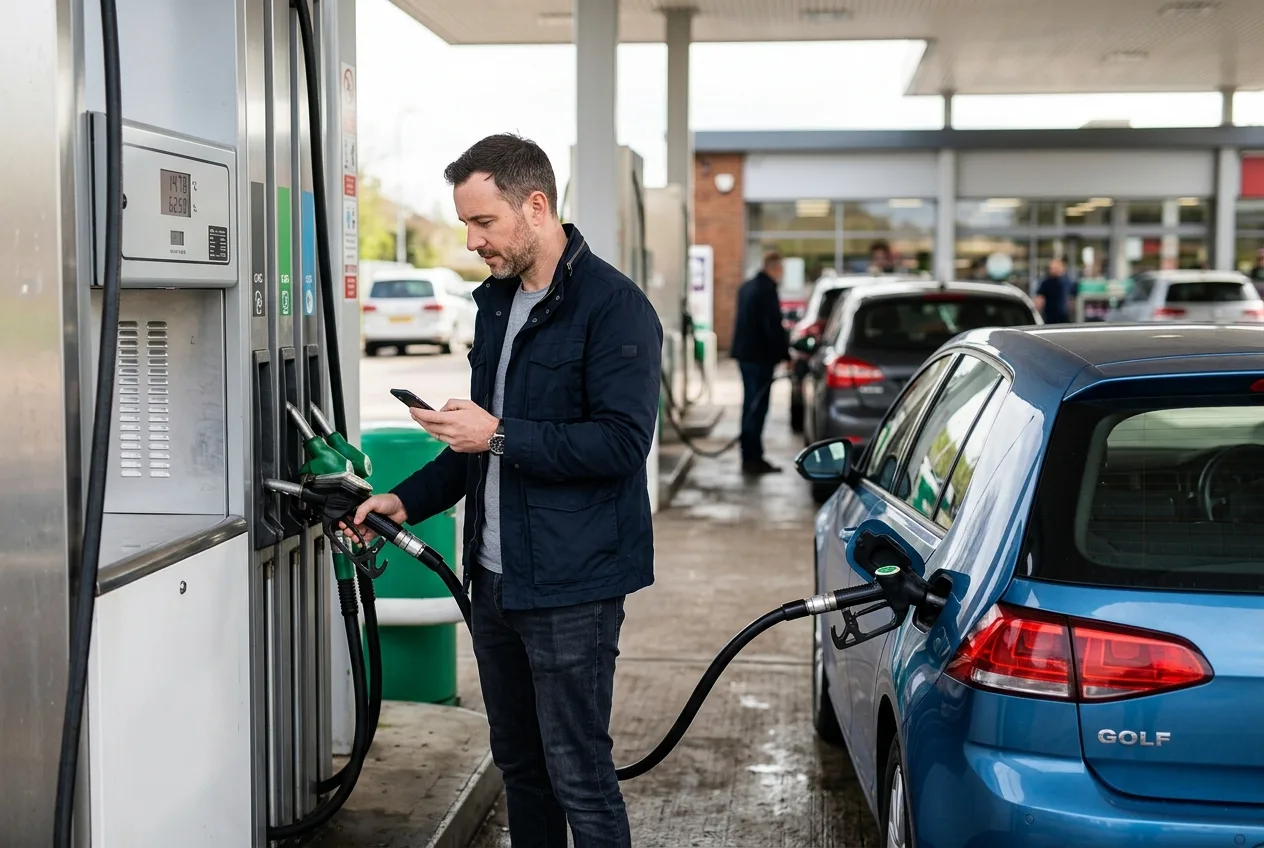
Find a car loan for gas-powered vehicles online
Find the best car loan for your gas-powered vehicle. Compare interest rates online and secure top terms. Get advice now!
 Katrin StraubManaging DirectorInsurance expert with over 20 years of experience in the insurance industry.
Published on
Last updated on
5 min read
Table of Contents
Find an online car loan for a gas-powered vehicle: How to secure the best terms in 2025
Would you like to find an online car loan for a gas-powered vehicle and benefit from the best possible interest rates? Many buyers overlook the fact that the type of drivetrain plays only a minor role for the bank, whereas your creditworthiness and the vehicle’s value are decisive. This article shows you in three steps how to complete your desired loan digitally and avoid pitfalls in the contract.
Online car loans for gas-powered vehicles: The basics for a quick approval
Finding an online car loan for a gas-powered vehicle is more straightforward than many people think. For banks, the type of drive is secondary; the vehicle value serves as the primary security. Loan amounts range from 1,000 euros to over 100,000 euros, with terms between twelve and 120 months. The basic requirements are identical for almost all providers: being of legal age, a German place of residence and a regular income. A positive decision depends largely on your credit check, which can be carried out digitally in just a few minutes. A cheap car loan for new cars is therefore also easily accessible for gas-powered vehicles. This basis creates the conditions for comparing interest rates in a targeted way in the next step.
Compare interest rates properly and save up to 16 per cent
The annual percentage rate of charge is the key figure for comparing loans, as unlike the nominal interest rate it includes most of the ancillary costs. The ranges are wide and currently run from around 3.79 per cent to over nine per cent, depending on creditworthiness and term. A careful comparison can reduce interest costs by up to 40 per cent. Purpose-bound car loans are often up to 16 per cent cheaper than unrestricted loans, as the vehicle serves as security. To find the best offers, you should bear the following points in mind:
- Effective annual rate: Always compare the APR, not the nominal rate.
- Creditworthiness-based interest rates: Many offers show teaser rates; your personal interest rate is only set after a credit check.
- Term: A shorter term usually means lower overall costs, but higher monthly instalments.
- SCHUFA neutrality: Make sure your loan enquiry is submitted as a „terms enquiry“ and not as a „loan enquiry“ so as not to affect your score.
With this knowledge, you can choose either a flexible three-way financing plan or a conventional instalment loan in a targeted way. Next, we will look at how your creditworthiness directly affects the terms.
Creditworthiness as the key: How your SCHUFA score directly influences interest rates
Your creditworthiness, summarised in the SCHUFA score, is the most important factor for interest-rate terms. A score of over 97 per cent signals a very low risk of default and secures you the best offers. If the value is between 90 and 97 per cent, the chances of financing are still good. Banks are legally required to carry out this credit check in order to avoid the borrower becoming overindebted. Even a few unnecessary current accounts or credit cards can lower the score by a few points. A used-car finance without a deposit requires particularly good creditworthiness. Knowing your score is therefore the basis for realistic expectations in the finance discussion.
Practical example: This is how much of an impact one percentage point has on total costs
Choosing the right loan has significant financial implications. Let’s assume a net loan amount of EUR 20,000 for a gas-powered vehicle with a term of 60 months. With an APR of 5.49 per cent, the monthly instalment is around EUR 382, resulting in total costs of EUR 22,920. If you manage to secure an interest rate of just 4.49 per cent thanks to a good SCHUFA score and a smart comparison, the instalment drops to around EUR 373. Over the full term, you save more than EUR 500. With an Online calculator for your loan instalment, you can run through different scenarios. This calculation shows how important it is to carefully check the contract details in order to avoid hidden costs.
Check contract details: Look out for special repayments and payment breaks
A low interest rate is only half the battle; the flexibility of a loan is equally important. In the contract, look specifically for the option of free early repayments. Many banks allow these at any time, enabling you to pay off the loan faster and save on interest. Another important clause is payment holidays, which can help in times of financial difficulty. Check the terms carefully, as these options are sometimes subject to fees. Early repayment compensation for premature settlement may not exceed one per cent of the outstanding balance for remaining terms of more than one year. A loan with a final instalment can reduce the monthly burden, but it requires careful planning for the final maturity payment. This flexibility is a decisive factor that goes beyond the interest burden alone.
Residual debt insurance: often expensive and rarely necessary
Banks often offer payment protection insurance (RSV), which covers instalments in the event of unemployment or death. However, this insurance is not mandatory for taking out a loan and can significantly increase the cost. The cost of a RSV often amounts to ten to 20 per cent of the loan amount, which can quickly wipe out a favourable interest rate. For a loan of EUR15,000, such insurance can increase the cost by an additional EUR1,500. Term life or disability insurance is often the cheaper and more comprehensive alternative. Before taking out a RSV, you should check the terms carefully and consider whether part-exchanging your old car could create more financial flexibility. This will ensure that you only pay for the protection you really need.
Digital application process: You will need these documents
The online application for a car loan can now be completed in just a few minutes. To make the process run smoothly, you should have the necessary documents ready in digital form. Most banks require the same basic documents. These include:
- Proof of identity: A copy of your valid identity card or passport.
- Proof of income: Usually the last three payslips or current bank statements.
- Employment contract: Sometimes a copy of the employment contract is required to confirm the employment relationship.
- Vehicle documents: After purchase, the vehicle registration document, part two (vehicle title), is often required as security.
With these documents, you can quickly complete the loan application with providers such as the digital platform for car & mobility. The final step is then just the digital signature.
Frequently asked questions
- What is the difference between the nominal interest rate and the effective annual interest rate?
The nominal interest rate (formerly nominal rate) is the pure interest rate for the borrowed amount. The effective annual rate also includes most additional costs such as processing fees and is therefore the more meaningful figure for comparing loan offers.
- What does a SCHUFA-neutral credit enquiry mean?
A SCHUFA-neutral enquiry is a “conditions enquiry”. SCHUFA records it, but it does not negatively affect your score. By contrast, a “credit enquiry” with several banks can lower your score, as it can be viewed like rejected applications.
- Is residual debt insurance worthwhile for a car loan?
A loan repayment insurance policy is often very expensive and significantly increases the total cost of the loan, sometimes by 10 to 20 per cent. Existing insurance policies such as term life or disability insurance often provide better and more affordable cover.
- What requirements do I need to meet for a car loan?
The standard requirements are that you are of legal age, have a place of residence and a bank account in Germany, as well as a regular income and sufficient creditworthiness (positive SCHUFA score).
- Can I also finance a used car with a gas engine?
Yes, financing is available for new and used cars. However, for older used cars, the bank may assess the value more closely, as it serves as security for the loan.
- Do I keep the vehicle registration document with a car loan?
That depends on the bank. With purpose-bound car loans, it is common for the bank to retain the vehicle registration document, Part II (vehicle title), as security until the loan has been repaid in full. However, some providers do not do this.
Sources
- [1]The German Bundesbank offers statistical data on interest rate developments among monetary financial institutions in Germany.
- [2]Statista provides a comprehensive overview with statistics and analyses on loans and debt in Germany.
- [3]The Federal Statistical Office (Destatis) provides datasets on loans and online transactions.
- [4]The Federal Motor Transport Authority (KBA) publishes statistics on environmental aspects and vehicles.
- [5]The Federal Statistical Office (Destatis) provides information on the average prices of natural gas and electricity in Germany.
- [6]The BDEW (German Association of Energy and Water Industries) offers data and graphics on gas mobility.
- [7]The German Bundesbank provides information on interest rates and yields for consumer loans to private households.
- [8]The consumer advice centre provides information on cancelling car financing loans and options for reversal.