Which insurance pays for professional dental cleaning?
Find out how to get 100% of the costs for your professional dental cleaning reimbursed. Get it checked free of charge now at nextsure.
All details are taken from the provider's linked product page and the contract documents (IPID/policy conditions) published there; the insurer's documents prevail. Premiums, benefits and the insurance product itself may change – please verify the details directly with the partner before signing up; only the information provided there is binding.
 Katrin StraubManaging DirectorInsurance expert with over 20 years of experience in the insurance industry.
Published on
Last updated on
10 min read
Table of Contents
A professional dental cleaning can quickly cost more than €100, but statutory health insurance often only pays a fraction. Find out how the right insurance can secure full cover and reduce your out-of-pocket costs to zero. This article shows you the way through the maze of tariffs.
dental supplementary insurance
Find the right dental supplementary insurance at nextsure. Comprehensive protection, digital processing, and tailor-made rates for your most beautiful smile.
Learn moreThe cost reality: Why dental cleaning is usually paid for privately
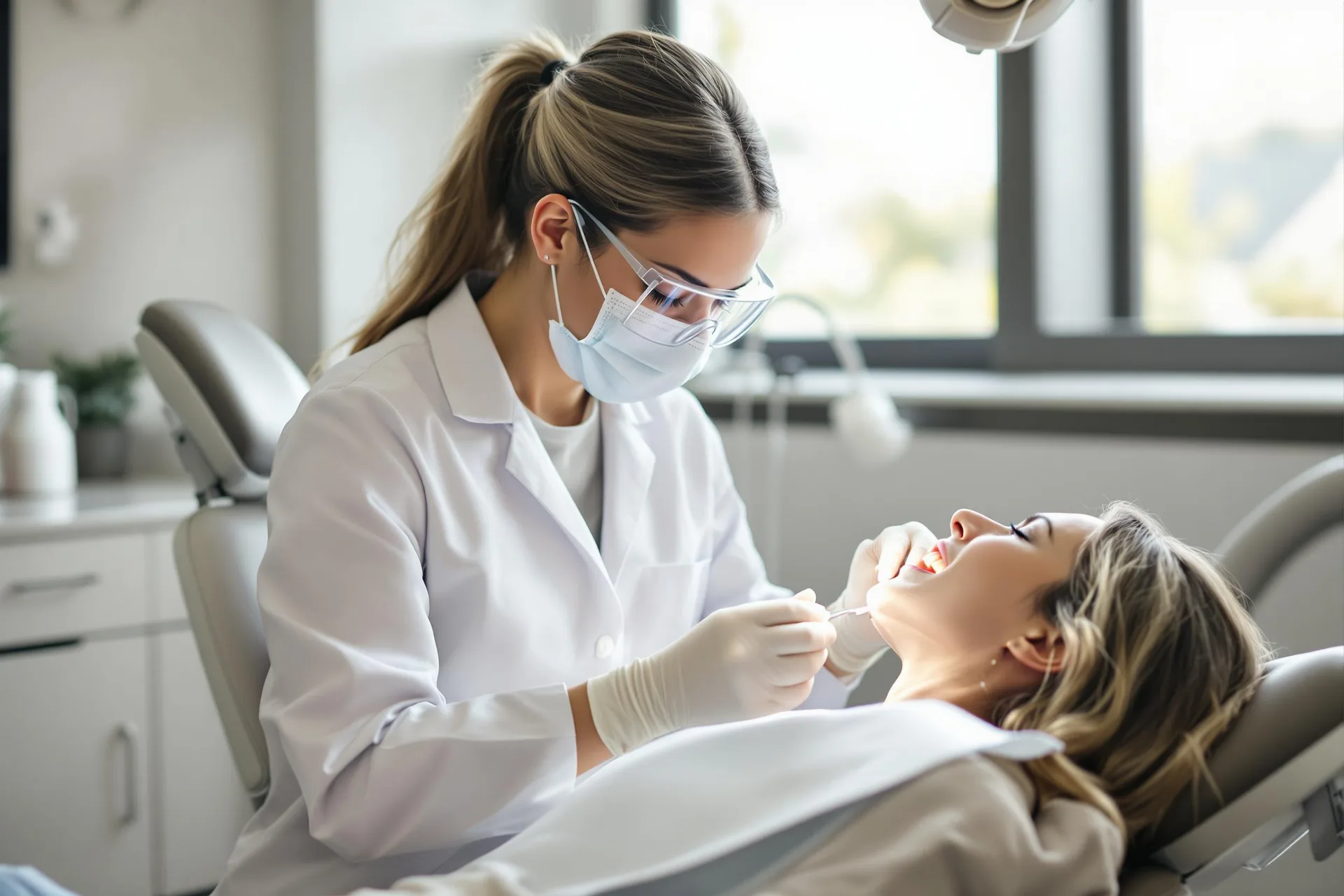
Professional dental cleaning (PZR) is not a service covered by statutory standard care, but a so-called individual health service (IGeL). The costs for this, according to the National Association of Statutory Health Insurance Dentists, are usually between €80 and €120 per treatment. Billing is carried out according to the private fee schedule for dentists (GOZ), item 1040, whereby the dentist can adjust the billing rate depending on the amount of work involved. A surcharge factor of 2.3 already results in costs of €3.62 per tooth, which quickly adds up to over €100. Without suitable insurance cover, this amount is borne entirely by the patient, which highlights the need for good protection.
Minimal cover: What statutory health insurance really provides
The statutory health insurance (GKV) only covers the removal of tartar once a year, which is not comparable to a professional dental cleaning. However, more than 100 of the 114 statutory insurers now subsidise professional dental cleaning (PZR) as a voluntary benefit under their rules and regulations, but full coverage of the costs is the absolute exception. Many insurers offer subsidies, which are often limited to €40 to €80 per year or tied to participation in bonus programmes. Some insurers also restrict reimbursement to treatments provided by selected partner dentists. Optimal dental health therefore usually requires additional cover.
The solution: How to secure 100 per cent cost coverage with supplementary dental insurance
To close the gap in statutory health insurance, a high-performance dental supplementary insurance policy is the most effective way to achieve full reimbursement of costs. Tariffs that cover 100 per cent of preventive care are already available for under 15 euros per month and protect you from high bills. Some tariffs even reimburse the cost of professional teeth cleaning without limit and with no waiting period. This makes preventive care predictable and financially risk-free. The investment in such a policy often pays for itself after just the first or second dental cleaning in a year.
What you should look for in tariffs for dental cleaning
For comprehensive cover, you should pay attention to four key tariff features:
- Reimbursement amount: The tariff should explicitly cover 100 per cent of the costs of professional teeth cleanings.
- Frequency: Make sure that at least two cleanings per year are fully reimbursed.
- Caps: Ideally, there should be no annual limit on the total amount for preventive measures, or it should be at least 200 euros.
- Waiting periods: Many top tariffs waive waiting periods for professional teeth cleaning, so you can use the benefit immediately after the contract starts.
A detailed comparison of different dental supplementary insurance policies is crucial in order to find the right cover.
Premium protection: full reimbursement of PZR costs in private health insurance
For policyholders in private health insurance (PKV), reimbursement for professional teeth cleaning is usually straightforward. Most PKV tariffs provide reimbursement of 70 to 100 per cent for preventive measures. In contrast to statutory health insurance (GKV), PZR is often a fixed component of cover here, which is reimbursed once or even twice a year without additional hurdles. High-quality tariffs cover the costs in full and with no annual limit. This means that a private health insurance policy offers comprehensive protection for your dental health from the outset. This underlines the clear advantage over solely statutory cover.
Expert tips: How to find the right tariff for your needs
The choice of the right insurance cover depends greatly on your individual situation. A plan that is ideal for one person may be insufficient for another. A sensible comparison always begins with an analysis of your own needs. Consider how often you have a professional dental cleaning carried out each year and which other dental services may be relevant for you over the next five years. Check the contract details carefully, especially the benefit limits in the first few years, the so-called dental scale. Our expert tip: Make sure that reimbursement is limited to 2.3 times the scale set out in the German Schedule of Fees for Dentists (GOZ), as higher rates can lead to unexpected out-of-pocket costs. A careful review ensures that your cover really applies in an emergency.
Your path to optimal protection
Full coverage for a professional dental cleaning is no coincidence, but the result of the right insurance decision. While statutory health insurance (GKV) only provides basic cover, comprehensive dental supplementary insurance and private health insurance can provide protection without any out-of-pocket contribution. With knowledge of the decisive tariff features, you can find the solution that is right for you and secure your dental health in the long term without financial worries. Request an individual risk analysis now: Have your insurance situation checked free of charge and receive specific optimisation suggestions.
Frequently asked questions
- Which insurance covers a professional dental cleaning 100 per cent?
Full coverage for a professional dental cleaning (PZR) is most reliably achieved through a good dental supplementary insurance policy or private health insurance (PKV). Statutory health insurers only provide this in rare exceptional cases.
- How much does the statutory health insurance fund contribute towards professional dental cleaning?
The subsidy varies considerably. Many statutory health insurers pay between 40 and 80 euros per year, often as part of bonus programmes or health accounts. Full reimbursement is not the norm.
- Do I have to expect waiting periods for professional dental cleaning with dental supplementary insurance?
No, many modern supplementary dental insurance policies do not have waiting periods for preventive services such as professional teeth cleaning. You can therefore use the cover immediately.
- How much does a professional dental cleaning cost without insurance?
The cost of a professional dental cleaning (PZR) in Germany averages between 80 and 120 euros. The price depends on the number of teeth, the amount of work involved and the multiplier that the dentist applies in accordance with the Schedule of Fees for Dentists (GOZ).
- Does my private health insurance always cover professional teeth cleaning in full?
In most cases, yes. Most private health insurance plans reimburse the cost of professional dental cleaning at 100 percent, often even for two treatments per year. However, it is advisable to check the exact terms of your individual plan.
- What does the limitation on the GOZ increase factor mean?
The schedule of fees for dentists (GOZ) allows dentists to reflect the effort involved in a treatment by means of a fee multiplier. Some insurance tariffs limit their reimbursement to 2.3 times the fee rate. If the dentist charges more, you will have to cover the difference yourself.
Sources
- [1]Wikipedia offers a comprehensive overview of professional dental cleaning.
- [2]The Bundeszahnärztekammer provides a position paper on professional dental cleaning as a preventive measure against tooth decay and periodontal disease.
- [3]The Kassenzahnärztliche Bundesvereinigung provides patients with information about professional dental cleaning.
- [4]The Verbraucherzentrale provides information on health insurance subsidies for professional dental cleaning.
- [5]The Stiftung Warentest publishes a test report on professional dental cleaning and health insurance subsidies.
- [6]Gesundheitsinformation.de, published by the Institute for Quality and Efficiency in Health Care (IQWiG), examines the pros and cons of professional dental cleaning.
- [7]The AOK provides information about its benefits in the area of professional dental cleaning.
- [8]The NDR offers a guide article on the actual benefits of professional dental cleaning.
Conclude directly online
Verified partner tariffs at no extra cost. The button takes you straight to the provider's calculator.
 Advigon
Supplemental dental insurance
Four supplemental dental tariffs ranging from basic cover to full protection, including children's tariffs with orthodontics.
- Dental Medium premium:
- €5.69-32.30/month depending on age
- Dental Luxus premium:
- €9.20-54.50/month depending on age
- Waiting period:
- none (AZM/AZL)
- Dental treatment: 75% (Dental Medium) or 100% (Dental Luxus)
- Dentures/crowns (Zahnersatz): 75% (AZM; 100% for standard care) or 100% (AZL)
- Preventive dental care: 100% up to €90/year (AZM) or up to €140/year (AZL)
- No waiting periods in Dental Medium and Dental Luxus
- Children's tariffs with orthodontics (KFO): Dental Clever €9.68/month, Dental Premium €18.76/month
- Stiftung Warentest rated Dental Premium "very good" (1.5) (Finanztest 2/25)
Key exclusions
- Reimbursement caps in the first 48 months: AZM €600-2,400, AZL €1,000-4,000 (tiered)
- No explicit benefit exclusions are stated in the available documentation
Stiftung Warentest „SEHR GUT (0,6)“, Finanzen 07/2025 (285 Tarife im Test)
Advigon Zahnzusatzversicherung Dental Luxus (AZL)
MORGEN & MORGEN M&M Rating Zahnzusatz: 5 Sterne „Ausgezeichnet“ (08/2023)
Advigon Versicherung AG, Dental Luxus (AZL)
Reimbursement caps do not apply in the case of an accident, after month 48, or with a recognized prior policy.
Fact sheet: benefits, exclusions and waiting periods in detail
 die Bayerische
Supplemental dental insurance
Supplemental dental cover in three tariffs (Smart, Komfort, Prestige) with no waiting period; the top tariff reimburses 100%.
- Reimbursement:
- 75-100% depending on the tariff
- Waiting period:
- none
- Teeth cleaning:
- €80-200/year depending on the tariff
- Zahn Sofort module:
- €29.90/month, ends after 2 years
- Dentures/crowns and dental treatment: Smart 75%, Komfort 80-100%, Prestige 100%
- Professional teeth cleaning in all tariffs (€80-200 per calendar year)
- No waiting periods in any of the three tariffs
- Orthodontics: €1,500 (including statutory health insurance benefit) or €2,000 (without statutory health insurance benefit) in Komfort and Prestige
- Prestige includes teeth whitening and a Happybrush sonic toothbrush
- Stiftung Warentest 07/2025: Zahn Prestige rated test winner with "very good" (0.5)
Key exclusions
- Treatments recommended or started before the policy began (only covered via the Zahn Sofort module)
- A flat 40% deduction for dentists without statutory-insurance accreditation
- Reimbursement capped at up to 3.5x the dental fee schedule (GOZ) rate
- Abroad, reimbursement is capped at the domestic benefit level
Stiftung Warentest „SEHR GUT (0,5)“, Ausgabe 07/2025 (285 Tarife im Test)
die Bayerische, Tarif ZAHN Prestige
ASCORE „Tarif des Jahres 2024“ (Krankenzusatz Zahn)
die Bayerische, Zahn Prestige 2023
Levelnine Rating „EXZELLENT“ (Stand 11/2024, gültig bis 11/2025)
die Bayerische, Tarif ZAHN Prestige
Benefit tiering: €500 in year 1 (Smart), €1,250 (Komfort), or €1,500 (Prestige); unlimited from calendar year 5; caps also do not apply in the case of an accident.
Fact sheet: benefits, exclusions and waiting periods in detail
Advigon Supplemental dental insurance: Benefits: Dental Medium (AZM) and Dental Luxus (AZL)
| Benefit | Dental Medium (AZM) | Dental Luxus (AZL) |
|---|---|---|
| Dental treatment | 75% | 100% |
| Pain therapy | 75% | 100% |
| Preventive dental care | 100% up to €90/year | 100% up to €70 per treatment, up to €140/year |
| Dentures/crowns | 75% (100% for standard care) | 100% |
| Monthly premium by age | €5.69-32.30 | €9.20-54.50 |
die Bayerische Supplemental dental insurance: Tariff comparison: Smart, Komfort, Prestige
| Benefit | Smart | Komfort | Prestige |
|---|---|---|---|
| Dentures/crowns (above standard care) | 75% | 80-90% | 100% |
| Dentures/crowns (up to standard care) | 75% | 100% | 100% |
| Dental treatment | 75% | 100% | 100% |
| Professional teeth cleaning | €80/calendar year | €100 per treatment, max. €150/year | €100 per treatment, max. €200/year |
| Orthodontics | not included | €1,500 (incl. statutory insurance) / €2,000 (excl. statutory insurance) | €1,500 (incl. statutory insurance) / €2,000 (excl. statutory insurance) |
| Teeth whitening | not included | not included | included |
| Example annual premium (age 33) | €152.40 | €244.80 (rural) / €321.60 (urban) | €405.60 (rural) / €529.20 (urban) |
All details are taken from the provider's linked product page and the contract documents (IPID/policy conditions) published there; the insurer's documents prevail. Premiums, benefits and the insurance product itself may change – please verify the details directly with the partner before signing up; only the information provided there is binding.
Information last updated: July 2026 · Source: provider product information (IPID/policy conditions)