Pre-operative work-up without surgery: who pays?
Does horse insurance pay for a work-up when no surgery follows? Barmenia's conditions leave conservative treatment with the owner. Here is why.
All details are taken from the provider's linked product page and the contract documents (IPID/policy conditions) published there; the insurer's documents prevail. Premiums, benefits and the insurance product itself may change – please verify the details directly with the partner before signing up; only the information provided there is binding.
 Katrin StraubManaging DirectorInsurance expert with over 20 years of experience in the insurance industry.
Published on
8 min read
Table of Contents
If the operation never happens, Barmenia's horse surgery insurance does not pay for the pre-operative work-up. The policy conditions are explicit: the insured event only begins once the diagnostic work leads to an operation. Where that operation never follows, the bill stays with you.
Equine surgery insurance
Horse surgery insurance via nextsure: Three flexible tariffs, reimbursement up to twice the GOT rate, and free choice of clinic worldwide. Protect your horse from high surgery costs – digital, transparent and uncomplicated.
Learn moreIntroduction and the core question: when does Barmenia pay for diagnostics?
When a horse suddenly falls ill or shows the signs of a painful colic, speed decides the outcome. In practice the attending vet works straight through a thorough assessment — case history, clinical checks, blood analysis, ultrasound — to pin down the cause and decide what happens next. Policyholders with Barmenia horse surgery insurance quite reasonably ask, at exactly that moment, whether the insurer also picks up this diagnostic work-up if it turns out that no operation is needed at all.
The contractual logic of Barmenia's conditions (AVB Pferde-OP-Kosten, as at 01.01.2024) ties every claim to an insured event. Under clause 2.1.2.1, the insured event begins with the examination that establishes the diagnosis leading directly to the operation. The decisive wording is therefore unambiguous: where no operation is ultimately performed, the pre-operative examination is not insured.
Because basic veterinary services are billed under the nationwide scale of fees for veterinary surgeons (GOT), significant costs arise with the very first treatment. A general examination with consultation on a horse already comes to 36.63 euros including VAT at the single GOT rate. Emergency call-outs, detailed laboratory work or repeat checks push that figure up quickly.
- Under a surgery-only policy, the insured event begins with the diagnostic examination that leads directly to a surgical operation.
- If the operation is not carried out in the end, the claim for the pre-operative examination falls away with it.
- Basic veterinary examinations are billed under the GOT and produce noticeable out-of-pocket costs even for a straightforward consultation.
- Knowing the conditions in detail protects owners from an unexpected refusal when the invoice is submitted.
Understanding this clean separation between surgical preparation and purely conservative diagnosis matters to every horse owner. For the full contractual picture, see our overview of what Barmenia covers.
What happens when the operation is called off
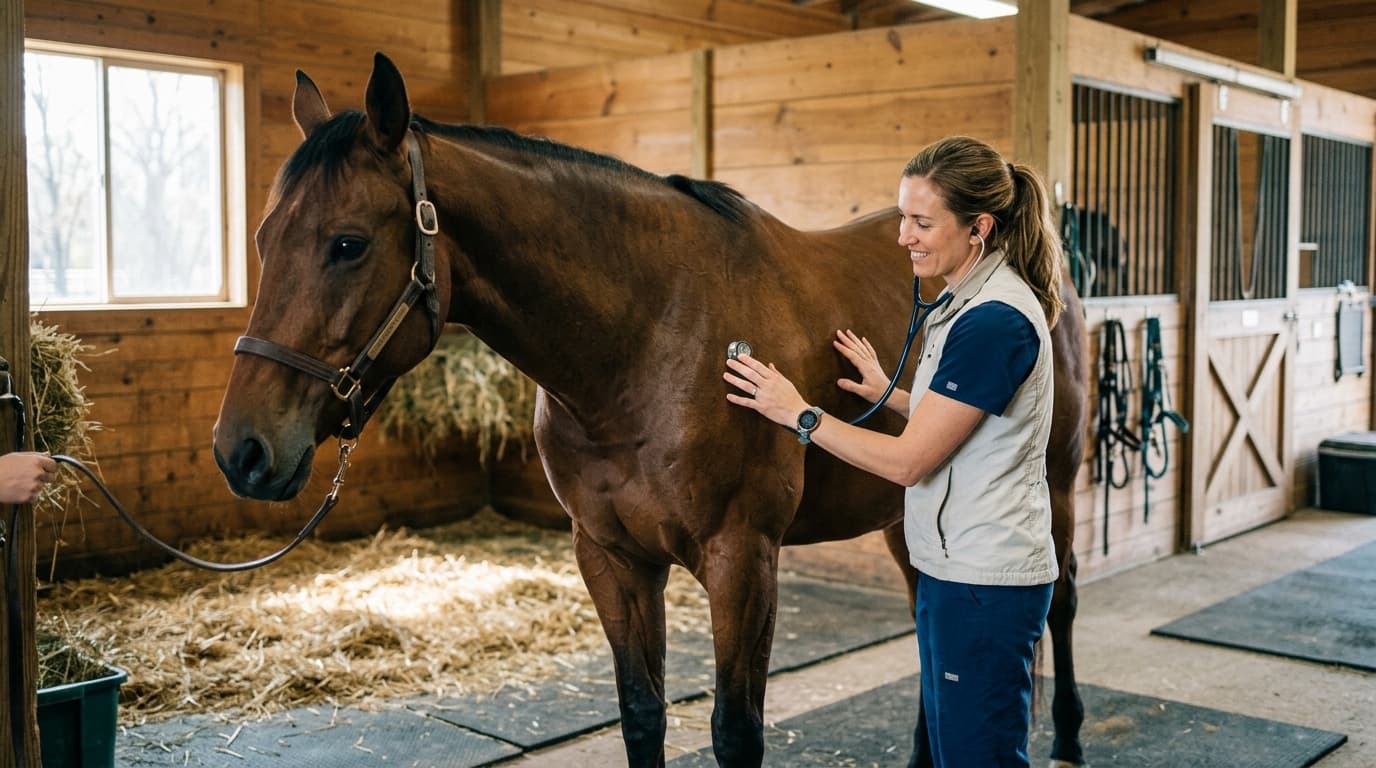
One everyday scenario shows how far this clause reaches. Late in the evening, an owner notices clear colic symptoms in their horse. The vet who is called out performs a thorough rectal examination, brings in a mobile ultrasound scanner, administers antispasmodic painkillers and monitors the horse's circulation for several hours. Conservative treatment works: the displaced intestine resolves and the horse is stabilised without any surgical intervention.
For the animal's health this is the best possible outcome, but for the owner it opens a gap in cover. Because no surgical procedure took place under general or local anaesthetic, there is contractually no insured event under the Barmenia horse surgery policy. The owner therefore pays the vet's invoice for diagnostics, medication and out-of-hours surcharges in full: in this example the treatment fees for a conservatively managed colic alone add up to 217.38 euros at the single GOT rate and 869.52 euros at four times the rate.
The same applies where a detailed examination produces an incurable diagnosis and the horse has to be put down before anaesthesia is even induced. In such cases too, surgery-only cover does not extend to the diagnostics that preceded it, because the operation the contract defines was never carried out.
- Intensive diagnostics on suspicion of colic: clinical examination, ultrasound and medication administered by the vet.
- Conservative treatment succeeds: the horse recovers without surgery.
- The claim is declined: with no operation, Barmenia does not classify the case as an insured event.
- The owner pays: the whole vet's invoice for diagnostics and medication stays with them.
Diagnostics and imaging: the expensive first step
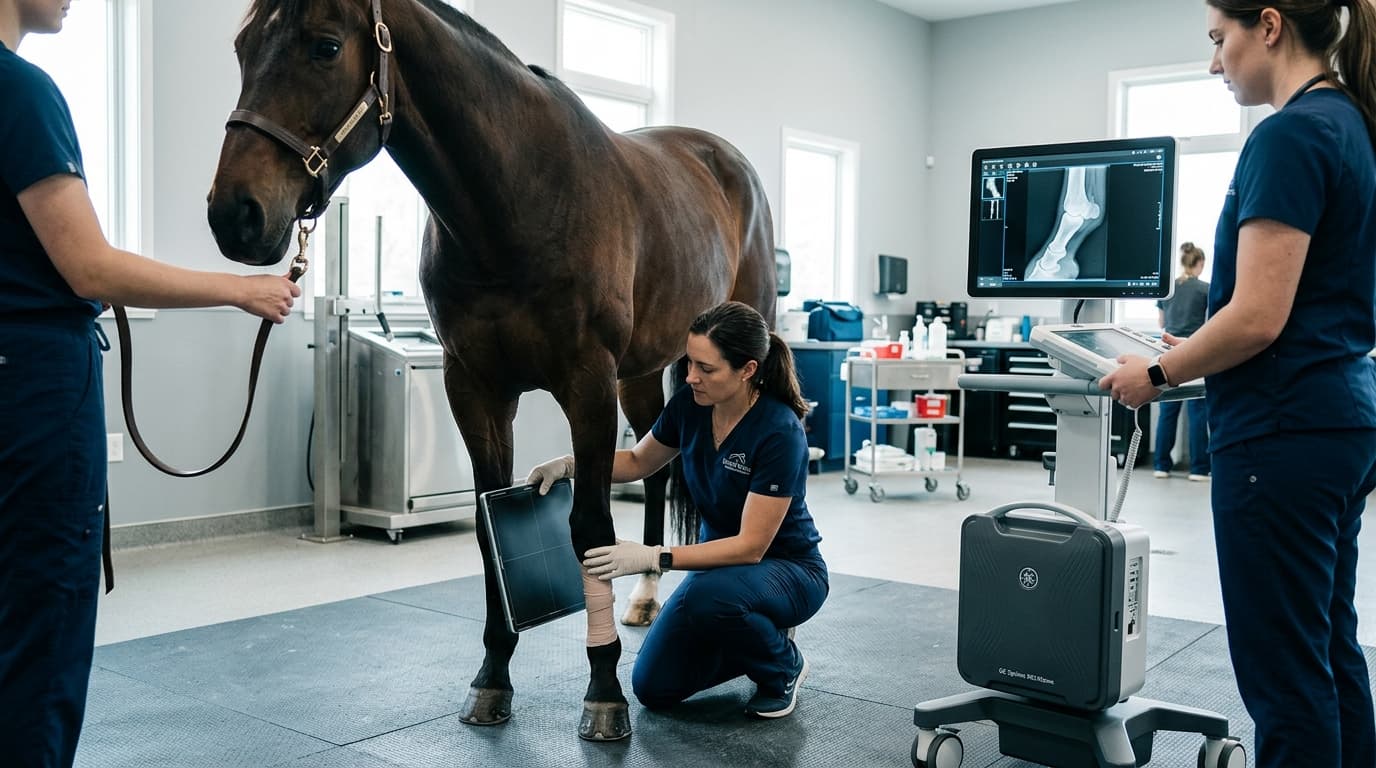
Ahead of complex surgery or joint operations, modern veterinary medicine leans heavily on imaging. X-rays, endoscopy of the airways or guttural pouches and computed tomography (CT) give the vet a precise picture of the surgical site. These procedures need specialist equipment, trained staff and careful interpretation of the findings.
Under the veterinary fee schedule, imaging leaves a sizeable mark on the invoice. An X-ray costs roughly 50 to 80 euros per image at twice the GOT rate, a clinical lameness examination 150 to 300 euros, and endoscopy of the upper airways 200 to 350 euros. For elaborate investigations at higher GOT multiples, or out of hours, those fees multiply fast.
| Veterinary service (GOT) | Single fee rate (incl. VAT) | Billing where surgery follows | Billing where it does not |
|---|---|---|---|
| General examination with consultation | €36.63 | Covered by the insurer | No reimbursement (paid by the owner) |
| X-ray (first and second image, each) | €31.57 | Covered as part of the pre-operative work-up | No reimbursement (paid by the owner) |
| Lameness examination | €50.73 | Covered where an operation follows | No reimbursement (paid by the owner) |
Barmenia's horse surgery insurance therefore picks up this expensive diagnostic work only once the findings make a covered operation unavoidable. Where the examination shows instead that surgery is not indicated, every diagnostic cost stays with the policyholder under clause 3.2 of the conditions.
Waiting periods and exclusions under Barmenia's conditions
Even where an operation does go ahead, reimbursement of the work-up and the surgery itself depends on further fixed conditions. If the illness began during a contractual waiting period, or if the condition falls under an exclusion, the insurer refuses the claim in its entirety.
Clause 2.2 of the AVB Pferde-OP-Kosten sets firm deadlines running from the start of the contract: three months as the general waiting period for illness, but a shortened waiting period of five days for abdominal surgery (colic). Joint operations connected with isolated radiographic shadows, OCD or Birkeland fractures carry a special waiting period of twelve months. Our article on the waiting period for colic surgery sets out the exceptions and deadlines in detail.
The financial risk of a refusal is considerable. Colic surgery in an equine clinic with several days of intensive care usually costs 5,000 to 12,000 euros depending on the GOT multiple applied, and considerably more where the case is complicated. If clinically relevant symptoms appear before the agreed waiting period has run, that illness and everything arising from it are excluded from cover permanently.
- General waiting period for illness: three months from the start of cover.
- Shortened waiting period for colic surgery: five days after the contract is signed.
- Special waiting period for joints (OCD, chip fractures): twelve months from the start.
- Pre-existing conditions: symptoms appearing before the waiting period ends trigger a permanent exclusion.
The alternative: full equine health cover versus surgery-only
To avoid carrying large costs whenever an operation is called off, owners should weigh a surgery-only horse policy against comprehensive equine health cover. Surgery-only cover is built specifically around procedures under anaesthetic, whereas a full health policy also pays for outpatient and inpatient treatment with no requirement that surgery follow.
Under comprehensive equine health cover, demanding diagnostics such as ultrasound, X-rays or endoscopy are — depending on the policy — also covered when the treatment that follows is purely conservative. That removes the worry of being left with the examination costs after a suspected emergency. Our guide to what horse surgery insurance costs compares the policies in detail.
| Area of cover | Surgery-only horse policy | Comprehensive equine health cover |
|---|---|---|
| Work-up followed by surgery | Reimbursed in full | Reimbursed in full |
| Work-up with no surgery following | No reimbursement (paid by the owner) | Reimbursed under the treatment module |
| Conservative colic treatment without surgery | No reimbursement | Vet's fees and medication reimbursed |
| Outpatient treatment & preventive care | Not insured | Included depending on the policy agreed |
Upgrading to comprehensive health cover pays off above all for owners who want their horse looked after from every angle, and who want protection from the cost of intensive conservative treatment in a clinic as well.
Conclusion and a plan for owners in an emergency
In an emergency, getting the horse treated quickly comes first. Knowing the conditions of the Barmenia horse surgery policy nonetheless spares owners an unpleasant surprise at the billing stage: a pre-operative examination is only reimbursed once it leads directly into a covered operation.
A clear routine in an emergency avoids mistakes when the vet's invoice is submitted. Talk openly to the clinic, have the link between the diagnostics and the operation documented on the invoice, and keep every receipt.
- Admission and briefing: tell the attending vet about your existing policy as soon as the horse is admitted.
- Complete documentation: keep every invoice and every diagnostic finding from the work-up.
- Check the link to the diagnosis: make sure the vet records on the invoice the direct causal connection between work-up and operation.
- Review your cover in good time: compare your terms against current Barmenia horse surgery policies so the gaps close before the emergency, not after.
As a digital marketplace for specialist and niche insurance, nextsure supports horse owners in Germany with transparent comparisons and independent advice. Guided by Digital. Secure. Tailored., we help you find the right cover at nextsure so your horse is properly looked after when it matters.
Frequently asked questions
- Does Barmenia cover a pre-operative examination if no surgery follows?
No. Where no operation takes place in the end, the pre-operative examination is not insured under Barmenia's conditions. The cost of the examination and any imaging is yours to carry in full.
- When does the insured event begin for equine surgery?
Where an operation is carried out, the insured event begins precisely with the examination that was needed to establish the diagnosis. From that moment on, the diagnostics and the work-up are covered within the terms of the contract.
- What do diagnostics cost when colic is suspected?
For initial treatment and follow-up on a colic, the GOT schedule puts the treatment fees at 217.38 euros at the single rate and 869.52 euros at four times the rate, with travel charges, medication and laboratory work on top. If that examination does not lead to an operation because the horse is managed conservatively, the surgery policy does not respond.
- Does horse surgery insurance pay for X-rays or an MRI scan?
Imaging such as X-rays, CT or MRI is reimbursed as part of an equine operation, but only where the findings result in a covered operation. An MRI scan on a horse costs roughly 1,200 to 2,500 euros depending on the GOT multiple, the region and the clinic.
- Is there an alternative to surgery-only cover?
Yes. Comprehensive equine health cover also pays for outpatient treatment and diagnostics, whether or not an operation follows. That protects you from high costs where the case is treated conservatively throughout.
Sources
Conclude directly online
Verified partner tariffs at no extra cost. The button takes you straight to the provider's calculator.
 Barmenia
Horse surgery insurance
Surgery cost cover for horses in case of illness and accidents, including diagnostics and after-care.
- Waiting period:
- 3 months (colic surgery: 5 days, accidents: none)
- Coverage abroad:
- worldwide, up to 12 months
- Maximum benefit:
- depends on the cover level, as stated in the policy
- Surgery costs for illness and accidents, including tooth extractions and root canal treatment
- Pre-surgical examination (X-ray, endoscopy, biopsy, lab work)
- After-care including acupuncture, homeopathy, physiotherapy, laser therapy
- Emergency veterinary service up to 4x the standard veterinary fee schedule (GOT) rate plus the emergency callout fee
- Premium cover: up to 5 physiotherapy sessions (max. 60 minutes each) after the after-care period ends
- Once per animal: surgery costs for a birth-related, medically necessary caesarean section
Key exclusions
- Illnesses and developmental abnormalities known at the time of application
- Hoof abscesses and hoof ulcers (exception: hoof cancer)
- Surgery due to cryptorchidism
- Neutering that isn't medically necessary
Service-Champions GOLD: Nr. 1 der Versicherer im Multikanalvertrieb (ServiceValue, 10/2024)
Barmenia (Anbieter der Pferde-OP-Versicherung)
Special waiting periods: 12 months for joint surgery (chip fragments, OC/OCD, Birkeland fractures), 6 months for medically necessary neutering; Premium cover includes a waiver of the insurer's right to cancel from the 7th insurance year.
Fact sheet: benefits, exclusions and waiting periods in detail
All details are taken from the provider's linked product page and the contract documents (IPID/policy conditions) published there; the insurer's documents prevail. Premiums, benefits and the insurance product itself may change – please verify the details directly with the partner before signing up; only the information provided there is binding.
Information last updated: July 2026 · Source: provider product information (IPID/policy conditions)