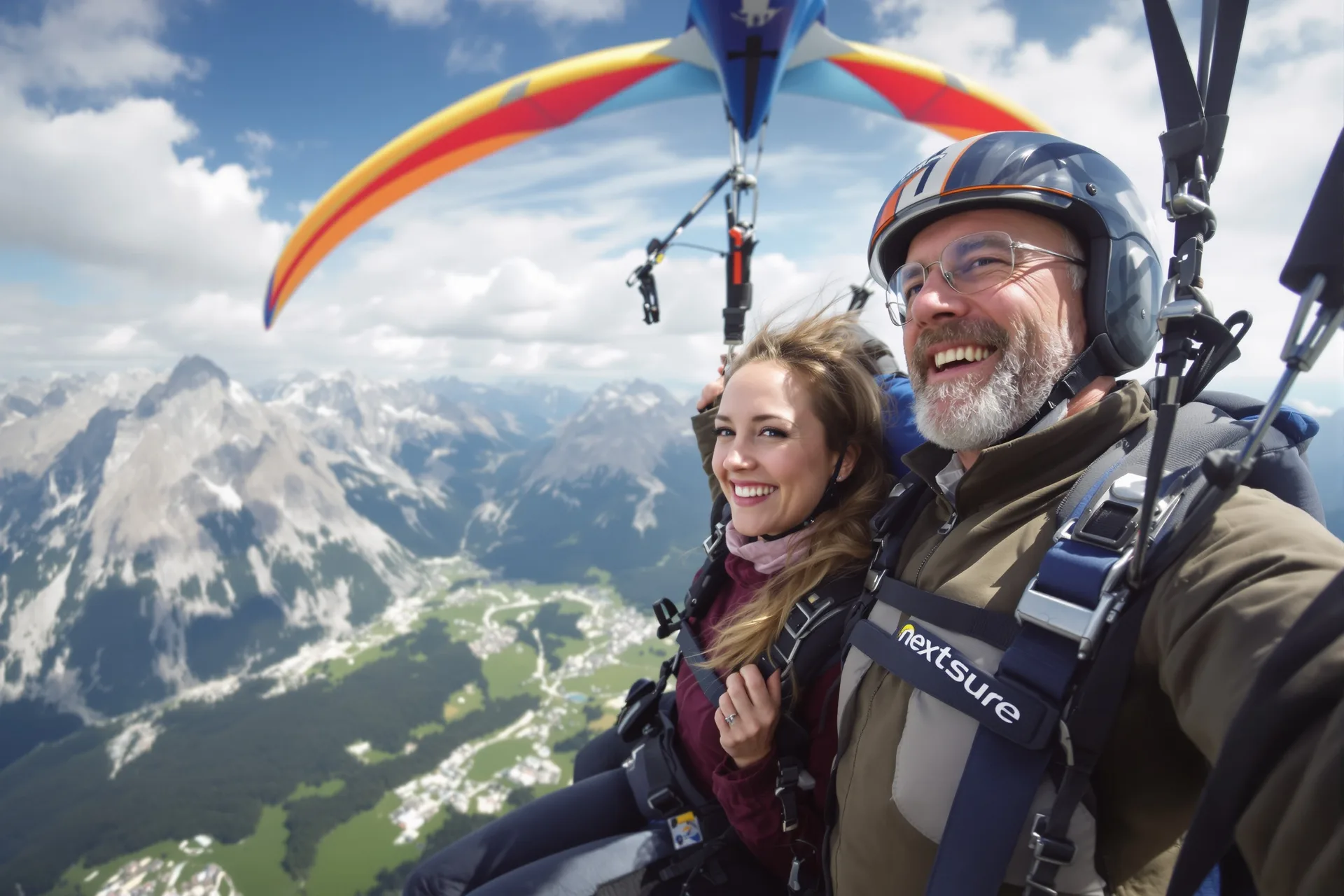
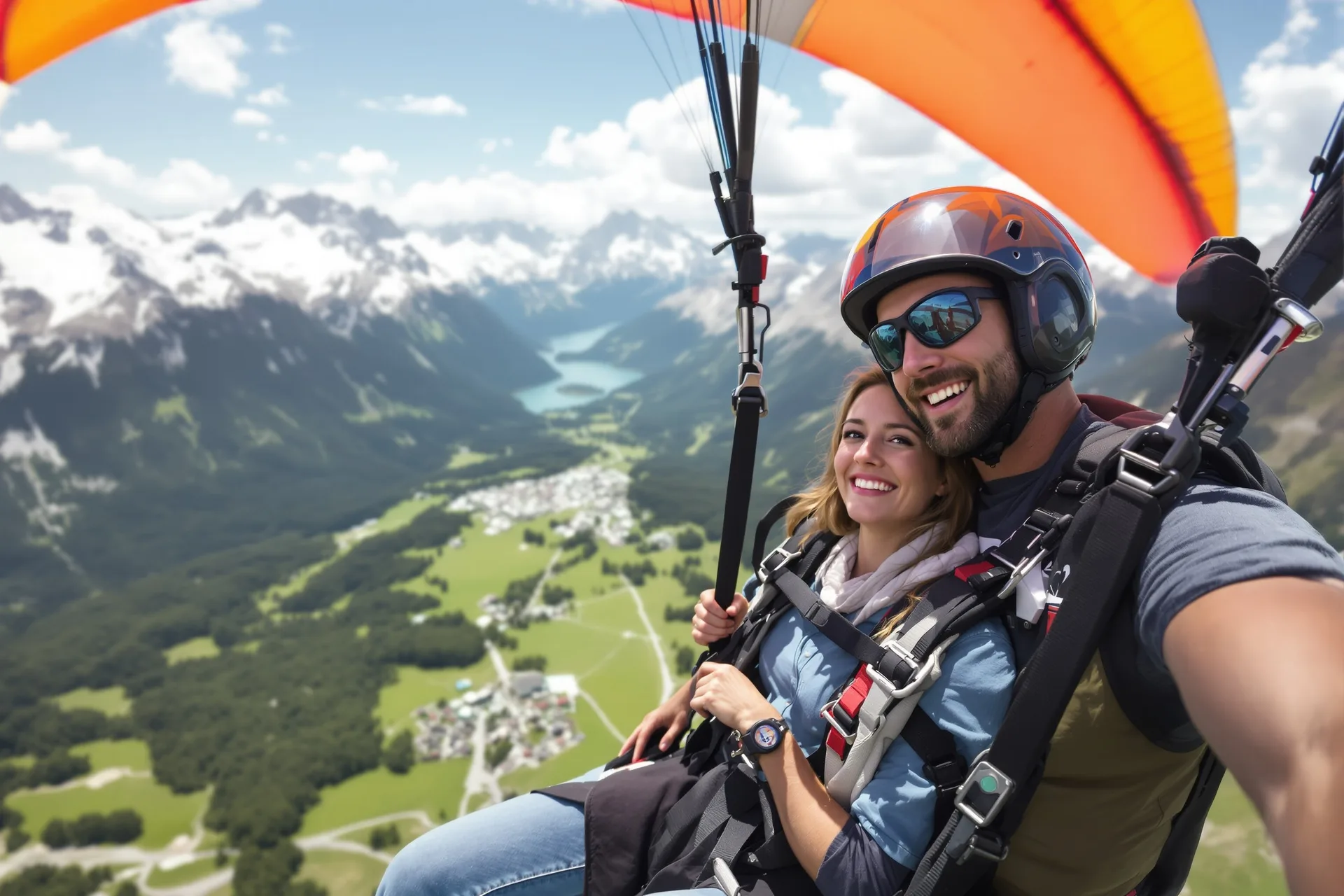
Tandem paragliding insurance & overseas cover
Your guide to tandem paragliding insurance. Make sure liability cover, rescue costs and overseas cover are properly protected. Find out more now!
 Katrin StraubManaging DirectorInsurance expert with over 20 years of experience in the insurance industry.
Published on
Last updated on
8 min read
Table of Contents
A tandem flight promises freedom, but inadequate insurance cover carries financial risks running into the millions. Many pilots underestimate the three critical areas: passenger liability, rescue costs and overseas cover. This article shows you how to close gaps in cover and make every flight safe.
The three pillars of your cover as a tandem pilot
Every tandem flight is based on trust and solid preparation, which also includes the right insurance. Cover for tandem pilots rests on three fundamental pillars that go far beyond standard pilot liability insurance. Without these building blocks, you and your passenger expose yourselves to an incalculable risk that, in an emergency, can run into six-figure sums.
Comprehensive cover is not an option, but a necessity for every responsible pilot. The statutory aircraft owner’s liability insurance alone does not cover the passenger, which makes a specific extension essential. Here are the three indispensable components:
- Passenger liability insurance: This is the legally required core insurance that covers personal injury and property damage to your passenger.
- Rescue costs insurance: It covers the often four- to five-figure costs of a rescue operation, even if there is no medical necessity.
- Overseas cover: A specialised travel medical and accident insurance closes the gap for flights outside Germany, where German health insurers often provide only limited cover.
These three elements form the foundation on which you can safely fulfil your responsibilities as a tandem pilot.
Passenger Liability: Why the Minimum Cover Isn’t Enough
The legally required owner’s liability insurance is intended for solo pilots and only protects third parties on the ground. For tandem flights, separate passenger liability insurance is essential. An error during take-off or landing that causes personal injury can quickly lead to claims running into the millions. The statutory minimum cover often amounts to only around €220,000 (SDR 113,100).
Imagine your passenger suffers a lasting impairment to their health as a result of a flying error. The costs for treatment, loss of earnings and compensation for pain and suffering far exceed the minimum sum. Experts therefore recommend a cover amount of at least three million euros to rule out risks that could threaten your livelihood. Such a policy often also covers damage to the passenger’s baggage up to €3,500. A solid paragliding insurance is the basis for every flight.
The right liability insurance protects your personal wealth and secures your passenger’s future, which makes analysing rescue risks all the more important.
Recovery costs: When a rescue costs 5,000 euros
A sudden change in weather forces you to land in rough terrain, far from any road. You and your passenger are uninjured, but a safe descent is impossible. In such a situation, statutory health insurance does not cover the costs of a helicopter rescue, as there is no medical emergency. You must cover the bill for the operation yourself.
A typical helicopter rescue operation in the Alps cost just under €5,000 in 2023. Without special rescue cost insurance, this amount will be billed directly to you. Good policies cover rescue costs of up to €20,000 and also include recovery of the aircraft up to €500. This cover is a key part of any well-considered paragliding accident insurance.
Such cover is not only crucial in the Alps, but also when flying in low mountain ranges. Yet the financial risks do not end at the German border.
Overseas cover: The financial risk beyond borders
Many popular flying areas are abroad, yet the cover provided by German policies often ends at the border or is inadequate. A standard overseas health insurance policy often explicitly excludes high-risk sports such as paragliding. After an accident in Spain or Austria, you could be left facing treatment costs running into tens of thousands of euros. A medically necessary return transport to Germany can even cost up to €100,000.
It is therefore essential to take out an overseas health insurance policy that explicitly includes paragliding. Make sure the policy covers the following points:
- Unlimited cover for medical treatment abroad.
- Coverage of the costs for a medically appropriate repatriation.
- Inclusion of search and rescue costs, often up to a limit of €5,000.
- Validity also when taking part in amateur competitions.
Check before every trip abroad whether your cover really protects you against all eventualities. Good preparation ensures that your flying adventure does not become a financial nightmare and that you know the legal details.
Expert depth: legal fundamentals and pitfalls in the policy
The insurance requirement for aircraft is enshrined in Germany's Air Traffic Act (LuftVG). Anyone who flies without the prescribed cover commits an administrative offence under § 58 LuftVG. Liability limits are often given internationally in Special Drawing Rights (SDR), a synthetic currency of the International Monetary Fund. This can make offers harder to compare.
A common mistake is to assume that every policy covers every scenario. Many contracts contain exclusion clauses that apply in the event of gross negligence or participation in competitions. Our expert tip: Have it confirmed in writing that your insurance cover also applies to flights as part of club competitions or during training. In addition, clarify how the insurer defines the term „gross negligence“ so that you do not face any unpleasant surprises in the event of a claim. Detailed advice on the details can help bring clarity here.
With this knowledge, you can now review and optimise your own cover in a targeted way.
Checklist for optimising your tandem paragliding insurance
Regularly reviewing your insurance policies is essential to avoid gaps in cover. Use this checklist to assess your current protection and make sure you are prepared for any eventuality. A comparison once a year is a good rule of thumb for staying up to date.
Check the following four points in your policy documents:
- Passenger liability: Is separate passenger liability insurance included with a sum insured of at least three million euros?
- Recovery costs: Are recovery costs covered up to at least 15,000 euros, even without medical necessity?
- Overseas cover: Does your international health insurance explicitly cover the risk of paragliding and include repatriation?
- Exclusions: Are there any clauses that restrict cover for competitions, training flights or gross negligence?
If you are unsure about any of these points, a professional analysis of your situation is the next logical step. Request an individual risk analysis now: Have your insurance situation reviewed free of charge and receive specific recommendations for optimisation.
Frequently asked questions
- Is tandem paragliding insurance legally required?
Yes, in Germany, passenger liability insurance is legally required for the commercial and private carriage of air passengers. The general owner’s liability insurance is not sufficient for this purpose.
- Which costs are exactly covered by the rescue insurance?
It covers the costs of search, rescue and recovery operations carried out by recognised rescue services, such as the mountain rescue service. This usually also includes costly helicopter operations necessary to get you out of a distress situation, even if you are not injured.
- Does my German paragliding insurance also cover me in Austria or Switzerland?
Liability insurance usually applies throughout the EU, the EEA and Switzerland. Nevertheless, you should check the exact areas of cover in your policy. For medical services and rescue operations, you absolutely need additional overseas cover.
- Is damage to my own paraglider covered?
No, the tandem liability insurance only covers damage to third parties or the passenger. Damage to your own equipment is not covered. For this, separate hull insurance for the aircraft would be necessary.
- What happens if my passenger is injured through no fault of my own?
Liability insurance provides cover if you, as a pilot, have made a mistake. If the passenger is injured through no fault of your own (e.g. due to unforeseeable turbulence), their private accident insurance will usually apply. With foreign guests, this can be problematic, which is why good cover is so important.
- Does the insurance exclude participation in competitions?
That depends on the respective policy. Many standard policies exclude participation in competitions or require an additional add-on. Be sure to clarify this point with your insurer before taking part in a competition.
Sources
- [1]The German Hang Gliding Association offers detailed information on insurance benefits for its members.
- [2]The German Insurance Association (GDV) provides statistics and general information on insurance and sports injuries.
- [3]The Federal Foreign Office provides up-to-date travel and safety advice for various countries.
- [4]The Bavarian Broadcasting examines in an article the question of cost coverage in mountain rescue operations.
- [5]The Federal Statistical Office (Destatis) publishes official statistics on causes of death, including accidents.
- [6]The German Hang Gliding Association provides the relevant legal basis for the operation of hang gliders and paragliders.
- [7]The Consumer Advice Centre provides comprehensive information on the insurance cover needed for travel abroad.