Horse Trailer Insurance Comprehensive Cover
Protect your horse trailer from theft & damage. Compare partial and comprehensive cover. Request your free risk analysis now.
 Katrin StraubManaging DirectorInsurance expert with over 20 years of experience in the insurance industry.
Published on
Last updated on
9 min read
Table of Contents
A brief moment of inattention while manoeuvring and it has already happened: costly damage to your own horse trailer. Many riders feel falsely secure, but the towing vehicle’s insurance is often not enough. This article shows you how comprehensive insurance for your horse trailer can protect you from financial losses of up to 20,000 euros.
Minimising risk: The three pillars of trailer securing
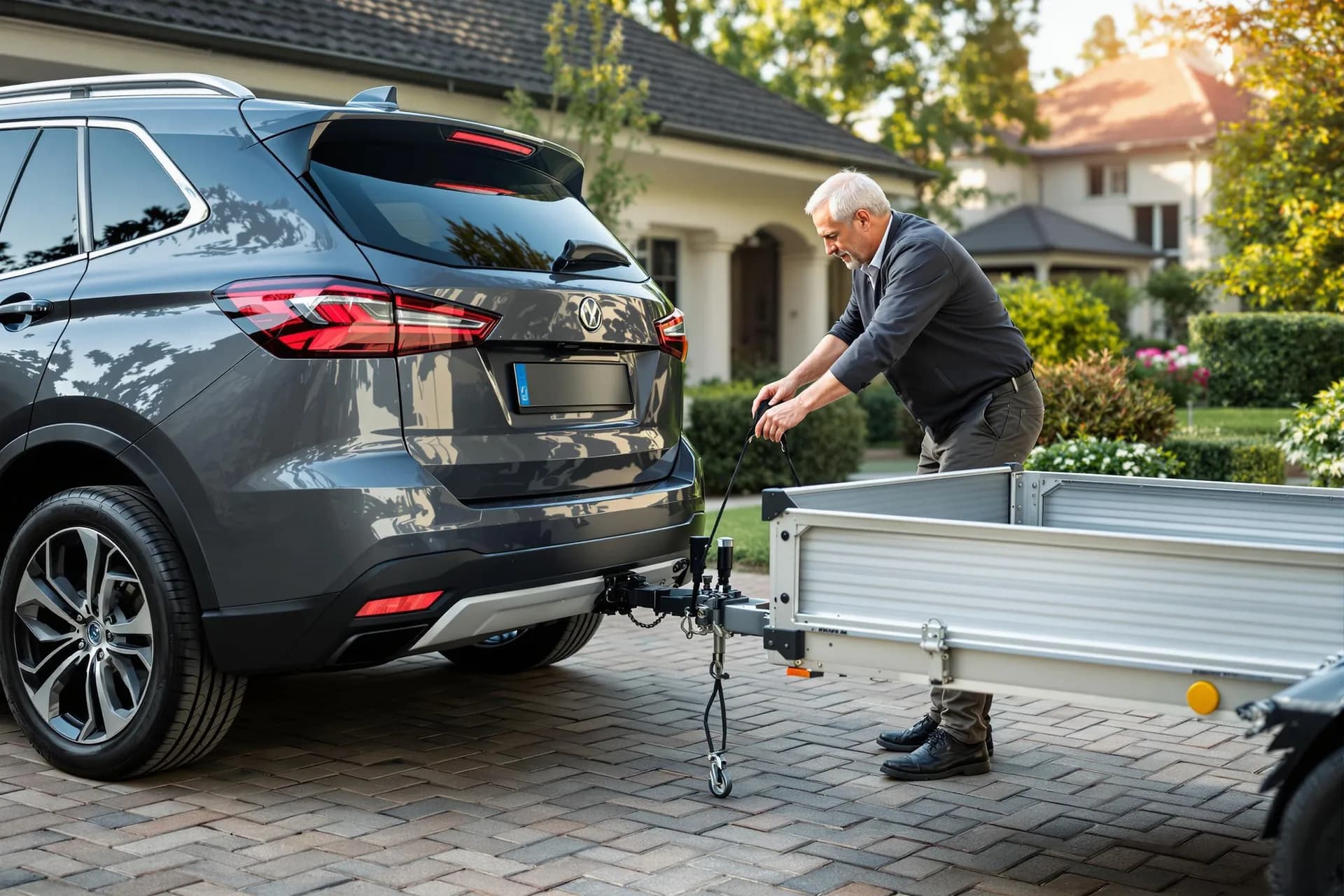
Every horse trailer in Germany requires its own motor third-party liability insurance as soon as it takes part in public road traffic. This basic cover protects against personal injury, property damage and financial loss that you cause to third parties, with sums of up to 100 million euros. It applies, for example, if your uncoupled trailer breaks free and damages another vehicle. However, this insurance does not cover damage to your own trailer. For this, you need voluntary comprehensive insurance. Many owners underestimate that the towing vehicle's liability insurance does not cover damage to the trailer itself. The right cover for your mobility begins with understanding this fundamental distinction. This distinction is the first step towards suitable cover.
Cost-benefit analysis: third-party, fire and theft versus comprehensive
The decision between third-party, fire and theft and comprehensive cover depends largely on the value and age of your trailer. Third-party, fire and theft insurance, which often costs only 50 to 80 euros per year, is the financial protection against uncontrollable risks. It covers damage you cannot influence yourself. These include:
- Theft of the entire trailer or permanently installed parts
- Fire and explosion
- Damage caused by storms (from wind force eight), hail, lightning strike or flooding
- Glass breakage on lighting equipment
- Collision with game as defined by the Federal Hunting Act
- Damage caused by animal bites (e.g. to cables)
Comprehensive cover is the most extensive form of horse trailer comprehensive insurance cover. It includes all the benefits of third-party, fire and theft cover and significantly expands the protection. For new trailers worth more than 5,000 euros, comprehensive cover is almost always the more economically sensible choice. It also covers accident damage caused by your own fault and deliberate damage by third parties (vandalism). Protection against unforeseen events is a key building block, but how do these benefits play out in practice?
Case studies decide: When which comprehensive car insurance pays out
Theory is all well and good, but concrete examples show the true value of insurance. Imagine you return to the car park and your trailer has been stolen — a loss of 10,000 euros. Without comprehensive cover, this is a total loss. With partial comprehensive cover, you are reimbursed for the replacement value. Another scenario: a severe storm with hail damages the roof of your trailer, and the repair costs 2,500 euros. Here too, partial comprehensive cover steps in. The fully comprehensive insurance shows its strengths in other situations. While manoeuvring in a tight tournament car park, you fail to notice a bollard — the side wall is damaged to the tune of 3,000 euros. Without fully comprehensive cover, you have to bear these costs in full yourself. Another example is vandalism: unknown persons scratch the paintwork of your trailer overnight.
Repainting costs 1,500 euros, a clear case for fully comprehensive cover. These examples illustrate the financial risks that go beyond basic cover.
Expert depth: understanding excess and no-claims discount
Two factors significantly influence your premium for comprehensive cover: the excess and the no-claims discount. An excess is the amount you pay yourself in the event of a claim. A typical excess is €150 for partial cover and €300 to €500 for comprehensive cover. By choosing a higher excess, you can reduce your annual premium by up to 20 per cent. Our expert tip: choose the excess high enough that you can easily cover the amount in an emergency, but low enough to allow you to report even minor damage. Unlike car insurance, horse trailer insurance generally does not include a no-claims discount (SF class). This means your premium does not decrease after claim-free years, but in return it is also not increased after a claim. This premium stability makes it much easier to calculate your annual costs. With this knowledge, you can now arrange your individual cover.
Step by step: how to respond correctly in the event of a claim
A claim is always frustrating, but with the right approach you can secure your entitlements quickly and easily. A prompt response prevents reductions in insurance benefits of up to 25 per cent. Follow these four steps:
- Document the damage immediately: Take photos of the site of the damage and the entire trailer from different angles straight away. Note the date, time and location of the incident.
- Inform the police: In the event of theft, vandalism, fire or a collision with wildlife, a police report is mandatory. Ask for a copy of the report for your records.
- Contact your insurer immediately: Report the damage to your insurer without delay – usually within one week. Have your policy number and the photographic documentation ready.
- Do not take any hasty action: Do not commission any repairs and do not obtain an expert report before you have received approval from your insurer. Wait for the claims manager's instructions.
A structured process is the key to full reimbursement of costs. A good trailer insurance actively supports you in this. Now only the final step remains: optimising your policy.
Optimise your contract and save up to 30 per cent on contributions
The right horse trailer comprehensive insurance not only protects, it can also be structured intelligently. An annual review of your policy can enable savings of up to 30 per cent. Check the replacement value of your trailer; if this has fallen significantly after five years, switching from fully comprehensive to partially comprehensive cover may make sense. Pay your premium annually instead of monthly or quarterly. Many insurers grant a discount of up to five per cent for this. Bundle your insurance: sometimes you get better terms if the towing vehicle is also insured with the same provider. Compare not only the price, but also the benefits in detail, such as waiver of the defence of gross negligence. A well thought-out insurance cover is not the product of chance, but the result of a deliberate decision. Request your individual risk analysis now: have your insurance situation reviewed free of charge and receive specific recommendations for optimisation.
Frequently asked questions
- What insurance do I need for a horse trailer with a green licence plate?
Even for a horse trailer with a green licence plate, used for sporting purposes and exempt from tax, you need your own motor vehicle liability insurance. Although exceptions are possible, taking out cover is strongly recommended, as you as the owner are always liable.
- What is the difference between new-value and replacement-value compensation?
The new-for-old compensation reimburses the amount that a new, equivalent trailer would cost today (often only within the first 12 to 24 months). The replacement value is the amount you would have to spend for a used, equivalent trailer on the day of the loss.
- Is there comprehensive insurance without an excess?
Yes, some insurers offer tariffs with no excess. However, these are significantly more expensive in the annual premium. An excess of 150 euros (partial cover) or 300 euros (comprehensive cover) usually offers the best compromise between premium amount and risk.
- Does comprehensive insurance also cover accessories such as a saddle room?
Fixed built-in parts such as the saddle room are generally covered as well. However, the contents, such as saddles or riding equipment, are usually not covered. For this, you need separate contents or transport insurance.
- How quickly do I need to report a claim?
You should report any damage to your insurer immediately, but no later than within one week. In the event of theft or vandalism, you must also file a report with the police straight away in order not to jeopardise your claim.
- Can I cancel the horse trailer insurance annually?
Yes, as with other motor insurance policies, you can usually cancel the contract annually at the end of the policy term. In most cases, a notice period of one month applies. There is also a special right of cancellation after a settled claim.
Sources
- [1]The Federal Government Portal provides information on various federal administrative services.
- [2]The Federal Ministry of Food and Agriculture provides statistical data on livestock in Germany.
- [3]The ADAC provides information on road safety when transporting horses on public roads.
- [4]Under Laws on the Internet you will find the Road Traffic Act (StVG) in its current version.
- [5]The Federal Statistical Office (Destatis) provides information and statistics on animals and animal production in agriculture.
- [6]The German Equestrian Federation (FN) covers the topic of horse keeping on its platform pferd-aktuell.de.