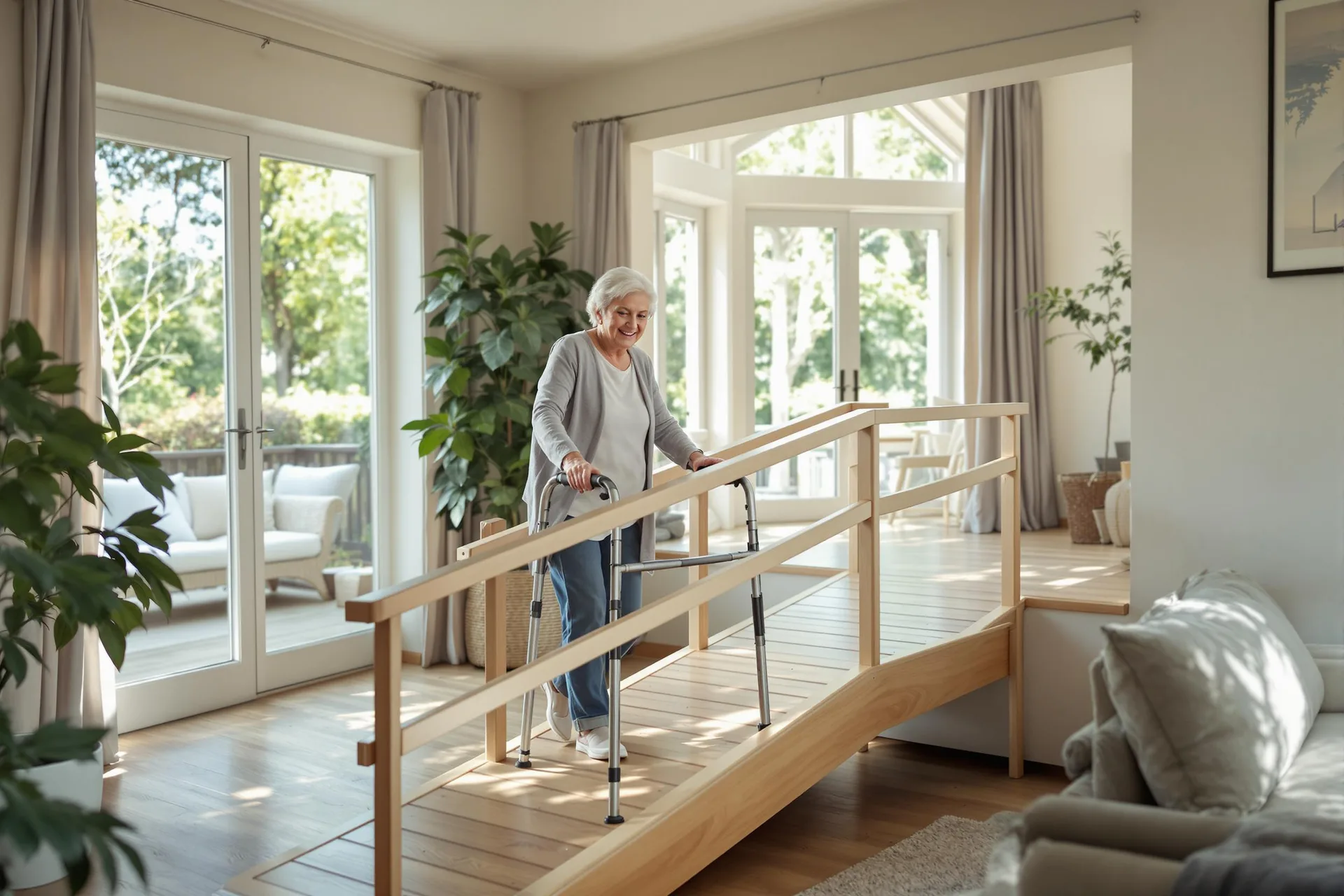
Modernisation loan for accessible conversion
Planning an accessibility-friendly renovation? Find out how to make the most of a modernisation loan and government grants. Find out more now!
 Katrin StraubManaging DirectorInsurance expert with over 20 years of experience in the insurance industry.
Published on
Last updated on
3 min read
Table of Contents
Renovation loan for accessible home adaptations: How to secure your future in your own home
Growing old in your own home is the wish of many. Yet barriers often stand in the way. A modernisation loan for the accessible conversion of your home can make this dream a reality.
Why accessible housing is becoming increasingly important
Demographic change in Germany is leading to a growing demand for age-appropriate housing. Only around three per cent of all disabilities are congenital; the vast majority are acquired during the course of life. This means that, statistically speaking, almost everyone benefits from accessibility at some point. A modernisation loan for accessible home renovation is therefore an investment in your own future. At present, less than two per cent of the entire housing stock in Germany is classified as low-barrier. This gap between demand and supply makes early planning all the more important. Well-considered renovation not only safeguards your own mobility, but also increases the value of your property. Financing is often easier than you might think.
The modernisation loan as a flexible financing solution
A modernisation loan is designed specifically to improve properties and is often cheaper than a standard personal loan. For amounts of up to EUR 50,000, no entry in the land register is often required, which speeds up the process and saves notary fees. The usual requirement is proof of property ownership and sufficient creditworthiness. This type of loan is ideal for financing targeted measures to improve accessibility. You can use it, for example, to cover the installation of a stairlift or the remodelling of the bathroom. Using such a loan for specific purposes makes it possible to implement necessary modifications promptly. The next question is which specific alterations are eligible for funding.
You can finance these conversion measures
The options for reducing barriers in your own home are varied and are often supported by loans and grants. Costs vary widely, but good planning helps keep the budget under control. A conversion to create an accessible home costs an average of 19,000 euros per flat in existing buildings. Here are some of the most common measures you can finance with a modernisation loan:
- Installation of a level-access shower, which can cost between 4,000 and 6,000 euros.
- Installation of a stairlift, with a price range from 3,800 to 9,500 euros.
- Widening doors to at least 80 centimetres for walkers or wheelchairs.
- Fitting support and grab rails in the bathroom and hallways.
- Creating step-free access to a balcony or terrace.
- Installing automatic door openers that make access easier.
These investments not only improve comfort, but also safety in everyday life. Combining them with government funding programmes can significantly reduce the financial burden.
Combine funding intelligently and reduce costs
One of the key sources of financing is the Kreditanstalt für Wiederaufbau (KfW). The programme “Barrier-reduced Refurbishment – Loan (159)” offers loans of up to EUR 50,000 per residential unit for measures to reduce barriers. This funding is independent of the applicant’s age. In addition, where a care level has been officially recognised, the care insurance fund grants subsidies of up to EUR 4,180 per person for measures to improve the home environment. If two people in need of care live in the household, the subsidy can even be applied for twice. Our expert tip: always apply for subsidies before you begin the building work or sign any contracts. Careful planning and the right combination of loan and grant, as with energy-efficient refurbishment, are crucial to financial success. The next step is the practical implementation of your application.
Five steps to a financed renovation
The journey from the initial idea to implementing an accessible refurbishment can be planned systematically. A structured process helps you keep track of everything and make full use of all funding opportunities. In general, approval of a loan or grant takes between two and four weeks. Here is the best way to proceed:
- Assess requirements and obtain quotes: Define the necessary measures and obtain at least two cost estimates from specialist companies.
- Apply for funding: Submit applications to KfW or your long-term care insurance fund before placing any orders.
- Secure financing: Conclude the contract for your modernisation loan as soon as the grants have been approved.
- Have the refurbishment carried out: Commission the tradespeople and have the planned measures implemented.
- Submit supporting documents: Submit the invoices to the bank and the funding bodies so that the funds can be released.
Careful documentation is the key to a smooth process. However, legal aspects should also not be overlooked.
Expert knowledge: Construction law and financial details
For a professionally executed conversion, compliance with technical standards is crucial. DIN 18040-2 is the basic standard for accessible building in Germany and defines requirements for homes. It specifies, for example, how much manoeuvring space is needed in the bathroom and kitchen for wheelchair users. Taking this standard into account is often a prerequisite for receiving funding. Financially, a modernisation loan offers you more favourable interest rates compared with an unsecured instalment loan. Terms typically range from five to 15 years. For older applicants, there are also special offers, such as a loan for pensioners. With the right planning, you can secure an independent life in your own home in the long term.
Frequently asked questions
- How much is a home improvement loan for accessible renovation?
Banks often grant modernisation loans of up to €50,000 without the need for a charge to be entered in the land register. KfW Programme 159 also supports the refurbishment with a loan of up to €50,000 per residential unit.
- Can I combine funding?
Yes, in many cases a combination is possible. For example, you can combine KfW loan 159 with a grant from the care insurance fund. However, it is not possible to receive double funding for the same measure, for example to have a stairlift subsidised by both KfW and the care insurance fund.
- Do I have to be a certain age to qualify for KfW funding?
No, the KfW programme „Age-Appropriate Home Adaptation“ is explicitly not dependent on the applicant’s age. It supports the removal of barriers for greater living comfort at every stage of life.
- What is the “Age-appropriate Home” standard?
The KfW standard „Age-Appropriate Home“ is achieved when access to the property and all essential living areas (living and sleeping rooms, kitchen, bathroom) are designed to be barrier-reduced and certain operating controls comply with the requirements.
- What is DIN 18040?
DIN 18040 is the German standard for accessible building. Part 2 (DIN 18040-2) sets out the technical requirements for accessible dwellings, for example circulation areas, door widths and the design of sanitary facilities.
- When do I need to submit funding applications?
All applications for grants or subsidised loans must be submitted before you begin the conversion or sign supply and service contracts. Retroactive funding is generally excluded.
Sources
- [1]KfW offers detailed information on funding to reduce barriers in existing properties for private individuals.
- [2]The Federal Funding Database presents the KfW funding programme for age-appropriate retrofitting of properties.
- [3]Aktion Mensch offers comprehensive information on accessible building and retrofitting of flats.
- [4]The Family Guide informs families about accessible building and retrofitting in the context of severe disability.
- [5]The KfW explains the investment grant (product 455) for age-appropriate retrofitting of existing properties.
- [6]Statista presents statistics on barrier-reduced living by age in Germany.
- [7]The Federal Statistical Office (Destatis) provides official data and information on disabled people in Germany.
- [8]The Federal Ministry of Labour and Social Affairs (BMAS) provides information on the Federal Accessibility Initiative.