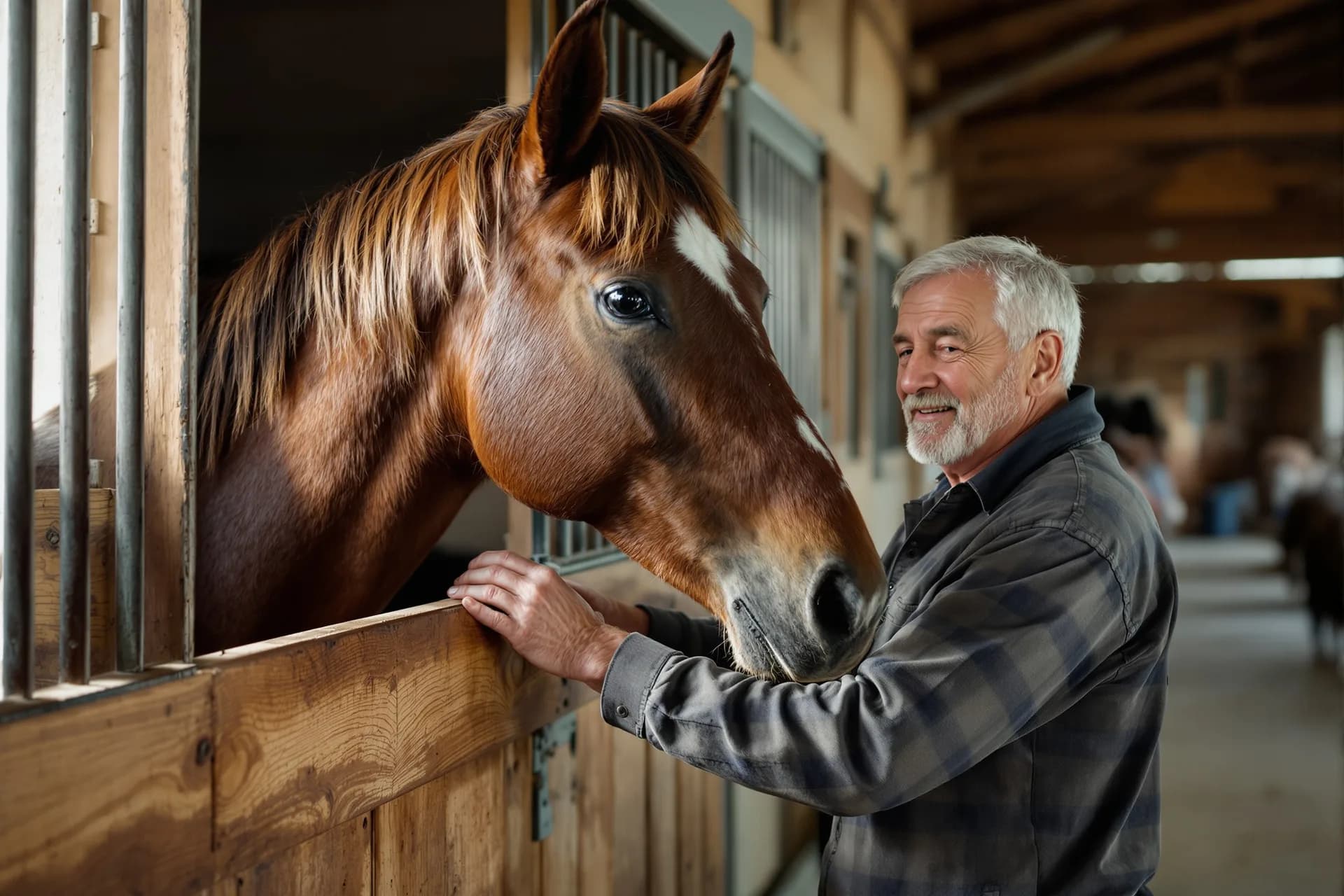

Loan for horse purchase & equipment
Planning to buy a horse? Discover how to get a loan for a horse and equipment and calculate the costs realistically.
All details are taken from the provider's linked product page and the contract documents (IPID/policy conditions) published there; the insurer's documents prevail. Premiums, benefits and the insurance product itself may change – please verify the details directly with the partner before signing up; only the information provided there is binding.
 Katrin StraubManaging DirectorInsurance expert with over 20 years of experience in the insurance industry.
Published on
Last updated on
8 min read
Table of Contents
Equine surgery insurance
Horse surgery insurance via nextsure: Three flexible tariffs, reimbursement up to twice the GOT rate, and free choice of clinic worldwide. Protect your horse from high surgery costs – digital, transparent and uncomplicated.
Learn moreLoan for horses and riding equipment: your path to financing
Buying a horse is an investment that can quickly exceed €20,000. A well-planned loan can make this dream achievable without putting your financial stability at risk. Find out how to calculate the costs realistically and find the right financing.
Calculate costs realistically: What your horse really costs
Many people underestimate the total costs associated with owning a horse. A horse kept purely for leisure can already cost €6,000 to purchase. For the initial equipment, including saddle, bridle and rugs, you should also budget at least €2,500.
The ongoing monthly costs are a crucial factor in your financial planning. These are made up of various items and can vary significantly. Expect monthly expenses of between €400 and €1,000.
Here is an example breakdown of the monthly costs:
- Livery: Depending on the region and services, between €200 and €700.
- Feed: In addition to hay, there are often costs of €20 to €100 for concentrated feed and mineral feed.
- Farrier: Every six to eight weeks, this costs €30 to €150.
- Insurance: Liability and surgical cover together cost at least €40 per month.
- Veterinarian: Budget at least €33 per month for routine care (vaccinations, worming).
A careful household budget is the basis for every loan application. With a clear overview of your income and expenses, as shown in a proper household budget, you can convince any bank. This precise calculation is the first step towards successful financing.
Choosing the right loan for your project
A classic instalment loan is usually best suited to financing a horse. Banks often offer loans for unrestricted use for this purpose. This means you can use the money flexibly for the purchase price, equipment or even initial vet bills. Loan amounts typically range from €1,000 to €50,000.
The terms for such loans usually run between 12 and 84 months. A longer term does reduce the monthly instalment, but increases the overall cost through interest. An effective annual interest rate can start at around three per cent for borrowers with good creditworthiness.
Always compare the effective annual interest rate, as this includes all loan costs. A loan for any purpose offers you the necessary flexibility. This also means you can cover unforeseen expenses, such as an expensive operation.
Choosing the right loan model lays the foundation for sustainable financing, but the banks have clear requirements for borrowers.
Meeting the requirements for a loan: How to convince the bank
Banks in Germany carefully check your creditworthiness before granting a loan. The basic requirements include being of legal age, a permanent residence in Germany and a German bank account. Regular and sufficient income is also essential.
Your creditworthiness is largely determined by your Schufa score. This score predicts the likelihood of repayment on time. A negative entry can make loan approval significantly more difficult. Banks also assess your income and expenditure situation to evaluate your financial capacity.
Our expert tip: A clean Schufa report is crucial. You can request a free self-disclosure once a year to check your data for accuracy. Incorrect or outdated entries should be corrected immediately.
A permanent employment contract significantly increases your chances of loan approval. With an online calculator for your loan instalment, you can check in advance what level of repayment your budget can handle. Once the financing is in place, protecting your precious pet comes into focus.
Cover risks: Essential insurance for horse owners
As a horse owner, you are liable for all damage caused by your animal, without limit, with your private assets. This is regulated in Section 833 of the German Civil Code (BGB). Horse owner liability insurance is therefore essential and protects you against the financial consequences of personal injury, property damage and financial loss.
The cost of such insurance starts at around 70 euros per year. Another important safeguard is horse surgery insurance. Veterinary procedures can quickly cost several thousand euros. A colic operation, for example, costs between 6,000 and 10,000 euros.
A good surgery insurance policy is available from just 22 euros per month and covers the costs of operations, aftercare and medication. The following points are important when choosing insurance:
- Sum insured: It should be high enough to cover even expensive operations.
- GOT rate: The policy should reimburse at least twice the scale of fees for veterinarians (GOT).
- Excess: A low excess of, for example, 250 euros is often sensible.
- Free choice of veterinarian: You should be able to choose the clinic or veterinarian freely.
Our expert tip: Make sure that third-party rider risk is also covered by your horse owner liability insurance. A comprehensive horse surgery insurance policy protects you from financial ruin. With these forms of cover behind you, you can approach the loan application process with peace of mind.
The loan application: A step-by-step guide
A well-prepared loan application significantly speeds up approval. The process can be broken down into five clear steps. First, create a detailed financial plan that takes into account all one-off and ongoing costs. This plan should cover at least the expenses for the first year.
Next, compare different loan offers. Use online comparison portals to find the best interest terms. Pay attention not only to the interest rate, but also to flexible repayment options such as free early repayments.
In the third step, prepare all the necessary documents. These usually include:
- The last three payslips
- Bank statements for the last three months
- A copy of your ID card
- Your employment contract
A complete and properly organised submission of your documents shortens the processing time by several days. After you have submitted the application online or at your bank, the identity verification follows, usually via VideoIdent or PostIdent. A loan with a long term can reduce the monthly burden. But there are also financial pitfalls that you should be aware of.
Avoid costly mistakes: What you should look out for when financing
A common mistake is taking out expensive payment protection insurance. This insurance is meant to step in if you become unemployed or unable to work, but it can increase the cost of the loan by up to 13 per cent of the loan amount. In many cases, the benefits are severely limited by long waiting periods and exclusion clauses.
A separate term life insurance or income protection policy is usually the cheaper and better alternative. These offer more comprehensive cover at significantly lower premiums. Check carefully whether payment protection insurance is really necessary.
Caution is also advised with teaser offers featuring extremely low interest rates. These often apply only to borrowers with excellent credit ratings. The interest rate offered to you individually can end up being significantly higher. So always obtain several binding offers.
Avoid loans without a SCHUFA check, as these are often associated with extremely high interest rates of over ten per cent. If unexpected veterinary bills arise, it is useful to know how a loan for veterinary bills works. Sound financing and insurance cover are the key to enjoying your horse with complete peace of mind.
Frequently asked questions
- Can I also get a loan for a horse with less-than-optimal creditworthiness?
Yes, some providers also offer financing even with less-than-perfect creditworthiness. However, the interest rates may be higher. A second borrower with good creditworthiness can significantly improve the chances of approval and better terms.
- Does the loan also cover the cost of riding equipment?
Yes, an instalment loan for unrestricted use can be used flexibly. You can use it to finance both the purchase price of the horse and the costs of the saddle, bridle and other accessories.
- What happens to the loan if I have to sell the horse?
You can repay most loans early at any time by making extra repayments or by repaying them in full. If you sell the horse, you can use the proceeds to pay off the loan. Check the contractual terms for any early repayment charges.
- Which term should I choose for a horse loan?
The term depends on your financial situation. A shorter term (e.g. 36 months) means higher instalments, but lower overall costs. A longer term (e.g. 84 months) lowers the monthly burden, but makes the loan more expensive overall.
- Why is horse owner's liability insurance so important?
Under Section 833 BGB, as the owner of an animal you are liable without limit with your private assets for all damage caused by your horse. Liability insurance protects you against potentially existence-threatening claims for damages.
- Can I also finance an expensive vet bill with a loan?
Yes, a personal loan can also be used to finance an unforeseen, expensive veterinary bill or operation. Some providers specialise in such cases. However, good horse surgery insurance is the better precaution.
Sources
- [1]German Equestrian Federation (FN) offers figures and facts on equestrian sport and horse keeping in Germany.
- [2]Statista contains a survey in Germany on private horse ownership and provides insights into its prevalence.
- [3]Federal Ministry of Food and Agriculture (BMEL) provides an article on horse keeping, covering agricultural and environmental aspects.
- [4]Animal Welfare Hesse explains that buying a horse is only the beginning of the responsibility and what obligations are associated with it.
- [5]Statista offers comprehensive statistics and information on loans and debt in Germany.
- [6]Deutsche Bundesbank publishes interest rates and yields for consumer loans to private households, particularly instalment loans.
- [7]Wikipedia offers a detailed article on the German Equestrian Federation (FN), its history and tasks.
- [8]German Federal Veterinary Chamber provides information on the law from the perspective of the veterinary profession, relevant for horse owners.
Conclude directly online
Verified partner tariffs at no extra cost. The button takes you straight to the provider's calculator.
 Barmenia
Horse surgery insurance
Surgery cost cover for horses in case of illness and accidents, including diagnostics and after-care.
- Waiting period:
- 3 months (colic surgery: 5 days, accidents: none)
- Coverage abroad:
- worldwide, up to 12 months
- Maximum benefit:
- depends on the cover level, as stated in the policy
- Surgery costs for illness and accidents, including tooth extractions and root canal treatment
- Pre-surgical examination (X-ray, endoscopy, biopsy, lab work)
- After-care including acupuncture, homeopathy, physiotherapy, laser therapy
- Emergency veterinary service up to 4x the standard veterinary fee schedule (GOT) rate plus the emergency callout fee
- Premium cover: up to 5 physiotherapy sessions (max. 60 minutes each) after the after-care period ends
- Once per animal: surgery costs for a birth-related, medically necessary caesarean section
Key exclusions
- Illnesses and developmental abnormalities known at the time of application
- Hoof abscesses and hoof ulcers (exception: hoof cancer)
- Surgery due to cryptorchidism
- Neutering that isn't medically necessary
Service-Champions GOLD: Nr. 1 der Versicherer im Multikanalvertrieb (ServiceValue, 10/2024)
Barmenia (Anbieter der Pferde-OP-Versicherung)
Special waiting periods: 12 months for joint surgery (chip fragments, OC/OCD, Birkeland fractures), 6 months for medically necessary neutering; Premium cover includes a waiver of the insurer's right to cancel from the 7th insurance year.
Fact sheet: benefits, exclusions and waiting periods in detail
All details are taken from the provider's linked product page and the contract documents (IPID/policy conditions) published there; the insurer's documents prevail. Premiums, benefits and the insurance product itself may change – please verify the details directly with the partner before signing up; only the information provided there is binding.
Information last updated: July 2026 · Source: provider product information (IPID/policy conditions)