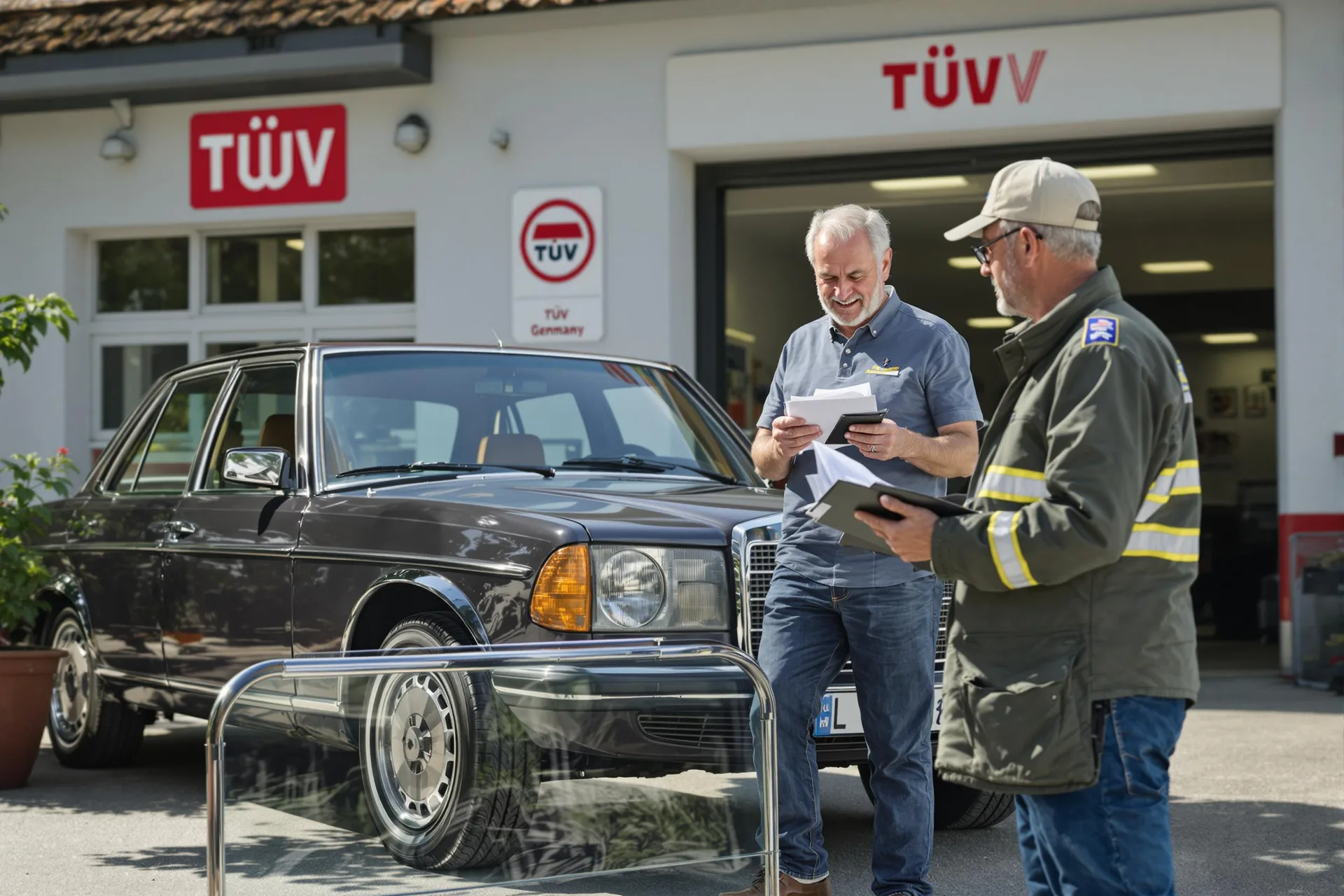

Insure a youngtimer as a classic car
Can you insure a youngtimer as a classic car? Find out all about age limits, valuations and potential savings. Get informed now!
All details are taken from the provider's linked product page and the contract documents (IPID/policy conditions) published there; the insurer's documents prevail. Premiums, benefits and the insurance product itself may change – please verify the details directly with the partner before signing up; only the information provided there is binding.
 Katrin StraubManaging DirectorInsurance expert with over 20 years of experience in the insurance industry.
Published on
Last updated on
11 min read
Table of Contents
Your classic car is more than just an old car – it’s a passion. But insurance costs can dampen that enjoyment. Find out how to classify your vehicle correctly and reduce the insurance premium by more than fifty per cent.

Classic car insurance
Discover nextsure's tailor-made classic car insurance. Optimal protection, digital processing, and expert advice for your automotive treasure.
Learn moreThe 30-year mark as a decisive hurdle
The most important prerequisite for insuring a youngtimer as a classic car is its age. A vehicle is only officially considered a classic car from the age of 30. This regulation is anchored in Section 23 of the Road Traffic Licensing Regulations (StVZO) and forms the basis for the coveted H licence plate. For vehicles that are between 20 and 29 years old, many insurers offer special youngtimer tariffs that are already cheaper than a standard car insurance policy. Making the jump to classic-car status, however, reduces costs by up to fifty per cent once again. Some insurers, such as DEVK, even offer a cheaper “enthusiast” tariff for vehicles from the age of 25. The transition from a youngtimer to a classic car is therefore a clearly defined process that has a significant financial impact.
Halve costs with the right status
The greatest incentive for switching to a classic car policy is the significant potential for savings. While a standard motor insurance policy for an older vehicle can cost €800 per year, a good youngtimer tariff is often available for just €400. A fully comprehensive classic car insurance policy can reduce annual costs to under €150. Premiums for classic cars are based not on vehicle type and region classes, but on the vehicle’s value and condition, which leads to stable contributions. In the event of a claim, there is also no loss of no-claims discount, which saves hundreds of euros over the years. This financial relief makes owning a classic car affordable for many enthusiasts in the first place. The exact savings depend on the vehicle model and the chosen scope of insurance cover.
Four criteria for recognition as a classic car
Alongside the minimum age of 30 years, four further key conditions must be met in order to obtain classic car status. These requirements help preserve value and minimise the insurer’s risk. Meeting these points is crucial for access to the favourable rates.
- Original condition: The vehicle must be largely in its original condition; period modifications are only permitted to a limited extent.
- Good condition: An assessor must certify the vehicle as at least condition grade 3.
- Valuation report: A short valuation report is often available for less than 200 euros and is a basic requirement for most insurers.
- Usage restrictions: The vehicle may not be used for everyday driving, which requires a primary vehicle to be available, and annual mileage is usually limited to 9,000 kilometres.
Reviewing these criteria ensures that it is a genuine enthusiast’s vehicle.
Use the bridging solution with the youngtimer tariff
For vehicles that have not yet reached the age of 30, a special youngtimer insurance policy is the ideal interim solution. Many providers already insure cars from the age of 20 under this more affordable tariff. The costs are often significantly lower than those of a normal motor insurance policy, as lower mileage and more careful use are assumed. These tariffs often require similar proof as a classic car policy, such as good condition and limited use. Allianz, for example, offers such insurance for a Mercedes-Benz SLK from 2001 for under 70 euros per year (third-party liability, seasonal registration). This allows you to build up a positive claims history with the insurer, making the later switch to a classic car tariff easier.
The valuation report as a central document
A professional valuation report is essential for insuring your youngtimer or classic car. It is not only the basis for calculating the premium, but in the event of a claim it is your most important piece of evidence, helping to avoid underinsurance. A short appraisal, which is sufficient for most vehicles valued at up to €50,000, often costs only between €100 and €200 from providers such as ADAC or DEKRA. For more valuable classics, a detailed appraisal is necessary, which can cost several hundred euros. Our expert tip: have the appraisal updated every two to three years so that increases in value are documented without gaps and, in the event of a claim, you receive reimbursement for the full replacement value. This approach protects your invested capital and secures the material value of your passion.
The legal framework for the H registration plate under Section 23 of the StVZO
The H licence plate is the official seal for a motor vehicle cultural asset and is awarded after a successful inspection in accordance with Section 23 of the StVZO. This inspection, which includes a general inspection, assesses the originality and condition of the vehicle, which must be at least 30 years old. In addition to the insurance benefits, as shown in our classic car insurance comparison, the H licence plate brings with it a flat-rate vehicle tax of around 192 euros per year and free access to all environmental zones. The H licence plate is the clearest proof for insurers that all criteria for a classic car have been met. Even though it is not always essential for taking out classic car insurance, it makes the process much simpler. This also gives your youngtimer legal recognition as a classic.
Frequently asked questions
- What documents do I need to take out a classic car insurance policy?
As a rule, you will need the vehicle registration documents, a current valuation report (usually a short appraisal), photos of the vehicle and proof of a daily-use vehicle.
- Can I use my car insured as a classic car for everyday use?
No, one of the main requirements for affordable classic car insurance is that the vehicle is not used for everyday journeys such as commuting to work. For this, a separate everyday vehicle must be available.
- What happens if my classic car increases in value?
Many insurers offer precautionary cover that automatically insures any increase in value up to a certain percentage (e.g. 25 per cent). For larger increases in value, you should update the valuation report and have the policy adjusted.
- Are modifications to the vehicle permitted under classic car insurance?
Modifications are only permitted if they are period-correct and authentic. Modern tuning measures can jeopardise classic-car status and insurance cover. Always clarify modifications with your insurer in advance.
- Is there a free choice of repair shop in classic car insurance?
Yes, as a rule, classic car policies include free choice of workshop. This is important because specialised workshops are often necessary for repairing classics.
- Can I also insure a classic car without a garage?
Most insurers require a locked garage or a secure parking space in order to minimise the risk of theft and vandalism. Policies without this requirement are rarer and often more expensive.
Sources
- [1]Kraftfahrt-Bundesamt (KBA) provides a press release on classic cars in 2023.
- [2]Kraftfahrt-Bundesamt (KBA) provides a short PDF report on the vehicle stock and vehicle age of classic cars in 2023.
- [3]Wikipedia offers an article about classic cars covering definitions, history and criteria.
- [4]ADAC provides information on registering classic cars, legal aspects and useful tips.
- [5]TÜV Association offers information on value appraisals for classic cars.
- [6]The insurers (GDV) provide information on classic car insurance.
- [7]Federal Ministry for Digital and Transport provides an overview of vehicle registration plates, including historic vehicle plates.
- [8]German Motor Trade Association (ZDK) provides information on classic cars on its website.
- [9]VDA, VDIK and ZDK have published a joint press release on classic cars as a billion-euro market in transition.
Conclude directly online
Verified partner tariffs at no extra cost. The button takes you straight to the provider's calculator.
 OCC
OCC
Classic car insurance
Modular motor insurance for classic and collector vehicles: liability, partial and comprehensive cover, plus optional add-on modules.
- Coverage area:
- Europe and non-European EU territories
- Notice period:
- 1 month before the end of the insurance year
- Payment frequency:
- monthly to annual
- Motor liability for third-party damage caused by the insured vehicle
- Partial comprehensive: theft, hail, storm, glass breakage
- Comprehensive: additionally covers vandalism and accidents
- ComprehensivePlus (VollkaskoPlus): further damage while operating the vehicle
- Roadside assistance package, driver protection, and vehicle environmental-damage cover are optional
Key exclusions
- Damage caused intentionally
- Participation in motorsport events and races
- Damage to cargo
- Wear-and-tear damage (Comprehensive/ComprehensivePlus)
Sums insured and the deductible are set out in the individual application or policy document. Insurer: Provinzial Nord Brandkasse AG
Fact sheet: benefits, exclusions and waiting periods in detail
All details are taken from the provider's linked product page and the contract documents (IPID/policy conditions) published there; the insurer's documents prevail. Premiums, benefits and the insurance product itself may change – please verify the details directly with the partner before signing up; only the information provided there is binding.
Information last updated: July 2026 · Source: provider product information (IPID/policy conditions)