Classic car insurance without a garage
Find out how to take out classic car insurance without a garage. We show accepted alternatives and savings opportunities. Get advice now!
All details are taken from the provider's linked product page and the contract documents (IPID/policy conditions) published there; the insurer's documents prevail. Premiums, benefits and the insurance product itself may change – please verify the details directly with the partner before signing up; only the information provided there is binding.
 Katrin StraubManaging DirectorInsurance expert with over 20 years of experience in the insurance industry.
Published on
Last updated on
9 min read
Table of Contents
Do you love your classic car, but don’t have a lockable garage? Many owners believe that this means they cannot get specialist insurance cover. Find out why that is a myth and how you can comprehensively insure your classic car even with a carport or on private property.
Classic car insurance
Discover nextsure's tailor-made classic car insurance. Optimal protection, digital processing, and expert advice for your automotive treasure.
Learn moreGarage requirement for classic car insurance – a fact check
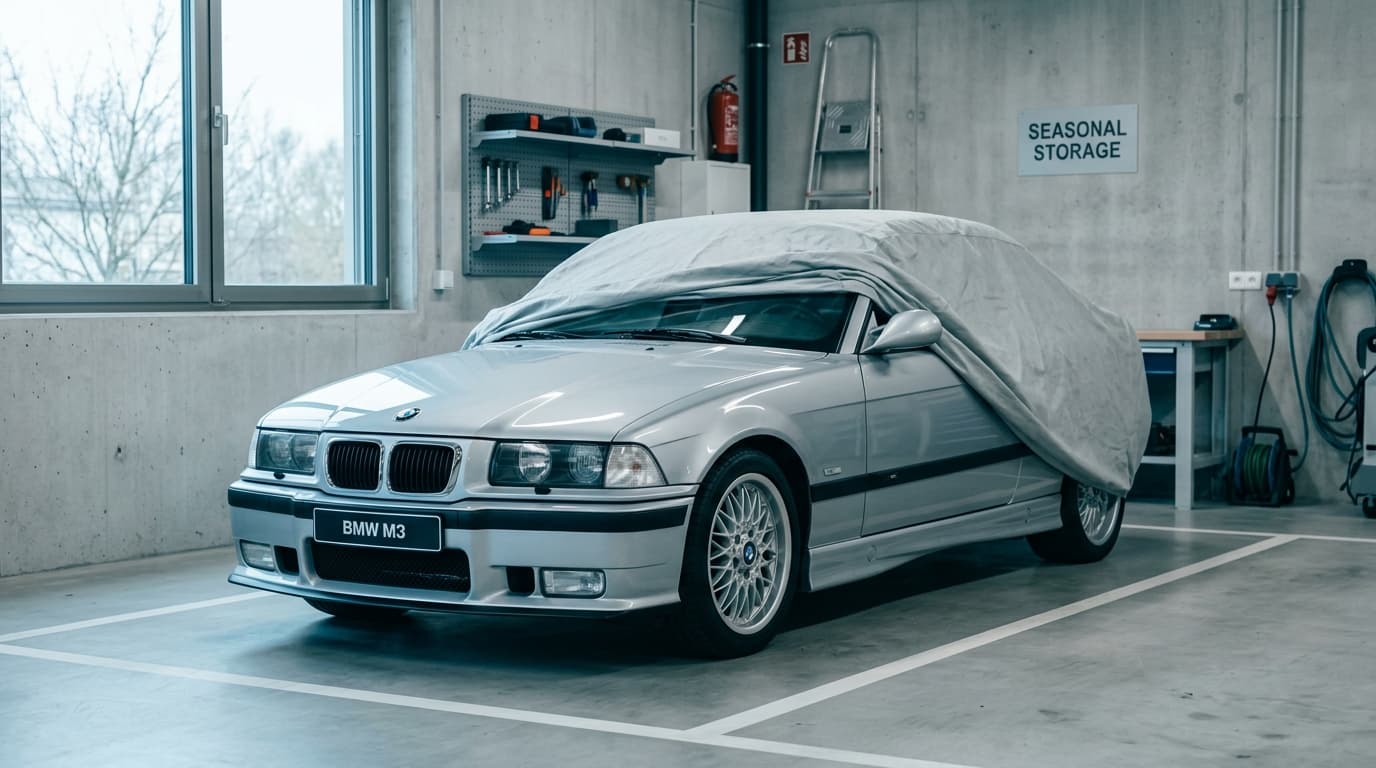
The assumption that classic car insurance necessarily requires a garage is widespread, but not universally applicable. Many insurers require a sheltered parking space in order to minimise the risk of theft and damage, which causes losses amounting to millions every year. However, some providers such as LVM or Allianz no longer explicitly require a garage. Instead, they assess the overall concept of vehicle use and security. The key question for the insurer is not only where the vehicle is parked at night, but how the owner ensures its value is preserved. A second everyday vehicle is one of the most important prerequisites for classic car insurance. This regulation ensures that the classic is used only for leisure drives, which reduces the overall risk by more than fifty per cent. The rigid garage requirement is therefore increasingly giving way to a more flexible risk assessment by insurance companies.
Insurers accept these alternative parking spaces
If a solid garage is not available, there are several alternatives that are recognised by insurers. The most important condition is that the parking space protects the classic car better than a public street. Many insurers regard a carport as sufficient protection against the effects of weather such as hail or strong sunlight. A private, enclosed (that is, fenced) property fulfils the requirement of keeping the vehicle away from direct public access. Even a fixed parking space in an underground or shared garage is often classified as equivalent to an individual garage. Allianz, for example, states that a carport or a parking space on enclosed private grounds is sufficient. Here is a list of common alternatives:
- Lockable underground parking spaces
- Private shared garages with a permanently assigned space
- Carports on your own property
- A fixed parking space on private property secured by a fence or gate
- Monitored multi-storey car parks for regular use
The exact description in the insurance application is decisive, as this determines what a classic car insurance policy costs. Transparent communication about the chosen parking space is therefore essential.
Costs and benefits: How the parking space affects the premium
The storage location of your classic car has a direct impact on insurance costs, as it is a key factor in risk calculation. A vehicle kept in a lockable garage can mean premium savings of up to twenty per cent compared with a car parked on the street. A carport or a fenced private parking space is often priced somewhere in the middle, with a discount of around ten per cent. Insurers reward the lower risk of theft and vandalism with more favourable premiums. Some providers also tie certain benefits to the parking location. For example, all-risks cover, which goes beyond standard comprehensive insurance, may only be granted for a garage space. It is important to check the details, because there are several things to consider with classic car insurance. The choice of parking space is therefore a balance between the options available and the desired level of protection.
Understanding the fine print: parking space clauses in the terms and conditions
In the policy terms and conditions, the parking location is often defined as „the predominant overnight parking place“ or „regular parking location“. These clauses are crucial, because false statements can lead to refusal of cover in the event of a claim. If you state a garage space even though the vehicle is parked on the street eighty per cent of the time, you are breaching a policy obligation. Our expert tip: document your parking space with photos and confirm acceptance with the insurer in writing before concluding the contract. This creates legal certainty for both parties. Some policies also include a „night-time clause“, which stipulates that the vehicle must be at the agreed location between twenty-two and six o’clock. Deviations, for example when travelling on holiday, are usually covered as well, but should be checked if in doubt. A careful comparison of classic car insurance policies helps identify such pitfalls.
Security measures as compensation for the missing garage
You can actively offset the higher risk of a less-than-ideal parking location by taking additional security precautions. Many insurers reward such measures with premium discounts of five to fifteen per cent. An alarm system fitted in the vehicle or a mechanical immobiliser make theft much more difficult. GPS tracking systems are particularly effective, as they enable recovery after a theft. The cost of such a system, at around two hundred euros, is often quickly recouped through the insurance savings. The following measures can have a positive effect:
- Installation of a VdS-approved alarm system
- Use of a steering wheel lock or wheel clamp
- Installation of a GPS tracker for vehicle location
- Fitting motion detectors with lighting at the parking location
These investments show the insurer that you take the protection of your classic seriously and can open the door to better terms, even if you cannot provide proof of a daily-use vehicle for classic car insurance.
In five steps to the right policy without a garage requirement
Searching for the right classic car insurance without a garage does not have to be complicated. With a systematic approach, you can find the right cover for your vehicle in five steps. First, you should determine the value of your classic car with an up-to-date appraisal, as this is the basis for every insurance sum. Second, define your actual parking location as precisely as possible in order to search specifically for providers that accept it. Third, compare not only the price, but above all the benefits and clauses relating to the parking location. A low premium is of no use if the cover is patchy in the event of a claim. Fourth, speak openly about any additional security measures you have taken.
Fifth, seek professional support to review the offers. This way, you can ensure that, in the end, you know when classic car insurance is really worthwhile. If you are considering building a parking space, you can even secure financing for a garage.
Frequently asked questions
- Do I have to notify the insurer of a change of parking space?
Yes, a change to the regular parking space specified in the contract is a reportable increase in risk. If you do not do this, the insurer may reduce or refuse payment in the event of a claim. A move or the loss of the garage parking space must therefore be reported immediately.
- Does the insurance cover also apply if the classic car is parked elsewhere while travelling?
Yes, insurance cover generally applies throughout Europe, and also when the vehicle is temporarily not at the agreed location, for example while on holiday in front of a hotel. The clause on the “night-time parking location” refers to the regular, everyday location.
- What is the difference between garage insurance and laid-up insurance?
Lay-up insurance is a premium-free or reduced-premium insurance policy for deregistered vehicles or vehicles taken off the road with seasonal licence plates. Garage insurance is not an official type of insurance, but is a colloquial term for comprehensive insurance for an unregistered vehicle that is permanently kept in a garage (e.g. during restoration).
- Do all insurers accept a carport as an alternative?
No, acceptance is not uniform. While many modern insurers consider a carport sufficient protection, some traditional providers continue to insist on a solid, lockable garage. It is essential to clarify this individually before concluding the contract.
- Can I insure a classic car without a daily-use vehicle?
That is very difficult and only possible with a few specialist providers, often at significantly higher costs. The existence of a regular-use vehicle is, for almost all insurers, proof that the classic car is used only as a hobby vehicle and not for the daily commute to work.
Sources
- [1]Federal Motor Transport Authority (KBA) offers a press release on the topic of classic cars from 2023.
- [2]Federal Motor Transport Authority (KBA) provides a short report (PDF) on the stock of classic cars and their vehicle age in 2023.
- [3]Federal Motor Transport Authority (KBA) offers comprehensive statistics on vehicle age and the overall vehicle stock.
- [4]TÜV Association provides detailed information about the H licence plate for classic cars and its requirements.
- [5]TÜV Nord offers a practical guide with tips on classic cars.
- [6]Federal Ministry of Transport (BMV) gives an overview of the different motor vehicle registration plates in Germany.
- [7]ADAC Motorsport presents the classic car statistics for 2023.
Conclude directly online
Verified partner tariffs at no extra cost. The button takes you straight to the provider's calculator.
 OCC
OCC
Classic car insurance
Modular motor insurance for classic and collector vehicles: liability, partial and comprehensive cover, plus optional add-on modules.
- Coverage area:
- Europe and non-European EU territories
- Notice period:
- 1 month before the end of the insurance year
- Payment frequency:
- monthly to annual
- Motor liability for third-party damage caused by the insured vehicle
- Partial comprehensive: theft, hail, storm, glass breakage
- Comprehensive: additionally covers vandalism and accidents
- ComprehensivePlus (VollkaskoPlus): further damage while operating the vehicle
- Roadside assistance package, driver protection, and vehicle environmental-damage cover are optional
Key exclusions
- Damage caused intentionally
- Participation in motorsport events and races
- Damage to cargo
- Wear-and-tear damage (Comprehensive/ComprehensivePlus)
Sums insured and the deductible are set out in the individual application or policy document. Insurer: Provinzial Nord Brandkasse AG
Fact sheet: benefits, exclusions and waiting periods in detail
All details are taken from the provider's linked product page and the contract documents (IPID/policy conditions) published there; the insurer's documents prevail. Premiums, benefits and the insurance product itself may change – please verify the details directly with the partner before signing up; only the information provided there is binding.
Information last updated: July 2026 · Source: provider product information (IPID/policy conditions)