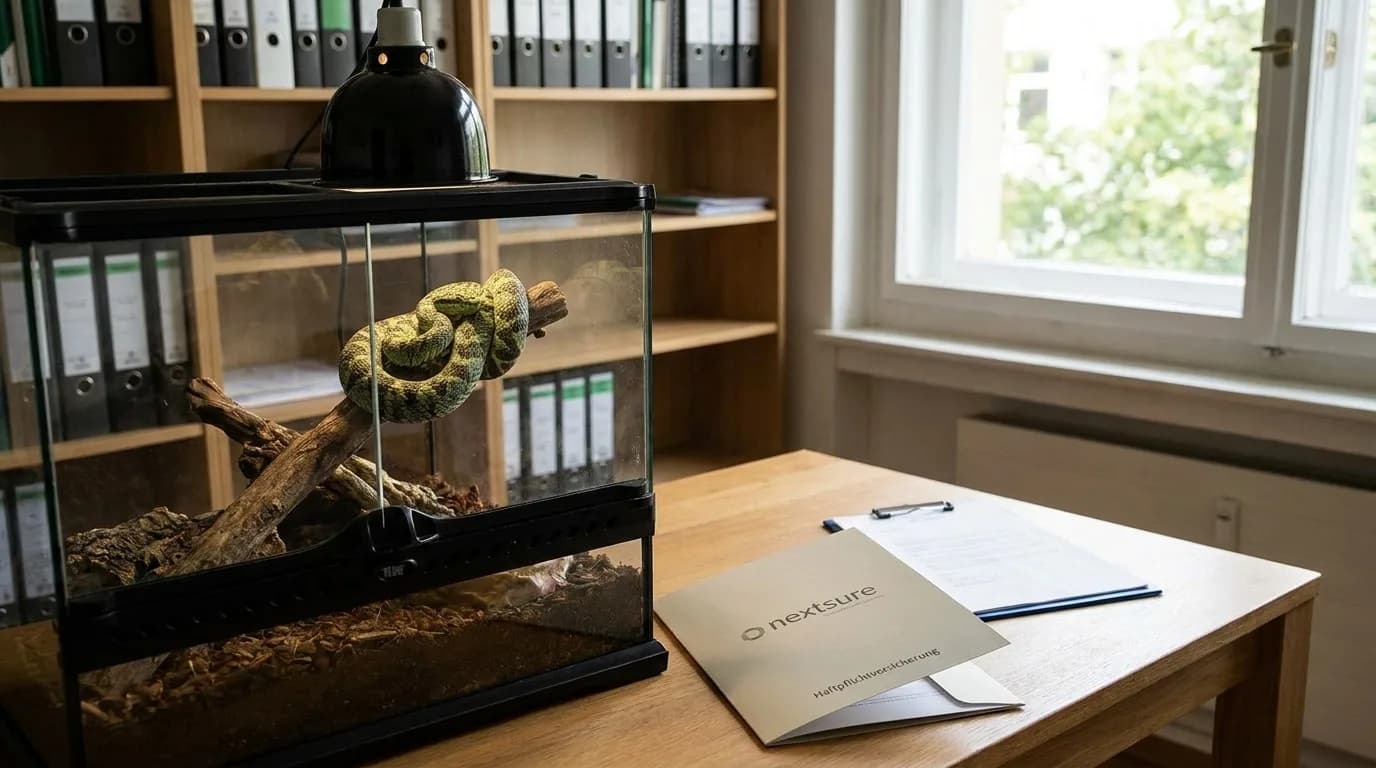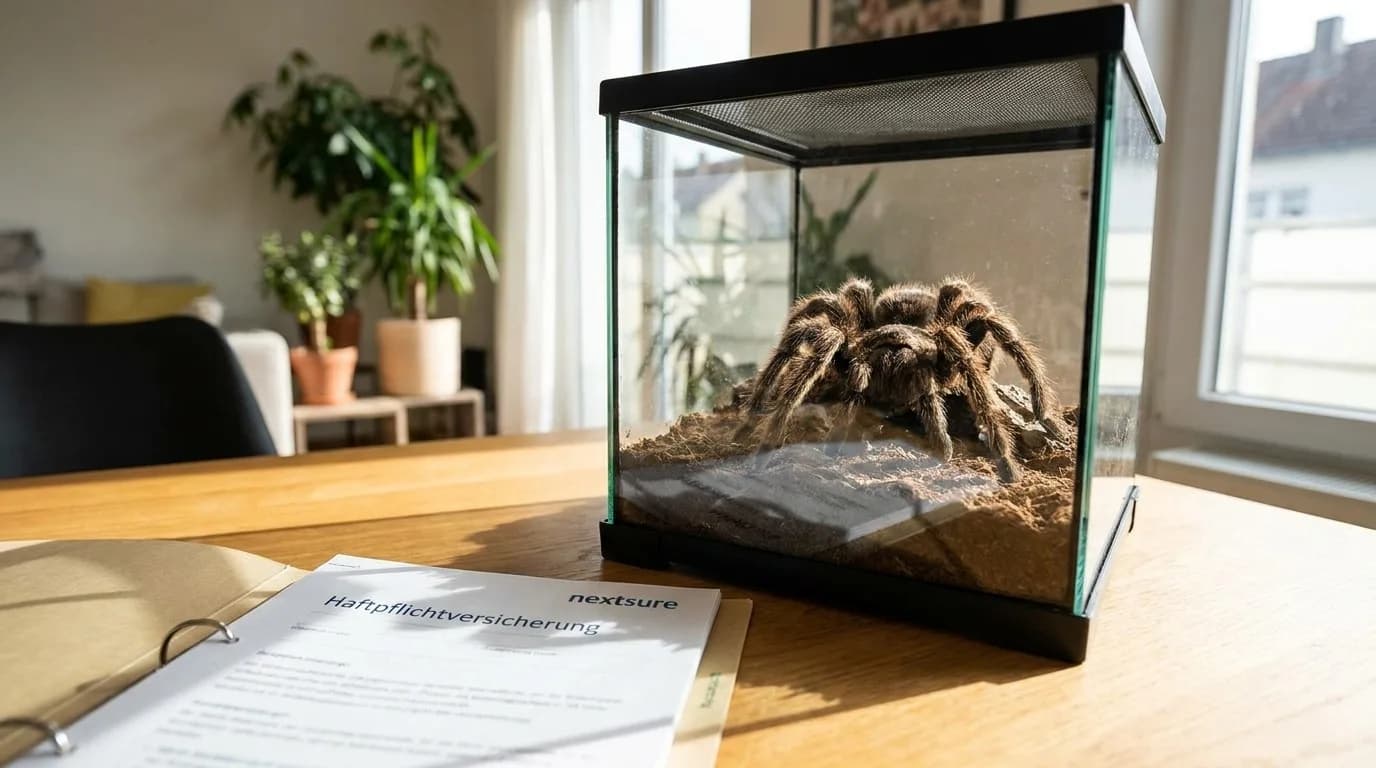
Exotic Pet Liability Without Waiting Periods: When Does Coverage Start?
When does exotic pet liability insurance start? Learn why there is no waiting period and how coverage under § 833 BGB begins on the start date.
All details are taken from the provider's linked product page and the contract documents (IPID/policy conditions) published there; the insurer's documents prevail. Premiums, benefits and the insurance product itself may change – please verify the details directly with the partner before signing up; only the information provided there is binding.
 Katrin StraubManaging DirectorInsurance expert with over 20 years of experience in the insurance industry.
Published on
11 min read
Table of Contents
There is no waiting period for exotic pet liability insurance. Because it protects against liability risks under Section 833 of the German Civil Code (BGB) rather than health risks, coverage begins immediately on the agreed start date for all newly occurring personal injury and property damage.
Exotenversicherung
Find personalised tariffs, compare services, and benefit from transparent information and personal advice – digital and straightforward.
Learn moreWhy exotic pet liability insurance has no waiting period
No, liability insurance for exotic pets does not have a waiting period (the contractually agreed timeframe between formal policy inception and the first day of eligibility for insurance benefits). Your insurance coverage takes effect immediately upon the agreed technical start date, as soon as the insurer has accepted your application and the initial premium is paid on time.
The reason many owners look for a waiting period stems from frequent confusion with pet health insurance. While surgery and veterinary health policies for dogs, cats, or horses routinely apply waiting periods of several months to offset pre-existing conditions, liability insurance serves a fundamentally different purpose: it does not cover the animal's health, but protects the keeper's personal assets against third-party claims for damages. According to a survey by the German Pet Trade & Industry Association (IVH) e. V., German households consistently maintained between 1.2 and 1.3 million terrariums in 2024. Whether snakes, spiders, scorpions, or large lizards: because biological age and medical history are irrelevant to pure liability risk, no medical pre-examination is required.
Liability risk versus health risk
The difference between the two insurance lines lies in their risk structure. In pet health insurance, the likelihood of veterinary costs rises steadily with increasing age or chronic pre-existing conditions. Pet owner liability insurance, on the other hand, exclusively covers unforeseeable loss events where third parties suffer harm.
- Pure liability risk: The policy covers the keeper's statutory liability for damages toward third parties in the event of bodily injury, property damage, or financial loss.
- No health check: Age, pre-existing conditions, or the exotic pet's condition play no role in application acceptance for liability insurance.
- Immediate coverage: Once the application is accepted and the start date is documented in the policy certificate, there are no waiting or deferment periods before the first covered loss event.
- Difference from health insurance: Medical treatments for the animal itself are not covered by the liability policy.
Strict Liability: The Risk Under Section 833 BGB
Legally speaking, keepers of exotic animals are subject to a strict legal rule: strict liability (Gefährdungshaftung — the statutory obligation to pay damages even in the absence of fault or negligence). Under Section 833 sentence 1 of the German Civil Code (BGB), the person who keeps an animal is fully liable for all damages the animal causes to the body, health, or property of third parties.
The German Civil Code makes a fundamental distinction between livestock/commercial animals and so-called luxury animals (Luxustiere). Exotic pets such as venomous snakes, tarantulas, monitor lizards, or scorpions are without exception classified as luxury animals under the law (animals kept for personal leisure, hobby, or prestige rather than for commercial gain or livelihood). The defense of exculpation (the legal proof that the due care required in ordinary relations was observed when supervising the animal) is expressly available only to keepers of domestic animals that serve a profession, gainful activity, or livelihood pursuant to Section 833 sentence 2 BGB, and is therefore excluded for luxury animals. Even if a terrarium was equipped with state-of-the-art security systems and the animal escapes due to unforeseeable circumstances, the keeper remains liable for damages without limit.
Typical Claim Scenarios and Financial Impact
The financial consequences of an incident involving exotic animals can reach ruinous proportions. These are rarely minor claims, but rather costly hazard prevention operations or specialized emergency medical treatments. A standard personal liability insurance policy generally does not apply to such risks, as exotic and venomous animals are usually excluded in standard contracts.
| Loss Scenario | Typical Cost Items | Why Costs Escalate Quickly |
|---|---|---|
| Escape of a venomous snake in an apartment building | Building evacuation, multi-day fire department deployment, involvement of reptile experts | Multiple emergency units and specialists over several days, plus accommodation costs for all affected households |
| Bite or sting injury from a venomous spider or snake | Emergency rescue, procurement of special antivenom, intensive care unit, loss of earnings | Antivenoms are rare and expensive; in addition, treatment consequences, compensation for pain and suffering, and permanent disability claims accrue |
| Water damage from a defective large aquarium or paludarium | Restoration of masonry and neighbouring apartments, drying equipment, furniture replacement | Moisture typically affects multiple residential units, and drying and restoration takes weeks |
Because statutory pet keeper liability applies strictly regardless of fault for luxury animals, a specialized policy with sufficient coverage sums for bodily injury, property damage, and financial loss is indispensable.
Technical and Material Inception of Insurance Coverage
To determine exactly when coverage takes effect, insurance law distinguishes between two points in time: the technical and the material inception. The technical inception denotes the date specified in the insurance contract and policy certificate from which the contractual relationship formally runs.
The material inception, by contrast, marks the exact moment at which the insurer actually provides insurance coverage in the event of a claim and is obligated to settle justified claims. For this protection to take effect, the timely payment of the initial premium is decisive.
Significance of the Initial Premium Under Section 37 VVG
According to Section 37 of the German Insurance Contract Act (VVG), substantive insurance coverage depends on the payment of the initial premium (the first insurance contribution due after conclusion of the contract). If the insured person does not pay the initial premium on time, the insurer is exempt from the obligation to pay for damages occurring in this interim period, provided that the policyholder is responsible for the non-payment and proper legal notification was given.
- Application and acceptance: You submit your digital application. The contract comes into effect upon the declaration of acceptance or receipt of the insurance certificate.
- Technical start date: The date agreed in the insurance certificate determines the contractual start date (e.g., immediately upon acceptance or on a chosen preferred date).
- Payment of the initial premium: When setting up a SEPA direct debit mandate, payment is deemed to have been made on time as long as the account has sufficient funds on the due date.
- Full coverage from day 1: If the technical start date is on or before the application date and the initial premium is debited on time, unrestricted coverage without waiting periods applies from the very first second throughout the entire agreed policy period.
Statutory Obligations: The Venomous Animals Act as an Example
In individual federal states, immediate liability coverage for certain animal species is not merely an individual precautionary choice, but a statutory keeping requirement. A prominent example is the Venomous Animals Act of North Rhine-Westphalia (GiftTierG NRW), which came into force in 2021 and establishes strict requirements for keeping venomous animals.
Under the legal provisions in NRW, keepers of venomous snakes, spiders, or scorpions must provide proof of specialized liability insurance that features a minimum coverage amount of 1,000,000 euros for personal injury, property damage, and financial loss, and explicitly covers animal escapes. Authorities require this proof without gaps starting from the very first day of official notification or keeping permit approval.
Why Waiting Periods Contradict Regulatory Requirements
If an insurance plan contained a waiting period of several weeks or months, it would fail to satisfy regulatory public safety requirements. A waiting period would create an impermissible coverage gap during which the general public remained unprotected. Specialized plans such as exotic pet liability from Cleos Welt ensure compliance with the requirements of the GiftTierG NRW, offering coverage amounts of up to 10 million euros as well as up to 1.5 million euros for search, rescue, or recovery operations.
| Feature | Statutory minimum requirement (e.g. GiftTierG NRW) | High-performance exotic pet liability |
|---|---|---|
| Waiting period before start of benefits | 0 days (seamless protection from registration) | No waiting period (protection from technical start date) |
| Minimum sum insured | €1,000,000 for personal injury and property damage | Up to €10 million flat sum for personal injury, property damage, and financial loss |
| Inclusion of animal escape | Mandatory by law | Fully covered |
| Search and recovery costs | Required in the event of an escape for hazard prevention | Up to €1.5 million for rescue and recovery operations |
The Only Exception: Pre-Existing Damage and Losses
Even though exotic pet liability policies do not apply contractual waiting periods, an elemental boundary exists: the prohibition of retroactive insurance for pre-existing losses. The decisive factor for insurance coverage is the exact time at which the insured event (the specific incident that directly led to the damage) occurred.
If an incident occurs prior to the technical start date documented in the insurance certificate, no insurance coverage applies. If an animal has, for example, already escaped its terrarium, bitten a neighbor, or caused property damage, this loss cannot be settled under a retroactively concluded policy. This actuarial fundamental principle protects the insured collective against fraudulent claims.
Distinction: What Is Insured from Day 1 and What Is Not
Conventional personal liability insurance often explicitly excludes damages caused by wild or venomous animals in the fine print. Anyone taking out specialized exotic pet liability insurance benefits from reliable coverage for future events right from the first effective day, but must exclude existing pre-existing damages.
- Insured from policy start: All personal injury, property damage, and financial losses where the triggering event occurs after the documented start of insurance.
- Insured from Day 1: Expenses incurred to defend against unjustified third-party compensation claims (passive legal protection).
- Insured from Day 1: Necessary rescue and retrieval operations if an animal escapes after the policy start.
- Not insured: Damages or search operations that already started before conclusion or before the technical start date.
- Not insured: Intentionally caused damages by the animal keeper.
Outlook and next steps for exotic pet owners
The legal framework for keeping exotic and dangerous animals is constantly evolving. In the animal welfare and regulatory debates in 2026, nationwide uniform standards, positive lists, or expanded expertise and verification requirements are regularly discussed. For keepers, it therefore remains essential to keep an eye on local official regulations and review insurance coverage on a regular basis.
To protect your collection legally and straightforwardly, a structured approach is recommended:
- Check the general rule: Liability insurance for exotic animals generally applies without any waiting period from the agreed technical start date of the policy, provided the initial premium is paid on time.
- Evaluate your individual situation: Whether and in what quantity you keep notifiable venomous animals, reptiles, arachnids, or other exotics determines the required coverage amount and official requirements in your federal state.
- Recognize the limits of general information: A general guide cannot definitively reflect your specific housing situation, exact species composition, and potential local municipal conditions.
- Take the next step: Gain clarity and compare transparent tariffs. With tailored exotic pet liability insurance through nextsure, you can protect your animals digitally, transparently, and without waiting periods with coverage of up to 10 million euros.
Frequently asked questions
- Is there a waiting period in exotic pet liability insurance?
No. Unlike health or surgery insurance, there is no waiting period for liability insurance. Because this does not insure the animal's health risk but rather your liability risk, coverage begins immediately on the agreed start date of the policy.
- What does strict liability mean for exotic animals?
Under Section 833 of the German Civil Code (BGB), as the keeper of a luxury animal you are strictly liable regardless of fault for all personal injury, property damage, and financial losses caused. Exculpation is not possible, making immediate protection indispensable.
- When exactly does insurance coverage begin?
Coverage begins at the time specified in the insurance certificate (technical start of coverage). The prerequisite for substantive coverage is generally that you pay the initial premium on time and the application is accepted by the insurer.
- Can I retroactively insure damage that has already occurred?
No. A damage event that occurred before the start of insurance coverage can no longer be insured. Insurance coverage applies exclusively to incidents that take place after the start of the policy.
- Is exotic pet liability insurance legally required?
That depends on the federal state. In North Rhine-Westphalia, for example, the Venomous Animal Act (Gifttiergesetz) strictly requires proof of liability insurance with a minimum coverage amount of 1,000,000 euros for personal injury, property damage, and financial losses.
Sources
Conclude directly online
Verified partner tariffs at no extra cost. The button takes you straight to the provider's calculator.
 Cleos Welt
Liability insurance for exotic animals
Liability cover for owners of exotic animals such as snakes, spiders, or alpacas, with coverage of up to €10 million.
- Sum insured:
- up to €10 million
- Number of animals:
- up to 200 smaller animals or a maximum of 5 larger animals
- Events:
- covered (e.g. trade fairs)
- Personal injury, property damage, and financial loss: up to €10 million
- Search, rescue, and recovery operations: up to €1.5 million
- Damage to rented premises up to €300,000; up to €5,000 in vacation accommodation
- Commercial use covered up to €22,000 in annual revenue
- Young animals up to 12 months old are covered
- Meets the mandatory insurance requirement under the NRW Venomous Animals Act (Gifttiergesetz, €1 million)
Key exclusions
- Animals subject to a keeping ban
- Herds of more than 5 larger animals (e.g. alpacas, donkeys)
Google Rezensionen: 4,5/5 Sterne (210 Bewertungen)
Cleos Welt insgesamt (Anbieterbewertung, alle Versicherungen)
Includes an update guarantee and a grandfathering guarantee (Besitzstandsgarantie); proof for authorities is provided directly after the policy starts.
Fact sheet: benefits, exclusions and waiting periods in detail
Cleos Welt
Small pet insurance
Health insurance for small mammals, birds, and reptiles: reimburses surgery, treatment, and after-care costs up to the agreed maximum veterinary fee schedule (GOT) rate.
- Waiting period:
- 30 days, 6 months for specific surgeries
- Coverage abroad:
- up to 12 months
- Age-based adjustment:
- 3% premium increase per year
- Surgery, treatment, and after-care up to the agreed maximum GOT rate
- Medication as well as boarding and feeding during clinic stays
- Specific surgeries (egg binding, otitis, malocclusion) after a 6-month waiting period
- Remote diagnostics and consultation with a veterinarian
- Optional: vaccinations, neutering, physiotherapy, and supplemental dental cover
- Accidents are covered with no waiting period
Key exclusions
- Pre-existing conditions and treatments recommended before the policy started
- Myxomatosis/RHD in rabbits without proof of vaccination
- Neutering/spaying without a separate agreement
- Damage from Encephalitozoon cuniculi without a negative test (test max. 1 year old)
Google Rezensionen: 4,5/5 Sterne (210 Bewertungen)
Cleos Welt insgesamt (Anbieterbewertung, alle Versicherungen)
Cancellation possible at any time with 14 days' notice; sum insured and deductible (Selbstbeteiligung) as stated in the policy. Insurer: Uelzener Allgemeine Versicherungs-Gesellschaft a.G.
Fact sheet: benefits, exclusions and waiting periods in detail
All details are taken from the provider's linked product page and the contract documents (IPID/policy conditions) published there; the insurer's documents prevail. Premiums, benefits and the insurance product itself may change – please verify the details directly with the partner before signing up; only the information provided there is binding.
Information last updated: July 2026 · Source: provider product information (IPID/policy conditions)