Event cancellation insurance
Protect your event against financial losses in the event of cancellation. Cover your costs. Request your individual risk analysis now.
 Katrin StraubManaging DirectorInsurance expert with over 20 years of experience in the insurance industry.
Published on
Last updated on
3 min read
Table of Contents
Cancelling an event is painful; having to bear the costs can put the very existence of your business at risk. Event cancellation insurance protects you against this financial risk. Find out how you can protect your budget with manageable effort.
Event cancellation cost trap: The underestimated financial risk
A city festival with €50,000 in upfront costs is just around the corner, but a storm with wind force eight is approaching. The authorities revoke the permit for safety reasons just 24 hours before the event begins. Without event cancellation insurance, that €50,000 would be a direct loss for the organiser. Scenarios like this are not uncommon and can threaten a business’s very existence. This is exactly where the insurance comes in.
The reasons for a cancellation are varied and often beyond your control. The keynote speaker at a conference is injured in an accident, or the booked concert hall suddenly becomes unusable due to a burst water pipe. In either case, you are left to bear the costs already incurred. Many organisers underestimate that even a single cancellation can lead to insolvency. A well-considered form of cover is therefore not a luxury, but a central component of risk management, similar to business interruption insurance for companies. The policy covers these invested costs precisely.
It becomes clear that protection does not begin only when the event itself starts, but already safeguards the planning phase.
Scope of cover: Event cancellation insurance covers these costs
The core of every event cancellation insurance policy is reimbursement of costs incurred in vain. This protects your invested capital if the event has to be cancelled, postponed or interrupted. Cover is modular in structure and can be tailored to the respective risk. For an open-air concert, for example, additional weather cover is essential.
The items typically insured include:
- Rental costs for the event venue and technical equipment.
- Fees and honoraria for artists, speakers and service providers.
- Expenses for advertising, marketing and ticket sales.
- Staff and travel costs already incurred.
- Cancellation fees from contracts with suppliers.
- Costs for permits and official requirements.
Some policies even allow lost profit to be insured. This is particularly relevant for commercial organisers, whose income from ticket sales and sponsorship exceeds the costs. A good event cancellation insurance policy therefore covers not only the expenses, but also the expected return. The precise definition of the insured costs is crucial for any later claim.
Premium calculation: How insurance costs are made up
The cost of event cancellation insurance is always tailored individually and depends on the specific risk. Insurers assess several factors in order to calculate a premium. The insured sum, which is based on the total cost of the event, is the most important lever. A higher insured sum directly leads to a higher premium.
A calculation example illustrates the scale: for a conference with a budget of 40,000 euros, the premium can start at around 810 euros. A private wedding insurance policy with an insured sum of 15,000 euros is available from around 180 euros. The premium often amounts to only one to two per cent of the total insured sum.
Other factors that influence the premium are:
- The type of event (a rock concert carries a higher risk than a gala).
- The venue (indoor is safer than outdoor).
- The duration of the event (one day versus an entire week).
- Selected additional modules such as a bad weather or terrorism clause.
- The amount of any agreed excess in the event of a claim.
A precise analysis of these points helps to optimise cover and avoid unnecessary costs.
Typical exclusions: In these cases, the insurance does not pay
No insurance offers protection against absolutely every risk. Event cancellation insurance also has clearly defined limits. Understanding these exclusions is crucial in order to avoid false expectations and assess the residual risk correctly. A look at the insurance conditions is therefore essential.
Here are some of the most common grounds for exclusion:
- Cancellation due to lack of audience interest or sluggish ticket sales.
- Financial difficulties or insolvency of the organiser itself.
- Intentional acts by the policyholder or their agents.
- War, civil unrest or acts of political terrorism (often only insurable via an add-on).
- Lack of maintenance of technical equipment leading to failure.
Our expert tip: Check the policy carefully for clauses on pandemics or cyberattacks, as these often require special add-ons. An event ticket insurance policy for participants is separate cover and must not be confused with that of the organiser. These exclusions define the remaining entrepreneurial risk.
Legal framework: The Insurance Contract Act as the foundation
The legal basis for every event cancellation insurance policy in Germany is the Insurance Contract Act (VVG). It regulates the rights and obligations of insurer and policyholder and ensures transparency. For example, the Act specifies what information must be made available to you before the contract is concluded. Compliance with these requirements protects you as the event organiser.
A key obligation on your part is to notify any change in risk without delay. If, for example, you plan to use pyrotechnics that were not originally intended, you must inform the insurer. If you breach this duty of disclosure, your cover for your conference or convention may be at risk. The contractual terms specify the general requirements of the VVG.
Pay particular attention to clearly worded clauses to avoid later disputes. In the event of a claim, complete documentation of all events and communications is crucial. This ensures that you also receive the contractually guaranteed benefits and that your financial protection takes effect.
Practical scenario: how the police save an open-air festival
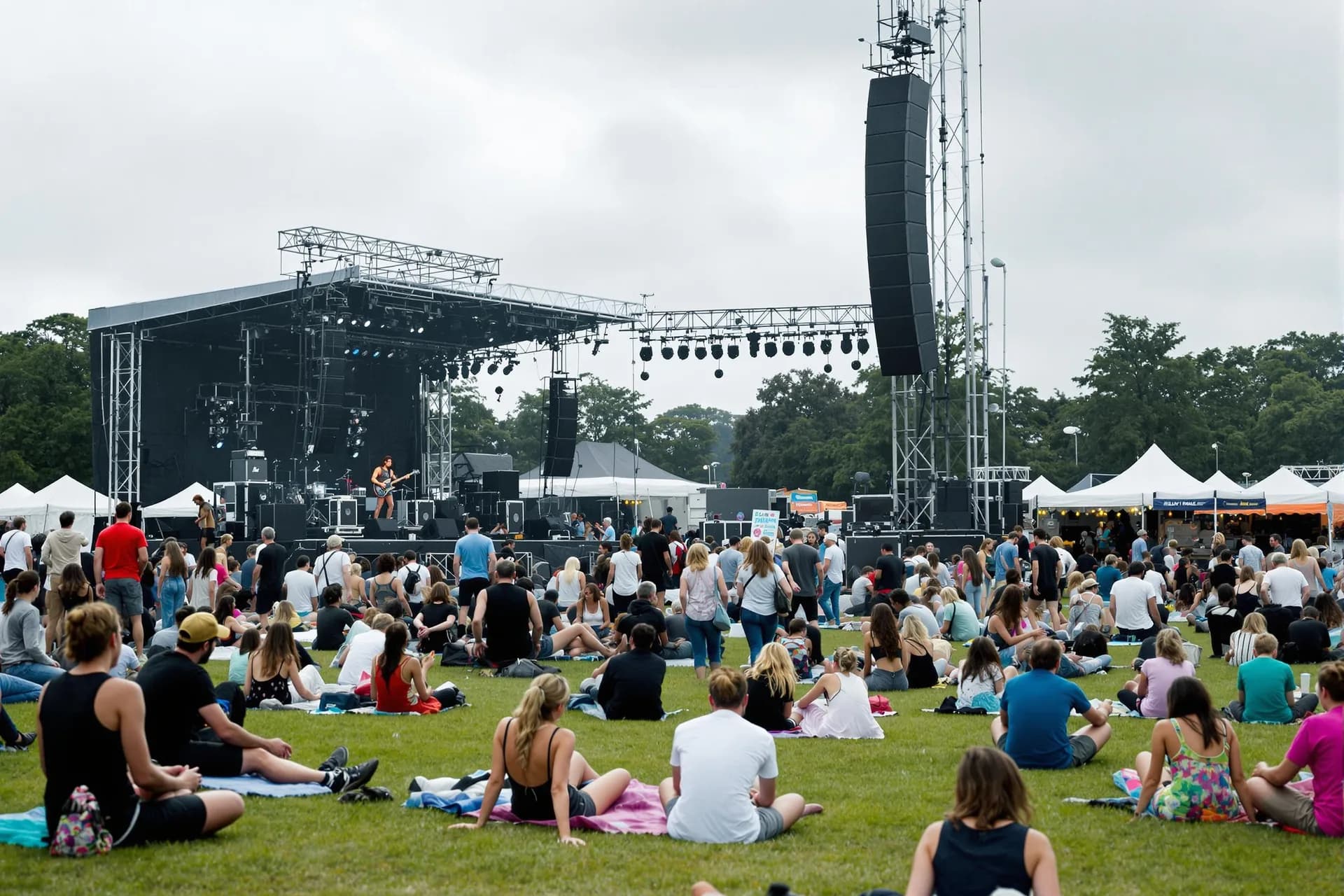
Imagine a two-day music festival with a total budget of €250,000. On the morning of the first day, the weather service issues an official severe weather warning for the region. Storms with wind force nine and heavy rain are expected, posing a threat to life and limb. The responsible authority then revokes the event permit with immediate effect.
For the organiser, this means an immediate cancellation. Thanks to event cancellation insurance, however, the financial damage is cushioned. The insurance covers the costs already incurred and non-refundable. These include, for example, €70,000 for stage and sound equipment, €50,000 in artists' fees already paid, and €30,000 for marketing and staff. Without the insurance, a loss of €150,000 would have meant the end for the organiser.
This example shows how festival insurance functions as a financial safety net. It makes it possible to plan the next event even after a cancellation through no fault of your own. The premium of just a few thousand euros has averted a potentially existential situation.
Frequently asked questions
- What is the difference between event liability insurance and event cancellation insurance?
Event liability insurance covers damage caused to third parties (e.g. visitors) during your event (personal injury and property damage). Event cancellation insurance, on the other hand, protects you as the organiser against your own financial losses if the event cannot take place at all or not as planned.
- Are pandemics such as coronavirus covered by event cancellation insurance?
Following the experience of the COVID-19 pandemic, pandemics are explicitly excluded in most standard policies. Insurance cover for this case is now only available via very specialised and expensive additional modules, if providers offer it at all.
- When should I take out event cancellation insurance?
Take out the insurance as early as possible in the planning phase. Ideally, as soon as you incur your first financial commitments, such as booking the venue or signing artist contracts. Many insurers have a waiting period, for example 14 or 21 days, before full cover takes effect.
- Can I also insure the absence of just one person?
Yes, that is possible. This so-called „non-appearance insurance“ is often a component of event cancellation insurance. It applies if a key person (e.g. a star DJ, a keynote speaker or the bride and groom) is unable to attend due to illness, accident or death and the event therefore has to be cancelled.
- What should I do in the event of a claim?
Notify your insurer immediately of any impending or already occurred loss. Document the cause of the loss (e.g. medical certificate, official order) and gather all supporting evidence of the costs incurred. Also act as if you were not insured, meaning try to keep the costs as low as possible through cancellations or rebookings (duty to mitigate loss).
- Does the insurance also cover losses due to terrorist threats?
Terrorism and threats of terrorism are often not included in the base cover, but can be insured as an additional module. If the police or another authority cancels the event due to a specific threat, the insurance will pay out, provided this module has been taken out.
Sources
- [1]You can find a PDF document on loss prevention in property insurance 2023-2024 from the German Insurance Association (GDV).
- [2]A study on the events industry is offered by the ifo Institute.
- [3]The German Bundestag provides a statement from the German Event Industry Association.
- [4]A meta-study on the overall economic significance of the events industry (RIFEL) can be found at the Interest Group for the Events Industry (IGVW).
- [5]Information on insurance for event services is available from the BMWK start-up portal.
- [6]The Consumer Advice Centre provides information on customer rights at festivals, concerts and sporting events (from cancellations to short-notice changes).
- [7]Information on exam dates for event management professionals is available from the IHK Niederbayern.