CT scans for horses: what does surgery cover pay?
Barmenia pays for a CT scan as a pre-operative examination, capped by the imaging sublimit. What it costs under the GOT 2022, and what you carry.
All details are taken from the provider's linked product page and the contract documents (IPID/policy conditions) published there; the insurer's documents prevail. Premiums, benefits and the insurance product itself may change – please verify the details directly with the partner before signing up; only the information provided there is binding.
 Katrin StraubManaging DirectorInsurance expert with over 20 years of experience in the insurance industry.
Published on
7 min read
Table of Contents
The Barmenia horse surgery policy covers the cost as a pre-operative examination, but caps it through the contractual sublimit for imaging under clause 2.3.2 b) of the conditions.
Equine surgery insurance
Horse surgery insurance via nextsure: Three flexible tariffs, reimbursement up to twice the GOT rate, and free choice of clinic worldwide. Protect your horse from high surgery costs – digital, transparent and uncomplicated.
Learn moreDoes surgery cover pay for a CT scan?
Equine surgery cover from Barmenia Allgemeine Versicherungs-AG pays for computed tomography (CT) where the scan is veterinarily necessary as a pre-operative examination performed immediately before a covered procedure. The CT then counts as part of the diagnostics preparing for the operation itself.
Reimbursement is bounded contractually, though. Under clause 2.3.2 b) of the conditions (AVB Pferde-OP-Kosten, as at 01.01.2024), computed tomography falls, along with other imaging such as MRI or scintigraphy, under a contractual sublimit. There is also only a claim where a covered operation follows the CT and neither waiting periods nor exclusions stand in the way.
- Veterinary necessity: the CT must be strictly required to prepare for a covered operation.
- The sublimit in clause 2.3.2 b): imaging is reimbursed up to the maximum agreed per insured event.
- Waiting periods run out first: no signs of trouble may have appeared before cover started or during the waiting period.
- No exclusion under clause 3.2: purely diagnostic scans with no surgical indication are not covered.
The timing of the first symptoms is decisive above all: if the condition appears before cover starts or inside the standard waiting period, that condition and its consequences are permanently outside cover. Diagnostics alone, with no surgery following, likewise fall outside what a horse surgery policy covers.
When does a horse need a CT scan?
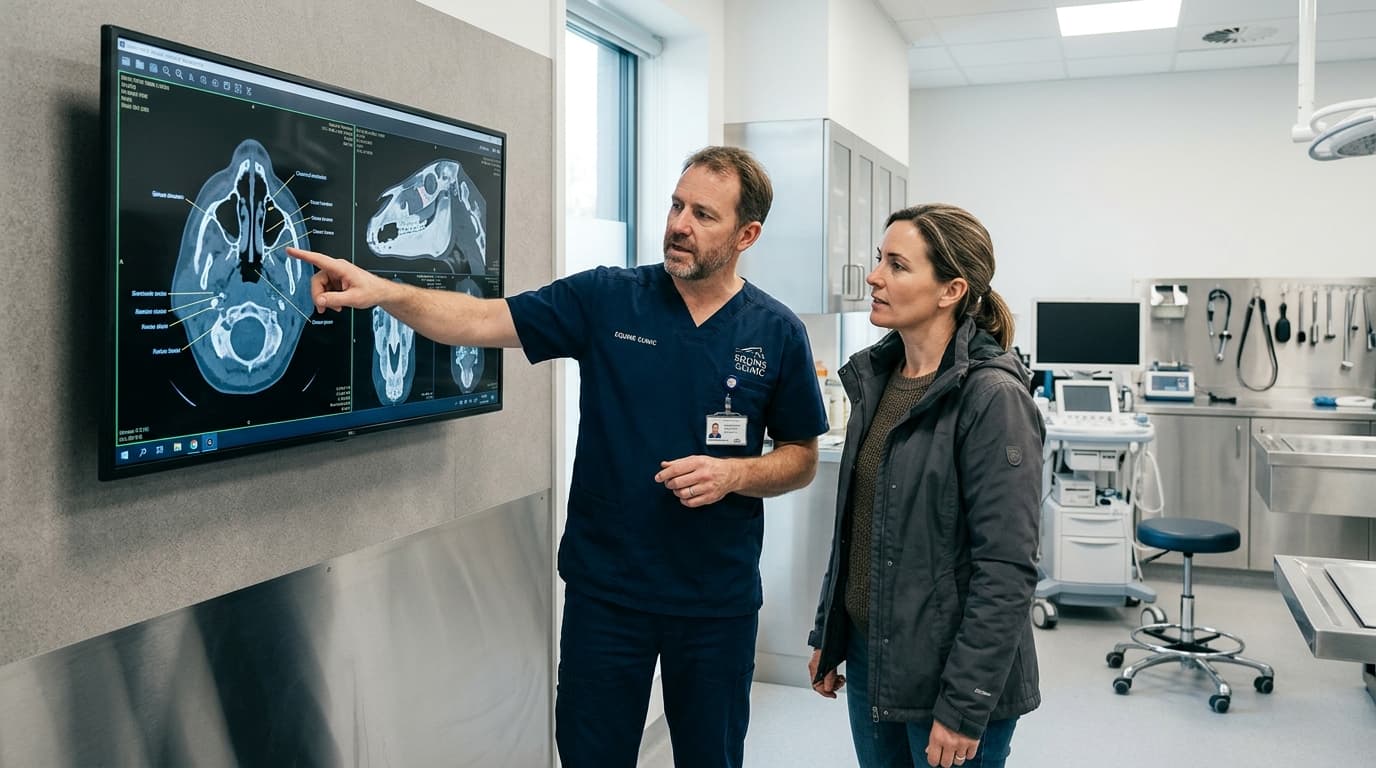
In modern equine medicine, computed tomography is a central tool wherever conventional diagnostics reach their limits. Two-dimensional X-rays frequently superimpose structures in complex anatomy, whereas a CT delivers high-resolution three-dimensional slices of the tissue in question.
Vets use computed tomography above all around the skull, the teeth, the paranasal sinuses and the limbs. CT is especially valuable for conditions of bone, joints, teeth and sinuses, because it images complex regions without superimposition — and it doubles as a valuable planning tool for surgery.
| Area | Medical indication for a CT | Advantage over X-ray |
|---|---|---|
| Teeth & jaw | Deep apical infections, tooth root abscesses, fractures | The affected root identified exactly, with nothing superimposed |
| Paranasal sinuses | Sinusitis, cysts, new growths in the maxillary sinus | Detailed slice imaging of tissue and secretions |
| Limbs & hoof | Fissures, keratomas, bone cysts, pedal bone fractures | The finest cracks in bone caught early, in three dimensions |
| Cervical spine | Narrowing of the spinal canal, arthritis of the facet joints | Precise assessment of bony canals and joint surfaces |
Because nothing is superimposed, the surgeon sees exactly which structures are involved. That shortens the operation itself and cuts the horse's anaesthetic risk considerably.
CT versus MRI in practice
Computed tomography (CT) and magnetic resonance imaging (MRI) are both modern cross-sectional techniques, but what each is good for differs sharply in practice.
CT works with rotating X-ray beams and is the method of choice for hard bony structures, teeth and air-filled cavities. One decisive advantage is speed: with modern equipment, the imaging itself takes only seconds. MRI, by contrast, uses a strong magnetic field and is ideal for soft tissue such as tendons, ligaments and joint capsules.
| Criterion | Computed tomography (CT) | Magnetic resonance imaging (MRI) |
|---|---|---|
| Main indication | Bone, teeth, paranasal sinuses, skull | Tendons, ligaments, cartilage, navicular apparatus |
| Imaging time | Seconds per scan | Considerably longer, several sequences in succession |
| Signal source | Rotating X-ray beams | Magnetic field and radio waves |
| Anaesthesia | Possible on the standing, sedated horse | General anaesthesia usually required |
Which method is chosen depends on the tissue involved. For reimbursement purposes, Barmenia's conditions place both under the same sublimit for imaging under clause 2.3.2 b).
Anaesthetic risk: general or standing sedation?
Going down and getting back up under general anaesthesia always carries some risk of injury for a large animal. Thanks to height-adjustable platforms and modern CT gantries, the head, much of the cervical spine and the limbs from the hoof up to the carpal and tarsal joints can today be scanned on the standing horse under sedation alone.
Under this standing sedation the horse is deeply sedated and locally anaesthetised so it feels no pain, but stays on its own legs. The scan is quick and gentle. General anaesthesia remains indicated where higher regions have to be imaged — the whole cervical spine, the shoulder, stifle, hip or pelvis.
- Standing sedation: gentle on the circulation and the musculoskeletal system, ideal for CT scans of head and teeth.
- General anaesthesia: needed for inaccessible regions, or where surgery follows straight away.
- Insurance cover: both forms are fully covered under clause 2.1.1.1 a).
- Monitoring: vital signs are checked continuously in specialist equine clinics.
Both are covered contractually: under clause 2.1.1.1 a), a veterinarily necessary procedure counts as a covered insured event whether performed under general anaesthesia or under sedation, local anaesthesia or standing sedation.
What a CT scan costs under the GOT 2022
A CT scan on a horse is billed under the official scale of fees for veterinary surgeons (GOT 2022). The fee schedule lists computed tomography at items 175 and 176: the single fee rate for scanning one body part is 350.00 euros net, and 500.00 euros net for several body parts or a whole-body CT, in both cases without distinguishing between species and therefore applying to horses as well. Because vets may bill up to three times the rate depending on the work involved, the range runs to 1,050.00 euros net for one body part and 1,500.00 euros net for a whole-body scan.
| Service under the GOT 2022 | Single rate (net) | Triple rate (net) |
|---|---|---|
| CT scan of one body part (item 175) | €350.00 | €1,050.00 |
| CT of several body parts / whole-body CT (item 176) | €500.00 | €1,500.00 |
On top of the CT fee itself come sedation or general anaesthesia, contrast medium, medication and interpretation of the findings. Equine clinics often bill CT work at twice or three times the rate out of hours or where conditions are difficult, so the total cost of diagnosis multiplies accordingly. Choosing the right GOT rate in your policy is therefore critical.
Working out what you pay under the sublimit
What the owner ends up paying comes out of the interaction between the clinic's invoice, the reimbursement rate and the sublimit for imaging under clause 2.3.2 b).
- Establish the total: add up the work-up, the CT, the operation and the aftercare.
- Apply the sublimit: cap the reimbursable amount for the CT at the maximum agreed for imaging under clause 2.3.2 b).
- Apply the reimbursement rate: use the rate, or the excess, recorded in your policy schedule.
- Calculate your share: what is left above the sublimit, plus the excess, is yours to pay.
Before agreeing to an elaborate cross-sectional scan, owners should always check the contractual waiting periods and the limits recorded in the policy schedule. On nextsure, Barmenia horse surgery policies and their conditions can be compared transparently and bought online.
Frequently asked questions
- When is a CT more useful than an MRI?
A CT is excellent for detailed imaging of bony structures — the head, teeth and pedal bones, for instance. The scan itself takes only about 30 seconds on the standing horse. An MRI gives the best pictures of soft tissue such as tendons or cartilage, but takes considerably longer.
- Does a horse need an anaesthetic for a CT scan?
Thanks to modern equipment, the head, neck and lower limbs can often be scanned on the standing animal under sedation alone. That reduces the medical risk enormously. Other regions, or surgery following directly, call for general anaesthesia — which horse surgery insurance covers as well.
- Does the CT count towards the maximum benefit?
Yes. A CT is imaging and is taken into account when the claim is settled. At Barmenia the special sublimit under clause 2.3.2 b) applies here, meaning reimbursement for the CT is capped at a contractually fixed maximum, which is then taken into account in the overall settlement for the operation.
- What does a CT scan on a horse cost?
Costs follow the scale of fees for veterinary surgeons (GOT 2022). The single fee rate is 350.00 euros net for scanning one body part and 500.00 euros net for several body parts or a whole-body CT. Because up to three times the rate may be billed, the range runs to 1,050.00 and 1,500.00 euros net respectively. Sedation, an intravenous catheter, contrast medium and interpretation come on top, so the clinic's invoice can be higher again.
- Does the insurer pay for a CT with no operation following?
The Barmenia horse surgery policy covers imaging as a pre-operative examination. That means the CT is only reimbursed where it was medically necessary and led directly to a covered operation. If no surgery takes place, the owner carries the cost of the diagnostics.
Sources
Conclude directly online
Verified partner tariffs at no extra cost. The button takes you straight to the provider's calculator.
 Barmenia
Horse surgery insurance
Surgery cost cover for horses in case of illness and accidents, including diagnostics and after-care.
- Waiting period:
- 3 months (colic surgery: 5 days, accidents: none)
- Coverage abroad:
- worldwide, up to 12 months
- Maximum benefit:
- depends on the cover level, as stated in the policy
- Surgery costs for illness and accidents, including tooth extractions and root canal treatment
- Pre-surgical examination (X-ray, endoscopy, biopsy, lab work)
- After-care including acupuncture, homeopathy, physiotherapy, laser therapy
- Emergency veterinary service up to 4x the standard veterinary fee schedule (GOT) rate plus the emergency callout fee
- Premium cover: up to 5 physiotherapy sessions (max. 60 minutes each) after the after-care period ends
- Once per animal: surgery costs for a birth-related, medically necessary caesarean section
Key exclusions
- Illnesses and developmental abnormalities known at the time of application
- Hoof abscesses and hoof ulcers (exception: hoof cancer)
- Surgery due to cryptorchidism
- Neutering that isn't medically necessary
Service-Champions GOLD: Nr. 1 der Versicherer im Multikanalvertrieb (ServiceValue, 10/2024)
Barmenia (Anbieter der Pferde-OP-Versicherung)
Special waiting periods: 12 months for joint surgery (chip fragments, OC/OCD, Birkeland fractures), 6 months for medically necessary neutering; Premium cover includes a waiver of the insurer's right to cancel from the 7th insurance year.
Fact sheet: benefits, exclusions and waiting periods in detail
All details are taken from the provider's linked product page and the contract documents (IPID/policy conditions) published there; the insurer's documents prevail. Premiums, benefits and the insurance product itself may change – please verify the details directly with the partner before signing up; only the information provided there is binding.
Information last updated: July 2026 · Source: provider product information (IPID/policy conditions)