

Dental Insurance Premium Refunds: Save Up to 25%
How the no-claims discount works on dental insurance: save up to 25% while keeping full benefits and free checkups.
All details are taken from the provider's linked product page and the contract documents (IPID/policy conditions) published there; the insurer's documents prevail. Premiums, benefits and the insurance product itself may change – please verify the details directly with the partner before signing up; only the information provided there is binding.
 Katrin StraubManaging DirectorInsurance expert with over 20 years of experience in the insurance industry.
Published on
12 min read
Table of Contents
A no-claims discount on supplementary dental insurance rewards claim-free years with falling premiums. With providers such as Advigon, the contract starts at 100 percent of the premium and drops each year to as low as 75 percent, equivalent to a 25 percent discount. Importantly, professional teeth cleaning and checkups do not count as a claim. These can be used without losing the premium discount. Full insurance cover remains in place at all times.
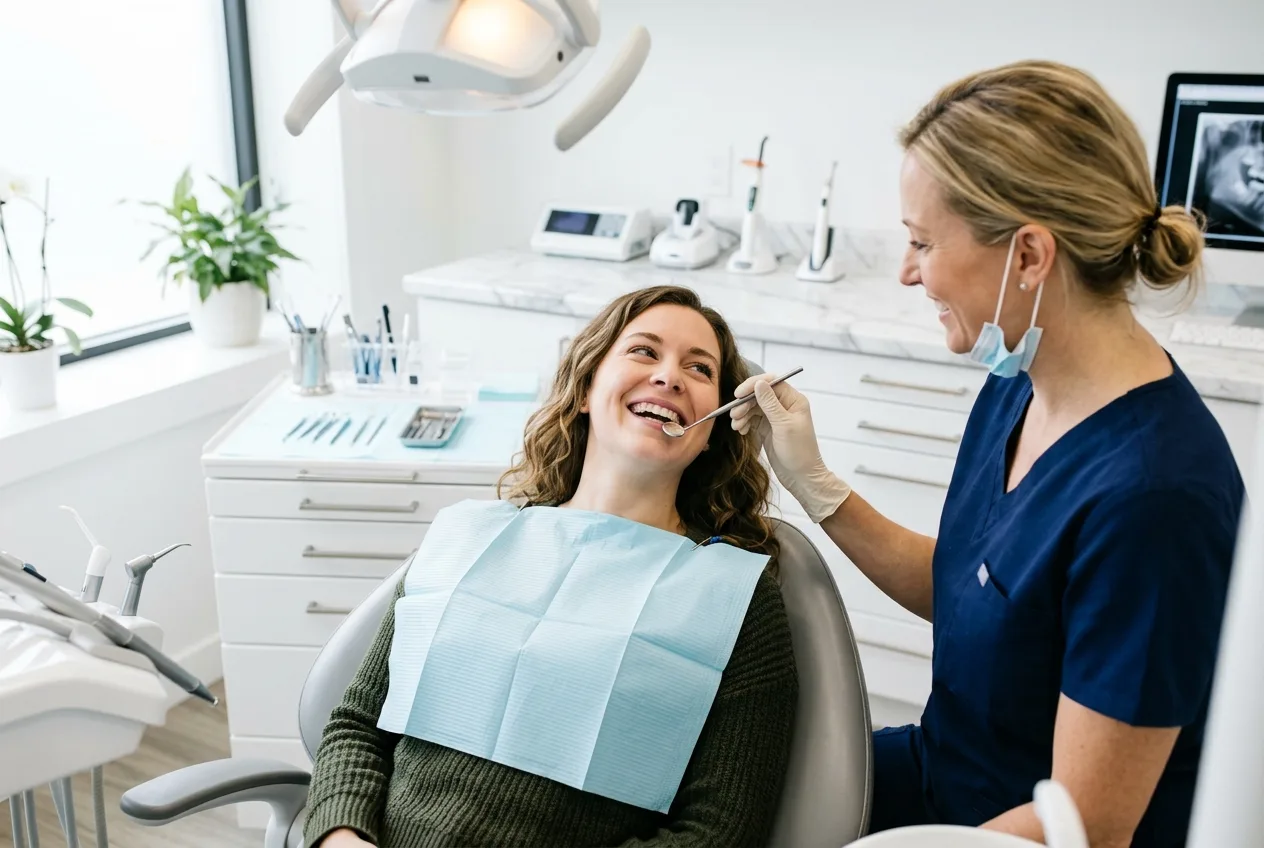
dental supplementary insurance
Find the right dental supplementary insurance at nextsure. Comprehensive protection, digital processing, and tailor-made rates for your most beautiful smile.
Learn moreHow the no-claims discount works
How the discount tiers work
The mechanics behind this model directly and measurably reward health-conscious behavior. A no-claims discount of up to 25 percent considerably lowers the ongoing cost of cover [1]. After signing the contract, policyholders usually start in no-claims class five. This corresponds exactly to 100 percent of the regular base premium, which depends on the age at entry. If the policyholder makes no claims for a full calendar year, they are automatically moved up a tier the following year. The system moves the contract up one class each year. The absolute maximum is reached at no-claims class ten. Here, customers pay only 75 percent of the original premium. This clever approach originally comes from classic motor insurance. It encourages personal responsibility and helps insurers reduce administrative costs for minor claims.
The financial lever in everyday life
A concrete example illustrates the financial lever this discount gives the end customer. If supplementary dental insurance normally costs €40 a month, the premium drops to just €30 at the maximum discount. That's an annual saving of €120 that stays directly in the policyholder's account. This premium reduction applies fully automatically in the background. Customers don't need to submit a separate application or fill out forms. Insurers check claim-free status in their systems at the turn of the year and adjust direct debits accordingly. If invoices are only submitted late in the following year, the tier is corrected retroactively and the difference is charged back. The system is transparent and easy to follow. However, it does call for a strategic approach to smaller dental bills, so as not to carelessly forfeit the valuable discount.
Being moved down a tier after a claim
Placement in the various no-claims classes follows a strict, contractually fixed mathematical grid. Every claim settled leads to a move down a tier in the following year of insurance. If policyholders submit a large invoice for dentures or an elaborate root canal treatment, they usually drop several classes. The exact downgrade table varies by provider and tariff. At Advigon, a claim generally means an immediate drop back to the regular base premium of 100 percent. However, the contractually agreed insurance cover remains fully in place and unreduced. Only the monthly premium changes, not the quality of medical care. In the long run, it is above all policyholders with excellent dental health who benefit from this model. They enjoy the maximum discount for many years and thereby save thousands of euros in premiums.
Preventive care and premium refunds
The special role of preventive care
Preventive care plays an absolutely special role in premium refunds and the discount system. Many people with statutory health insurance fear that even a simple professional teeth cleaning will jeopardize the discount they've painstakingly built up. This concern is unfounded with modern, high-performance tariffs. Benefits for dental preventive care have no negative effect on the no-claims discount [1]. Insurers treat these preventive measures as an investment expense. They prevent expensive follow-up treatments such as implants or bridges in the long run. Placement in the lucrative no-claims class therefore remains untouched, even if the insurer pays for the cleaning. This generally also applies to dental checkups and drawing up treatment and cost plans. Prevention is thus rewarded twice under this rule: through healthy teeth and through permanently low insurance premiums. Anyone who attends preventive checkups regularly secures the financial benefit with no downside whatsoever when it comes to billing.
Budgets for teeth cleaning
The exact contractual coverage for professional teeth cleaning is precisely defined in the insurance conditions. Under the premium Advigon Dental Luxus (AZL) tariff, policyholders have €140 a year available for preventive measures. The somewhat cheaper Dental Medium (AZM) tariff offers a budget of €90 per calendar year here. In both cases, reimbursement is capped at a maximum of €70 per individual treatment. So under the AZL tariff, policyholders can easily have a professional cleaning done twice a year without having to worry about a co-payment. The discount earned, of up to 25 percent, remains fully intact and untouched. This is a decisive and measurable competitive advantage in the German market. Other, older providers immediately cancel the premium refund at any claim whatsoever, paradoxically penalizing their own customers' important preventive dental care.
Long-term dental health
Regular, professionally performed teeth cleaning significantly lowers the risk of painful cavities and chronic periodontitis. This not only protects long-term dental health but also spares the budget. Anyone who takes an active approach to prevention will need expensive, elaborate dentures far less often in old age. Without any dentures invoices submitted, the no-claims discount stays permanently fixed at the attractive maximum of 25 percent. The clever combination of fully paid preventive care and continuously falling premiums creates a positive financial cycle. In the long run, the insurer benefits from considerably lower claim rates across its portfolio. The customer, in turn, benefits from maximum savings and perfect teeth. It's a classic win-win situation that puts the principle of modern health insurance into practice in the best possible way, rewarding personal responsibility. Healthy teeth thus become a financial asset.
Benefits of the preventive-care rule
- Professional teeth cleaning does not lead to being moved down a tier in the discount system.
- Checkups also remain harmless to the premium.
- Up to €140 a year in budget is available under the premium tariff.
- Two teeth cleanings per year are possible with no co-payment and no loss of discount.
- Prevention protects against expensive dentures and permanently secures the 25 percent saving.
The exact reimbursement amounts for preventive care vary depending on the chosen tariff (AZM or AZL).
Tariff comparison between AZM and AZL
Benefit differences in detail
A detailed tariff comparison reveals the fine, but decisive, differences in benefits between the available models. With the Dental Medium (AZM) and Dental Luxus (AZL) tariffs, Advigon offers two very clear and transparent tiers. The AZM tariff reimburses a solid 75 percent of the costs incurred for dental treatment and high-quality dentures. The AZL tariff, by contrast, covers a full 100 percent of the reimbursable expenses [2]. Pleasingly, both tariffs do away entirely with the initial waiting periods of up to eight months that are otherwise standard in the industry. Comprehensive cover therefore applies immediately after the contract is successfully signed. This is especially relevant for people who decide quickly and are planning treatment soon. Monthly premiums strictly depend on the age of the insured person at entry. They rise as expected with increasing age, which is a completely normal process in private health insurance and necessary for the calculations to work.
Premium structure by age
The fixed monthly costs differ considerably depending on the age group and tariff variant chosen. The AZM tariff costs exactly €14.98 a month for the 26-to-35 age group. The considerably more comprehensive AZL tariff costs €27.90 a month for the same age group. For 36- to 50-year-olds, premiums rise, due to age, to €22.60 and €36.90 respectively. These contractual base premiums form the absolute basis for calculating the no-claims discount. If a 40-year-old AZL customer reaches the highest discount tier through claim-free years, they pay only around €27.67 instead of the regular €36.90. So the absolute saving in euros grows proportionally with the tariff premium chosen. This discount mechanism makes high-quality, comprehensive premium cover considerably more affordable in the long run and noticeably eases the monthly household budget.
Reimbursement limits in the first few years
A significant, and often overlooked, difference shows up in the contractual reimbursement limits during the first few years of insurance. Under the AZM tariff, maximum benefits in the first year are strictly capped at €600. Under the AZL tariff, the customer has €1,000 available immediately for necessary treatment. After 48 months have elapsed, these sum limits fall away entirely and permanently for both tariffs. Fortunately, these initial limits also do not apply to accident-related dental treatment. Choosing the right tariff ultimately depends heavily on the individual's need for security and the state of their teeth. Anyone wanting to rule out the full financial cost risk of implants should definitely choose the AZL tariff. Anyone just looking for very solid, cost-effective basic cover does considerably better financially with the AZM model. Both variants, however, offer full access to the attractive discount system.
| Benefit | Dental Medium (AZM) | Dental Luxus (AZL) |
|---|---|---|
| Reimbursement for dentures | 75% | 100% |
| Reimbursement for dental treatment | 75% | 100% |
| Preventive care per year | €90 | €140 |
| Limit in year 1 | €600 | €1,000 |
| Waiting periods | None | None |
Reimbursement limits fall away entirely for both tariffs after 48 months or in the event of an accident.
Financial impact and cost structure
Long-term cost-effectiveness
The financial impact of the discount system adds up to considerable amounts over the years. The general cost of supplementary dental insurance depends heavily on the level of reimbursement chosen and the age at entry. This discount changes the long-term cost-effectiveness calculation enormously. With a regular monthly premium of €50, a claim-free customer saves exactly €150 per calendar year. Over a full decade, this seemingly small amount adds up to a substantial €1,500. This cumulative saving very often exceeds the actual cost of smaller, routine dental treatments. From a purely mathematical standpoint, it is therefore worth simply paying for minor claims yourself. Permanently preserving the maximum discount is, in the long run, almost always the more economically sensible and smarter decision for the policyholder.
A worked example for minor claims
A concrete example from dental practice illustrates this important financial strategy. Suppose a simple but high-quality composite filling costs the patient exactly €80 out of pocket at the dentist. If they submit this relatively small invoice to the insurer, they lose their hard-earned no-claims discount entirely in the following year. The monthly premium immediately rises back to the full 100 percent of the base premium. In our earlier example, that means concrete additional costs of €150 in the next year of insurance. The policyholder makes a real financial loss here. It is therefore essential to check every single invoice very critically before submitting it. Submitting a claim is only always, without a doubt, worthwhile for genuinely expensive dentures or elaborate root canal treatments.
Cost coverage for pain therapies
The detailed cost structure of the tariffs pleasingly also includes very innovative, modern pain therapies. Both Advigon tariffs examined here cover special treatments such as acupuncture, general anesthesia, laughing gas, and gentle twilight sleep. Under the AZM tariff, 75 percent of the costs incurred are covered as agreed. The AZL tariff reimburses these special benefits at a full 100 percent. These valuable additional benefits are extremely valuable and helpful, especially for patients with a diagnosed dental phobia, in everyday treatment. However, they naturally incur very high additional costs, which can quickly put the painstakingly built-up discount at risk if submitted as a claim. Policyholders therefore need to weigh up, case by case, whether they really want to bill these special comfort benefits through the insurance. Either way, the intelligent discount system always preserves financial and therapeutic flexibility and ensures the best possible care.
Switching and prior insurance periods
A seamless transition with no waiting period
Switching insurers always requires a very close, detailed review of the contractual terms. Anyone looking for new, suitable supplementary dental insurance often fears having to start new, months-long waiting periods. Advigon offers an extremely customer-friendly, transparent solution here for customers wanting to switch. Proven prior insurance periods from other, previous providers are credited in full under certain, clearly defined conditions. In the best case, this can lead to the usual reimbursement limits in the first few years being waived immediately and completely. The switching customer thus enjoys unlimited, full insurance cover from the very first day. This is a huge, tangible advantage over a classic new sign-up with no prior insurance to credit. The switching process must be strictly seamless.
Conditions for recognition
The exact conditions for successfully recognizing the prior insurance period are strictly defined in the tariff terms. The terminated previous contract must have run uninterrupted with the old company for at least 48 months. In addition, the transition to the new, more comprehensive tariff must be absolutely seamless, without a single day's gap. Another important hurdle is the general level of benefits under the old contract being terminated. For a successful switch to the AZM tariff, the old contract must have offered at least 75 percent reimbursement for dental treatment and dentures. For the AZL tariff, 100 percent reimbursement is required. If the existing old contract meets all these strict criteria, the usual tiered limits of up to €4,000 in the first four contract years fall away entirely, with nothing put in their place.
Advantages for long-standing policyholders
This far-reaching switching guarantee makes switching tariffs extremely attractive even for long-standing, loyal policyholders. Very often, these customers are stuck in completely outdated, low-performing tariffs. These old policies generally offer no premium refunds and show considerably worse benefits for modern treatment methods. A targeted switch to a modern, high-performing system with a built-in no-claims discount noticeably lowers ongoing monthly costs. At the same time, the level of medical benefits improves dramatically, for example for expensive implants or high-quality ceramic inlays. A concrete real-world reimbursement example shows this clearly: five lab-made inlays quickly cost around €4,778. After deducting the small statutory-fund contribution, the AZL tariff covers the remaining €4,560 in full. Without corresponding insurance, the patient would have to bear this enormous sum entirely out of pocket.
Requirements for recognizing the prior insurance period
- The previous contract must have run uninterrupted for at least 48 months.
- The switch to the new provider must be seamless, with no gap in time.
- For the AZM tariff, the old contract must have offered at least 75 percent reimbursement.
- For the AZL tariff, the old contract must have offered at least 100 percent reimbursement.
- The old contract must no longer have had its own reimbursement limits.
If these conditions are met, the initial tiered limits of up to €4,000 fall away immediately.
Premium refunds vs. no-claims discount
Technical differences between the systems
Premium refunds differ considerably, both technically and commercially, from a pure no-claims discount. A classic premium refund (Beitragsrückerstattung, BRE) actively pays money back into the claim-free customer's checking account at the end of the year [3]. The no-claims discount, by contrast, directly lowers the monthly premium. Both systems reward proven claim-free status, but use completely different financial and accounting mechanisms to do so. With a contractually fixed refund, there is a firm entitlement to payment of a defined sum [4]. With the discount system, only the monthly amount debited from the policyholder's account is reduced. For a household's ongoing cash flow, the discount system is often considerably more pleasant and easier to plan around. The customer doesn't have to wait for an annual, often late, lump-sum payment, but benefits from the saving immediately every month.
Psychological effects on the consumer
Advigon's innovative discount system is structured directly along the lines of the well-known motor-insurance model. It normally starts at 100 percent of the premium and, with claim-free years, drops in stages to as low as 75 percent. A classic BRE, by contrast, often pays back a flat one to three months' premiums at the end of the year. Mathematically, a 25 percent discount corresponds exactly to three full months' premiums per year, since three of twelve months is exactly a quarter. So the financial value of both models is identical down to the cent. However, the psychological effect on the consumer differs considerably. Most customers find a permanently, reliably low monthly premium considerably more pleasant. It noticeably and permanently reduces the household's fixed monthly costs.
Inflation protection through percentage-based discounts
Another, very important difference lies in how the two models handle unavoidable premium increases in practice. If the tariff's contractual base premium rises due to necessary age-related reserves or general medical inflation, the discounted premium naturally rises accordingly too. The percentage discount of exactly 25 percent, however, remains untouched in every case. With a fixed BRE payout defined in absolute euro amounts, the refund loses considerable real value to inflation over the years. The percentage-based discount system is thus inherently perfectly inflation-protected and future-proof. It grows completely automatically and proportionally along with rising premiums in old age. This makes the percentage-based no-claims discount a stable, reliable tool for long-term, strategic cost control for the policyholder.
Test winner and market assessment
Top rating from Stiftung Warentest
An official test winner gives consumers objective certainty. Anyone truly looking for a high-performing test-winner tariff should absolutely pay attention to independent, methodologically sound ratings. The premium Advigon Dental Luxus (AZL) tariff was reviewed in great detail by the renowned Stiftung Warentest. In the current Finanztest 07/2025 issue, it received the absolute top rating of "SEHR GUT" (very good), with an outstanding grade of 0.6 [2]. This rare top rating underscores the extremely high quality and reliability of the underlying insurance conditions. Among other things, the testers assessed the actual reimbursement rates for expensive implants, lab-made inlays, and classic crowns. The smooth coverage of expensive dental ancillary costs, such as necessary bone grafting, also significantly contributed to the testers' excellent overall verdict.
A unique selling point in the market
A close look at the market clearly shows that tariffs with a built-in no-claims discount are extremely rare in Germany. The vast majority of providers on the market do away entirely with this customer-friendly model. They prefer to calculate with fixed, rigid premiums with no financial incentives whatsoever for cost-conscious behavior by policyholders. HanseMerkur, as Advigon's strong parent company, also offers very high-performing tariffs in its portfolio with no waiting period at all [5]. However, the specific, contractually fixed 25 percent discount is a genuine unique selling point of Advigon's particular product line. It is aimed specifically at well-informed customers who want to actively and preventively look after their dental health. Through this financial incentive, the model in effect systematically selects good risks for the insurer. In the long run, this stabilizes premiums for the entire pool of policyholders and prevents premiums from exploding.
Legal certainty for complex treatment
For the end consumer, the outstanding grade of 0.6 above all means maximum legal certainty in what is often a contentious claims process. The underlying insurance conditions are extremely transparent, clearly structured, and written in an absolutely consumer-friendly way. This tariff has no hidden or vague clauses that could suddenly and unexpectedly cap reimbursement for expensive implants. The important dental functional analysis and the subsequent functional therapy are also firmly anchored in the extensive benefits catalog. These special diagnostic measures are essential for complex, extensive dentures, but are generally not paid for by statutory health insurance. A genuine test-winner tariff reliably covers exactly these extremely expensive and often unforeseen gaps. The customer is thus protected from unpredictable financial surprises.
Strategy for a claim
Commercially reviewing treatment and cost plans
The optimal financial strategy for upcoming dental treatment always requires the patient to think somewhat commercially. Submitting a cost estimate in good time is always the very first and most important step here. Before elaborate, expensive treatment begins at the dentist, the detailed treatment and cost plan must be reviewed by the insurer. The insurer then tells the customer, in writing and precisely, exactly what sum will ultimately be reimbursed. Only with this reliable information can the policyholder do the math and plan seriously. They compare the confirmed reimbursement sum directly against the looming financial loss from the no-claims discount built up over the coming years. If the confirmed reimbursement is considerably below the calculated value of the discount loss, they are better off simply paying the invoice entirely out of pocket. This protects the favorable premium tier in the long run.
What to do for major procedures
For truly major, expensive dental procedures, however, the decision is absolutely trivial and quickly made. If, for example, the patient needs a high-quality implant costing €3,000, they naturally submit the corresponding invoice to the insurer right away. The temporary loss of perhaps €150 a year in discount doesn't matter at all against this enormous sum. At this moment, the insurance fulfills its most important purpose. It protects the patient from existential financial burdens and enables the best possible medical care. After the claim is settled, the contract is automatically moved back to 100 percent of the regular premium the following year. After that, building the discount back up through claim-free years simply starts over from the beginning. This cyclical system ensures lasting fairness for both parties to the contract.
Digital processing of claims
Digital claims processing considerably speeds up this entire process today. Modern insurers such as Advigon offer intuitive apps and secure online portals for quickly submitting invoices and treatment and cost plans. The customer simply photographs the document with their smartphone and uploads it in encrypted form. Commercial review often happens within a few business days, so treatment at the dentist can begin without major delays. This high processing speed is an invaluable advantage, especially for acute pain treatment or after accidents. The combination of a high-performing tariff, an intelligent discount system, and fully digital administration makes modern supplementary dental insurance an essential building block of private health provision. It secures not only a brilliant smile, but also effectively protects personal wealth from unpredictable risks.
Frequently asked questions
- How does the premium refund on supplementary dental insurance work?
The premium refund takes the form of a no-claims discount. If no invoices for dental treatment or dentures are submitted in a calendar year, the premium automatically drops the following year. The system moves the contract up one class each year until the maximum discount is reached.
- How much discount is possible if I don't use any benefits?
With providers such as Advigon, you can save up to 25 percent of the regular tariff premium. The contract starts at 100 percent and, with continuous claim-free years, drops in stages to as low as 75 percent. This saving is preserved as long as no invoices are submitted.
- Does dental preventive care count as a claim?
No, professional teeth cleaning and dental checkups explicitly do not count as a claim for the purposes of the discount system. These important preventive measures can be used and billed without putting the accumulated no-claims discount at risk.
- Does the full scope of benefits remain in place despite the discount?
Yes, the contractually agreed insurance cover remains at 100 percent at every discount tier. Even while paying only 75 percent of the premium, you're entitled, in an emergency, to the full reimbursement rates for implants, crowns, or root canal treatments under your chosen tariff.
- Which tariffs does the discount apply to?
The no-claims discount of up to 25 percent applies specifically to Advigon's Dental Medium (AZM) and Dental Luxus (AZL) tariffs. Both tariffs offer this system, but differ in their overall reimbursement level of 75 percent and 100 percent respectively.
- What happens to the discount if I submit an invoice?
If an invoice for dental treatment or dentures is submitted, the contract is moved down a tier in the discount system the following year of insurance. The contract generally then falls back to the regular base premium of 100 percent, and building up the discount starts over from the beginning.
Sources
Conclude directly online
Verified partner tariffs at no extra cost. The button takes you straight to the provider's calculator.
 Advigon
Supplemental dental insurance
Four supplemental dental tariffs ranging from basic cover to full protection, including children's tariffs with orthodontics.
- Dental Medium premium:
- €5.69-32.30/month depending on age
- Dental Luxus premium:
- €9.20-54.50/month depending on age
- Waiting period:
- none (AZM/AZL)
- Dental treatment: 75% (Dental Medium) or 100% (Dental Luxus)
- Dentures/crowns (Zahnersatz): 75% (AZM; 100% for standard care) or 100% (AZL)
- Preventive dental care: 100% up to €90/year (AZM) or up to €140/year (AZL)
- No waiting periods in Dental Medium and Dental Luxus
- Children's tariffs with orthodontics (KFO): Dental Clever €9.68/month, Dental Premium €18.76/month
- Stiftung Warentest rated Dental Premium "very good" (1.5) (Finanztest 2/25)
Key exclusions
- Reimbursement caps in the first 48 months: AZM €600-2,400, AZL €1,000-4,000 (tiered)
- No explicit benefit exclusions are stated in the available documentation
Stiftung Warentest „SEHR GUT (0,6)“, Finanzen 07/2025 (285 Tarife im Test)
Advigon Zahnzusatzversicherung Dental Luxus (AZL)
MORGEN & MORGEN M&M Rating Zahnzusatz: 5 Sterne „Ausgezeichnet“ (08/2023)
Advigon Versicherung AG, Dental Luxus (AZL)
Reimbursement caps do not apply in the case of an accident, after month 48, or with a recognized prior policy.
Fact sheet: benefits, exclusions and waiting periods in detail
 die Bayerische
Supplemental dental insurance
Supplemental dental cover in three tariffs (Smart, Komfort, Prestige) with no waiting period; the top tariff reimburses 100%.
- Reimbursement:
- 75-100% depending on the tariff
- Waiting period:
- none
- Teeth cleaning:
- €80-200/year depending on the tariff
- Zahn Sofort module:
- €29.90/month, ends after 2 years
- Dentures/crowns and dental treatment: Smart 75%, Komfort 80-100%, Prestige 100%
- Professional teeth cleaning in all tariffs (€80-200 per calendar year)
- No waiting periods in any of the three tariffs
- Orthodontics: €1,500 (including statutory health insurance benefit) or €2,000 (without statutory health insurance benefit) in Komfort and Prestige
- Prestige includes teeth whitening and a Happybrush sonic toothbrush
- Stiftung Warentest 07/2025: Zahn Prestige rated test winner with "very good" (0.5)
Key exclusions
- Treatments recommended or started before the policy began (only covered via the Zahn Sofort module)
- A flat 40% deduction for dentists without statutory-insurance accreditation
- Reimbursement capped at up to 3.5x the dental fee schedule (GOZ) rate
- Abroad, reimbursement is capped at the domestic benefit level
Stiftung Warentest „SEHR GUT (0,5)“, Ausgabe 07/2025 (285 Tarife im Test)
die Bayerische, Tarif ZAHN Prestige
ASCORE „Tarif des Jahres 2024“ (Krankenzusatz Zahn)
die Bayerische, Zahn Prestige 2023
Levelnine Rating „EXZELLENT“ (Stand 11/2024, gültig bis 11/2025)
die Bayerische, Tarif ZAHN Prestige
Benefit tiering: €500 in year 1 (Smart), €1,250 (Komfort), or €1,500 (Prestige); unlimited from calendar year 5; caps also do not apply in the case of an accident.
Fact sheet: benefits, exclusions and waiting periods in detail
Advigon Supplemental dental insurance: Benefits: Dental Medium (AZM) and Dental Luxus (AZL)
| Benefit | Dental Medium (AZM) | Dental Luxus (AZL) |
|---|---|---|
| Dental treatment | 75% | 100% |
| Pain therapy | 75% | 100% |
| Preventive dental care | 100% up to €90/year | 100% up to €70 per treatment, up to €140/year |
| Dentures/crowns | 75% (100% for standard care) | 100% |
| Monthly premium by age | €5.69-32.30 | €9.20-54.50 |
die Bayerische Supplemental dental insurance: Tariff comparison: Smart, Komfort, Prestige
| Benefit | Smart | Komfort | Prestige |
|---|---|---|---|
| Dentures/crowns (above standard care) | 75% | 80-90% | 100% |
| Dentures/crowns (up to standard care) | 75% | 100% | 100% |
| Dental treatment | 75% | 100% | 100% |
| Professional teeth cleaning | €80/calendar year | €100 per treatment, max. €150/year | €100 per treatment, max. €200/year |
| Orthodontics | not included | €1,500 (incl. statutory insurance) / €2,000 (excl. statutory insurance) | €1,500 (incl. statutory insurance) / €2,000 (excl. statutory insurance) |
| Teeth whitening | not included | not included | included |
| Example annual premium (age 33) | €152.40 | €244.80 (rural) / €321.60 (urban) | €405.60 (rural) / €529.20 (urban) |
All details are taken from the provider's linked product page and the contract documents (IPID/policy conditions) published there; the insurer's documents prevail. Premiums, benefits and the insurance product itself may change – please verify the details directly with the partner before signing up; only the information provided there is binding.
Information last updated: July 2026 · Source: provider product information (IPID/policy conditions)