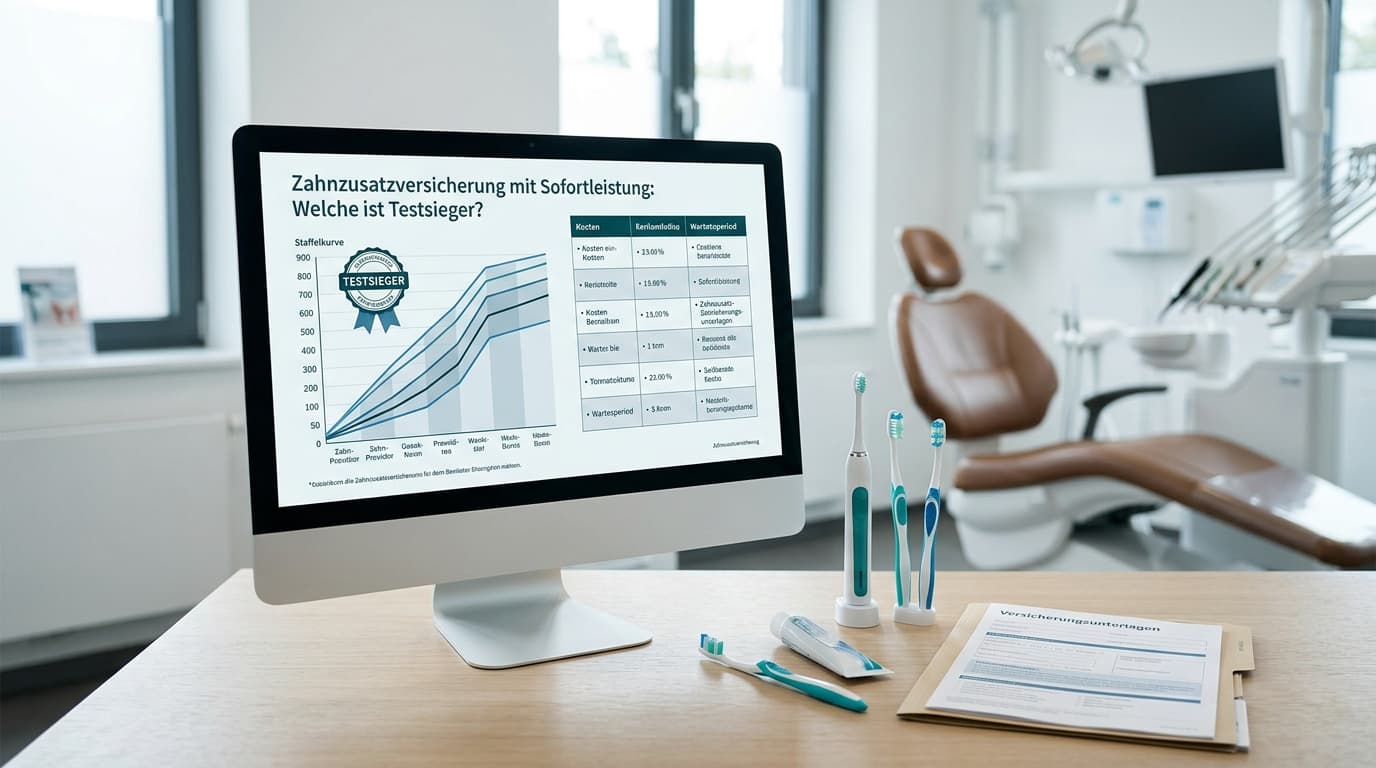

Advigon Dental Insurance Review & Test 2026
In-depth review of Advigon supplementary dental insurance, comparing the Dental Medium and Luxus tariffs and their 100% coverage.
All details are taken from the provider's linked product page and the contract documents (IPID/policy conditions) published there; the insurer's documents prevail. Premiums, benefits and the insurance product itself may change – please verify the details directly with the partner before signing up; only the information provided there is binding.
 Katrin StraubManaging DirectorInsurance expert with over 20 years of experience in the insurance industry.
Published on
12 min read
Table of Contents
Advigon's supplementary dental insurance offers two strong options with its Dental Medium and Dental Luxus tariffs. Reviews and test reports, including from Stiftung Warentest (a leading German consumer testing organization), rate the premium tariff with 100% reimbursement as very good ('sehr gut'). A major advantage is the complete absence of waiting periods. However, customers need to be aware of tiered coverage caps during the first four years. Premiums also rise on a set schedule as policyholders get older.
dental supplementary insurance
Find the right dental supplementary insurance at nextsure. Comprehensive protection, digital processing, and tailor-made rates for your most beautiful smile.
Learn moreMarket Analysis and Advigon's Tariff Structure
The Insurer's Historical Development
The market analysis shows a clear positioning for Advigon Versicherung AG in the supplementary health insurance space. The company, headquartered in Vaduz, Liechtenstein, operated under the name CSS Versicherung AG until 2015 [2]. Today the provider runs a focused portfolio on the German market. The German market for supplementary dental insurance keeps growing, since statutory fund benefits have stagnated. More than 17 million Germans already hold a corresponding policy. Consumers frequently look for solid data to base their decision on. A thorough review of Advigon's supplementary dental insurance reveals a two-tier tariff model. This model targets different budgets and coverage needs. Focusing strategically on just two main tariffs considerably reduces complexity for the end customer. Rather than offering dozens of hard-to-compare options, product development concentrates on clear coverage limits. The facts speak for themselves.
The Two-Tier Tariff Model
The insurer avoids a confusing sprawl of products and focuses on two core offerings. The Dental Medium (AZM) tariff provides basic coverage, reimbursing 75% of the cost of dentures and dental treatment [5]. By contrast, the premium Dental Luxus (AZL) tariff offers full 100% cost coverage. Both variants waive initial waiting periods entirely, meaning policyholders are entitled to benefits from the very first day of the contract. Such contract terms matter especially to patients planning dental procedures in the near term. Both tariff levels firmly build in coverage for modern treatment techniques that go beyond the statutory fund standard. This gives policyholders access to high-quality materials excluded from standard statutory health insurance care. A comparison is worthwhile.
Target Groups and Pricing
A close look at the premium structure reveals how the Liechtenstein-based company targets different groups. Young adults between 0 and 25 pay just €5.69 a month for the AZM tariff. The AZL tariff costs €9.20 a month in this age group. Premiums rise on a set schedule as customers get older. People aged 61 and above pay €32.30 for Medium coverage or €54.50 for the Luxus variant. This transparent pricing structure allows for precise budget planning over decades. Anyone looking for the right supplementary dental insurance needs to factor these long-term cost trends into their calculations. The nextsure platform analyzes these premium trajectories automatically. A digital comparison quickly shows whether initially low premiums remain affordable in old age too. That creates planning certainty.
| Age group | Dental Medium (AZM) | Dental Luxus (AZL) |
|---|---|---|
| 0 to 25 years | €5.69 | €9.20 |
| 26 to 35 years | €14.98 | €27.90 |
| 36 to 50 years | €22.60 | €36.90 |
| 51 to 55 years | €27.10 | €43.90 |
| From 61 years | €32.30 | €54.50 |
Premiums automatically rise once the next age bracket is reached.
Coverage Comparison for Dentures
Differences in Cost Reimbursement
A detailed coverage comparison reveals significant differences between the two tariff levels for cost-intensive procedures. Advigon's dental insurance track record shows that dentures represent the biggest financial risk factor for patients. Dentists often bill high-quality work at 3.5 times the standard rate under the German dental fee schedule (Gebührenordnung für Zahnärzte, GOZ), which makes costs balloon. The AZL tariff covers 100% of the cost of crowns, bridges, implants, and veneers. The AZM tariff covers exactly 75% of these expenses. These percentage differences have a massive impact on complex restorative work. A concrete example from the insurer illustrates the financial leverage involved. Fitting five high-quality inlays results in total costs of €4,778. The statutory health fund contributes to this amount with a minimal fixed subsidy of just €218. The customer bears the risk.
Impact on the Out-of-Pocket Share
Without supplementary coverage, patients have to fund the remaining coverage gap entirely out of their own pocket. Under the AZM tariff, the total reimbursement including the statutory subsidy amounts to €3,584, or 75% of the total cost; Advigon itself pays €3,366 of this. The policyholder is left with an out-of-pocket share of €1,194. An out-of-pocket amount of nearly €1,200 can put serious strain on a household budget. The premium AZL tariff, by contrast, reimburses the full €4,778. In this scenario, the out-of-pocket share drops to exactly zero euros. Examples like this illustrate the value of comprehensive coverage. Stiftung Warentest particularly recommends taking out supplementary dental insurance for people with statutory coverage who want high-quality dentures [3]. The choice between 75% and 100% coverage ultimately comes down to individual risk tolerance. This is where premium coverage pays off.
Ancillary Benefits and Expert Recommendations
Beyond pure cost reimbursement, both tariffs include important ancillary benefits. These include functional analysis and functional therapy, which are essential for implants to fit properly. Repairs to existing dentures are also explicitly included in the policy terms. Covering anesthesia costs as an ancillary benefit is another plus point of Advigon's terms. Independent financial experts point out, however, that tariffs offering 100% reimbursement for dentures tend to be comparatively expensive versus the broader market [1]. Finanztip (a German consumer-finance outlet) therefore often recommends tariffs with somewhat lower reimbursement as a cheaper alternative. Anyone using the current top-rated supplementary dental insurance policies as a guide should critically examine the ratio of monthly premium to potential reimbursement. The nextsure experts recommend a sober cost-benefit analysis. This saves real money.
| Payer | AZM tariff (75%) | AZL tariff (100%) |
|---|---|---|
| Statutory health fund | €218 | €218 |
| Advigon reimbursement | €3,366 | €4,560 |
| Remaining out-of-pocket share | €1,194 | €0 |
Calculation based on Advigon's official tariff examples.
Preventive Care and Extended Pain Management
Budgets for Teeth Cleaning
Regular preventive care forms the foundation of lasting dental health and is a key factor in evaluating a policy. Preventive care significantly lowers the risk of periodontitis. Reviews of Advigon's dental insurance highlight the reimbursement of professional teeth cleaning as a strong point. Professional teeth cleaning in Germany typically costs between €80 and €120. The AZM tariff provides an annual budget of €90 for preventive measures. The AZL tariff raises this amount to €140 a year. An important limitation in the premium tariff is a cap of €70 per individual treatment. Patients therefore need to plan at least two sessions a year to use up the full budget. While this structure encourages regular dental visits, it does require deliberate appointment planning. Fissure sealants are also part of the covered services. The system works efficiently.
Solutions for Anxious Patients
A standout feature of both tariffs is the inclusion of extended pain-management options. These benefits are aimed specifically at people with significant dental anxiety. General anesthesia at the dentist can quickly cost €200 to €300 per hour. On top of standard local anesthesia, the tariffs cover the cost of acupuncture, general anesthesia, nitrous oxide sedation, and twilight sleep (conscious sedation). The AZM tariff reimburses 75% of these costs. The AZL tariff covers the expenses for these innovative pain-management options at 100%. Such benefits are by no means standard in the German insurance market. Many basic policies strictly exclude anesthesia costs or limit them to surgical procedures. Advigon positions itself here as a customer-friendly provider for anxious patients. The numbers back this up.
Modern Treatment Methods
Coverage for micro-invasive caries infiltration is another technical detail in the policy terms. This method allows for pain-free treatment of early-stage tooth decay without using a drill. Bite guards and splints for treating bruxism are also covered. Both tariffs also cover root canal and periodontal treatments, as long as the statutory health fund doesn't cover them first. Anyone planning to take out supplementary dental insurance directly online should compare these detailed coverage components closely. nextsure's digital platform presents these tariff details transparently. Signing up quickly only makes sense if specific needs, such as anesthesia preferences or regular cleanings, are exactly matched by the chosen tariff. A comparison is worthwhile.
Pain-Management Options Covered by Advigon
- Acupuncture for pain relief
- General anesthesia for major procedures
- Nitrous oxide sedation for anxious patients
- Twilight sleep (conscious sedation / analgosedation)
AZM reimburses 75%, AZL covers 100% of the costs.
Waiting Periods and Tariff Coverage Caps
Waiving Waiting Periods
Contractual waiting periods are often the deciding factor when customers looking to switch choose a tariff. Both Advigon tariffs waive a general waiting period entirely. This generates positive reviews from customers who need coverage urgently. However, the insurer protects itself against adverse selection through tiered coverage caps during the first four years of the contract. Actuarial science uses these tiers to protect the risk pool from cost blowouts. Under the AZM tariff, reimbursement is capped at €600 during the first 12 months. This amount rises to €1,200 after 24 months and to €1,800 after 36 months. In the fourth year, the ceiling stands at €2,400. The system works efficiently.
Tiering in the Premium Tariff
The premium AZL tariff naturally offers higher reimbursement limits in the initial phase. Up to €1,000 is available in the first year. After 24 months, the budget doubles to €2,000. In the third year, €3,000 is available, and after 48 months a limit of €4,000 applies. From the fifth year of coverage onward, these restrictions no longer apply at all. An important exception applies to accidents: if an accident is what creates the need for dental treatment, the coverage caps are waived immediately. Losing a tooth in a sports accident therefore results in full cost coverage even in the very first month. Anyone specifically searching for supplementary dental insurance without a waiting period needs to clearly distinguish these initial coverage caps from actual waiting periods. The facts speak for themselves.
Crediting Prior Insurance Periods
A particular contractual advantage is the possible crediting of prior insurance periods. If a customer switches to Advigon from another provider, the coverage caps can be waived entirely. This requires an uninterrupted prior policy of at least 48 months, and the old contract must transition seamlessly into the new tariff. To switch into the AZL tariff, the prior policy must already have offered 100% coverage for dental treatment and dentures. For AZM, 75% coverage under the previous contract is enough. This switching guarantee is a strong argument for policyholders. Still, submitting a cost estimate before starting treatment remains advisable. This lets patients secure a binding commitment for cost coverage from the insurer in advance. That creates planning certainty.
Coverage Caps in the Dental Luxus (AZL) Tariff
- Maximum €1,000 in the first year of coverage
- Maximum €2,000 in the first 24 months
- Maximum €3,000 in the first 36 months
- Maximum €4,000 in the first 48 months
- Unlimited coverage from the fifth year onward
For accident-related treatment, these limits are waived immediately.
Test Reports and External Ratings
Top Marks for the Premium Tariff
The available test reports from independent institutions give an objective picture of product quality. Stiftung Warentest regularly reviews over 200 tariffs using model customer profiles. The Advigon Dental Luxus (AZL) tariff is among the policies that received an outstanding 'sehr gut' (very good) rating from Stiftung Warentest [1]. The July 2025 issue of Finanztest once again underlined the importance of high-quality dentures. Such top ratings strongly shape how Advigon's dental insurance is perceived by the public. This level of quality is also reflected on major comparison portals. There, the AZL tariff achieves an excellent tariff score of 1.4 [2]. These scores are usually based on a standardized set of criteria that quantifies reimbursement rates, scope of coverage, and contract terms. The consistently positive ratings confirm the strength of this Liechtenstein-based insurer's offering in the premium segment. The numbers back this up.
Critical Voices on Value for Money
Despite the good ratings, there are also critical voices in the market. Some independent testers criticize the value for money of the Dental Luxus tariff when compared directly with cheaper competitors [4]. A monthly premium of over €50 in old age adds up to more than €6,000 over a decade. 100% coverage naturally requires high monthly premiums. For many consumers, 80% to 90% reimbursement makes more economic sense, since the premium savings often more than offset the remaining out-of-pocket share. The AZM tariff, with its 75% coverage, represents an attempt to appeal to a more price-sensitive audience. That said, 75% coverage sits toward the lower end of current market recommendations. A comparison is worthwhile.
Putting the Test Results in Strategic Context
Putting these test results in strategic context requires professional expertise. According to experts, the ideal time to take out supplementary dental insurance is around age 40 [3]. At this age, teeth are usually still healthy, but the statistical risk of needing dentures later rises. Missing teeth or treatments already recommended at the time of application lead to coverage exclusions with many top-rated policies. Advigon carefully checks dental status at the time of application. Anyone wanting to interpret the test results correctly needs to know their individual dental profile. A top-rated tariff is of little use if it excludes specific needs such as orthodontics for adults. The nextsure platform filters tariffs not just by blanket ratings, but by actual coverage features. The system works efficiently.
Premium Development and Age-Related Reserves
Calculation Without Age-Related Reserves
Long-term premium development is an often underestimated factor when choosing supplementary health insurance. Reviews of Advigon's dental insurance show that the AZM and AZL tariffs are calculated without so-called age-related reserves (Altersrückstellungen). Age-related reserves are a complex topic. Without them, the contract functions like a pure risk-based policy. In actuarial terms, this calculation approach is classified as a type of non-life (indemnity) insurance. This means monthly premiums don't stay constant but automatically rise once certain age brackets are reached. A 30-year-old customer initially pays €27.90 for the AZL tariff. Once they turn 36, the premium jumps to €36.90. This mechanism makes for affordable entry prices at a young age but leads to a noticeable burden later in life. The customer bears the risk.
Premium Jumps in Detail
The highest premium tier at Advigon kicks in from age 61. From that point on, the premium tariff costs €54.50 a month. For a 55-year-old, the AZL premium comes to €43.90, signaling the approaching jump into the most expensive bracket. The basic AZM tariff then costs €32.30. Compared with tariffs that build up age-related reserves — which are more expensive from the start but stay stable in old age — this model requires deliberate financial planning. The advantage lies in its high flexibility: customers only ever pay the statistical risk of their current age group. Anyone who cancels the contract after just a few years hasn't unnecessarily tied up capital with the insurer in the form of reserves. This saves real money.
Strategic Contract Optimization
Understanding this type of calculation is essential for optimizing a contract strategically. Switching insurers is financially less painful with tariffs that have no age-related reserves, since no accumulated funds are lost. Even so, the prior insurance period needs to be considered to avoid facing new coverage-cap tiers again. Especially during retirement, when income falls, fixed monthly costs of over €50 weigh heavily. Digital needs assessment accounts for these shifts in income. nextsure's experts analyze premium trajectories over the entire expected term of the policy. A seemingly cheap entry-level tariff can turn into a cost trap over 20 years. The transparent presentation of premium jumps in Advigon's terms is commendable, but it does require consumers to plan their liquidity ahead of time. That creates planning certainty.
Specific Treatment Examples and Cost Simulation
The Cost Trap of Implant Treatment
A concrete treatment example makes the abstract percentage figures in the policies tangible. Advigon's dental insurance shows its true value only in the dentist's chair. Titanium implants are considered the gold standard in modern dentistry. Suppose a patient needs a single-tooth implant including bone grafting. Bone grafting is often unavoidable when the jawbone doesn't have enough substance. The total cost for this surgical and prosthetic procedure quickly reaches €3,200. Statutory health insurance grants only the diagnosis-related fixed subsidy for standard care, which comes to around €450. This creates a massive coverage gap of €2,750. Without private supplementary coverage, the patient has to raise this entire amount out of taxed income. The customer bears the risk.
Simulating the Reimbursement Rates
In this scenario, the mechanics of the two tariff levels play out drastically differently. The AZM tariff reimburses 75% of the total cost, or €2,400. After deducting the statutory fund's contribution, an out-of-pocket share of €350 remains. This €350 difference under the basic tariff is still manageable for many households, but it shows the limits of 75% coverage. The AZL tariff covers the full €3,200. Since the statutory fund contributes €450, Advigon pays the remaining €2,750. The patient pays not a single cent extra. This cost simulation assumes the four-year coverage-cap tier has already run its course. If the case occurs in the second year of coverage, the cap of €1,200 or €2,000 applies instead. This is where premium coverage pays off.
The Importance of Ancillary Benefits
Simulations like this highlight the need for early coverage. Anyone who only takes out a policy once acute pain sets in inevitably runs into the initial reimbursement limits. Coverage for ancillary services such as 3D X-ray diagnostics is essential for implants and is built into the premium terms. A DVT (cone-beam CT) scan alone costs between €150 and €250, and statutory health insurance generally doesn't cover it. nextsure's technology makes it possible to simulate exactly these specific treatment scenarios in advance. The algorithm calculates not just the monthly premium but also transparently shows the potential out-of-pocket share for typical major procedures. This data-driven approach protects consumers from nasty surprises when the oral surgeon's bill lands in the mailbox. The system works efficiently.
Conclusion and Digital Sign-Up Options
Summary of Tariff Strengths
The final verdict on this Liechtenstein-based company's product lineup is nuanced. Reviews of Advigon's dental insurance confirm a high density of benefits in the premium segment. Taking over the CSS book of business gave the company a solid foundation in the German market. The Dental Luxus tariff impresses with its uncompromising 100% reimbursement and its inclusion of modern pain-management options. Waiving waiting periods is a strong argument for patients who need to act quickly. Set against that are the ambitious premiums in the higher age brackets and the strict coverage caps in the first four years. The Dental Medium tariff, with 75% coverage, offers solid but not outstanding basic protection for price-sensitive customers. The facts speak for themselves.
Weighing Up Your Individual Situation Before Signing Up
The decision for or against these tariffs requires carefully weighing up your own dental status. A missing tooth at the time of application can fundamentally change the premium calculation. Anyone who values premium materials and innovative treatment methods such as micro-invasive caries infiltration will find reliable commitments in the terms. The option to credit prior insurance periods to bypass the coverage-cap tiers is a tactical advantage for people switching providers. Even so, the market should always be viewed as a whole. The German insurance market offers more than 200 different dental tariffs. Manually evaluating these options is far beyond the capacity of an average consumer. This is where modern insurtech solutions come in. A comparison is worthwhile.
The Digital Path with nextsure
nextsure's digital infrastructure turns this complex search process into an efficient online experience. Instead of working through pages of PDF policy terms, users get hand-picked tariff suggestions based on their actual data. This end-to-end process saves valuable time and minimizes the risk of errors when answering health questions. Broker status under § 34d GewO (German Trade Regulation Act) guarantees independent advice that serves the customer's interests. The platform doesn't just bundle the comparison — it also enables a completely paperless application process. In the event of a claim, the system helps with submitting invoices digitally. This turns supplementary dental insurance from an abstract set of contract terms into a tangible, easily managed building block of personal healthcare provision. The system works efficiently.
Frequently asked questions
- What reviews exist for Advigon's dental insurance?
Reviews of Advigon's dental insurance are largely positive, especially in the premium segment. Customers praise the absence of initial waiting periods and the comprehensive 100% reimbursement under the Dental Luxus tariff. Criticism occasionally focuses on premium jumps in old age, since the tariffs are calculated without age-related reserves.
- How was the Advigon Dental Luxus tariff rated?
The Advigon Dental Luxus (AZL) tariff regularly achieves top ratings in independent tests. Stiftung Warentest has previously awarded the tariff its top rating of 'sehr gut' (very good). The tariff also earns excellent scores on major comparison portals, underlining its strong position in the market for premium supplementary dental insurance.
- Does Advigon's dental insurance have waiting periods?
No, both Advigon tariffs (Dental Medium and Dental Luxus) waive general waiting periods entirely. Policyholders are entitled to benefits from the very first day of the contract. However, tiered coverage caps apply during the first four years of coverage, limiting the maximum reimbursement per year.
- How quickly does Advigon reimburse submitted invoices?
The reimbursement time depends on the complexity of the submitted invoice. As a rule, Advigon processes claims quickly, provided all necessary documents and treatment and cost plans are complete. For larger procedures, it's advisable to submit a cost estimate in advance to clarify cost coverage on a binding basis.
- Are the costs of professional teeth cleaning covered?
Yes, Advigon covers the cost of preventive measures. The Dental Medium tariff provides a budget of €90 per year. The Dental Luxus tariff offers up to €140 annually, though reimbursement is capped at a maximum of €70 per individual treatment session.
- Do Advigon's premiums rise with age?
Yes, premiums rise on a set schedule. Because Advigon's tariffs are calculated without age-related reserves, policyholders are grouped into fixed age brackets. Once the next age bracket is reached, the monthly premium increases automatically. The highest premium tier is reached from age 61.
Sources
Conclude directly online
Verified partner tariffs at no extra cost. The button takes you straight to the provider's calculator.
 Advigon
Supplemental dental insurance
Four supplemental dental tariffs ranging from basic cover to full protection, including children's tariffs with orthodontics.
- Dental Medium premium:
- €5.69-32.30/month depending on age
- Dental Luxus premium:
- €9.20-54.50/month depending on age
- Waiting period:
- none (AZM/AZL)
- Dental treatment: 75% (Dental Medium) or 100% (Dental Luxus)
- Dentures/crowns (Zahnersatz): 75% (AZM; 100% for standard care) or 100% (AZL)
- Preventive dental care: 100% up to €90/year (AZM) or up to €140/year (AZL)
- No waiting periods in Dental Medium and Dental Luxus
- Children's tariffs with orthodontics (KFO): Dental Clever €9.68/month, Dental Premium €18.76/month
- Stiftung Warentest rated Dental Premium "very good" (1.5) (Finanztest 2/25)
Key exclusions
- Reimbursement caps in the first 48 months: AZM €600-2,400, AZL €1,000-4,000 (tiered)
- No explicit benefit exclusions are stated in the available documentation
Stiftung Warentest „SEHR GUT (0,6)“, Finanzen 07/2025 (285 Tarife im Test)
Advigon Zahnzusatzversicherung Dental Luxus (AZL)
MORGEN & MORGEN M&M Rating Zahnzusatz: 5 Sterne „Ausgezeichnet“ (08/2023)
Advigon Versicherung AG, Dental Luxus (AZL)
Reimbursement caps do not apply in the case of an accident, after month 48, or with a recognized prior policy.
Fact sheet: benefits, exclusions and waiting periods in detail
 die Bayerische
Supplemental dental insurance
Supplemental dental cover in three tariffs (Smart, Komfort, Prestige) with no waiting period; the top tariff reimburses 100%.
- Reimbursement:
- 75-100% depending on the tariff
- Waiting period:
- none
- Teeth cleaning:
- €80-200/year depending on the tariff
- Zahn Sofort module:
- €29.90/month, ends after 2 years
- Dentures/crowns and dental treatment: Smart 75%, Komfort 80-100%, Prestige 100%
- Professional teeth cleaning in all tariffs (€80-200 per calendar year)
- No waiting periods in any of the three tariffs
- Orthodontics: €1,500 (including statutory health insurance benefit) or €2,000 (without statutory health insurance benefit) in Komfort and Prestige
- Prestige includes teeth whitening and a Happybrush sonic toothbrush
- Stiftung Warentest 07/2025: Zahn Prestige rated test winner with "very good" (0.5)
Key exclusions
- Treatments recommended or started before the policy began (only covered via the Zahn Sofort module)
- A flat 40% deduction for dentists without statutory-insurance accreditation
- Reimbursement capped at up to 3.5x the dental fee schedule (GOZ) rate
- Abroad, reimbursement is capped at the domestic benefit level
Stiftung Warentest „SEHR GUT (0,5)“, Ausgabe 07/2025 (285 Tarife im Test)
die Bayerische, Tarif ZAHN Prestige
ASCORE „Tarif des Jahres 2024“ (Krankenzusatz Zahn)
die Bayerische, Zahn Prestige 2023
Levelnine Rating „EXZELLENT“ (Stand 11/2024, gültig bis 11/2025)
die Bayerische, Tarif ZAHN Prestige
Benefit tiering: €500 in year 1 (Smart), €1,250 (Komfort), or €1,500 (Prestige); unlimited from calendar year 5; caps also do not apply in the case of an accident.
Fact sheet: benefits, exclusions and waiting periods in detail
Advigon Supplemental dental insurance: Benefits: Dental Medium (AZM) and Dental Luxus (AZL)
| Benefit | Dental Medium (AZM) | Dental Luxus (AZL) |
|---|---|---|
| Dental treatment | 75% | 100% |
| Pain therapy | 75% | 100% |
| Preventive dental care | 100% up to €90/year | 100% up to €70 per treatment, up to €140/year |
| Dentures/crowns | 75% (100% for standard care) | 100% |
| Monthly premium by age | €5.69-32.30 | €9.20-54.50 |
die Bayerische Supplemental dental insurance: Tariff comparison: Smart, Komfort, Prestige
| Benefit | Smart | Komfort | Prestige |
|---|---|---|---|
| Dentures/crowns (above standard care) | 75% | 80-90% | 100% |
| Dentures/crowns (up to standard care) | 75% | 100% | 100% |
| Dental treatment | 75% | 100% | 100% |
| Professional teeth cleaning | €80/calendar year | €100 per treatment, max. €150/year | €100 per treatment, max. €200/year |
| Orthodontics | not included | €1,500 (incl. statutory insurance) / €2,000 (excl. statutory insurance) | €1,500 (incl. statutory insurance) / €2,000 (excl. statutory insurance) |
| Teeth whitening | not included | not included | included |
| Example annual premium (age 33) | €152.40 | €244.80 (rural) / €321.60 (urban) | €405.60 (rural) / €529.20 (urban) |
All details are taken from the provider's linked product page and the contract documents (IPID/policy conditions) published there; the insurer's documents prevail. Premiums, benefits and the insurance product itself may change – please verify the details directly with the partner before signing up; only the information provided there is binding.
Information last updated: July 2026 · Source: provider product information (IPID/policy conditions)