Commercial Cargo Bike Insurance for the Self-Employed
Commercial cargo bike insurance for the self-employed: tariffs and cover compared for couriers, trades and delivery.
 Katrin StraubManaging DirectorInsurance expert with over 20 years of experience in the insurance industry.
Published on
Last updated on
9 min read
Table of Contents
Commercial cargo bike insurance for the self-employed covers cargo bikes used for business purposes against theft, damage and consequential loss. Private policies usually exclude commercial use. Self-employed couriers, delivery businesses and tradespeople therefore need specialist policies with all-risk cover, worldwide protection, an optional battery clause and provisions for multiple riders. Tariffs differ by contract term, type of use and premium model.
Why commercial cargo bike insurance is essential for the self-employed
The coverage gap in private tariffs
Commercial cargo bike insurance closes a specific gap: private cargo bike policies typically exclude damage caused by commercial use. Anyone who uses the bike daily as a courier, delivery rider or tradesperson falls outside that cover. This isn't fine print — it's standard practice. Even widely used market offerings such as hepster's bicycle insurance explicitly list damage from commercial use as not covered. Self-employed people therefore need a dedicated commercial policy.
Risk profile: theft and damage in business use
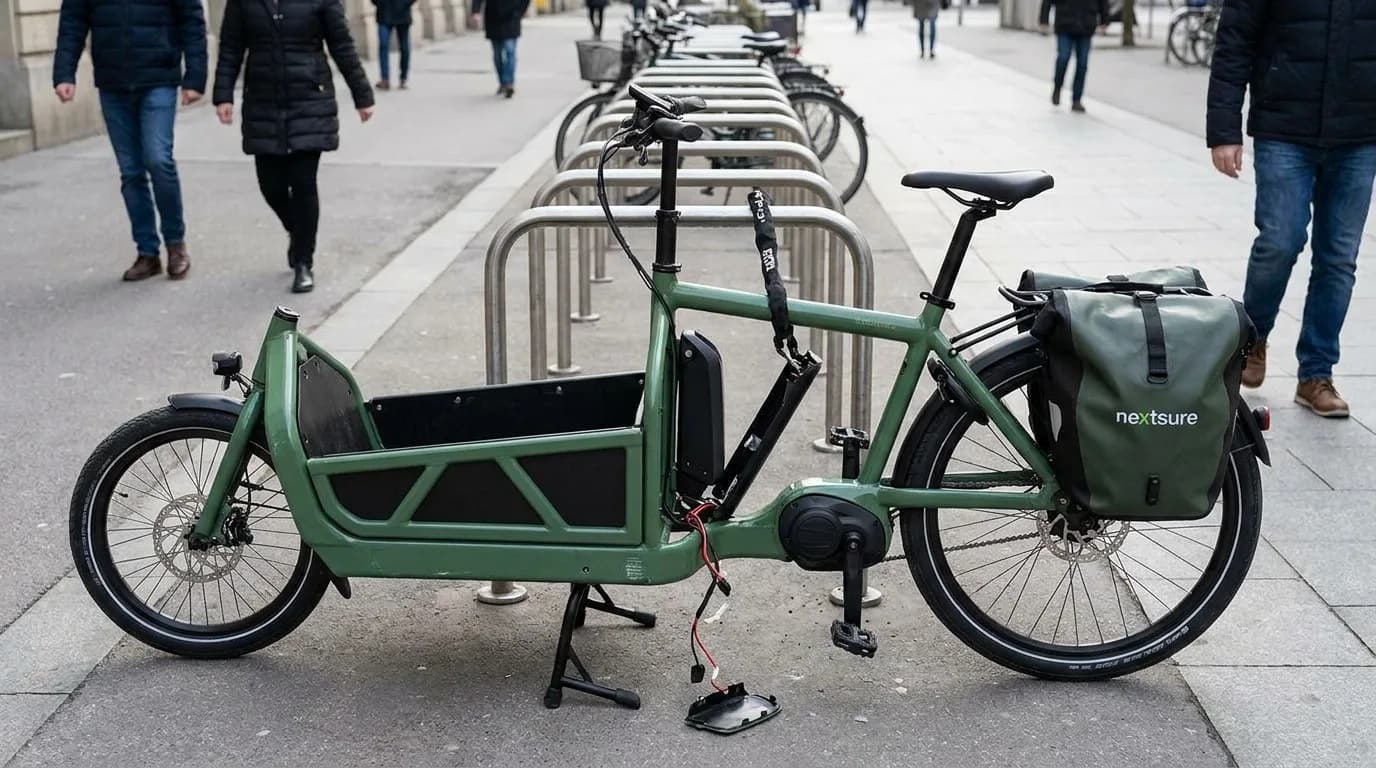
Theft risk is the main driver. According to police crime statistics, the number of stolen bicycles rose by almost 14 percent in 2022 to around 266,000 [2]. Insurers also report that the average claim for insured bicycle theft reached a new high of €1,270 in 2025 [1]. For e-cargo bikes with purchase prices of €5,000 to €15,000, the real loss is considerably higher. On top of that come fall damage, operating errors and battery damage in day-to-day business.
Legal framework: Pedelec 25 and the insurance requirement
Legally, most commercial cargo bikes count as Pedelec 25s. Under road traffic law, Pedelec 25s are treated the same as ordinary bicycles, provided rated continuous power stays at 250 W and assistance cuts out at 25 km/h [5]. That means no motor liability insurance requirement applies. Faster S-Pedelecs are different: they need an insurance registration plate, comparable to the insurance registration plate requirement for small electric vehicles. nextsure's cargo bike insurance covers these forms of use according to the relevant vehicle class.
What components a good commercial cargo bike policy includes
Property damage, theft and all-risk cover
A robust cargo bike policy covers property damage broadly. Standard market terms include damage from destruction, damage, operating errors and improper handling, fire and explosion, storm, hail, flooding, avalanches, landslides, and wear on the bike. Premium tariffs add theft, burglary theft, looting, robbery and extortion by force. For self-employed people, theft is the most important component — without it, the policy is unusable for courier work.
Battery, drive unit and tuning exclusions
The battery and drive unit are the most expensive components on an e-cargo bike. Good tariffs insure them explicitly against operating errors and consequential damage. Modifying the bike puts that cover at risk: damage from intentional acts and tampering with the drive system, such as tuning, is always excluded from cover. CFRP (carbon) components are also often only covered with an additional agreement — relevant for cargo bikes with carbon frames.
Territorial scope and security obligations
Territorial scope matters a great deal in day-to-day business use. High-quality tariffs provide worldwide cover, which includes trips abroad and trade fairs. Obligations apply in the event of a claim: if the bike wasn't locked to a fixed object in the customary manner, benefits may be reduced in the case of theft. Self-employed people should therefore document their locking systems and parking routines. A quick photo habit is often enough.
Comparing tariff models: fixed term, monthly subscription and annual subscription
Contract terms and cancellation
Cargo bike insurance tariff models follow three basic patterns. First, the fixed term: if you choose a fixed contract term, the contract ends automatically on the agreed date, so you have no ordinary right of termination. Second, the monthly subscription, with a minimum term of 3 months and a notice period of 3 business days before the end of the insurance period. Third, the annual subscription: with the annual subscription, the contract renews automatically from year to year, with a notice period of 3 business days before the end of the insurance period. Self-employed people with seasonal business often benefit from the monthly subscription.
Waiting period and start of cover
Waiting periods are a common trap when taking out a policy. A waiting period of 6 weeks applies unless the bike is insured with proof of purchase within 12 months of the purchase date. Insuring the bike straight after purchase avoids the waiting period. Anyone taking out cover later should plan the start of protection realistically. Cover also only begins once you have paid the first or one-off premium on time and in full; otherwise, cover starts when payment is made.
Sum insured and provisional cover amount
The sum insured is based on the bike's replacement value. Helpful for self-employed people: in addition to the sum insured, a provisional cover amount of 15 percent applies. This absorbs price increases and retrofitted accessories. Anyone fitting a trailer, box body or advertising to the bike should update the value in the policy — otherwise, underinsurance is a risk.
| Model | Minimum term | Notice period | Suited for |
|---|---|---|---|
| Fixed term | Fixed contract duration | No ordinary right of termination | Project or seasonal business with a clear end date |
| Monthly subscription | 3 months | 3 business days before the end of the period | Couriers with fluctuating order volumes |
| Annual subscription | 12 months | 3 business days before the end of the period | Established self-employed people and small fleets |
Source: standard market terms and conditions for bicycle insurance (example: hepster product information).
Tariffs for couriers, trades and delivery services: where the differences lie
Courier and delivery service profile
In the courier and delivery service profile, the cargo bike runs daily, often across multiple shifts. Theft protection is essential, and so is all-risk cover. Anyone with a fixed location can lower the premium with documented security measures. Detailed questions on security obligations and the battery clause are covered in the guide Theft protection for e-cargo bikes in courier use. The main risk isn't total loss but recurring minor damage.
Trades and mobile service providers
Tradespeople and mobile service providers use the cargo bike differently. They transport tools, materials and occasionally customer goods. This has two consequences: first, the policy must cover attachments such as tool boxes. Second, goods belonging to others that are being transported need to be checked separately — plain bicycle tariffs rarely cover this. Supplementary commercial liability insurance is standard here.
Subsidies and the economic framework
Federal subsidies support the economic case. Eligible applicants are private businesses regardless of legal form, as well as self-employed professionals [3]. 25 percent of purchase costs are eligible, up to a maximum of €3,500 per e-cargo bike or trailer [3]. Businesses can still apply for the subsidy until 30 June 2027 [4]. Anyone who has the bike subsidized should set the insured value directly at replacement value.
Employees, multiple riders and additional insured parties in commercial tariffs
Who is covered as an additional rider?
The question of covered additional riders is central to commercial tariffs. If temporary staff or subcontractors use the bike, the policy must allow for this. Many tariffs only cover the holder named on the certificate; commercial tariffs extend that circle to named or general riders. The background and logic behind additional insured riders is explained in the guide for cases where different people use the vehicle. When in doubt, the exact wording of the certificate applies.
Obligations of riders
Additional insured riders are also subject to the policy's obligations. These include prompt claim notification and careful handling: you must keep the insured bike in proper condition at all times in line with the manufacturer's instructions and observe the prescribed maintenance intervals. It also applies that: you must notify us of every claim without delay. You must keep the cost of the damage as low as possible. A brief rider briefing is worthwhile.
Minor damage and self-settlement
Not every paint scratch needs to be reported. In borderline cases, self-employed people can settle minor damage without notifying the insurer, to keep their claims history clean. The benchmark is the ratio of repair costs to the deductible and any premium adjustment. With e-components, that ratio tips quickly. A brief internal threshold per claim helps in day-to-day business.
Selection process: how self-employed people find the right tariff
Needs analysis in four steps
A structured selection process saves time and premium cost. First, describe the intended use precisely: courier work, trades, rental, or mixed use. Second, document the bike's value including the battery, attachments and carbon parts. Third, check the security situation at the parking location. Fourth, prioritize the components you want (theft, worldwide protection, battery clause). nextsure's cargo bike insurance bundles these components to match typical self-employed profiles.
Obligations when taking out the policy
Clear obligations toward the insurer apply when taking out the policy. You must answer all questions truthfully and completely. You must pay the insurance premiums on time and in full. Anyone who conceals commercial use risks losing their entitlement to benefits in the event of a claim. Indicating self-employed or commercial status belongs on the application — it's the single most important decision point.
Advice instead of a comparison portal
Self-employed people are usually better served by curated advice than by pure comparison portals. nextsure operates as an insurance broker under § 34d GewO (German Trade Regulation Act) and works on a commission basis; the comparison is free for end customers. Stiftung Warentest tested app-based comparison brokers and found varying quality [6]. For niche risks such as commercial cargo bikes, the depth of the terms matters more than the breadth of the portfolio. That's exactly where the curated approach comes in.
| Check point | Why it matters |
|---|---|
| Type of use declared as commercial | Otherwise, benefits may be forfeited due to a false statement |
| Theft component included | The main risk in day-to-day courier and delivery work |
| Battery and drive protection regulated separately | The largest single value on an e-cargo bike |
| Multiple riders covered | Allows temporary staff and subcontractors |
| Sum insured checked including attachments | Prevents underinsurance |
| Security obligation documented | Avoids reduced benefits in the event of theft |
Points consolidated from standard market terms and practical experience from broker advice.
Frequently asked questions
- What insurance do I need for a commercially used cargo bike?
Self-employed people need an explicitly commercial cargo bike policy with theft and all-risk cover. Pure private tariffs generally exclude damage from commercial use. Commercial liability insurance is also worthwhile, since goods belonging to others that are being transported wouldn't otherwise be covered.
- Does private cargo bike insurance cover business use?
No. Standard private tariffs list damage from commercial use as an exclusion. Anyone using the bike as a courier or tradesperson must state this on the application and choose a commercial tariff. Otherwise, they risk losing their entitlement to benefits in the event of a claim.
- What does commercial cargo bike insurance cost?
The premium depends on replacement value, type of use, parking location and the chosen mix of components. For an e-cargo bike worth €6,000 to €10,000, premiums in the market typically fall in the double- to triple-digit range per month. Specific tariffs require an individual needs analysis.
- Which tariffs cover delivery services and courier trips?
Specialist tariffs for couriers and delivery services include theft protection, all-risk cover, worldwide territorial scope and provisions for multiple riders. They account for daily use and higher mileage. Standard private tariffs aren't designed for this kind of use.
- Are employees and multiple riders covered?
This depends on the tariff. Commercial policies generally allow additional insured riders, provided they ride on behalf of the policyholder. The exact wording of the certificate is decisive. For temporary staff and subcontractors, the clause should be checked before taking out the policy.