Photo equipment insurance Safari Africa
Protect your camera on safari in Africa. Our short-term photo equipment insurance covers theft and damage. Find out more now!
All details are taken from the provider's linked product page and the contract documents (IPID/policy conditions) published there; the insurer's documents prevail. Premiums, benefits and the insurance product itself may change – please verify the details directly with the partner before signing up; only the information provided there is binding.
 Katrin StraubManaging DirectorInsurance expert with over 20 years of experience in the insurance industry.
Published on
Last updated on
8 min read
Table of Contents

Camera Equipment Insurance
Secure your valuable camera equipment thoroughly against damage, theft, and loss with the camera equipment insurance from nextsure. Tailored protection for professionals and hobby photographers.
Learn morePhoto equipment insurance for safari in Africa: short-term cover for your equipment
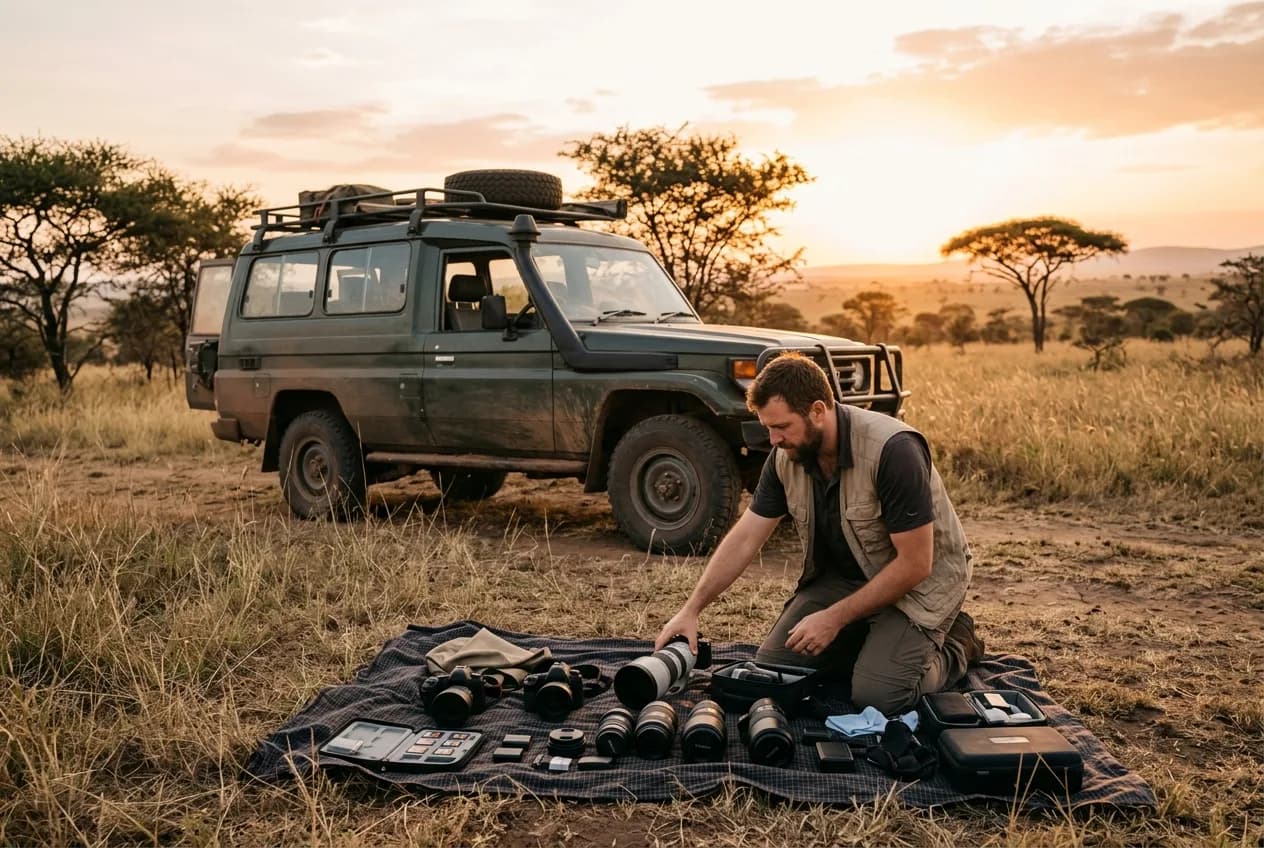
Your high-quality camera equipment is in the open safari vehicle, surrounded by dust and unpredictable situations. A single careless moment or theft can result in financial damage of more than ten thousand euros. A specialised insurance policy for camera equipment for a safari in Africa as a short-term policy protects you precisely against these risks.
Risk analysis: Why standard insurance policies fail on safari
The harsh conditions of a safari increase the risk of damage to camera equipment by an estimated 70 per cent compared with a normal city break. Standard travel baggage insurance is insufficient for such scenarios. The consumer advice centre even often advises against such policies, as the benefits are severely limited.
A typical policy limits liability for valuables such as cameras to a maximum of 4,000 euros, which by far does not cover the value of professional equipment. Much more important, however, is that damage caused by your own fault, such as dropping a lens, is almost never insured. A specialised camera equipment insurance policy closes precisely this gap.
Here are the four main reasons why standard insurance policies are not sufficient:
- Limited sums insured: Often, only up to 20 per cent of the total sum insured is provided for valuables.
- Exclusion of simple theft: Theft from an unattended moment is usually not covered.
- No cover for your own fault: A fall of the camera or water damage caused by carelessness is not reimbursed.
- Actual cash value instead of replacement value: Often only the actual cash value is reimbursed, which for a three-year-old camera may still be only 60 per cent of the purchase price.
These coverage gaps make targeted cover for travel essential, so that in the event of a claim you do not end up left with damage costing thousands of euros.
Valuation: Determine the correct sum insured for your equipment
An exact valuation is the basis for any insurance cover, because even underinsurance of ten per cent can lead to deductions in the settlement. Add up the replacement values of all the items you are carrying to arrive at the required sum insured. An example calculation for ambitious safari equipment could look like this.
A photographer travels to Tanzania with equipment worth a total of EUR 13,500. His contents insurance only covers valuables abroad up to EUR 3,000. In the event of theft, this creates a cover gap of more than EUR 10,000. A specialist professional photographers' insurance would cover the full amount.
This is how the values are made up:
- Camera body (e.g. Canon EOS R5): EUR 4,000
- Telephoto lens (e.g. RF 100-500mm): EUR 3,000
- Standard zoom lens (e.g. RF 24-70mm): EUR 2,500
- Wide-angle lens (e.g. RF 15-35mm): EUR 2,000
- Laptop and hard drives: EUR 1,500
- Tripod, filters and batteries: EUR 500
The exact list before travelling not only helps when choosing the right sum insured, it also speeds up claims handling in the event of a loss by up to 50 per cent.
Policies in detail: all-risk cover as a decisive factor
The key difference between a standard policy and genuine photo equipment insurance lies in the so-called all-risk cover. This not only protects against specifically named perils such as fire or theft by forced entry, but also covers any loss, destruction or damage. This includes the greatest risks on safari.
These include typical scenarios such as fine desert sand entering the camera body, which can cause repair costs of more than €800. Damage caused by severe jolting in a 4x4 vehicle that damages the image stabilisation of a €3,000 lens is also covered. Even user error, the most common cause of claims, is insured. Such cover is particularly crucial when travelling to demanding regions, such as with camera insurance for a trip to Mexico or Africa.
Please note the following three key benefits of all-risk cover:
- Protection against drops and breakage: Covers damage if the camera slips from your hand.
- Cover for liquid damage: Pays out if a water bottle leaks in your rucksack and destroys the electronics.
- Protection against theft and robbery: Also applies if the bag is stolen when left unattended for a moment.
This comprehensive cover ensures that your investment is protected even under the unpredictable conditions of a safari.
Expert knowledge: understanding replacement value compensation and excess
Another critical point in the insurance terms is the type of compensation: replacement value or current value. Current value takes age and wear into account, which means that for a five-year-old camera you may only receive 45 per cent of the original purchase price. A good camera insurance policy, on the other hand, reimburses the replacement value, i.e. the amount required to purchase an equivalent new device.
Our expert tip: Document all your equipment before you leave. Photograph each item and note down the serial numbers. This list is worth its weight in gold in the event of a claim and is a requirement for speedy settlement with over 90 per cent of insurers.
The excess is also an important factor. Tariffs without an excess are often more expensive, but may be worthwhile in the event of a loss amounting to several thousand euros. A typical excess is 250 euros per claim. Weigh up whether a lower premium is worth the risk of a higher excess in the event of a claim, especially if you also need laptop theft protection abroad.
Claim in Africa: The right steps to swift compensation
If, despite all precautions, damage occurs, quick and correct action is crucial for a smooth claim settlement. Most insurers require immediate notification, often within 48 hours. In the event of theft, the first and most important step is to report it to the local police.
Without an official police report with a case number, almost all insurers will reject a claim for theft. Insist on receiving written confirmation of the report, even if it takes time. This is your most important document for the insurer. Good cover for travel and leisure includes clear instructions for this situation.
Follow these three steps for a successful claim notification:
- Document the damage immediately: Take photos of the damaged equipment or the scene of the theft.
- File a police report: Report any theft immediately to the nearest police station and obtain the report.
- Inform the insurer promptly: Contact your insurer via the emergency hotline or online and submit all documents, including the serial number list and the police report.
Frequently asked questions
- Why isn’t my contents insurance enough for a safari in Africa?
Your contents insurance often only covers damage abroad to a very limited extent (external cover). Usually, only damage caused by burglary is insured in permanent buildings, but not simple theft or damage caused by sand, water or being dropped. In addition, the compensation limits for valuables are often too low.
- What is the difference between travel luggage insurance and photo equipment insurance?
Travel luggage insurance has strict conditions, low cover limits for electronics (often only up to €4,000) and usually reimburses only the current value. A photo equipment insurance policy offers all-risk cover, which also includes self-inflicted damage and operating errors, and usually reimburses the replacement value.
- What damage is specifically covered by all-risk insurance?
It covers almost all unforeseen events that are not explicitly excluded. These include damage caused by drops, breakage, water and sand, user error, short circuits, as well as simple theft, burglary and robbery.
- How do I prove the value of my equipment in the event of damage?
The best way is to create a detailed list with purchase receipts, serial numbers and photos of the equipment before you travel. This speeds up the process considerably.
- What should I do if my camera is stolen in Africa?
Report the theft to the local police immediately and obtain a police report. Then inform your insurer without delay, usually within 48 hours, and submit the police report as well as your equipment list.
- Can I take out insurance only for the duration of the trip?
Yes, many providers offer flexible terms. You can take out photo equipment insurance specifically as a short-term policy for the duration of your safari in Africa, for example for one month.
Sources
- [1]The Foreign Office offers detailed safety advice specifically for travel to South Africa.
- [2]General travel and safety advice for various countries can be found on the website of the Foreign Office.
- [3]The GDV (German Insurance Association) provides comprehensive statistics on the German insurance industry, particularly on property and casualty insurance.
- [4]The German Photographic Association (DVF) is the central point of contact for amateur and professional photographers in Germany.
- [5]The Consumer Advice Centre provides information on the insurance cover needed for trips abroad and offers valuable tips for consumers.
- [6]Current travel warnings and safety advice from the Foreign Office help with travel planning and risk assessment.
Conclude directly online
Verified partner tariffs at no extra cost. The button takes you straight to the provider's calculator.
 Hepster
Camera insurance
Worldwide cover for new and used cameras, including original accessories.
- Coverage area:
- worldwide
- Battery-wear threshold:
- up to 60% remaining capacity, device max. 4 years old
- Minimum term:
- 3 months (monthly subscription)
- Drop, breakage, sand, and liquid damage
- Fire, explosion, power surge, short circuit, sabotage, vandalism
- Battery and screen damage, plus battery wear (where not covered by warranty)
- Operating errors and improper handling
- Theft module: theft, burglary from a car or home, robbery
Key exclusions
- Loss and forgetting outside the insured theft scenarios
- Devices without a known serial/IMEI number
- Damage covered under warranty or manufacturer's guarantee
- Gross negligence or intentional acts
Trusted Shops: 4,5/5 „Sehr gut“ (2.600 Bewertungen)
hepster insgesamt (Anbieterbewertung, alle Versicherungen)
Claims must be reported online within 14 days; theft must be reported to the police within 24 hours. Insurer: Hiscox SA, Niederlassung für Deutschland
Fact sheet: benefits, exclusions and waiting periods in detail
All details are taken from the provider's linked product page and the contract documents (IPID/policy conditions) published there; the insurer's documents prevail. Premiums, benefits and the insurance product itself may change – please verify the details directly with the partner before signing up; only the information provided there is binding.
Information last updated: July 2026 · Source: provider product information (IPID/policy conditions)