Is a Deductible Worth It in Private Health Insurance?
When does a deductible make sense in private health insurance?
 Katrin StraubManaging DirectorInsurance expert with over 20 years of experience in the insurance industry.
Published on
Last updated on
12 min read
Table of Contents
A deductible in private health insurance is especially worthwhile for the self-employed and freelancers, since they cover their own premiums entirely and a deductible directly lowers their monthly costs. For employees, a deductible pays off less often, since the employer subsidy falls but the employer doesn't share in the cost of the deductible. Choosing the right amount requires careful strategic weighing.
How deductibles work in PKV
Basic principles of cost-sharing
The mechanics of a deductible define what share of medical costs the policyholder pays out of pocket. This mechanism is a key control lever for the monthly health insurance premium. Insurers calculate tariffs with a deductible more cheaply, since they save administrative costs on small bills and shift risk onto the policyholder. A flat deductible sets a fixed amount per calendar year. Up to this limit, the policyholder pays all costs themselves. Only once this is exceeded does the insurer pay. This noticeably lowers the premium. However, the savings must be weighed against the financial risk.
A €500 deductible can often reduce the annual premium by €600 or more. This mathematical leverage arises from the massively reduced administrative costs for insurers. Every submitted receipt generates internal processing costs. If these are eliminated for small bills, the insurer passes this cost advantage directly on to the customer. Defining the exact deductible level is therefore the first step in tariff calculation. That's an important fact.
Percentage-based and case-based models
Alongside the flat amount, there are also percentage-based models, where policyholders cover a fixed percentage of each bill up to an annual maximum [4]. This variant has the advantage that the insurer covers part of the cost from the very first bill. Case-based deductibles, which apply only to hospital stays, for example, are rarer, but interesting for specific risk profiles. The choice of model considerably affects liquidity planning. Policyholders must always be able to cover the maximum deductible from liquid funds. An emergency fund is essential for this. With a 20 percent deductible up to a maximum of €1,000, the policyholder pays exactly €100 out of pocket on a €500 bill. This model smooths the financial burden across the year. It prevents the shock of one large lump-sum payment in January. Setting up such tariffs requires a precise analysis of one's own spending patterns.
Effects on future premium development
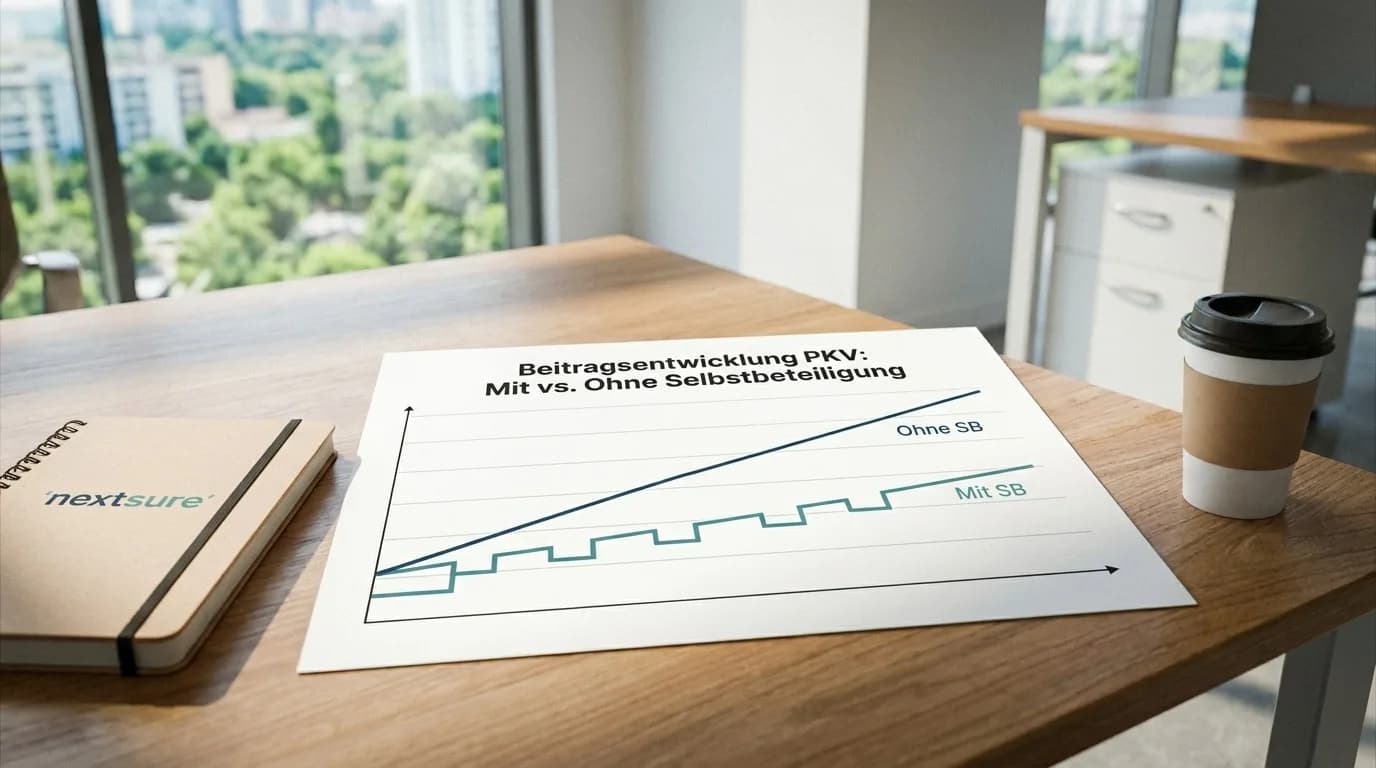
A higher deductible dampens the impact of future premium adjustments. Since the policyholder bears part of cost inflation themselves, premiums in tariffs with a deductible historically rise more moderately. This is a decisive factor for the long-term affordability of private health insurance in old age. Even so, the deductible cannot be set arbitrarily high. Statutory rules cap the maximum deductible at €5,000 a year. In practice, amounts between €300 and €1,000 prove to be the optimal compromise between premium savings and a manageable personal risk. Tariffs with a deductible over €2,000 are extremely rare and carry a high risk of financial distress for the policyholder in the event of illness. The features of a good tariff balance these risks. A smart tariff choice protects against being overwhelmed financially. That secures long-term stability.
Common deductible models
- Flat deductible: a fixed amount per year (e.g., €500).
- Percentage deductible: proportional cost-sharing (e.g., 20 percent) up to a maximum amount.
- Case-based deductible: co-payment only for specific benefits, such as hospital stays.
- Modular deductible: different deductibles for outpatient and dental benefits.
Choosing a model requires strict alignment with individual liquidity.
Target group analysis: employees versus the self-employed
The specific situation for the self-employed
A detailed target-group analysis shows that self-employed people and freelancers are the primary beneficiaries of a deductible. Since they fund their health insurance premiums entirely themselves, every premium reduction directly benefits their liquidity [1]. A €600 deductible can often reduce the annual premium by a similar or even greater amount. As long as the policyholder stays healthy, they realize a genuine financial gain. Even in the event of illness, the loss is heavily cushioned by the premium savings. This mathematical asymmetry makes the deductible an essential strategic tool for this professional group. Take the example of a freelance IT consultant. Without a deductible, he pays €800 a month. With a €1,000 deductible, his premium drops to €650. He therefore saves €1,800 a year. Even if he uses up the full deductible, he's still ahead by €800. That's a clear advantage.
The problem for employees
For employees, the situation looks fundamentally different. The employer covers at most half of the actual PKV premium, capped at the statutory maximum subsidy [5]. If an employee lowers their premium through a deductible, the employer's absolute subsidy falls in parallel. The employee, however, must bear the full cost of the deductible alone in the event of illness. The employer does not contribute toward doctor's bills that fall under the deductible [1]. This means the financial advantage of the premium reduction almost entirely evaporates. Employees should therefore prefer tariffs with no deductible, or a very small one. In 2026, the maximum employer subsidy toward health insurance is around €509 a month. If the employee's premium is €700, the employer pays €350. If the employee lowers the premium to €600 via a deductible, the employer only pays €300. The employee loses €50 in subsidy per month. That adds up.
Exceptions and special cases
There are a few exceptions where a deductible can also make sense for employees. This is the case when the PKV premium significantly exceeds the maximum amount for the employer subsidy. In this situation, a moderate premium reduction doesn't lead to a cut in the employer's share. The employee then benefits fully from the savings. Such scenarios require a precise calculation by an independent expert. In addition, employees must factor in the risk of a longer loss of earnings. In such cases, it's advisable to have daily sickness benefit adjusted to avoid liquidity shortfalls. An employee with a €950 premium receives the full subsidy of €421. If they reduce the premium to €850, the subsidy stays at €421. Here, the savings apply at 100 percent. Case studies like this show the importance of an individual assessment. Blanket statements fall short here.
| Criterion | Self-employed | Employees |
|---|---|---|
| Premium savings | 100% to the policyholder | Often shared with the employer |
| Cost of the deductible | 100% borne by the policyholder | 100% borne by the policyholder |
| Strategic recommendation | A high deductible often makes sense | No or minimal deductible |
The actual savings depend on the individual tariff and the employer subsidy.
Tax treatment of the deductible
Deductibility of insurance premiums
The tax treatment of health insurance costs is strictly regulated. Premiums for basic private health insurance coverage are tax-deductible as special expenses (Sonderausgaben). A tariff with a deductible reduces the monthly premium, and thus also the tax-deductible amount. This leads to a higher tax burden, which partly eats into the financial advantage of the premium savings. Calculating the actual savings absolutely requires factoring in the personal marginal tax rate. Looking only at the raw premium difference inevitably leads to poor decisions. Net savings are the only relevant figure for choosing a tariff. Since the Citizens' Relief Act (Bürgerentlastungsgesetz), premiums for basic coverage can be fully claimed for tax purposes. Comfort benefits such as chief-physician treatment or a single room are excluded from this. A lower premium means fewer deductible special expenses. At a marginal tax rate of 42 percent, a premium saving of €1,000 shrinks to a real €580. That's a substantial difference.
No recognition as a special expense
A widespread misconception concerns claiming self-paid doctor's bills for tax purposes. The contractually agreed deductible in PKV cannot be claimed for tax purposes as a special expense [3]. The tax office does not treat these expenses as insurance premiums, but as ordinary living costs. The Federal Fiscal Court (Bundesfinanzhof) has confirmed this in several rulings. Anyone who pays €1,000 in deductibles a year cannot directly deduct this amount from their taxable income. This tax asymmetry considerably worsens the profitability of deductible tariffs. Policyholders must factor this disadvantage into their overall calculation. The strict separation between insurance premiums and illness costs is firmly anchored in the Income Tax Act. Lawmakers argue that choosing a deductible is a deliberate decision to bear risk oneself. Therefore, the tax privilege doesn't apply. That is current law.
Extraordinary burdens as a way out
A small tax loophole remains. Self-paid medical costs can only be taken into account for tax purposes as extraordinary burdens (außergewöhnliche Belastungen), provided they exceed the reasonable burden threshold [3]. This threshold depends on income, marital status, and number of children. For high earners, the hurdle is often several thousand euros. A regular €500 deductible falls far short of crossing this threshold. This tax mechanism only applies for extremely high illness costs that exceed the deductible. That is rarely the case. The reasonable personal burden varies between one and seven percent of total income. A single taxpayer with €80,000 income often has to bear over €4,000 themselves before anything shifts for tax purposes. The deductible alone almost never reaches this sum. Precise tax planning is essential.
Prevention and preventive care under a deductible tariff
Excluding preventive check-ups
How prevention is handled contractually is a quality marker. Good PKV tariffs explicitly exclude vaccinations and preventive check-ups from the deductible [2]. This makes medical and economic sense, since prevention avoids expensive treatments long term. When coverage for preventive check-ups is not counted against the deductible, the barrier to regular doctor visits falls. Policyholders should carefully check the tariff terms. If this clause is missing, patients pay for routine check-ups entirely out of pocket. This massively undermines the idea of preventive care. Typical preventive services include cancer screening, the "Check-up 35" health check, and routine gynecological exams. A high-quality tariff lists these benefits in detail in the insurance terms. Setting up such tariffs ensures that policyholders don't skip important screenings for financial reasons. In doubt, that can save lives.
Dental prophylaxis
Dental prophylaxis deserves special attention. Many insurers classify professional teeth cleaning as a preventive benefit and therefore don't count these costs against the deductible. This, however, varies considerably between providers. Some tariffs only exclude legally defined preventive programs, while others apply a broader definition of prevention. For policyholders who value comprehensive private health insurance benefits, this distinction is crucial. A clear contractual definition protects against surprise out-of-pocket costs for routine procedures. The fine print decides hundreds of euros a year here. Professional teeth cleaning quickly costs between €80 and €150. If this happens twice a year, that adds up to as much as €300. If these costs are excluded from the deductible, that's a noticeable financial advantage. Tariff features must be compared precisely here.
Prevention as a strategic lever
Prevention serves not only health, but also preserving premium refunds. When preventive services aren't counted against the deductible, they're often also considered harmless to the premium refund. The policyholder can therefore go to the doctor without jeopardizing their bonus. This is a powerful financial lever. Tariffs that penalize prevention are no longer up to date. A modern tariff structure actively encourages health-conscious behavior. Anyone who cuts corners here ends up paying more in the long run through undetected illnesses and lost bonuses. Combining premium refunds with harmless preventive care is the strongest feature of modern PKV tariffs. It rewards health-conscious behavior twice over. Policyholders get money back while staying optimally covered medically. That's real added value.
Important clauses on prevention
- Explicit exclusion of statutory preventive programs from the deductible.
- No counting of vaccinations against the deductible.
- Professional teeth cleaning counts as harmless to the deductible.
- Preventive services don't jeopardize the premium refund.
These points require detailed review before signing any tariff.
Switching tariffs and flexibility of the deductible
Hurdles when reducing it
Switching tariffs later to adjust the deductible is complex. Anyone who once chooses a tariff with a high deductible cannot easily lower it again later [2]. Reducing the deductible constitutes an increase in benefits. The insurer requires a new health assessment in this case. If new pre-existing conditions have arisen in the meantime, the insurer can charge risk loadings or reject the reduction entirely. This one-way street makes the initial choice of deductible a far-reaching decision. Flexibility in PKV often comes at a high price. The right to switch tariffs under Section 204 of the German Insurance Contract Act (VVG) does guarantee a switch into similar tariffs. But it does not protect against health assessments for added benefits. Anyone who wants to lower a €1,000 deductible to €0 must be in perfect health. That is rarely the case later in life.
Raising the deductible
Raising the deductible, by contrast, is possible at any time with no health assessment. This is a popular way to cushion rising premiums in old age. By taking on a higher personal risk, policyholders can lower their monthly burden. However, liquidity for the higher deductible must be secured in retirement. Raising it from €500 to €1,500 saves money monthly, but requires a solid financial cushion. This strategy only suits policyholders with sufficient reserves. A hasty increase can quickly lead to financial overreach. Implementing such a strategy should ideally be coordinated with a financial planner. The saved premiums must be invested profitably. Only this way is the capital available when illness strikes. That requires iron discipline.
Option rights and tariff modules
Modern tariffs offer option rights that allow later adjustments with no new health assessment. These rights are often tied to specific life events or deadlines. Anyone seeking flexibility should watch for such clauses. Alternatively, outpatient supplementary insurance can be used to offload specific risks. Combining a basic PKV tariff with a high deductible and targeted add-ons, however, requires precise coordination. Double coverage must be strictly avoided. An independent broker is essential for structuring such a portfolio. Option rights often must be exercised within the first five to ten years of the policy. If this deadline is missed, the right lapses with no compensation. Managing such deadlines is an important part of insurance management. A good broker proactively reminds clients of these dates.
Premium refund versus deductible
How the mechanisms interact
The premium refund is another lever for optimizing costs. Many insurers refund part of the premium if no bills are submitted in a calendar year. This mechanism interacts strongly with the deductible. It's advisable to first collect doctor's bills, in order to weigh whether submitting the bills or receiving a premium refund is financially more advantageous [4]. If the bills are only slightly above the deductible, forgoing submission is often more lucrative. In these cases, the refund clearly exceeds the insurance payout. Some insurers pay out up to six months' premiums as a performance-based refund. At a monthly premium of €600, that's €3,600 a year. Anyone who risks this bonus over an €800 bill is acting economically unwise. Collecting receipts is a must.
Tax implications of the refund
Premium refunds have tax consequences. They reduce the deductible special expenses in the year they're received. Anyone who gets back €1,000 must adjust their taxable income accordingly. This reduces the net effect of the refund. When weighing between submitting bills and taking the refund, this tax penalty must be calculated. A purely gross comparison leads to wrong decisions. The complexity of this calculation overwhelms many policyholders. Systematically collecting and evaluating bills at year-end is essential. That requires discipline. The tax reduction happens exactly in the year the refund is credited to the account. The cash-receipt principle (Zuflussprinzip) of the Income Tax Act applies here. A refund for 2023 paid out in September 2024 affects the 2024 tax return. That must be kept in mind.
Strategic bill management
Strategic bill management optimizes the return. Policyholders should collect all receipts and compile a total in December. The policyholder then weighs the collected bills, minus the deductible, against the expected net premium refund. Only if the insurer's reimbursement (bills minus deductible) exceeds the net refund does the policyholder submit the receipts. This approach maximizes the financial advantage. It does, however, require enough liquidity to front the doctor's bills during the year. Anyone lacking this liquidity cannot make use of this optimization potential. Insurers' digital apps make collecting receipts much easier. Documents are simply scanned via smartphone and saved in the app. At year-end, a single tap is enough to submit all the collected bills at once. That saves valuable time.
Strategic tariff choice and conclusion
A holistic view of costs
Choosing a tariff strategically requires a holistic view of all factors. Chasing the lowest premium in isolation often leads into a trap. A high deductible only makes sense if the premium savings justify the risk taken on and liquidity is secured. For self-employed people, a deductible between €500 and €1,000 is often the sweet spot. Employees should choose tariffs with no or minimal deductible, due to the employer-subsidy issue. Tax effects must in every case be modeled individually. Blanket recommendations aren't credible. The case study of the Becker family, planning for their future, illustrates this clearly. As an employed dual-income couple with children, they don't benefit from a high deductible. They need planning certainty and tariffs that fully cover preventive check-ups for the whole family. That's the right approach.
The importance of tariff terms
The quality of the tariff terms matters more than the raw amount of the deductible. Clauses on prevention, flexibility when switching tariffs, and transparent rules on premium refunds define a policy's real value. A seemingly affordable tariff with rigid terms quickly turns into a cost trap when a claim arises. Checking the fine print is essential. Anyone who cuts corners here pays more later. Excluding preventive measures from the deductible is a non-negotiable criterion for a modern PKV tariff. That secures long-term health. Integrating digital health apps and telemedicine is another important feature. Modern tariffs reimburse the cost of video doctor consultations with no counting against the deductible. This increases convenience and lowers the barrier to fast medical help. That's up to date.
Advice from experts
The complexity of private health insurance requires professional guidance. An independent broker analyzes the individual's tax and professional situation and calculates the net effects of various deductible models. The nextsure platform offers specialized advice and hand-picked tariffs for exactly this purpose. Skipping sound advice almost always leads to suboptimal decisions that can cost tens of thousands of euros over the term of the policy. Choosing the right deductible is not a gut decision, but a mathematical optimization problem. That requires expertise. iMatch GmbH, the operator of nextsure, is licensed as an insurance broker under Section 34d of the German Trade Regulation Act (GewO). This regulatory basis guarantees legally sound, liability-covered advice. Customers benefit from a curated portfolio of over 70 products. That protects against poor decisions.
Frequently asked questions
- Is a deductible worth it in PKV?
For the self-employed usually yes, because the premium savings often exceed the agreed deductible. Employees, by contrast, lose part of their employer's contribution, so high deductibles pay off for them less often.
- How much does a deductible lower the premium?
A deductible of 500 euros can often lower the annual premium by 600 euros or more. The effect arises because the insurer saves the administrative costs of many small invoices and passes this advantage on to the customer.
- Does the deductible also apply to preventive check-ups?
Not in good tariffs: vaccinations and preventive check-ups are explicitly exempt from the deductible there. This clause should be checked specifically before signing.
- Can I change the deductible later?
Raising the deductible is usually possible without issue. Lowering it, however, constitutes an increase in benefits and usually requires a new health assessment by the insurer.
Sources
Free advice on this topic
Our experts advise you without obligation and find the right cover: online or by phone.
- Free & non-binding
- 100% digital