
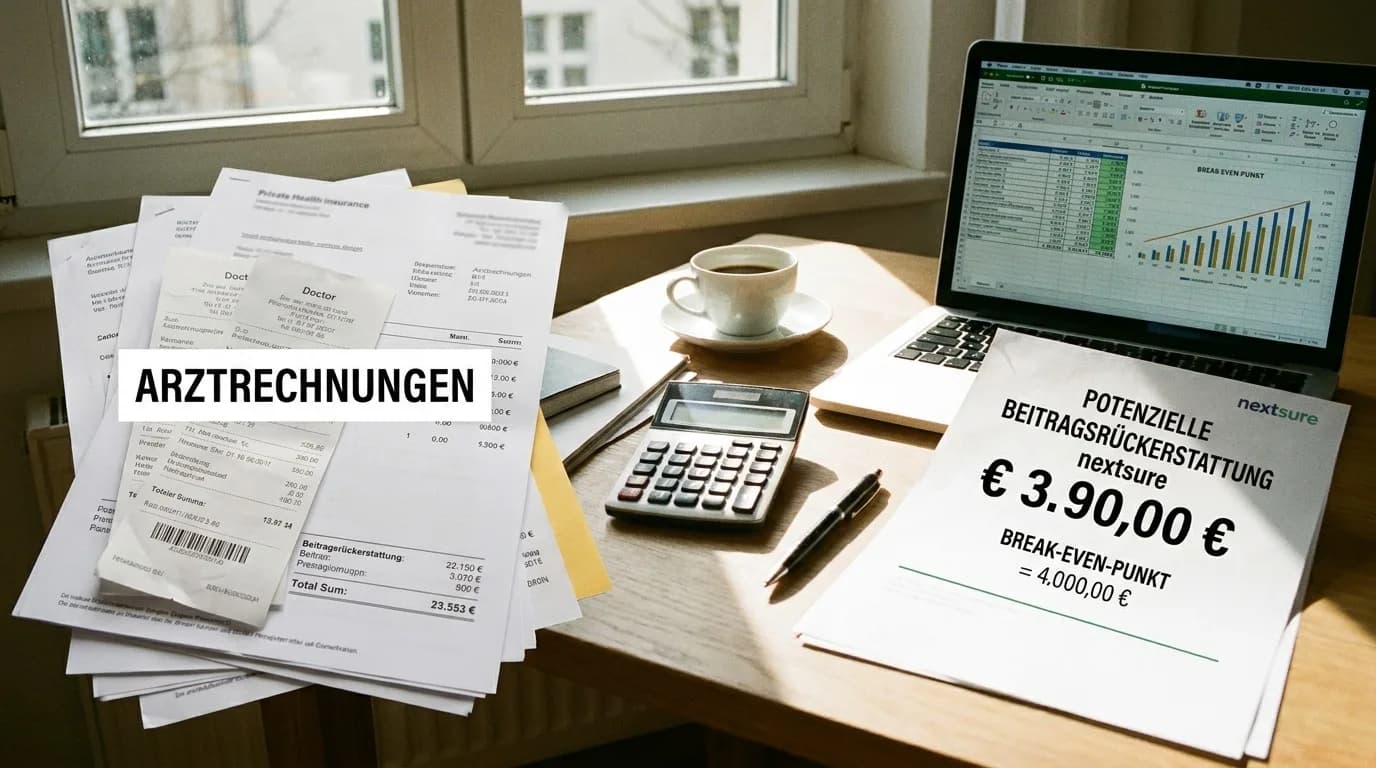
PKV Premium Refunds: Mechanics, Tax & Returns
Is the PKV premium refund worth it? Break-even points, tax implications, and tariff models analyzed.
 Katrin StraubManaging DirectorInsurance expert with over 20 years of experience in the insurance industry.
Published on
12 min read
Table of Contents
The premium refund (Beitragsrückerstattung) in private health insurance rewards claim-free years with a payout of up to six months' premiums. Whether it's worth skipping the submission of smaller doctor's invoices depends on your individual break-even point, which requires careful calculation. The tax consequences must also be considered without fail, since the refund reduces deductible special expenses and medical costs you cover yourself are often not tax-deductible.
Basics of the PKV premium refund
How it works and the financial incentive
The basics of the premium refund define the financial incentive for policyholders in private health insurance. Anyone who submits no invoices to their insurer for an entire calendar year often gets back a significant share of the premiums they paid. This system rewards health-conscious behavior and considerably relieves the insurer of administrative costs for minor claims. The size of the payout varies greatly between providers and ranges from one to six months' premiums. Some insurers pay flat sums such as €600, while others calculate a percentage of the annual premium. Every year, policyholders face the strategic decision of whether to pay doctor's costs themselves or submit the invoices. A precise mathematical comparison is essential here. The possible refund often clearly exceeds the sum of smaller doctor's invoices — a clear advantage. Still, policyholders must factor in the long-term effect on their tax burden without fail. The tax component fundamentally changes the calculation.
Reimbursable versus non-reimbursable costs
A central aspect of this mechanism is the strict distinction between reimbursable and non-reimbursable costs. The private health insurance premium refund generally only applies if absolutely no invoices for outpatient or dental treatment were claimed in the calendar year just ended. Inpatient hospital stays are excluded from this strict rule in many strong tariffs — anyone who undergoes surgery after a serious accident therefore does not necessarily lose their bonus. This nuance is decisive for risk assessment. A close look at the policy terms often reveals further important exceptions for certain medical services. The trend in private health insurance premiums also shows that regular refunds can form an effective financial buffer against unavoidable premium adjustments in old age. This buffer massively stabilizes long-term financial planning — it pays to know the exact tariff details.
Payout terms and deadlines
The premium is usually paid out in late summer or autumn of the following year. Insurers first check all invoices received for the calendar year just ended for completeness and wait out any late-submission deadlines. Only once these deadlines have finally passed is the bonus calculated and transferred to the account. This time lag requires a degree of liquidity from policyholders, since they must first front doctor's costs out of pocket. Strategically planning health spending therefore becomes an important tool for personal financial optimization. Disciplined collection of every receipt until year-end is essential — only then can an informed decision be made in December: submit the receipts, or take the payout? This question must be reassessed every year, and insurers' deadlines must be strictly observed.
Steps for a strategic year-end invoice review
- Systematically collect all medical receipts and prescriptions from the calendar year.
- Ask the insurer for the exact expected amount of the premium refund.
- Check which invoices count as harmless preventive services.
- Compare the sum of the harmful invoices against the potential refund.
- Factor the extra tax burden from the refund into the calculation.
Ideally, the decision is only made in the last week of December.
Tariff-based vs. success-dependent models compared
The guaranteed premium refund
The tariff's design largely determines how reliable the refund is for the policyholder. The market essentially offers two different systems, which are also often combined. The guaranteed premium refund is fixed in the general insurance terms. Policyholders have a legally binding claim to this payment, provided they remain claim-free for the calendar year. This tariff-based variant cannot be unilaterally cut by the insurer or scrapped in a weak economic year [3], offering maximum planning certainty for the client. Anyone structuring their finances for the long term values this contractual guarantee enormously. By contrast, the success-dependent refund follows entirely different economic rules and is considerably more volatile in payout. Guaranteed models are often the safer choice — they protect against unpleasant surprises at year-end.
The success-dependent premium refund
The success-dependent variant often offers higher maximum amounts but carries a clear risk of falling short. Here, insurers distribute surpluses they achieved through good management in the past financial year. The company's board decides on the exact size of the distribution anew every year. For the policyholder, this means considerable uncertainty in personal financial planning. A tariff with exclusively guaranteed refunds is therefore often the more solid choice. Combining both models in one tariff is also commonly found on the market: a fixed base amount is guaranteed and topped up with a variable component. Such hybrid models try to combine security and return potential optimally. A close analysis of the provider's historical payouts is advisable — past payouts are a good indicator, though they guarantee no future gains.
Long-term stability and tariff choice
nextsure supports choosing the right model with data-driven analysis. The platform compares not only current premiums but also assesses the long-term stability of refunds over the past decades. A tariff that looks cheap with a purely success-dependent component can turn into a cost trap over the years if the insurer's surpluses collapse. The guaranteed refund acts like a contractually assured discount on the annual premium — this is especially relevant when looking at total costs over a decade. Integrating solutions such as Airbnb host insurance into a personal portfolio shows how important tailored cover is. This decision must be made on a highly individual basis — blanket recommendations always fall short for complex financial products, so sound advice is essential.
The break-even point when reviewing invoices
The math behind the decision
The break-even point marks the financial threshold of profitability for the policyholder. Above this exact amount, it is worth submitting collected invoices to the insurer rather than waiting for the bonus. The calculation requires a sober comparison of the potential premium refund against cumulative doctor's costs. If costs are below the expected refund, the policyholder is better off paying the invoices themselves. If medical spending exceeds the bonus, submitting the receipts is the more economical route. This simple basic rule, however, is massively complicated by tax aspects. The private health insurance premium refund reduces the tax-deductible provision expenses (Vorsorgeaufwendungen) — an important factor. Looking only at the plain payout amounts inevitably leads to costly wrong decisions; the math here must be absolutely precise.
Tax effects in practice
A concrete worked example illustrates the enormous complexity of this seemingly simple decision. Suppose a policyholder expects a tariff-based refund of €900. Over the course of the year, doctor's invoices totaling €600 accumulate. At first glance, this looks like a clear gain of €300 if the invoices are not submitted. However, the €900 refund reduces the deductible special expenses on the income tax return. At a marginal tax rate of 42 percent, this results in an extra tax burden of €378. The apparent gain thus turns into an actual loss of €78. This effect is often overlooked. A detailed calculation that factors in the individual's tax rate is essential — only then can the true break-even point be determined.
Strategic restraint and supplementary policies
The tax implications can completely neutralize the financial benefit of the refund [2]. It is therefore highly advisable to carefully collect all receipts in a folder and only make a final decision at year-end. Many insurers offer online calculators that help with this complex weighing-up. nextsure's advisors also help precisely analyze the individual break-even point. Anyone who regularly incurs high invoices may want to consider outpatient supplementary insurance to intelligently offload the main risk. Strategic restraint in submitting receipts requires discipline, but it rewards the policyholder in the long run with stable premiums and attractive bonuses, provided the math checks out. A cool head is decisive here — emotional decisions often cost a lot of money.
| Item | Scenario A: submit invoices | Scenario B: pay invoices yourself |
|---|---|---|
| Total doctor's costs | €600 | €600 |
| Reimbursement by PKV | €600 | €0 |
| Premium refund (BRE) | €0 | €900 |
| Extra tax burden (at 42%) | €0 | €378 (42% of €900) |
| Overall financial result | €0 (costs covered) | -€78 (loss despite BRE) |
The calculation shows that Scenario A is economically preferable despite forfeiting the BRE.
Tax consequences of the refund
Reduction of special expenses
The tax treatment of the refund requires special attention in financial planning. A premium refund is not tax-free extra income — it reduces the deductible health insurance premiums in the year it is paid out. The tax office treats the refund as a direct reduction of the special expenses previously claimed. If a policyholder receives a refund in 2025 for the claim-free year 2024, their tax-deduction headroom for 2025 shrinks. This inevitably leads to a higher income tax burden, since fewer expenses can be claimed to reduce tax. The exact size of this extra burden depends on the individual's marginal tax rate — high earners feel this effect especially clearly. The tax component must therefore be factored into the profitability calculation without fail; ignoring this aspect ends up costing money.
No deductibility for self-paid costs
Another critical point is the tax treatment of medical costs paid out of pocket. Anyone who pays invoices themselves to preserve the premium refund often hopes to deduct them as an extraordinary expense (außergewöhnliche Belastung). However, the Lower Saxony Fiscal Court has ruled that medical costs voluntarily paid out of pocket are not deductible as extraordinary expenses, since they lack the legal element of unavoidability [1]. The taxpayer voluntarily opts against the contractual reimbursement from the insurer, so the tax deduction is lost entirely. This creates a double tax disadvantage for the policyholder: special expenses fall because of the refund, and the medical costs remain completely disregarded for tax purposes. This is a hard blow — the legal position here is absolutely clear.
Strategic realignment
This legal reality fundamentally changes the strategic approach to the premium refund. It is no longer enough to simply compare plain doctor's costs with the refund amount — the forgone tax saving must be factored into the equation as a hard cost item. Skipping the submission of invoices is often only worthwhile if the refund exceeds doctor's costs by a very wide margin. nextsure's experts therefore recommend a very conservative calculation at year-end; when in doubt, it is economically smarter to submit the invoices to the insurer. Adjusting daily sickness benefit is another example of how important it is to look at the insurance contract holistically — every isolated decision has far-reaching consequences, and the overall picture must always add up.
Preventive check-ups and keeping the bonus
Prevention without a financial downside
Preventive check-ups play a special role in the private health insurance system. Many policyholders fear that a cancer screening or a dentist visit will instantly wipe out their entitlement to the premium refund. Modern PKV tariffs, however, have recognized this health-policy issue and implemented corresponding exceptions. Statutorily defined preventive check-ups and professional dental cleanings are often harmless to the refund in strong tariffs, meaning the policyholder can submit these invoices and still receive their full bonus at year-end. This rule promotes prevention and stops policyholders from skipping important medical checks purely for financial reasons — sound from a health-policy perspective, since prevention saves costs for everyone involved in the long run. Health always comes first.
Tariff differences for specialized check-ups
The exact definition of harmless services, however, varies enormously from provider to provider. While standard cancer screening is almost always covered, the picture often looks very different for specialized examinations. Preventive eye check-ups for early glaucoma detection, for example, can immediately jeopardize the bonus under older tariffs. A detailed look at the fine print of the policy terms is therefore essential. Some insurers also offer guaranteed health bonuses that are explicitly paid for claim-free behavior and increase over the years [4]. Such bonuses are often structured entirely independently of the classic premium refund, offering an additional incentive for a health-conscious lifestyle. The terms must be checked precisely — only then can costly mistakes be avoided.
Optimizing the annual medical schedule
Strategically using these preventive-care exceptions considerably optimizes the financial benefit of private health insurance. Policyholders should draw up a precise annual schedule for their medical checks and match it against the tariff terms. Invoices for harmless preventive services are submitted immediately, while invoices for curative treatment are first collected in a drawer. nextsure helps its clients identify tariffs with especially generous preventive-care rules — switching tariffs can quickly pay for itself through improved terms in this specific area alone. Absolute transparency about these details is a core promise of the digital broker platform, creating genuine certainty. Only those who know the rules of the game precisely can use the system to their advantage — knowledge here is real money.
Prepayments for tax optimization
The principle of premium prepayment
Prepaying health insurance premiums offers enormous tax potential for high-earning policyholders. Alongside the classic premium refund, prepayment is a powerful tool for legally reducing the tax burden. Policyholders can pay their PKV premiums to the insurer up to three years in advance [4]. This prepayment becomes fully tax-effective as a special expense in the year of payment and drastically lowers taxable income. In the following years, for which the premiums have already been paid, the tax-deduction allowance for other provision expenses becomes fully available again and can then be used for other insurance such as liability or disability cover — a strategic lever. The Income Tax Act explicitly permits this kind of prepayment.
Interactions with the premium refund
Combining prepayment with the premium refund, however, requires extremely precise timing. If a refund arrives in a year in which no ongoing premiums are paid because of the prepayment, this can cause tax complications. The refund reduces special expenses that, in this particular year, might already be at zero. This produces a negative special-expenses figure, which the tax office then adds back to income. The tax saving from the prepayment is thereby partly eaten up again. Detailed advice from a qualified tax advisor is strongly recommended for such arrangements — the complexity of German tax law forgives no mistakes here, and every step must be planned exactly.
Strategic use for fluctuating income
nextsure positions itself as a strategic partner in structuring such sophisticated contracts. The platform offers not just plain tariff comparison but also sheds light on the administrative options for structuring the contract. Prepayment is especially interesting for self-employed people and freelancers with strongly fluctuating income. In an economically very strong year, profits can be neutralized for tax purposes by prepaying PKV premiums. The private health insurance premium refund often takes a back seat in such complex scenarios — the tax saving from prepayment usually exceeds the financial benefit of the claim-free bonus many times over. This is a huge lever, and holistic financial planning is the key to success here — isolated views are often misleading.
Strategic tariff choice and contract optimization
Benefits before refunds
Strategic tariff choice determines the long-term success of private health insurance. The premium refund should never be the sole criterion for choosing a particular insurer — excellent cover in the event of illness always takes absolute priority. Tariffs that lure with extremely high refunds often have painful gaps in their policy terms. An open catalog of medical aids, worldwide cover, and high reimbursement rates for dentures are fundamental benefit features that are non-negotiable. Once this foundation is right, the refund can be viewed as an attractive extra feature. nextsure specifically filters the market for tariffs that convince both on benefits and on bonus models — creating genuine security. Health must never be sacrificed for a financial bonus.
Ongoing contract management
Continuously monitoring and optimizing existing contracts is just as important as the initial sign-up. Life circumstances change significantly, and tariffs continue to evolve in the market. A tariff that was the best choice five years ago may have become completely unattractive today because of premium adjustments. Switching within the same insurer under Section 204 VVG often offers the chance to move to more modern tariffs with better refund terms without losing valuable aging reserves. Digital management via the nextsure platform makes such optimization potential immediately visible — the algorithm reliably detects when switching tariffs makes economic sense and suggests appropriate alternatives. This saves real money; active management is essential.
The holistic advisory approach
Private health insurance is a lifelong companion that must be actively and professionally managed. Deciding whether to submit invoices or bet on the refund is just a small part of this complex management. A holistic approach considers taxes, benefit strength, and premium stability equally. With carefully selected tariffs and personal expert advice, nextsure ensures clients don't fall into the typical premium-refund traps. Absolute transparency about tax disadvantages and legal pitfalls is what distinguishes excellent advice from plain product sales. Anyone who fully understands the mechanics of PKV can save tens of thousands of euros over the long run while still enjoying first-class medical care — a measurable return advantage. The right strategy always pays off.
Frequently asked questions
- How does the premium refund work in PKV?
The premium refund (BRE) is a financial bonus in private health insurance. Anyone who submits no invoices for medical treatment in a calendar year gets back part of their premiums the following year. Depending on the tariff, this can be between one and six months' premiums. Inpatient treatment is often excluded from this rule.
- How many months' premiums do I get back?
The size of the refund depends heavily on the chosen tariff and insurer. Under guaranteed tariff-based models, these are often fixed amounts that increase with each claim-free year (for example, from one up to six months' premiums). Under success-dependent models, the payout varies each year depending on the company's economic surplus.
- Is it worth not submitting small invoices?
This is only worthwhile if the expected premium refund is clearly higher than the sum of the doctor's invoices plus the extra tax burden. Since the refund reduces deductible special expenses, the tax burden rises. A precise break-even calculation at year-end, factoring in the individual's tax rate, is therefore essential.
- Does the refund have tax consequences?
Yes, the premium refund has direct tax consequences. The tax office treats it as a reduction of the health insurance premiums paid. This lowers the deductible special expenses in the year of payout, leading to a higher income tax burden. In addition, invoices voluntarily paid out of pocket cannot be deducted as extraordinary expenses.
- Does the refund still apply after preventive check-ups?
In many modern PKV tariffs, statutorily defined preventive check-ups and professional dental cleanings do not jeopardize the premium refund. These invoices can be submitted without endangering the bonus. For specialized examinations, such as glaucoma screening at the ophthalmologist, the rules vary by provider and tariff terms.
- When is the premium refund paid out?
Payout usually happens in late summer or autumn of the following year. Insurers first wait to see whether any further invoices for the calendar year just ended are submitted. Only after these internal review deadlines have passed is it determined who remained claim-free, and the premium transfer is arranged.
Sources
Free advice on this topic
Our experts advise you without obligation and find the right cover: online or by phone.
- Free & non-binding
- 100% digital